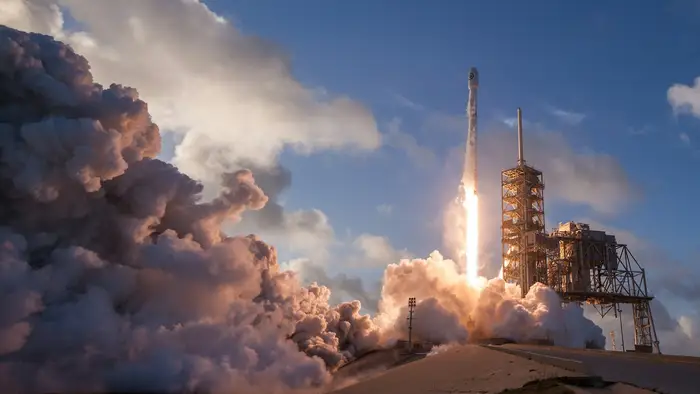
Something fundamental has changed in humanity's relationship with space. A generation ago, a rocket launch was a rare national occasion, announced weeks ahead and watched by the whole world. Today, orbital launches happen several times a week, every week, from spaceports on four continents. The world attempted more than 250 orbital launches in 2024, roughly double the busiest years of the Apollo era, and the pace has not slowed since. The reason is not a single breakthrough but a stack of them: reusable first stages that fly home and land themselves, mass-produced satellites built on assembly lines instead of in clean-room cathedrals, and launch vehicles designed from the start to fly often and cheaply. Space has become infrastructure, and infrastructure rewards those who pay attention early.
Nowhere is the change more visible than in the return to the Moon. NASA's Artemis programme is bringing astronauts back to lunar space for the first time since Apollo 17 in 1972, this time to stay: the long-term goal is a sustained presence around the lunar south pole, where craters in permanent shadow hold water ice that can become drinking water, oxygen, and even rocket propellant. America is not going alone, and it is not going unchallenged. China has landed a series of increasingly ambitious robotic missions, including the first sample return from the Moon's far side, and has announced its intention to land its own astronauts before 2030. India has landed near the south pole, Japan has put a lander down with pinpoint precision, and commercial companies are delivering cargo to the surface under NASA contracts. The Moon has become the proving ground where the next fifty years of exploration will be rehearsed.
Low Earth orbit, meanwhile, is turning into an economy. Fleets of thousands of satellites, led by Starlink and now joined by China's GuoWang network and others, are beaming broadband to ships, aircraft, and villages that fibre will never reach. The International Space Station, continuously inhabited since November 2000, is planned to retire around 2030, and commercial stations are being built to take its place as laboratories, film sets, and destinations for private astronauts. Companies are testing in-orbit manufacturing, satellite servicing, and debris removal, because an orbit full of working hardware is an orbit worth maintaining. Every one of these ventures can fail, and some of them will; the value of honest coverage is knowing which milestones were actually reached and which were only announced.
Above the traffic, the great observatories are rewriting astronomy. The James Webb Space Telescope, parked 1.5 million kilometres from Earth at the Sun–Earth L2 point, is dissecting the atmospheres of planets around other stars and finding mature galaxies far earlier in cosmic history than theories predicted. Hubble, launched in 1990, still works alongside it. On the ground, a new generation of extremely large telescopes is rising in the Chilean Andes, with mirrors tens of metres across. Robotic explorers are spread across the solar system: a spacecraft launched in 2024 is cruising toward Jupiter's ocean moon Europa, rovers are caching samples on Mars for a future return, and asteroid missions have already delivered pieces of ancient worlds to laboratories on Earth. This is the richest era of discovery since the first telescopes were pointed at the sky, and most of it happens in announcements, data releases, and mission updates that deserve more than a headline.
The economics explain the momentum. Industry estimates value the global space economy at more than $600 billion a year, and the fastest growth is no longer in government programmes alone but in commercial services: broadband constellations, Earth-imaging subscriptions, rideshare launches that let a university fly a satellite for the price of a house. Lower launch costs compound through everything built on top of them. A sensor that would once have waited a decade for a bespoke ride to orbit now flies within a year, which means more data, more science, and more companies whose business plans begin with the words "in orbit". Covering that economy honestly, separating the manifests that flew from the decks that were only presented, is part of the same job.
That is why SpaceNews exists. We publish five editions a day, every day, following launches as they happen and discoveries as they are confirmed, and we hold ourselves to a simple standard: liftoff is not deployment, a target date is not a promise, and a claim is not a fact until a source we can name has confirmed it. Whether you are a lifelong space enthusiast, an investor trying to understand the fastest-growing sector of the aerospace industry, or a student deciding whether the future might have a place for you in it, this is where the new space age gets documented, one verified story at a time.