ISS Final Solar Array Spacewalk October 29: Menon and Kutryk to Finish the Station's Power Upgrade
On Thursday, October 29, two astronauts will step out of the International Space Station’s Quest airlock and begin the last act of one of the longest-running construction projects in orbit. NASA astronaut Anil Menon and Canadian Space Agency astronaut Joshua Kutryk are scheduled to install and deploy the seventh International Space Station Roll-Out Solar Array, known as an iROSA, on the station’s 2A power channel. One week later, on Thursday, November 5, the same pair will go out again to install the eighth and final array on the 3B channel. When the second wing unrolls and locks into place, a power upgrade that began more than five years ago will be complete, and the station will carry the full electrical capacity it needs for its final years of science — and for its carefully choreographed farewell at the end of the decade.
The two excursions carry milestone numbers of their own. NASA designates the October 29 outing as U.S. spacewalk 100, its running count of American station excursions, and the November 5 outing as U.S. spacewalk 101. Counted another way, including spacewalks by all partner agencies in support of station assembly, maintenance and upgrades, they will be the 285th and 286th. The numbers are a reminder of how much of the station’s history has been written outside its walls, one bolt, cable and bracket at a time, by astronauts working in gloves so thick that handling a tool is an exercise in patience.
For Menon, the October 29 spacewalk will be his fourth excursion. For Kutryk, it will be his first — and the start of a remarkable debut fortnight in orbit, with two spacewalks in eight days on his first spaceflight. Kutryk will become the fifth Canadian Space Agency astronaut to work outside a spacecraft in orbit, following Chris Hadfield, Steve MacLean, Dave Williams and David Saint-Jacques, and the first Canadian to do so since Saint-Jacques’s spacewalk in April 2019. He arrived at the station on October 1 with SpaceX Crew-13 and is due to spend about six months aboard. Menon, meanwhile, has already spent much of 2026 preparing the very hardware the pair will now finish: he spacewalked in August to ready the station’s starboard truss for one of the new arrays, and in the weeks before the October outings he worked inside the Quest airlock cleaning the cooling loops in the spacesuits, while Kutryk filled suit tanks and liquid cooling and ventilation garments with clean water.
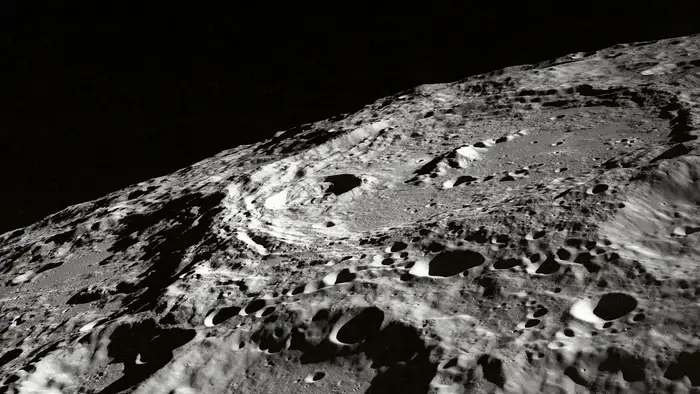
The International Space Station, whose solar wings are about to receive their final upgrade. Image: Unsplash.
Two Thursdays, two wings
The schedule, as NASA laid it out in its October 20 briefing at Johnson Space Center in Houston, is precise on paper and, like every spacewalk schedule, subject to the realities of orbit. The first spacewalk is scheduled to begin at 8 a.m. EDT on October 29 — 12:00 UTC — with NASA+ coverage starting at 10:30 UTC. NASA expects it to last about six hours and 45 minutes. The second is scheduled to begin at 8:10 a.m. EST on November 5 — 13:10 UTC — with coverage from 11:45 UTC. The October 29 array goes on the port side of the station’s truss, on power channel 2A; the November 5 array goes on the starboard side, on channel 3B. Between them, they close out the upgrade.
The choreography of each outing follows a pattern the station program has refined over dozens of similar installations. The astronauts will exit through Quest, make their way along the truss — the station’s long girder backbone that carries its solar wings — and work at the installation site, where one of them may stand on the Canadian-built Canadarm2 robotic arm, which serves as a mobile platform for a spacewalker. The rolled-up array, delivered to the station in a compact package, will be mounted in front of one of the station’s original solar wings, bolted into the modification kit that earlier spacewalks installed for exactly this purpose, electrically connected, and then released to unroll. There are no motors involved in the unrolling itself: the flexible blanket deploys from its stored roll on its own composite booms, a trick that looks almost casual on video and represents years of engineering.
NASA has said it will share more operational detail closer to each spacewalk, and that is worth keeping in mind. Spacewalk timelines are living documents. A stubborn bolt, a suit sensor reading, a station attitude adjustment or a change in the orbital traffic picture can shift a start time or stretch a task list. What is not in doubt is the destination of the two arrays and the order in which they fly: 2A first, on the port side, then 3B on the starboard side, and then the upgrade is done.
Why a station that already has solar wings needs new ones
The International Space Station has been generating power from sunlight since its earliest days, but its original solar wings are old. The first arrays were launched in 2000, and like every solar panel, they have degraded with time and with exposure to the harsh radiation and thermal cycling of low Earth orbit. A solar array that spends years swinging between blazing sunlight and deep shadow every 90 minutes does not age gracefully. By the late 2010s, the station’s power output had fallen well below its original design level, even as demand for electricity kept growing: more science racks, more commercial activity, more visiting vehicles, and eventually the power-hungry systems needed to bring the station down safely at the end of its life.
The iROSA program was NASA’s answer, and it was deliberately designed as an augmentation rather than a replacement. Each new array mounts in front of an original wing and partly covers it — engineers use the word “shadow” — and the old and new arrays work electrically together. The result, when all eight arrays are in place, is a station whose generating capacity rises from about 160 kilowatts to about 215 kilowatts. NASA describes the gain as up to 30 percent, a figure its operations integration manager for the Low Earth Orbit Program, Gaurang Patel, repeated at the October 20 briefing when he said the arrays “increase our power generation capability up to 30 percent.” The two endpoint figures imply roughly 55 kilowatts of additional capacity, and the small difference between the percentage and the endpoints is a reminder that “about” does a lot of work in spaceflight arithmetic: the station’s output varies with its orientation, the season, and the age of each wing.
That extra power is not abstract. It runs the science. It runs the life-support systems that keep seven people alive. It charges visiting vehicles and powers the experiments that, in recent weeks alone, have included portable biological sampling in microgravity and three-dimensional cell printing — work that is easier to do aboard the station than to explain on the ground. And, crucially, it keeps the station controllable through its final chapter. NASA has said the upgraded power will support critical station operations, including the controlled descent that will bring the station out of orbit at the end of its life, currently planned for 2030. A station that cannot keep its guidance, navigation and communications systems powered cannot be steered, and a station that cannot be steered cannot be brought down over a remote stretch of ocean. In that sense, these two spacewalks are not just about more electricity for experiments. They are about keeping the station’s ending as deliberate as its beginning.
A wing that arrives rolled up like a carpet
Each iROSA is a study in doing more with less. Fully deployed, one array measures about 63 feet long and 20 feet wide — roughly 19 meters by 6 meters — yet it launches rolled into a compact package that fits aboard a cargo spacecraft. The blanket itself is a thin, flexible sheet of solar cells, built around flexible composite booms. When the array is released, it unrolls without motors or other deployment equipment, a property that gives roll-out arrays an advantage over rigid panels: fewer moving parts, less mass, and a smaller stowed volume for the same collecting area. The technology was first demonstrated aboard the station in June 2017, years before the first operational wings flew.
The cells are the other half of the story. Each iROSA uses XTJ Prime solar cells from Boeing’s Spectrolab subsidiary, high-efficiency triple-junction cells that rank among the most powerful ever manufactured for spaceflight. Early program figures put each array at more than 20 kilowatts at the beginning of its life; later figures for the production wings run higher, above 28 kilowatts. Either way, a single iROSA produces several times the power of a typical home solar installation, and it does so while weighing far less than the rigid wings it augments. The wings are built by Redwire under contract to Boeing, NASA’s prime contractor for station operations, with teams in Goleta, California, responsible for design, analysis, manufacture, testing and delivery. Redwire’s role is a quiet illustration of how the modern station program works: a commercial supplier building flight hardware to a prime contractor’s requirements, for a government customer, on a station operated by five space agencies.
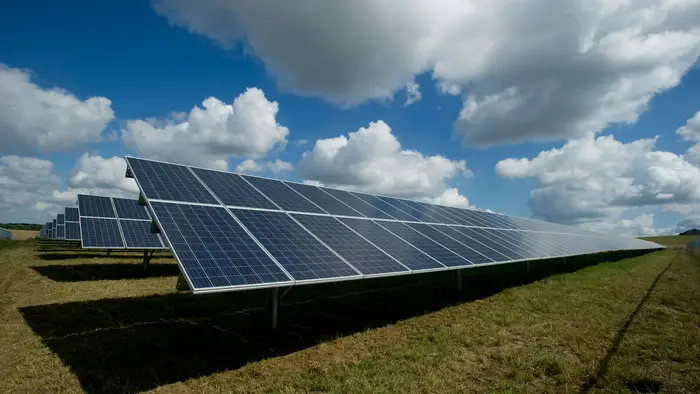
Roll-out solar arrays unroll in orbit without motors, using flexible composite booms. Image: Unsplash.
Five years, eight wings, dozens of spacewalks
The upgrade did not begin with the arrays themselves. It began with brackets. In February and March 2021, spacewalkers Kate Rubins, Victor Glover and Soichi Noguchi installed the first modification kits — pyramidal steel structures bolted onto the station’s truss at the base of the original wings — on the P-6 truss. Those kits are the sockets into which the roll-out arrays plug, and installing them was itself a multi-spacewalk construction job. Only then could the wings fly.
The first pair of iROSAs launched on June 3, 2021, aboard the SpaceX-22 cargo resupply mission. NASA astronaut Shane Kimbrough and European Space Agency astronaut Thomas Pesquet installed them during three spacewalks on June 16, June 20 and June 25, on the far end of the port-side truss, on power channels 2B and 4B. A year later, the second pair launched in November 2022 and was installed in December. The third pair followed in 2023, with installation work wrapping up that June, and the fourth set — arrays seven and eight in the original counting, before the program was extended — was manifested for later flights. In all, the installation campaign to that point involved 15 American spacewalks, 15 astronauts from the United States, France, Japan and the United Arab Emirates, and more than 102 hours outside the station, before the final pair even arrived.
The final pair’s journey to orbit is a story in itself. The two arrays were delivered by SpaceX’s 35th Commercial Resupply Services mission, CRS-35, whose Dragon spacecraft launched on October 13 from Cape Canaveral Space Force Station and docked to the station’s Harmony module two days later, carrying more than 2,850 kilograms — about 6,300 pounds — of cargo, including the final solar arrays. After docking, Menon opened Dragon’s hatch and, together with Kutryk and fellow NASA astronauts Jessica Watkins and Luke Delaney, began transferring supplies, research hardware and samples into station freezers and racks. The arrays then waited, stowed, while the crew prepared: suit checks, tool configuration, procedure reviews, and a pre-spacewalk conference with mission controllers on the ground, the unglamorous rehearsal that makes the glamorous part possible. Readers who followed the cargo mission itself can find the fuller docking story in SpaceX Dragon Docks at the Space Station With the Final Solar Wings — and a Cargo Hold Full of Medical Promise.
The preparatory spacewalks of 2026 deserve their place in the timeline too. In January, astronauts worked to prepare the 2A power channel for its roll-out array, the same channel Menon and Kutryk will now complete. And in August, Menon and station commander Jessica Meir spent six hours and 27 minutes outside installing the seventh and final set of mounting brackets — the last piece of preparatory construction for the upgrade, on the 3B channel — a mission recounted in One More Step: Meir and Menon’s 6.5-Hour Spacewalk Completes the ISS Solar Upgrade Puzzle. Without those brackets, the arrays arriving on CRS-35 would have nowhere to bolt. With them, the October and November outings become installation missions rather than construction missions, and that distinction is part of why NASA can plan two full installations eight days apart.
The two astronauts at the center of it
Anil Menon is, by now, one of the station’s most experienced hands outside the airlock. A NASA astronaut and flight engineer on Expedition 75, he has spacewalked before — the August 2026 outing with Meir was part of that record — and he brings to the October outings both the muscle memory of working in a suit and the specific knowledge of the truss hardware he helped prepare. His fourth spacewalk, on October 29, will be the first of the pair, on the port side; his fifth, on November 5, will close the program on the starboard side. There is a neat symmetry in that: the astronaut who helped build the last brackets will help bolt in the last wings.
Joshua Kutryk’s story is different, and in some ways more striking. A colonel in the Canadian Space Agency, he reached the station on October 1 with Crew-13, the mission whose record-fast arrival is told in Crew-13 Reaches the Space Station in Record Time as Watkins Becomes First Black Woman to Command a Crew in Orbit. Within a month of arriving, he will have performed his first two spacewalks — and his first spacewalk will be a milestone outing, U.S. spacewalk 100, installing a wing that completes half of the station’s remaining power upgrade. For Canada, the symbolism runs deeper than one astronaut’s resume. Canadarm2, the Canadian-built robotic arm that will serve as a platform for one of the spacewalkers, was attached to the station with the help of Chris Hadfield on Canada’s first spacewalk in April 2001. Twenty-five years later, a Canadian astronaut will stand on a Canadian arm to finish an American-led power upgrade on an international station. The program’s history has a habit of rhyming like that.
The partnership matters beyond ceremony. The station is operated by five agencies — NASA, the Canadian Space Agency, the European Space Agency, the Japan Aerospace Exploration Agency and Roscosmos — and each has committed to operations through 2030, with the exception of Roscosmos, which has committed through at least 2028. A power upgrade that keeps the station healthy through its final years is therefore a shared interest, and a Canadian astronaut performing the final installations is a fitting emblem of it. The Canadian Space Agency, for its part, has made no secret of the occasion: it hosted a technical briefing previewing Kutryk’s spacewalks and has kept its media channels focused on the two Thursdays as the centerpiece of his mission.
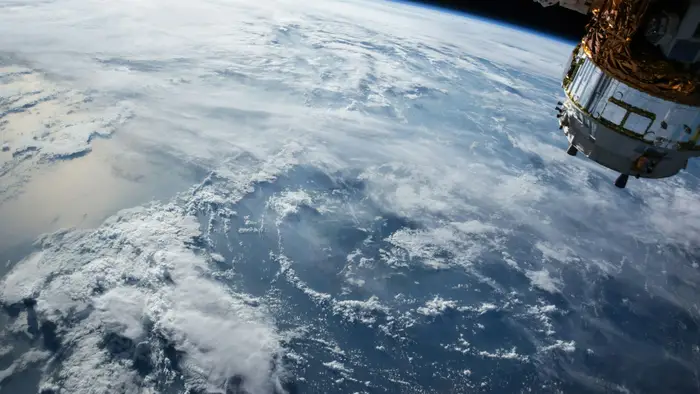
Earth’s horizon from orbit, where the station circles the planet every 90 minutes. Image: Unsplash.
What the extra power buys — and what comes after
It is tempting to describe a power upgrade as infrastructure, and therefore boring. On a space station, infrastructure is destiny. The station’s science program is power-limited in ways that are invisible from the ground: an experiment that needs continuous power competes with life support, communications, thermal control and the visiting vehicles docked at any given moment. Adding roughly 55 kilowatts does not just let the station do more of the same; it changes which experiments are feasible, how many can run at once, and how much margin the crew has when something goes wrong. The biomedical research that topped the station’s schedule in the week the spacewalk preparations began — portable biological sampling in microgravity, three-dimensional cell printing — is exactly the kind of work that benefits from a station that is not rationing watts.
The power also buys time, and time is the station’s scarcest resource in a different sense. The station is scheduled to operate through 2030, after which NASA plans a controlled deorbit, guiding the massive laboratory to a destructive reentry over a remote area of the Pacific Ocean. SpaceX is under an $843 million contract to build the U.S. Deorbit Vehicle that will perform that final push, a spacecraft based on Dragon heritage hardware that NASA will operate. For that plan to work, the station must remain a healthy, controllable spacecraft until its final orbits — its computers running, its radios talking, its gyroscopes and thrusters responding. Solar wings that keep the batteries charged through every eclipse are part of that chain, unglamorous and indispensable. The final iROSAs are, in this light, not merely the last upgrade of the station’s middle age. They are part of its end-of-life plan, installed years early so that the ending can be managed rather than improvised.
There is a longer legacy, too. Roll-out solar array technology, proven on the station, is already migrating elsewhere. The same flexible-blanket approach is attractive for commercial stations now being designed to succeed the ISS, for lunar surface power systems that must pack small and deploy large, and for any spacecraft where mass and stowed volume matter more than the familiarity of a rigid panel. Every iROSA installed on the station is a flight qualification for the next generation of solar wings, and the final two are the last data points in a five-year demonstration that the technology works at scale, in the harshest environment available, installed by hand.
Watching the last two wings go up
For viewers on the ground, the two spacewalks will be among the most accessible events of the station’s year. NASA plans to stream both outings on NASA+, with coverage beginning at 10:30 UTC on October 29 and 11:45 UTC on November 5. In Jakarta time, the October 29 spacewalk is scheduled to begin at 7 p.m. WIB, with coverage from 5:30 p.m., while the November 5 outing begins at 8:10 p.m. WIB, with coverage from 6:45 p.m. — evening viewing, in other words, for a construction job 400 kilometers overhead. The October 20 briefing, led by Patel and spacewalk flight director Garrett Hehn, set the tone: this is a program finishing what it started, and NASA is treating the final installations as a milestone worth explaining, not just executing.
Expect the unexpected, even so. Spacewalks are among the most complex operations humans perform, and the station program has learned, over 285 excursions and counting, to plan for the plan to change. A task may be deferred to the second outing. A spacewalk may run long. A date may slip by a day for weather at a landing site that has nothing to do with the work itself, or for a traffic conflict with a visiting vehicle. None of that would diminish what the two Thursdays represent. The wings are aboard. The brackets are installed. The crew is trained. The only remaining step is the one that has to be done by hand, outside, in vacuum, by two people in white suits with a robotic arm for a scaffold.

An astronaut’s view of Earth from the station, which has hosted crews continuously for more than a quarter century. Image: Unsplash.
The last bolt of a five-year build
When the eighth array unrolls on November 5 — if the schedule holds, late in the evening Jakarta time, with the station sweeping over some ocean or continent far from Houston’s control room — a quiet threshold will be crossed. The station’s power system, patched and augmented wing by wing since 2021, will be whole. No more modification kits are waiting. No more roll-out arrays are manifested for this upgrade. The astronauts who spent the better part of a decade bolting brackets, routing cables and unrolling blankets will have finished the job, and the station will hum along on up to about 215 kilowatts, its lights and laboratories and life-support systems fed by eight new wings laid over eight old ones.
That is a fitting way to spend the station’s final years: not with a dramatic new module or a record-breaking mission, but with the completion of a long, careful piece of work. The International Space Station was never a single launch or a single achievement. It was an accumulation — of modules, of spacewalks, of crews, of experiments, of power. The last two solar arrays are the last major accumulation of that kind, and they arrive just in time. After November 5, the station’s builders can put down their tools, at least for this project, and its scientists can get on with using the power. The station has perhaps four more years of science ahead of it, and then a fiery, deliberate descent into the Pacific. Thanks to two Thursdays in late autumn, and to the two astronauts who will spend them outside, it will face both its work and its ending with its batteries full.
Starfield over Earth’s horizon — the view the spacewalkers will work against. Image: Unsplash.