3C 120 Black Hole Jet 2026: XRISM Finds the Hot Inner Flow That Launches It
A fast eater with a powerful exhaust
Somewhere in the direction of the constellation Taurus, about 420 million light years from Earth, a supermassive black hole is doing two things at once that theory has long struggled to reconcile. It is swallowing surrounding matter at a rapid rate, and it is firing a powerful jet of plasma outward at nearly the speed of light. Either behaviour on its own would be unremarkable for an active galaxy. Together, they have presented astronomers with a puzzle that has refused to go away: the kind of disk expected around a rapidly feeding black hole should be a poor place to build a jet, yet the jet is plainly there.
A study published in The Astrophysical Journal Letters on October 19, 2026, offers a way out of the contradiction, and it does so not with a new theory but with a measurement. Led by Associate Professor Hirofumi Noda of Tohoku University and Associate Professor Kazuhiro Hada of Nagoya City University, the team combined X-ray observations from Japan’s X-ray Imaging and Spectroscopy Mission, known as XRISM, with radio observations from three international telescope networks. Working together, the two kinds of data let the researchers see both sides of the system at once: the matter falling inward and the jet streaming outward. What they found was a boundary. The relatively cool, flat disk of infalling matter does not reach the black hole at all. It stops short, at roughly 20 times the black hole’s radius, and inside that edge the flow changes character entirely, becoming a hot, thick river of plasma hundreds of millions of degrees in temperature. The jet, traced back toward its origin by the radio telescopes, begins inside that hot region.
The paper’s title states the claim plainly: “Disk Truncation Triggers Relativistic Jet Launching of a Highly Accreting Supermassive Black Hole.” Truncation is the key word. It means the cool disk is cut off, and the authors argue that this cut-off is what makes the jet possible. For a field that has spent decades arguing about jet physics from incomplete pictures, a spatial measurement like this — this ends here, that begins there — is a rare and valuable thing.

The galaxy 3C 120 lies in the direction of Taurus, some 420 million light years away. Image: Unsplash.
Why a fast feeder should struggle to make a jet
To understand why the result matters, it helps to picture what happens around a supermassive black hole. Matter rarely falls straight in. Because it carries some sideways motion, it spirals inward instead, gathering into a flattened, rotating structure called an accretion disk. Friction and other processes heat that material until it glows, and astronomers read that glow the way a doctor reads a scan: the light carries information about a region far too small and distant to photograph directly.
The trouble is that the disk’s structure depends on how fast the black hole is feeding. When matter pours in rapidly, theory expects a relatively cool, geometrically thin disk that extends close to the black hole — cool only in comparison with the far hotter plasma nearer the centre, and thin in the sense that its vertical thickness is small compared with its width, like a flattened sheet of paper. That picture has a problem when it comes to jets. The leading explanation for powerful jets, the Blandford-Znajek mechanism, requires strong, well-organised magnetic fields near a rotating black hole. Such fields are thought to be difficult for a thin disk to sustain. A thin disk, in other words, is a good eater but a poor jet engine.
The opposite regime has been far more comfortable for theorists. In weakly feeding systems, where matter trickles in, the flow near the black hole is already hot and thick, and that puffed-up geometry gives magnetic fields somewhere to gather and hold their shape. The galaxy M87, whose black hole became famous as the first ever imaged, belongs broadly to this weakly feeding family, and hot, thick flows there have already helped support the magnetic explanation for jet production. The new work on 3C 120 extends the investigation to the other end of the feeding scale, to a system where the old picture said a jet should be hard to launch. The black hole at the centre of 3C 120 has a mass of roughly 60 million Suns, and it is both rapidly consuming surrounding matter and producing a powerful jet. That combination is precisely what makes it such a useful test case.
Earlier work on black holes in our own cosmic neighbourhood has shown how violently these engines can behave. Readers who followed A Solar Storm Erupted Around a Monster Black Hole will recall how an eruption around a different supermassive black hole left a fingerprint familiar from the Sun. The 3C 120 result belongs to the same research programme in spirit: it treats black holes not as distant curiosities but as physical machines whose parts can be located, measured, and understood.
Reading the disk through iron
The X-ray half of the measurement depended on a single spectral feature, and it is worth pausing over how much information astronomers can extract from it. XRISM detected X-rays emitted by iron in the material around 3C 120’s black hole. Iron, like other elements, radiates at characteristic energies, producing a recognisable feature called an emission line in an X-ray spectrum — a spectrum being simply radiation separated according to its energy. Near a black hole, that line does not stay neat. Material moving toward or away from the observer shifts the energy of the radiation, and the black hole’s intense gravity shifts it further still. Together, these effects spread and distort the line into a broad, skewed shape.
That distortion is the measurement. The amount of broadening depends on how close to the black hole the light was emitted, so by modelling the distorted iron line the researchers could work out how far inward the relatively cool disk extends. Their answer was about 20 gravitational radii, a distance scale set by the black hole’s own mass, which the university’s announcement expresses as roughly 20 times the black hole’s radius. Inside that boundary, the team infers, the cool disk is gone, replaced by a hot, geometrically thick flow. The plasma there is thought to reach temperatures of hundreds of millions of degrees — plasma being gas in which electrons have separated from atoms, allowing the material to interact strongly with magnetic fields.
It is a striking image: a flat, orderly disk that simply ends, like a road stopping at the edge of a cliff, with something wilder taking over beyond the edge. And it is an image built entirely from light that no telescope could ever resolve into a picture. Even the Hubble Space Telescope cannot resolve a region this small at this distance. The structure had to be inferred from spectra and interferometry, from the colour of X-rays and the shape of a radio jet, rather than seen.
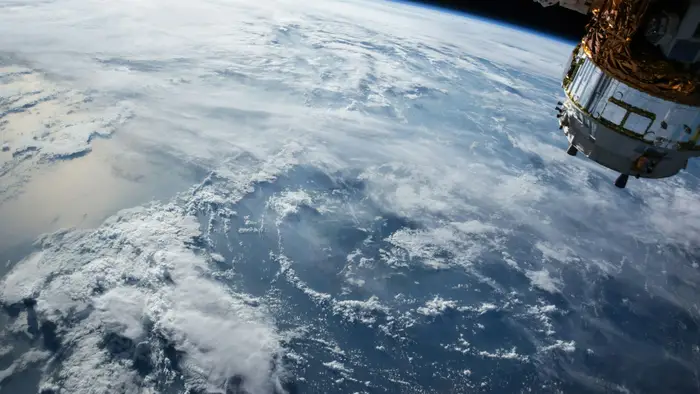
XRISM read the shape of an iron emission line to locate the inner edge of 3C 120’s cool disk. Image: Unsplash.
Tracing the jet back to its birthplace
The radio half of the study supplied the other side of the picture, and it required telescopes working together across continents. The team used three networks: the Global Millimeter VLBI Array, the Very Long Baseline Array, and the East Asian VLBI Network. These networks combine measurements from widely separated telescopes through very long baseline interferometry, a technique that lets astronomers distinguish far finer details than any single radio telescope could resolve on its own. In this study, it allowed them to follow the jet as it narrowed toward the black hole, tracing its shape inward like following a river upstream to its source.
From the jet’s narrowing shape, the researchers estimated that its base has a radius no greater than about 10 black hole radii. Their combined interpretation places the jet’s origin within the hot inner flow identified through the X-ray measurements, close to the black hole. That overlap is the heart of the paper. The X-ray data locate the inner boundary of the cooler disk; the radio data trace the jet toward a region inside that boundary. Read together, the observations give researchers a spatial explanation for how a rapidly feeding system can maintain conditions favourable to a powerful jet. It is more specific, and more persuasive, than simply finding a disk and a jet around the same object. The study connects the disk’s changing structure with the location where the jet begins, bringing the incoming and outgoing material into the same physical picture.
Noda, who co-led the research, explained why combining the observations mattered: “By looking at the same black hole with state-of-the-art X-ray and radio telescopes, we were able to see both the hot plasma surrounding the black hole and the jet emerging from it. This allows us to directly connect the extreme environment near the black hole with the formation of the jet.” The emphasis on simultaneity is important. Black holes vary, and observations taken years apart might catch a system in different states. By observing at around the same time, the team could be confident that the disk and the jet they were comparing belonged to the same moment in the system’s life.
How rotation could power the jet
The proposed explanation links three ingredients: a rotating black hole, a hot flow of incoming plasma, and strong magnetic fields. The cooler outer disk supplies the matter. Closer to the black hole, the hotter and thicker flow provides a region where magnetic fields can accumulate more readily than they could in a thin disk. Those fields could then extract some of the black hole’s rotational energy and direct it into a narrow stream of plasma. This is the Blandford-Znajek mechanism in outline: magnetic field lines threading the region near a spinning black hole act something like drive belts, tapping rotational energy and channelling it outward.
For 3C 120, the researchers propose that the change from a thin outer disk to a thick inner flow makes the two movements of the system compatible. Matter continues to fall inward, feeding the black hole, while energy flows outward along the jet, shaped by fields that the hot flow helps to anchor. The jet is therefore powered near the black hole even as other matter keeps falling in — an inward supply and an outward exhaust, running at the same time, in the same small volume of space.
It is worth being precise about what the study does and does not claim. The observations demonstrate that 3C 120 satisfies the conditions required for this mechanism to operate, and they provide new insight into how rapidly feeding supermassive black holes can produce relativistic jets. They do not, by themselves, prove that every rapidly feeding black hole launches its jet in exactly the same way. The exact magnetic field structure and the way rotational energy is transferred into the jet remain subjects for further study, and the authors are careful to frame their result as evidence for a connection rather than a final verdict on jet physics. That caution is a strength, not a weakness: a single system, however well measured, is the beginning of a pattern, not the pattern itself.
The broader census of black holes in the early universe shows why such patterns matter. The survey described in A Census of Dawn: Euclid Spots 31 of the Universe’s Oldest Quasars found quasars — actively feeding supermassive black holes — shining less than a billion years after the Big Bang, far earlier than simple growth models would comfortably allow. If black holes could grow that fast, they must have been efficient feeders, and efficient feeders that also launch jets would have shaped their host galaxies from very early on. Understanding how feeding and jet launching coexist in a system like 3C 120 therefore feeds directly into the story of how galaxies and their central black holes grew up together.
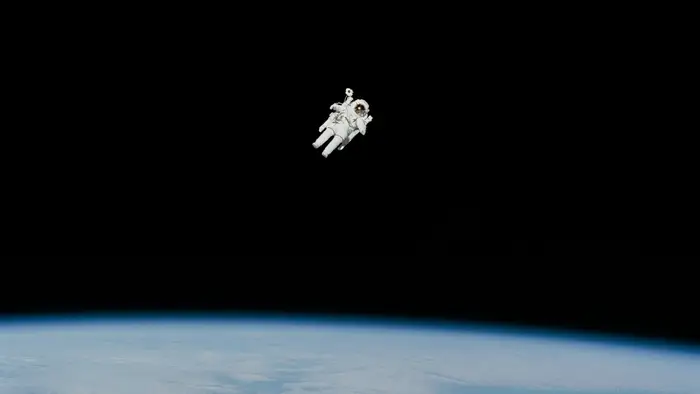
Jets carry energy from the black hole’s neighbourhood far out into its host galaxy. Image: Unsplash.
Why one galaxy’s jet matters for all galaxies
Jets are not decorative. They carry enormous amounts of energy away from the immediate surroundings of supermassive black holes, and when they plough into gas in and around galaxies, they can heat it, push it around, and change the conditions under which new stars form. Astronomers call this feedback, and it is one of the main ways black holes are thought to regulate the growth of their host galaxies. A black hole that cannot launch a jet influences its galaxy differently from one that can. Understanding the engine near the black hole therefore helps researchers study changes occurring on vastly larger scales, from the star-forming gas of a single galaxy to the evolution of galaxy clusters.
The 3C 120 findings supply a concrete connection between those scales. The structure of the incoming matter — specifically, where the cool disk ends and the hot flow begins — may help determine whether a powerful jet can form at all. A boundary only a few dozen gravitational radii from the black hole could influence how energy is delivered across thousands of light years. That is the kind of link astronomers dream of: a small, measurable feature near the event horizon with consequences visible across a galaxy.
There is also a methodological prize here. The study offers a new way to examine the immediate surroundings of supermassive black holes, by pairing high-resolution X-ray spectroscopy with radio interferometry taken at the same time. If the approach works on 3C 120, it can be turned on other systems, and each new system becomes a test of whether the disk-truncation picture is a general rule or a quirk of one galaxy. The team is already conducting further coordinated observations of a more massive black hole using XRISM and global radio observatories, and plans to compare the results with theoretical models and computer simulations, testing how well the proposed geometry explains the behaviour of matter and magnetic fields.
Extreme physics around compact objects keeps producing surprises of this kind. The measurement reported in Empty Space Is Not Empty: IXPE’s Magnetar Measurement and the 90-Year Hunt for Vacuum Birefringence showed how a different kind of observation — polarised X-rays from a magnetar — could confirm a prediction about empty space itself that had waited ninety years for a test. The 3C 120 result belongs in that tradition: a patient, technically demanding measurement that turns an abstract prediction into something located in space, with a distance and a temperature attached.
What comes next
The publication sequence tells its own story about how modern astronomy moves. The study appeared in The Astrophysical Journal Letters on October 19, 2026, carrying the digital object identifier 10.3847/2041-8213/aeaa2c. Tohoku University announced the findings the following day, on October 20, describing the combined X-ray and radio observations and the team’s next steps. The next stage is already under way: coordinated observations of a more massive black hole, analysed alongside theoretical models and simulations, to see whether the structural transition found in 3C 120 shows up in a different system with a different mass and feeding rate.
That follow-up matters because the most interesting question the paper raises is also the most obvious one. Is 3C 120 typical? If other rapidly feeding black holes show the same truncated disk and the same jet origin inside a hot flow, then disk truncation may be a universal part of the disk-jet connection, a geometric switch that lets fast feeders fire jets after all. If they do not, then astronomers will have learned something equally valuable: that jet launching depends on details — spin, magnetic field history, environment — that vary from galaxy to galaxy. Either outcome sharpens the picture, and both depend on repeating this difficult, coordinated kind of observation.
Noda described the purpose of that next stage in terms that reach well beyond one galaxy: “Our next goal is to build a more complete picture of how matter, magnetic fields and black hole rotation interact in these extreme environments. Understanding this process may also help us better understand how supermassive black holes influence the evolution of galaxies and the larger structures of the Universe.” It is a fitting summary of why astronomers chase measurements like this one. The region within a few dozen gravitational radii of a black hole is among the most extreme environments in the universe, and yet its behaviour ripples outward to shape the largest structures we know.

The team is now applying the same X-ray and radio method to a more massive black hole. Image: Unsplash.
The edge where dinner becomes exhaust
Strip away the jargon, and the 3C 120 result has a pleasing, almost mechanical clarity. A black hole eats through a flat disk. That disk stops. Inside the stopping point, the flow thickens and heats until it can hold the magnetic fields a jet needs. And from inside that hot zone, a jet is born, carrying a fraction of the black hole’s spin energy out into the galaxy. Dinner goes in; exhaust comes out; and the boundary between the two turns out to be the most interesting place in the whole system.
Astronomy has a habit of rewarding patience. The iron line that revealed the disk’s edge was distorted by relativity itself, bent and smeared by the very gravity it was measuring. The jet that confirmed the picture was traced by telescopes on different continents acting as a single instrument. Neither measurement would have meant much alone. Together, they locate something no one has ever seen: the exact neighbourhood where a rapidly feeding black hole stops merely eating and starts pushing back. For a universe full of galaxies shaped by jets like this one, that neighbourhood may be one of the most consequential addresses in the sky.

Where the cool disk ends, the jet begins — a boundary with consequences across an entire galaxy. Image: Unsplash.