A Solar Storm Erupted Around a Monster Black Hole — and Left the Sun's Fingerprint
For ten days in July 2024, an X-ray telescope stared at a galaxy with a monster at its heart, and waited. The galaxy was NGC 3783, an active galaxy whose central black hole weighs about 28 million times as much as the Sun and feeds on a swirling disk of gas. Most of the flares the telescope saw during that campaign behaved as expected. One did not. Its high-energy X-rays rose and fell out of step with its lower-energy glow, by hours, in a pattern astronomers know intimately — because they have watched it happen on the Sun for more than half a century.
That misbehaving flare, reported in October 2026 in The Astrophysical Journal Letters, is the first time the telltale timing signature of a solar storm has been found in the corona of a supermassive black hole. The finding, led by doctoral student Gal Vardi of the Technion Faculty of Physics under the supervision of Professor Ehud Behar, with collaborators from Japan, Europe, and the United States, suggests that the same magnetic violence that drives solar flares and coronal mass ejections also erupts around black holes millions of times more massive than the Sun. It is a striking case of the universe reusing one piece of physics at wildly different scales.
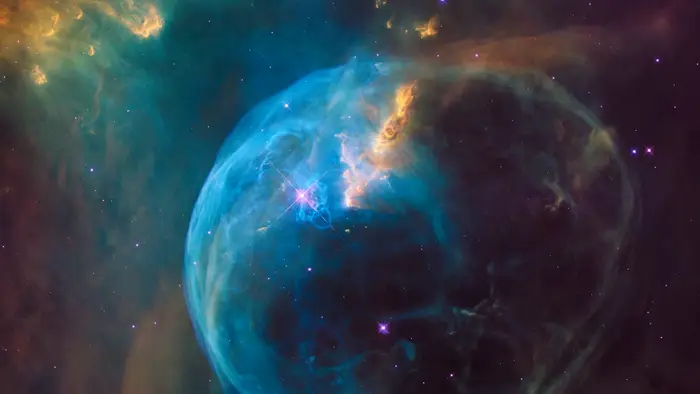
A bubble of hot gas blown by energetic stars — a reminder that the cosmos is shaped by violent, glowing plasma. Image: Unsplash.
A flare that refused to behave
The campaign that caught the flare was led by XRISM, the X-ray Imaging and Spectroscopy Mission, a joint observatory of the Japan Aerospace Exploration Agency (JAXA), NASA, and the European Space Agency (ESA). Several other space observatories joined the ten-day watch of NGC 3783. The analysis that produced the new result concentrated on XRISM’s Xtend X-ray imager and on data from ESA’s XMM-Newton observatory, including its ultraviolet observations, giving the team independent views of the same events at different energies.
Several flares appeared during the campaign, typically lasting around one to two days. Most showed closely matched changes in hard and soft X-rays — the higher- and lower-energy photons streaming from the black hole’s surroundings. One event behaved differently. Its hard X-ray variation preceded its soft variation by roughly 30,000 seconds, about eight hours. After the flare peaked, its hard X-rays dropped sharply while its soft X-rays faded more gradually. That mismatch was the first clue that something structurally different was happening: two kinds of light, telling two different parts of the same story, rather than a single brightening rising and falling in unison.
On the Sun, astronomers would recognise the pattern at once. It is the Neupert effect, first identified in solar observations in 1968 and never before observed around a black hole. The effect concerns a precise relationship between hard and soft radiation during some solar flares. Hard X-rays can trace the immediate energy release from accelerated particles, while softer radiation reflects the accumulated heating those particles produce. As a result, the hard X-ray brightness can follow the rate of change of the softer emission, rather than the softer emission itself. A heating signal can peak while stored thermal energy is still increasing, producing a later soft X-ray maximum. The delayed soft peak therefore becomes meaningful when paired with the changing hard emission — it is a fingerprint of energy being dumped into plasma by fast particles, not just of something getting brighter.
The team tested that relationship in the NGC 3783 flare and found it held. For XRISM, the comparison produced a correlation strength of 0.84, with a reported p-value of 0.002. XMM-Newton independently showed the same relationship, with a correlation of 0.92 and a p-value of 0.02. The authors also checked whether their choice of time intervals had manufactured the result. The relationship remained significant when measurements were grouped into intervals between 4,000 and 8,000 seconds; finer intervals lacked enough signal, while broader averaging blurred the flare’s distinguishing features. Two telescopes, two independent datasets, one timing signature.
It is worth pausing on why a timing pattern carries so much weight. Astronomers cannot resolve the corona of NGC 3783 into an image; the entire region around the black hole appears as a single point of X-ray light, even to the best telescopes. Everything they know about its structure must therefore be decoded from how that point brightens and fades, and in which colours of X-ray light. An ordinary flare, in which all energies rise and fall together, says little about mechanism: many processes can simply make something brighter. A flare in which the hard light tracks the rate of change of the soft light, however, is a much more specific fingerprint, because it encodes a sequence — fast particles first, heating second, cooling third. That sequence is exactly what magnetic reconnection predicts, and it is why a stopwatch measurement can stand in for a photograph of magnetic loops no telescope will ever resolve.

X-ray observatories in orbit give astronomers views of the high-energy universe that Earth’s atmosphere blocks. Image: Unsplash.
The Sun’s fingerprint, on a cosmic scale
To appreciate why this matters, it helps to picture what a solar storm actually is. The Sun’s outer atmosphere, its corona, is threaded by magnetic fields that can store enormous amounts of energy. When those fields become unstable, they can snap into a new configuration in a process called magnetic reconnection, converting magnetic energy into kinetic energy. The snap accelerates charged particles to high speeds. Some of those particles plunge into denser material and heat it, producing a flare. Others escape outward altogether in a coronal mass ejection, a billion-tonne cloud of plasma that can buffet Earth’s magnetic field, threaten astronauts, and disrupt satellite communications.
Astronomers have long suspected that a related mechanism operates above the accretion disks of black holes. In an active galaxy like NGC 3783, matter spirals inward through a disk, and above that disk sits a corona of extremely hot gas that produces energetic X-rays. Both the disk and the corona occupy the black hole’s surroundings; the escaping radiation and wind do not emerge from inside the event horizon, the point of no return. The analogy between stellar and black hole coronae also addresses a shared heating problem: coronae can become much hotter than the underlying sources of visible or ultraviolet light, and in active galaxies coronal temperatures can approach a billion kelvins. Something must be heating them, and magnetic reconnection has featured in models of black hole environments for decades.
Until this event, however, the evidence for reconnection’s role in active galactic coronae remained circumstantial, according to the authors. Models could invoke it, and indirect clues could point toward it, but no observation had caught the process in the act with a diagnostic as specific as the Neupert effect. The new timing analysis supplies a more specific test of that longstanding interpretation — and it passed. The same physical processes underlying solar storms, the Technion team concluded, also occur in the environments of supermassive black holes.
A wind at a fifth of light speed
The timing signature was not the only evidence. A separate analysis of the same campaign had already identified an ultrafast outflow associated with the flare, material streaming away at approximately one-fifth of the speed of light. The new paper connects that escaping material with the timing evidence, interpreting it as the counterpart of a solar coronal mass ejection: the eruption that accompanies the flare.
In the proposed sequence, magnetic reconnection accelerates charged particles around a magnetic loop above the corona. Some material escapes, while other particles travel toward denser regions near the loop’s base. There, they deposit their energy and produce the softer component of the flare. Comparisons of X-ray brightness across different energy bands support the picture of two distinct processes at work: the strongest correlation occurs between hard X-rays in the 7.2–12 keV band and changes in soft X-rays in the 1.2–2.0 keV band, suggesting the two arise from different physical mechanisms rather than a single brightening.
The timing also offers a tentative way to estimate distances that telescopes cannot resolve directly. The eight-hour offset between the brightness curves is different from the delay used to estimate particle travel; the hard emission and the rate of soft brightening matched within the shortest reliable time interval. Under the reconnection interpretation, that limits the travel time to less than about 4,000 seconds. Assuming particles travel close to light speed, the authors place the reconnection region within about 30 gravitational radii of the loop’s base — a gravitational radius being a unit of distance set by the black hole’s mass. It is an elegant piece of detective work: turning a stopwatch reading into a map of a region no telescope will ever image directly.
There are differences from the solar case, and the authors do not gloss over them. Around this black hole, they interpret both X-ray components through inverse Compton scattering, in which energetic particles boost photons to higher energies, rather than through the radiation mechanisms that dominate solar flares. The proposed resemblance concerns magnetic energy release and subsequent heating, despite differences in how the radiation itself is produced. Ultraviolet measurements offer another possible connection, with a weak flare appearing around 60,000 seconds after the hard X-ray event; the authors suggest that hard radiation illuminated and heated a more distant part of the disk, but the ultraviolet uncertainties prevented a formal correlation measurement, making that part of the sequence less secure.
The night sky over a mountain ridge, streaked by a meteor. Distant galaxies like NGC 3783 hide far beyond the stars of our own Milky Way. Image: Unsplash.
Two telescopes, one storm
The result is also a showcase for the observatories that made it. XRISM, led by JAXA with NASA and significant ESA participation, carries instruments designed to dissect X-ray light with exquisite precision, and its Xtend imager provided the wide-field X-ray view of the campaign. XMM-Newton, ESA’s long-serving X-ray observatory, supplied an independent X-ray eye plus ultraviolet coverage, letting the team cross-check the flare’s behaviour across the spectrum. That independence mattered: when two very different instruments, operated by different agencies, return the same subtle timing relationship, the result is much harder to dismiss as an artefact of one detector.
The campaign itself illustrates how modern astronomy works. No single snapshot settled the question. It took a ten-day stare, flares lasting a day or two each, and a careful comparison of light curves band by band, second by second, before one flare stood out from the rest. Most of the flares in the campaign showed hard and soft X-rays marching together. Only the odd one out carried the Neupert signature — which is precisely why it is interesting. Nature rarely labels its experiments; astronomers find them by noticing which events refuse to fit the pattern.
Why a black hole needs a corona
The stakes go beyond one flare in one galaxy. Active galactic nuclei are among the most luminous persistent objects in the universe, and their coronae are engines of that luminosity. Understanding what heats a corona — and what launches winds from it at a fifth of light speed — feeds directly into questions about how black holes grow, how they influence their host galaxies, and how energy flows from the smallest scales near the event horizon out to galactic distances. A wind racing away from a black hole’s corona can carry energy and momentum into the surrounding galaxy, potentially shaping star formation across thousands of light-years. If magnetic reconnection is a routine driver of such eruptions, then the physics of solar weather becomes a key to galactic weather too.
The result also sharpens a broader theme in modern astrophysics: the universality of plasma physics. The same equations that describe magnetic fields snapping above a sunspot also describe fields snapping above a disk of gas spiralling into a black hole 28 million times the Sun’s mass. The scales differ by orders of magnitude — a solar flare spans a fraction of the Sun’s diameter, while the NGC 3783 event unfolded around an object whose gravitational reach spans the inner solar system and beyond — yet the timing signature is the same. That universality is what makes a single well-measured flare worth a paper in a major journal.
The crowded heart of our own galaxy. Every large galaxy is thought to host a supermassive black hole at its centre. Image: Unsplash.
Ruling out the impostors
Before claiming a first, the team had to eliminate the mundane explanations. A flare’s light curve can change shape for reasons that have nothing to do with magnetic reconnection: a cloud of gas drifting across the line of sight can absorb some energies more than others, and light reflected from surrounding material can add a delayed glow that mimics a separate process. The researchers examined both alternatives and found neither fit. There was no corresponding absorption change that tracked the flare’s distinctive timing, and no soft-excess variation that could explain it away. What remained was the reconnection interpretation — not because it was the only idea on the table, but because it was the one that survived the tests.
That discipline matters because the claim is a strong one: the first magnetic reconnection eruption and the first coronal mass ejection ever identified in the corona of a black hole. Firsts in astronomy attract scrutiny precisely because they rewrite what is considered possible, and the history of the field is littered with apparent breakthroughs that dissolved under a closer look at the data. Here the double confirmation — XRISM and XMM-Newton independently returning the same timing relationship, with the same sense and similar strength — is what elevates the result from suggestive to convincing. A detector artefact or a quirk of one analysis pipeline would be unlikely to reproduce itself in a second observatory’s data.
What the discovery does not prove
Good science states its limits, and this result has clear ones. The magnetic field strength involved is model-dependent, with different estimates probing different assumptions and stages of the event. The proposed loop and particle paths remain a physical interpretation of unresolved observations — the telescopes measured light curves, not pictures of magnetic loops. The researchers examined alternatives, including changing absorption and radiation reflected from surrounding material, and found no corresponding absorption change or soft-excess variation that explained the flare’s distinctive timing. Their analysis favours reconnection, but it does not photograph it.
Most importantly, this is a single flare. One event does not establish whether similar structures and conditions characterise other active galaxies, or how often Neupert-like eruptions occur. Finding more such events, and determining their frequency, would test whether the solar analogy explains a broader class of black hole eruptions or whether NGC 3783’s flare was an unusual case. The team is candid that the ultraviolet connection remains tentative and that the magnetic geometry itself is inferred rather than directly observed. Those caveats do not weaken the central claim — the timing signature is real and independently confirmed — but they define the work still to be done.
That work is already conceivable. XRISM continues to observe, XMM-Newton remains in service, and future X-ray observatories will watch other active galaxies with even greater sensitivity. Each new campaign is another chance to catch a flare misbehaving in exactly this way. If Neupert-like events turn out to be common, textbooks on active galaxies will gain a new chapter, one that begins with a familiar picture: magnetic fields, twisted and stressed, snapping like rubber bands and unleashing a storm.
There is also a practical lesson in the discovery for how astronomy is done. The breakthrough did not come from a bigger telescope alone, but from watching one object patiently, for ten days, with more than one instrument, and from analysing the data not just for brightness but for the relationships between different kinds of light. The flare that made history was not the brightest of the campaign; it was the oddest. It stood out only because the team had a baseline of ordinary flares to compare it against, and because they knew what a solar storm’s fingerprint looks like. Cross-pollination between fields — solar physics lending its diagnostics to the study of distant galaxies — is what turned an eight-hour lag into a discovery.
It is a pleasing symmetry. The Sun’s storms were once mysterious too, until decades of observation revealed the magnetic machinery behind them. Now that same machinery has been glimpsed around a black hole millions of times more massive, in a galaxy far beyond our own. The universe, it turns out, does not invent new physics for its monsters. It simply plays the same storm, louder.

The Milky Way arcs over snowy peaks. Astronomers now hunt for more solar-like storm signatures in other active galaxies. Image: Unsplash.