A Census of Dawn: Euclid Spots 31 of the Universe's Oldest Quasars
Somewhere overhead, in the dark between the stars, photons are falling onto Euclid’s mirrors that set out when the universe was a toddler. They left their quasars roughly thirteen billion years ago, when everything we know was five percent of its current age, and they have been traveling ever since — through voids, past galaxies that did not yet exist when they began, across the long night of cosmic time. This week, the European Space Agency announced that its Euclid space telescope has caught 31 of them, in a single survey sweep. It is the largest haul of quasars ever collected from the universe’s first billion years, and it roughly doubles the number known from that ancient epoch.
The discovery, published on July 6 in the journal Astronomy & Astrophysics under the title “Euclid: Discovery of 31 new quasars at 6.6<z<7.8,” includes the two most distant quasars ever observed. Their light began its journey when the cosmos was just 670 million years old. They beat the team’s previous record for the earliest known quasar, announced in 2021, by about 20 million years. And, perhaps more importantly than the records, the 31 new objects are mostly ordinary quasars — not the freakishly bright outliers that earlier searches could find, but a first true sample of the population at cosmic dawn.
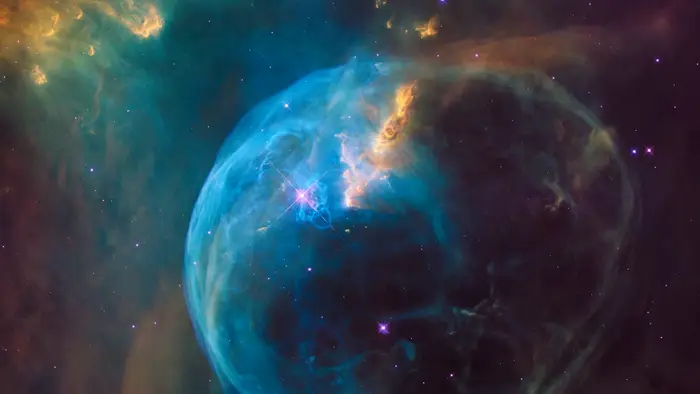
“The Euclid team has taken a true ‘census’ of quasars at the dawn of the universe for the first time,” said Antonio La Marca, a Ph.D. candidate at the Netherlands Institute for Space Research and a research fellow on the Euclid team, in an ESA statement. “It’s a big step toward understanding these fascinating objects on a more fundamental level.”
Thirty-One Beacons From the First Billion Years
To understand what makes this discovery special, it helps to know what a quasar is. A quasar is the blazing core of a young galaxy, lit from within by a supermassive black hole. As immense amounts of gas and dust spiral toward the black hole, extreme gravitational and frictional forces heat the infalling material to millions of degrees. The result is a luminosity so intense that a region smaller than our solar system can outshine the combined light of the billions of stars in its entire host galaxy — brighter by a factor of one hundred to a thousand.
But quasars from the epoch Euclid is probing are extraordinarily hard to find. They are rare, because only a handful of galaxies had grown large enough by then to host such monsters. They are faint, because of their staggering distance. And they are easy to confuse: their original light can be mistaken for the light of ordinary stars much closer to home. For decades, astronomers have been hunting the very first quasars in the universe, and progress has been slow. It took researchers more than a decade to find the first ten or so of the very oldest ones — those from the deepest slice of cosmic time. Euclid gathered more than that in about a year of observations.
The 31 newly identified quasars were found during the first 1.5 years of Euclid’s Wide Survey, which has so far mapped about 3,000 square degrees of sky. Twelve of them sit at redshift 7 or higher — redshift being the astronomer’s measure of distance and lookback time: the higher the number, the older and more distant the object. Those twelve shone during the universe’s first 770 million years. The two record-breakers push deeper still.
The Record-Breakers
The two oldest quasars in the new sample carry designations that read like serial numbers but point to the deepest depths ever plumbed: EUCL J172902.75+641018.1 and EUCL J125308.55+705432.3. Their redshifts are 7.77 and 7.69 respectively, surpassing the previous record by about 20 million years. When their light set out, the universe was 670 million years old — five percent of its present 13.8-billion-year age.
“These early quasars date back to the universe’s infancy,” said Daming Yang of Leiden University in the Netherlands, the study’s lead author. “By finding and studying them, we can better understand how these enormous systems formed and grew so quickly — one of the greatest mysteries in astrophysics.”
That mystery is real, and it has been getting more uncomfortable with each new observation. Supermassive black holes powering these quasars must have masses of billions of suns. Yet the universe was, by these measures, a newborn. The stars and galaxies that would eventually feed such black holes had only just begun to form. So how did a black hole grow so enormous so quickly? The new sample — ordinary quasars rather than extreme outliers — gives theorists their first statistically meaningful population to test their ideas against, instead of a handful of exceptional cases that might be misleading.
How Euclid Did It
The discovery is a triumph of survey astronomy — the art of looking at enormous amounts of sky rather than staring deeply at one spot. Euclid, launched in 2023 aboard a SpaceX Falcon 9 rocket and operated by ESA, was designed for exactly this kind of work. Its mission is to image billions of galaxies to map the structure and history of the universe, with the ultimate goal of understanding dark energy, the mysterious phenomenon causing the universe’s expansion to accelerate.
An international team from the Euclid Consortium — including researchers from the University of Hamburg Observatory — combined multiple machine-learning and probabilistic techniques to sift through the torrent of data from the Wide Survey and flag promising quasar candidates. Finding them was only half the job; confirming them required spectroscopic observations with ground-based telescopes, measuring the characteristic spectral signatures that distinguish a quasar’s glow from starlight.
This is what La Marca means by “census.” Previous searches found the brightest, easiest targets. Euclid’s combination of wide field of view, near-infrared sensitivity, and systematic survey strategy can find the ordinary members of the population — the typical quasars of the epoch of reionisation, when the first stars and galaxies transformed the young universe from an opaque, neutral state into the transparent cosmos we see today.
A Companion Study in the French Alps
One of the 31 new quasars has already drawn a second look. A companion study led by Silvia Belladitta of the Max Planck Institute for Astronomy followed up on one of the quasars using a ground-based array in the French Alps to measure star formation inside its host galaxy. This is the next frontier for the new sample: not just finding these objects, but studying the galaxies around them — how fast they are forming stars, how much gas surrounds the central black hole, and how the two grow together.
That growth is another piece of the puzzle. In the nearby universe, black hole mass and galaxy mass are tightly correlated — a relationship so consistent that it implies the two grow in lockstep, regulated by some feedback process. Whether that relationship already held when the universe was 670 million years old is an open question, and the new Euclid sample offers the first large enough set of targets to ask it properly.
Why the First Quasars Matter
Quasars represent a brief phase in a galaxy’s life — a few tens of millions of years during which large amounts of matter flow into the central supermassive black hole, releasing enormous amounts of energy. But their importance goes far beyond the fireworks. These objects provide some of the most important clues about what happened in the earliest stages of the cosmos: the formation of the first supermassive black holes, the assembly of the first galaxies, and the reionisation of the universe’s hydrogen by the first generations of stars and quasars.
Consider the timing. The two record-holders formed during the universe’s first 670 million years. The cosmic microwave background tells us the universe was about 380,000 years old when it became transparent enough for light to travel freely. So within roughly 670 million years — a blink by cosmic standards — some black holes had grown to billions of solar masses and were blazing as quasars. Every theory of black hole formation has to explain how that happened, and until now, the observational sample was painfully small.
One popular idea is that these black holes grew from “seeds” — the remnants of the first generation of stars, which may have been hundreds of times more massive than our Sun. Another is direct collapse: vast clouds of pristine gas in the early universe collapsing straight into black holes of tens or hundreds of thousands of solar masses, skipping the stellar stage entirely. A third invokes runaway mergers in dense young star clusters. The Euclid census, with its ordinary quasars, lets astronomers compare the mass distribution and properties of the real population against what each model predicts.
Euclid’s Bigger Job
It is worth remembering that Euclid was not built to hunt quasars. Its primary mission is dark energy — the unknown driver of the universe’s accelerating expansion, which makes up roughly 68 percent of the cosmic energy budget and remains one of the greatest mysteries in physics. Euclid’s job is to map the geometry and structure of the universe with unprecedented precision, using techniques like weak gravitational lensing, to pin down how dark energy has behaved across cosmic time.
In June 2026, scientists published the first demonstration that Euclid can trace massive structures dominated by dark matter using weak gravitational lensing — a validation of the mission’s core technique ahead of the first cosmology results expected in 2027. The quasar discovery shows how a survey built for cosmology can deliver transformative results for astrophysics along the way. A telescope that images billions of galaxies will inevitably catch the universe’s rarest, brightest objects — and sometimes, it will catch them at the dawn of time.
NASA is a partner in the Euclid mission, and ESA’s announcement noted that Euclid’s findings will help inform plans for NASA’s Nancy Grace Roman Space Telescope. Roman, which had its own dramatic launch in August 2026, will pick up the dark-energy baton with even wider-field infrared surveys, extending the census of the distant universe to fainter and more distant populations. The two missions are complementary chapters of the same story: Euclid maps the dark universe and finds its brightest ancient beacons; Roman will follow with deeper, sharper infrared vision.
What Comes Next
The 31 new quasars are a beginning, not an end. The Euclid Wide Survey is still in its early years; the full survey will eventually cover about a third of the sky — some 14,000 square degrees — and future data releases will multiply the sample many times over. Each new data release brings deeper images and better calibration, letting the machine-learning pipelines dig fainter and further.
And the follow-up has barely started. Spectroscopic confirmation with ground-based telescopes was necessary for this first sample, but the coming years will bring more powerful tools to bear. Astronomers will measure black hole masses, host galaxy properties, star formation rates, and chemical abundances for these objects. They will compare the quasar population at redshift 7 with the population at redshift 6, 5, and 4, tracing how the first black holes grew across the first two billion years.
For Antonio La Marca, Daming Yang, and their colleagues, the work of the census is just beginning. They have taken the first true headcount of quasars at the dawn of the universe. Now comes the harder part: understanding what the numbers mean. But for the rest of us, the image is worth savoring — a space telescope catching photons that left their quasars when the universe was five percent of its current age, and delivering them, thirteen billion years later, to scientists who have finally learned how to count the lights of dawn.
The View From the Ground
The discovery also highlights the enduring partnership between space and ground. Euclid’s great advantage is its perch above the atmosphere and its wide field of view, but its quasar candidates are only candidates until a ground-based spectrograph splits their light. The confirmation observations for this sample relied on large ground telescopes that could tease out the broad emission lines — the fingerprint of gas whipping around a supermassive black hole at thousands of kilometers per second.
That partnership will deepen. As Euclid’s survey area grows, the candidate lists will grow with it, and ground-based observatories will confirm the most interesting targets. The companion study in the French Alps — measuring star formation in a quasar’s host galaxy with a ground-based array — is a template for how the community will exploit the Euclid sample: space finds them, the ground studies them, and together they reconstruct the first billion years.
It is a remarkable return on a mission that has been operating for less than two years. Euclid was launched in the summer of 2023, and its first 1.5 years of science operations have already more than doubled the known population of quasars from the universe’s infancy. If the rest of the six-year prime mission goes half as well, the cosmic dawn may turn out to be far better populated — and far better understood — than anyone dared to hope.
The Epoch of Reionisation: Lighting Up the Dark
The 31 new quasars do more than illuminate the growth of black holes — they are lighthouses from one of the most dramatic transitions in cosmic history. For its first few hundred million years, the universe was filled with neutral hydrogen gas, opaque to the ultraviolet light that would otherwise travel freely. Then the first stars ignited, the first galaxies assembled, and the first quasars switched on, and their radiation began to tear electrons from hydrogen atoms across the cosmos. This is the epoch of reionisation: the moment the universe went from fog to transparency.
Quasars are among the most powerful sources of ionising radiation in the early universe, and pinning down how many of them existed — and how bright they were — is essential to understanding who did the reionising. Was it mostly stars, with quasars playing a supporting role? Or did quasars contribute more than previously thought? Until now, the sample of quasars from the reionisation era was too small and too biased toward the brightest outliers to answer that question. The Euclid census, with its 31 objects including ordinary quasars, gives astronomers their largest sample yet from this epoch, and the first one capable of constraining the quasar contribution to reionisation with real statistics.
There is a poetic symmetry in it. The light from these quasars traveled for thirteen billion years through a universe that their own kind helped make transparent — and it arrived at a telescope built to study the dark energy that now drives that universe apart. Euclid’s wide survey, designed to map billions of galaxies for cosmology, has turned out to be a time machine for the cosmic dawn.

Thirteen billion years ago, in a universe five percent of its current age, thirty-one black holes were blazing. We have only just learned to see them. The census has begun.