NASA NEO Surveyor Sunshade Tests Complete: Asteroid Hunter's 20-Foot Solar Shield Ready
NASA has cleared one of the biggest pieces of hardware on its next planetary-defense mission. Teams have finished integrating solar arrays onto the sunshade of the Near-Earth Object (NEO) Surveyor spacecraft, and the solar array has now passed its functional and performance testing, the agency announced on October 26, 2026. The milestone brings the first space telescope built specifically to hunt large numbers of potentially hazardous asteroids and comets one step closer to launch.
The sunshade is the largest component of the spacecraft, and it does two jobs at once. It blocks the Sun’s glare so that NEO Surveyor’s infrared telescope can stay cold enough to sense the faint heat of asteroids, and it generates every watt of electricity the spacecraft will use. In a mission where the instrument must measure heat rather than light, shade is not a convenience. It is the whole observing strategy.
The deep sky NEO Surveyor will scan for the heat signatures of near-Earth asteroids. Image: Unsplash.
A 20-foot shield that is also a power station
The numbers behind the structure explain why NASA calls it the spacecraft’s largest component. The sunshade stands 20 feet (6 meters) tall and measures 8 feet (2.4 meters) wide at its base. Its two flat panels are joined at a 23.5-degree angle and carry 864 interconnected solar cells. That specialized array can produce up to 2 kilowatts of power, enough to generate all the electricity needed to charge the onboard batteries that run the spacecraft’s systems.
The angle matters. NEO Surveyor will observe from a vantage point where sunlight is a constant adversary, and the panels are shaped to keep the telescope in shadow while the cells face the Sun. Behind the shade, the telescope’s infrared detectors must stay cold enough to measure the heat radiating from asteroid surfaces. Sunlight that leaked into the instrument would swamp exactly the signal the mission is looking for.
The design also solves a longevity problem that constrained earlier infrared surveys. NEO Surveyor relies on passive cooling rather than a finite supply of cryogenic coolant. Earlier infrared telescopes carried liquid helium or similar cryogens, and when the coolant ran out, the mission’s most sensitive observing ended. By designing a telescope that stays cold behind a shade, without consumable coolant, the mission team has removed one of the hard limits on how long the survey can run. That choice is what makes a survey lasting a decade or more plausible at all.
The long road from Stockton to Boulder
The sunshade that passed its tests in October is the product of a manufacturing journey that crossed four states. Applied Aerospace in Stockton, California, built the sunshade structure. SolAero Technologies in Albuquerque, New Mexico, fitted it with its solar cells in January 2026. Environmental testing of the sunshade and solar array followed at a commercial thermal vacuum testing facility in El Segundo, California, in March. The structure was delivered to BAE Systems Space and Mission Systems in Boulder, Colorado, ahead of schedule in May 2026.
Since arriving in Boulder, the team has added coarse Sun sensors used to determine the spacecraft’s attitude, along with temperature sensors, and completed the functional and performance testing of the solar array. NASA published photos in October showing the sunshade mounted on an assembly ring during inspections in a clean room at the Boulder facility in July 2026, a quiet moment in the middle of a very deliberate build.
That sequence matters because the sunshade is not a part that can be serviced after launch. Every cell, every sensor, and every joint has to survive launch vibration, the vacuum of space, and years of thermal cycling at the Sun-Earth Lagrange point 1, the gravitationally stable spot sunward of Earth where the observatory will operate. Ground testing is the only chance to find problems, and the October announcement says the array passed.
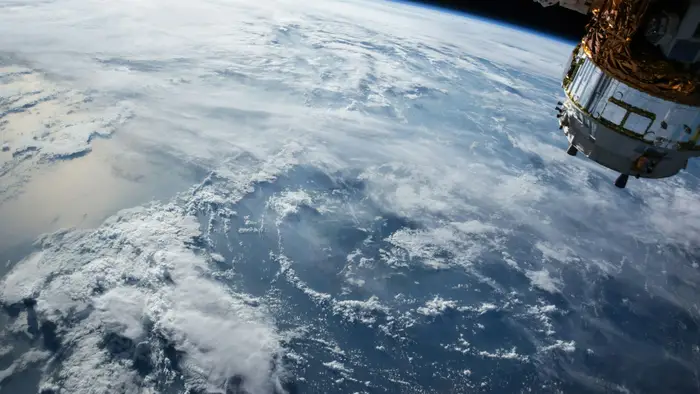
NEO Surveyor’s hardware must survive launch and years in deep space with no chance of repair. Image: Unsplash.
Why infrared, and why it changes the count
NEO Surveyor’s telescope is modest by the standards of great observatories. Its aperture is 20 inches (50 centimeters) wide. What makes it powerful is not light-gathering area but wavelength. The telescope carries a pair of infrared detector arrays, each producing a 16-megapixel mosaic of the sky, tuned to two infrared bands. Imaging the same patch of sky in both bands lets the science team determine an asteroid’s temperature, and temperature combined with brightness yields an estimate of size. Size is the key piece of information for assessing a near-Earth object, because a rock’s hazard depends on how big it is, not merely on how bright it appears.
Visible-light surveys have a blind spot that infrared fills. A large, dark asteroid reflects little sunlight and can look like a much smaller, brighter object in a visible-light telescope. Measuring heat breaks that ambiguity: a big dark rock and a small bright rock at the same distance radiate differently. Infrared also reveals objects that visible surveys struggle to see at all, including those lurking in the direction of the Sun, a region of sky where ground-based optical telescopes have a harder time searching because they cannot point near the Sun without being blinded.
That is precisely the population NEO Surveyor is built to find. Some of the hardest-to-find asteroids and comets spend time in the Sun’s direction as seen from Earth, and a space telescope stationed sunward of our planet can look outward and catch them against the dark sky. It is a geometry trick as much as a technology one: put the telescope between Earth and the Sun, keep it shaded, and look away from the glare.
The approach builds on the legacy of the NEOWISE mission, the repurposed infrared survey telescope that spent years cataloguing near-Earth objects before its retirement. NEO Surveyor’s data-processing plan adapts software developed for NEOWISE to distinguish moving objects from background stars and galaxies. The observing schedule is designed to gather enough repeated measurements to find objects again after a first detection, because a single sighting is not enough to compute an orbit. Caltech’s IPAC center will handle survey processing and archiving, distributing images and extracted sources through the NASA/IPAC Infrared Science Archive and working with the Minor Planet Center and NASA’s Planetary Data System to release detections and physical measurements.
The five-year task, and the twelve-year ambition
The mission’s formal requirements give NEO Surveyor a demanding baseline and an even more ambitious extended goal. Within its five-year baseline survey, the mission must find and characterize at least two-thirds of potentially hazardous asteroids larger than 140 meters. The extended goal, requiring 10 to 12 years of operations, is to push completeness past 90 percent for that same population.
The 140-meter threshold is not arbitrary. Objects of that size and larger are the ones that could cause regional devastation if they struck Earth, and they are also the ones that remain substantially uncatalogued. Smaller objects are far more numerous, but a 140-meter rock striking land could devastate a metropolitan area, and striking ocean could generate a dangerous tsunami. Congress set the goal of cataloguing 90 percent of near-Earth objects larger than 140 meters in 2005, and two decades later that census remains incomplete. NEO Surveyor is the mission designed to finish it.
The stakes are not abstract. In February 2013, a roughly 20-meter asteroid exploded over Chelyabinsk, Russia, injuring more than a thousand people, most of them from shattered glass. That object was far smaller than the ones NEO Surveyor is tasked with finding, and it arrived with no warning because it approached from the Sun’s direction. The Chelyabinsk event did not change the laws of physics, but it changed the politics of planetary defense, and it is frequently cited by mission planners as a reminder of what an unwatched sky can deliver.
Planetary defense has since grown from a niche concern into a program with demonstrated hardware. NASA’s DART mission in 2022 proved that a spacecraft can be deliberately crashed into an asteroid to change its orbit, striking the moonlet Dimorphos and measurably shortening its orbit around the asteroid Didymos. But deflection only works if the threatening object is found years in advance, and finding it is NEO Surveyor’s job. Detection and deflection are two halves of the same capability, and detection has always been the harder half.
Planetary defense begins with detection: an asteroid must be found years in advance for deflection to be possible. Image: Unsplash.
How NEO Surveyor fits the wider asteroid fleet
NEO Surveyor will not work alone. It joins a growing fleet of asteroid missions, each attacking the problem from a different angle. NASA’s Psyche spacecraft is cruising toward the metal-rich asteroid of the same name, a mission that will study a world thought to be the exposed core of a failed planet. Japan’s Hayabusa2 mission returned samples from the asteroid Ryugu and has since flown on to a second target, proving that material from these ancient bodies can be brought home for laboratory study. Infrared observatories such as the planned PRIMA far-infrared telescope will extend humanity’s view into wavelengths that reveal the cold universe. Together, these missions are turning asteroids from points of light into places with geology, composition, and history.
Read more about the asteroid missions already underway: NASA Psyche’s cruise to a metal world, Hayabusa2’s flyby of a second asteroid, and the PRIMA far-infrared telescope and the cold universe.
What sets NEO Surveyor apart from those missions is that it is a survey, not a visit. It will not rendezvous with one asteroid. It will scan the whole sky repeatedly, building a catalogue that every future mission, and every future deflection plan, will depend on. The spacecraft’s 16-megapixel infrared mosaics, taken in two bands, will become a public archive of the moving sky, a resource for astronomers studying not only asteroids but comets, variable stars, and anything else that changes against the background of fixed stars.
The mission also closes a gap left by the end of NEOWISE. When that telescope was retired, the world’s dedicated infrared asteroid survey capability went dark. Ground-based visible surveys such as Pan-STARRS, the Catalina Sky Survey, and the forthcoming Vera Rubin Observatory continue to find near-Earth objects, and they find them in large numbers. But they cannot fully replace an infrared eye in space, particularly for dark objects and for objects near the Sun. NEO Surveyor restores that capability and upgrades it, with a telescope designed from the start for the survey rather than adapted from another purpose.
The two infrared eyes and the rhythm of the survey
The telescope’s two infrared bands are the heart of the measurement. Each detector array builds a 16-megapixel mosaic of the sky, and because the same field is imaged in both bands, the team can compare how bright an object appears at two different infrared wavelengths. A warm, small object and a cool, large object can look similar in one band, but their colors across two bands diverge, and that divergence is what lets scientists separate temperature from size. It is the same principle a doctor uses when reading a thermal camera: heat tells you something that brightness alone cannot.
The survey itself will run on a strict rhythm. NEO Surveyor will sweep the sky in a pattern designed to revisit each field multiple times, because a single detection is only a candidate. It takes a sequence of positions, spread over days and weeks, to pin down an orbit well enough to say where an object will be years from now. The software that turns those detections into orbits is descended from the pipeline built for NEOWISE, which processed more than a decade of infrared sky images and learned, frame by frame, how to tell a moving asteroid from a cosmic-ray hit, a variable star, or a distant galaxy that only looks like it moved. That heritage matters: survey astronomy is as much about rejecting false alarms as it is about finding real objects, and a pipeline with flight heritage starts ahead.
The observatory’s post at the Sun-Earth Lagrange point 1, about 1.5 million kilometers sunward of Earth, is part of the same design logic. From L1, the telescope can look outward into the dark sky while the Sun stays behind the shade, and the thermal environment is far more stable than in low Earth orbit, where a spacecraft swings between sunlight and Earth’s shadow every ninety minutes. Stability is what infrared detectors need most. A telescope that warms and cools with every orbit produces shifting backgrounds that masquerade as signals. At L1, behind a 20-foot shade, the detectors can settle into the deep cold where asteroid heat stands out most clearly. The trade-off is distance: L1 is four times farther than the Moon, so the spacecraft must be more autonomous, its communications delayed by seconds, and its station-keeping precise enough to hold a halo orbit around a point that is itself moving with Earth around the Sun.
What happens next
With the sunshade’s solar array tested, the remaining work is integration: joining the tested sunshade to the rest of the observatory, completing the spacecraft, and putting the whole assembly through the environmental testing that simulates launch and space. NASA’s October update gives no date for the next integration milestone, and it remains unclear exactly when the sunshade will join the complete telescope. What is known is the launch window framing: Caltech’s IPAC center lists the mission’s launch as no later than June 2028, while recent mission reporting has pointed to a September 2027 target. Either way, the observatory is now past the stage where its largest component was an open question.
There are honest limits to what the October milestone proves. Ground tests do not prove that the system will survive launch, nor that passive cooling will perform exactly as modeled over years at L1. NASA’s update provides no measured in-orbit sensitivity or discovery rate, because those numbers can only exist once the telescope is flying. The 10-to-12-year extended survey goal also requires operations well beyond the five-year baseline, which means funding, staffing, and spacecraft health must all hold up long after the headlines fade. The history of space telescopes is full of instruments that exceeded their design lives, and full of ones that did not.
But the direction of travel is clear, and it is worth pausing on what has actually been accomplished. A 20-foot structure built in California, fitted with solar cells in New Mexico, shaken and frozen in a thermal vacuum chamber in El Segundo, and inspected in a clean room in Boulder has now passed the tests that qualify it to power and protect a telescope that will watch the sky for the rocks that could one day threaten Earth. The largest piece of the mission is ready for its day in the Sun, as NASA put it, precisely so that the telescope behind it never has to face the Sun at all.
NEO Surveyor will scan the sky repeatedly in infrared light, building a catalogue of near-Earth objects. Image: Unsplash.
Watching the sky that watches us
There is a particular irony at the heart of NEO Surveyor. The telescope will spend its life staring at the darkness, looking for faint warmth against the cold, so that humanity never again has to learn about a dangerous rock from a flash in the sky and a rain of broken glass. It is a patient mission, a counting mission, a mission whose success will be measured in catalogues and completeness percentages rather than in dramatic images. Its triumphs will mostly be invisible: an asteroid found, an orbit computed, a risk retired before it ever became a headline.
That is the nature of planetary defense. The best outcome is that nothing happens, and the mission’s success is measured by the disasters that never occur. The sunshade that passed its tests in October is a shield in the most literal sense, a wall between a sensitive instrument and a blazing star, and it is also a shield in a larger sense: the first piece of a system designed to make sure that Earth is never again surprised by its own neighborhood.
The sky will keep sending its rocks. Thanks to a 20-foot shade covered in 864 solar cells, humanity is getting better at seeing them coming.
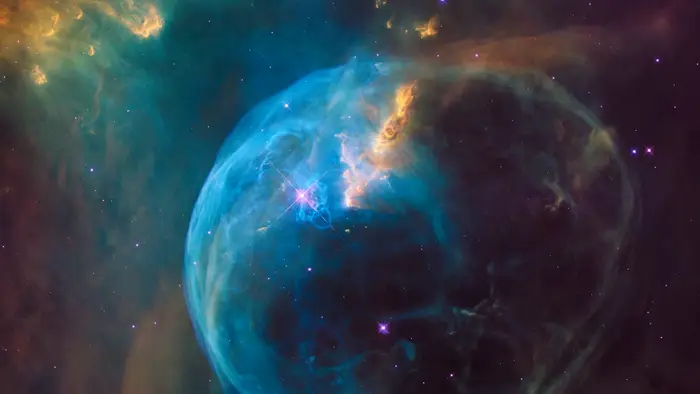
The night sky holds both wonder and risk; NEO Surveyor is built to tell the difference. Image: Unsplash.