Artemis I Crystal Detectors 2026: Tiny Crystals Reveal a Moon Radiation Surprise
The most revealing passengers on NASA’s first Artemis flight to the Moon were not alive, and they never said a word. They were two life-size human torsos, packed with sensors, strapped into the seats of an empty Orion capsule. For nearly a month in late 2022 they rode around the Moon and back, silently absorbing the radiation environment that future astronauts will have to live and work in. Now, almost four years later, a handful of tiny crystals carried inside those torsos has delivered one of the clearest pictures yet of what that environment actually does to a human body — and the picture contains a genuine surprise.
The surprise is not that radiation near the Moon is stronger than in low Earth orbit. It is. The surprise is how modest the increase appears to be, and how evenly it is spread. That finding, published in the journal Radiation Measurements on 1 September 2026, comes from experimental lithium fluoride crystal detectors developed at the Institute of Nuclear Physics of the Polish Academy of Sciences (IFJ PAN) in Cracow. It is a story about a measurement technique as much as it is about the Moon: crystals the size of a fingernail, read like photographic film under blue light, that can see particle tracks too faint for the detectors scientists have relied on until now.
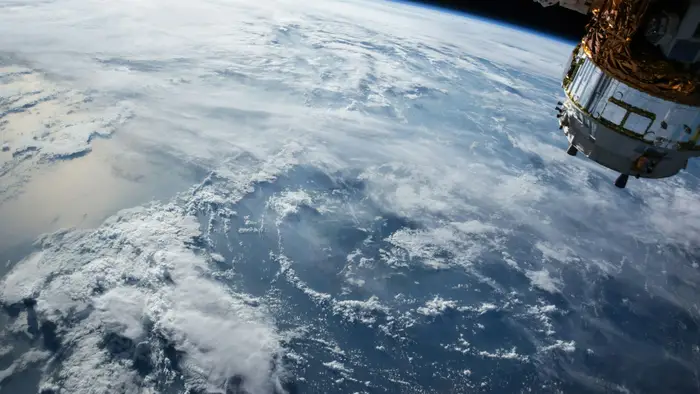
The Artemis I mission carried no crew, but it carried the most complete radiation record ever gathered beyond low Earth orbit. Image: Unsplash.
The dummies who flew to the Moon
The two phantoms at the heart of the experiment were called Helga and Zohar. They were built as torsos of an adult woman, made from materials that mimic the density of bone, organs and soft tissue, and they flew as part of the Matroshka AstroRad Radiation Experiment, known as MARE. MARE was a joint project of the German Aerospace Center (DLR), the Israeli company StemRad, NASA, Lockheed Martin and the Israeli Space Agency, and its purpose was straightforward: before sending people back to deep space, measure — inside something shaped like a person — exactly what the radiation there does.
That matters because the space beyond low Earth orbit is a fundamentally different radiation environment from the one astronauts experience aboard the International Space Station. In low Earth orbit, crews still sit inside Earth’s magnetic field, which traps charged particles and deflects much of what comes from deep space. On a lunar journey, that protection is gone. Astronauts face a constant drizzle of galactic cosmic rays — atomic nuclei accelerated to enormous energies by distant supernovae and other violent events — and the ever-present risk of a solar particle event, a sudden storm of protons hurled outward by the Sun that can raise particle counts by orders of magnitude in a matter of hours.
Artemis I, the uncrewed test flight of the Orion spacecraft, offered the first chance in half a century to measure that environment inside a crew-rated spacecraft travelling to the Moon and back. Aboard Orion, Helga and Zohar carried more than 10,000 tiny crystal detectors distributed through their simulated bodies. The new study focuses on a small but special subset: several dozen experimental fluorescent lithium fluoride detectors from IFJ PAN, together with nearly 600 crystalline detectors of another type, known as thermoluminescent detectors, supplied by the same Cracow team.
The context for why anyone should care about a crystal the size of a grain of rice is the programme those measurements are feeding. Six Months After Artemis II: Inside NASA’s Reworked Plan to Put Astronauts Back on the Moon describes how the crewed Artemis II flyby in April 2026 ended a 53-year gap in human travel beyond Earth orbit, and how NASA has since reshaped the missions that follow. Meet the Artemis III Crew: NASA Names the Astronauts Who Will Rehearse the Moon Landing introduced the four astronauts who will test Orion’s rendezvous and docking with commercial landers in 2027. And NASA’s Artemis Acceleration: the 2028 Moon Landing Plan After the Big October Update laid out the accelerated path toward a lunar touchdown in 2028. Every one of those crews will spend days or weeks in exactly the radiation field Helga and Zohar sampled — and on later surface missions, far longer.
How a crystal remembers radiation
The fluorescent detectors at the centre of the new paper work, in the words of co-author Professor Pawel Bilski of IFJ PAN, “like photographic film”. They are passive: they need no power, no electronics and no data link. They simply sit inside the phantom and wait. As particles of ionizing radiation pass through the lithium fluoride crystal, they knock electrons out of atoms and leave defects in the crystal lattice, the orderly arrangement of atoms that makes up the material. Those defects act as colour centres — tiny flaws that can trap energy and release it later as light.
Back in the laboratory, months or years after the flight, scientists shine blue light onto the crystal under a fluorescence microscope. The colour centres absorb the blue light and emit red fluorescence, and the pattern of that glow reveals the tracks left by individual particles, like footprints preserved in snow. Conventional plastic track detectors, the long-established alternative, require chemical etching before their tracks can be read at all. Lithium fluoride needs no such treatment, and a standard fluorescence microscope is enough to examine the tracks quickly.
The crystals themselves are the product of a decade of development at IFJ PAN. They were grown using the Czochralski method, in which a crystal is slowly pulled from molten material, and their dimensions are measured in millimetres rather than centimetres. That small size is a practical virtue: a detector that fits in a pocket of a phantom — or, one day, on a person’s clothing — can be placed exactly where a measurement is wanted, in large numbers, without disturbing the thing it is measuring. The detectors also resolve tracks more finely than chemically etched plastic, which means they can record higher radiation doses while individual particle tracks remain distinguishable, rather than blurring together into an unreadable mess.
Some of the fluorescent detectors flown on Artemis I were highly enriched in the isotope lithium-7. That detail matters because different isotopes respond differently to different particles, and the Cracow team’s design lets researchers separate one kind of signal from another. The thermoluminescent detectors, which release their stored energy as light when heated rather than when illuminated, provided an independent check on the same radiation field from a different physical mechanism.
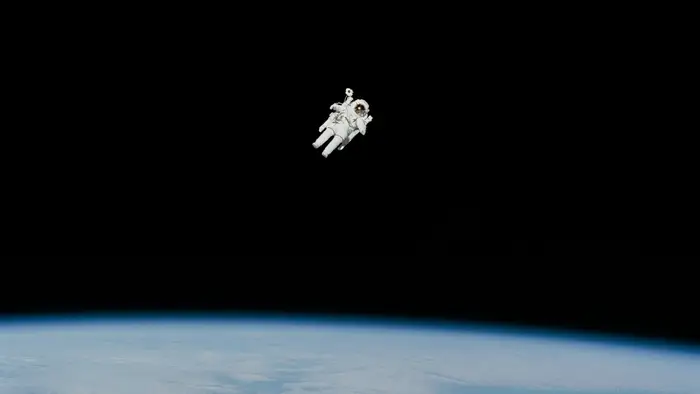
Beyond low Earth orbit, crews leave behind the protection of Earth’s magnetic field and face the full galactic radiation environment. Image: Unsplash.
The surprise: a smaller gap, spread evenly
The headline finding is a study in careful scientific understatement. “Low-energy protons, trapped by our planet’s magnetic field within the Van Allen belts, can account for the majority of the radiation dose received by astronauts in low Earth orbit,” Bilski said. “In the vicinity of the Moon, this substantial contribution disappears. Our measurements from the MARE experiment indicate that, although total radiation doses near the Moon are higher than those in Earth orbit due to the considerable levels of galactic radiation, the difference is not as large as one might intuitively expect.”
That sentence deserves unpacking, because it overturns a natural intuition. It is tempting to imagine radiation risk as a function of distance: the farther you go from Earth, the worse it gets, in a steep and steady climb. The Artemis I crystals suggest something subtler. In low Earth orbit, a large share of an astronaut’s dose comes not from deep space at all, but from low-energy protons trapped in the Van Allen belts — the doughnut-shaped zones of charged particles held around Earth by its magnetic field. Those protons are energetic enough to matter, but not so energetic that they pass straight through a body. They slow down inside tissue, depositing their energy at different depths, and that produces a markedly uneven dose distribution: some parts of a phantom receive much more than others.
Near the Moon, the Van Allen contribution vanishes. What remains is dominated by galactic cosmic rays, particles so energetic that they can pass through an entire human body, depositing only part of their energy along the way. The result, recorded inside Helga and Zohar, was a dose distribution that was essentially uniform. Every part of the phantom received roughly the same exposure. The total was higher than in low Earth orbit — nobody in the research team suggests otherwise — but the gap was smaller than a simple distance-based intuition would predict, because the low-orbit dose was already carrying a large trapped-proton component that the lunar dose does not.
The contrast with the earlier MATROSHKA experiment aboard the International Space Station, conducted more than a decade before Artemis I, makes the point concrete. In that experiment, low-energy Van Allen protons contributed a significant part of the phantom dose and lost their energy at different depths, producing the uneven distribution described above. On Artemis I, the galactic-dominated field smoothed that pattern out. Radiation exposure, the researchers stress, depends on particle energy, origin and interaction with human tissue — not simply on how far from Earth you are.
Reading a mess that no laboratory would tolerate
Getting a clean number out of the crystals was far from straightforward, and the paper is unusually candid about why. In a typical physics experiment, a detector is exposed to particles of a single type, with well-defined energies and a precisely known direction of arrival. Cosmic radiation offers none of those conveniences. It contains essentially every naturally occurring type of particle and atomic nucleus, spanning a very broad range of energies, arriving from every direction at once.
That messiness shows up directly under the microscope. The instrument brings a segment only about one micrometre across into sharp focus at a time, while its camera also captures a blurred glow from the out-of-focus portions of each track. That extra light contaminates the fluorescence intensity, which is the primary measurement used to assess ionization density — how densely a particle knocks electrons out of atoms along its path. Track shape complicates things further. Highly ionizing particles leave continuous, clearly defined lines. Weakly ionizing particles can leave a series of separate dots, which changes the measured intensity in ways that have to be modelled, not merely observed.
The Cracow team answered with a series of corrections and purpose-built software designed to strip away the interfering background. The validation, when it came, was striking. After the corrections, their results differed by no more than 15 percent from those obtained using conventional track detectors across the entire overlapping range of energy deposition values. And the new detectors went further: they recorded numerous particle tracks corresponding to energy deposits below the detection threshold of the detectors used to date. In other words, the fluorescent crystals did not merely match the old technology — they extended the measurable range toward weaker, harder-to-detect events that previous instruments simply could not see.
That matters beyond academic pride. Low-energy events are not a curiosity at the edge of the data. In a mixed radiation field, the particles that deposit small amounts of energy can be numerous, and understanding the full spectrum — not just the dramatic, high-energy tracks — is what turns a rough dose estimate into a trustworthy risk assessment. A detector that sees fainter tracks sees more of the truth.
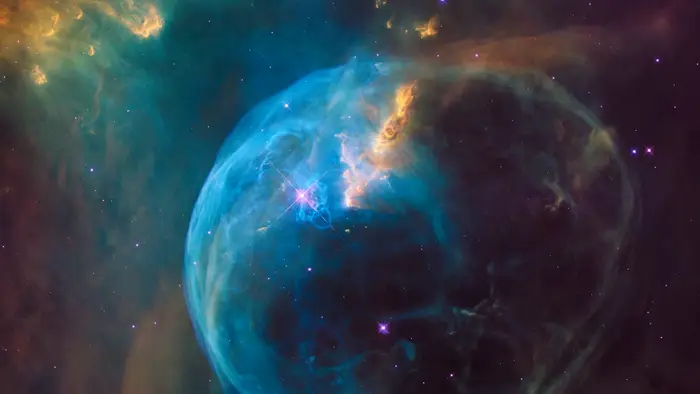
Galactic cosmic rays arrive from every direction and can pass through an entire body, which is why the lunar dose inside the phantoms was so uniform. Image: Unsplash.
What the crystals do not prove
Good radiation science is as much about stating limits as about announcing findings, and the researchers behind this study are careful on both counts. First, these are preliminary estimates. The paper presents a method for reading the fluorescent detectors and the first results obtained with it, not a final, complete accounting of lunar radiation risk. Absorbed dose alone does not establish biological harm: the same dose delivered by different particle types, over different timescales, carries different risks, and the long-term biological effects of the galactic-dominated field remain an active area of research.
Second, Artemis I flew through no major solar particle event. That is a crucial caveat for everything derived from its data, including the separate August 2026 analysis of the AstroRad vest worn by Zohar. That study, published in Science Advances and based on the same MARE flight data, simulated how the 26-kilogram vest would have performed had the mission encountered a storm on the scale of August 1972 or 1989. It concluded the vest could cut an astronaut’s dose by about 60 percent in a 1972-type storm and nearly 40 percent in a 1989-type event — equivalent, the authors calculated, to roughly 193 and 131 days respectively of avoided deep-space exposure. Those are scenario-based estimates layered on top of genuine flight data, not a live test against a real storm, and they should be read that way. No phantom, and no astronaut, has yet been measured through a major solar storm in deep space.
Third, the inside of a spacecraft is not one uniform environment, and the earliest MARE results made that point dramatically. Initial findings published in Nature by the DLR-led team showed that during the flight through Earth’s inner Van Allen belt, dose rates between the most and least protected areas inside the Orion capsule differed by a factor of four. In the most heavily shielded area of the capsule — the so-called storm shelter, where a crew would retreat during a solar event — the total dose from a large solar particle event could be limited to a maximum of 150 millisieverts, a level at which no signs of acute radiation sickness are expected. Spacecraft design, in other words, is itself a radiation instrument: where you sit, and where you shelter, changes your dose as much as where you fly.
Why a passive crystal may be the future of crew dosimetry
Set against those caveats, the promise of the lithium fluoride technique is practical and immediate. Active radiation monitors — instruments that count particles in real time and radio their data home — are essential aboard a spacecraft, but they are bulky, power-hungry and expensive, and there is a limit to how many can be flown. Passive crystals are the opposite: tiny, cheap, rugged and silent. They can be distributed by the thousands through a phantom, as on Artemis I, or worn by individual crew members as personal dosimeters, each one recording the dose at exactly the place it sat.
The neutron capability adds a further dimension. Lithium fluoride detectors enriched in lithium-6 can record neutron doses, because neutrons react with lithium nuclei inside the material and produce secondary charged particles locally, which then leave their own detectable tracks. Neutrons are a significant secondary component of the space radiation field — they are created when cosmic rays strike spacecraft shielding and human tissue itself — and a dosimeter that can see them, in the same small package that sees charged particles, gives mission planners a more complete picture from a single device.
There is also a subtler advantage, visible in the Artemis I results themselves. Because the fluorescent crystals resolve tracks so finely, they remain useful at high doses where conventional etched detectors would saturate into unreadability. On a long lunar surface stay, or on a Mars transit lasting months, cumulative doses will climb into exactly that regime. A detector that keeps distinguishing individual tracks as the dose grows is a detector that keeps telling the truth when it matters most.
None of this makes lunar radiation safe. It makes it measurable, and measurability is the precondition for every other kind of safety: for choosing shielding, for designing storm shelters, for deciding how long a crew can stay, and for knowing — rather than guessing — when a solar storm demands that a crew stop work and take cover. The Artemis programme’s great engineering achievements, the rockets and capsules and landers, tend to dominate the headlines. But the difference between a programme that flies people to the Moon and a programme that keeps them healthy while they are there may come down to something far smaller and quieter: a crystal, a few millimetres across, that remembers every particle that passed through it, and glows red under blue light when someone finally asks it what it saw.
Future Artemis crews will spend weeks in the radiation field Helga and Zohar sampled, and surface crews far longer — which is why a trustworthy personal dosimeter matters. Image: Unsplash.
The road from a phantom to a person
The path from this paper to a crew member’s pocket is not long, and that is part of the point. IFJ PAN developed its fluorescent lithium fluoride detectors a decade ago and has improved them continuously since. They have now survived a lunar voyage, a return through Earth’s atmosphere, and years of laboratory readout, and they have been validated against the established technology they are meant to complement. The next steps are the unglamorous work of any measurement science: more flights, more comparisons, more calibration against the messy reality of cosmic radiation, and integration into the personal dosimetry that crews will actually wear.
There is also unfinished science in the data already gathered. The MARE dataset is, in the words of the DLR team that led the experiment, still being analysed years after splashdown. Each new analysis technique — like the fluorescent readout described here — reopens the same flight and extracts a little more from it. The crystals, in a sense, are still flying: every time a researcher puts one under a microscope, a particle track recorded in the winter of 2022 speaks again.
For the public, the lesson is less technical and more human. When astronauts return to the Moon, they will not be stepping into a void that science has already mapped in perfect detail. They will be stepping into an environment whose risks are being quantified, piece by piece, by instruments that flew before them — by dummies that took the dose so that people would not have to guess at it. The tiny crystals inside Helga and Zohar did not make the Moon safe. They made the danger visible, measurable and a little less mysterious. That is how exploration has always advanced: not by eliminating risk, but by learning to read it, track by track, until it can be managed. And sometimes the instrument that teaches us the most is the smallest thing on the spacecraft.
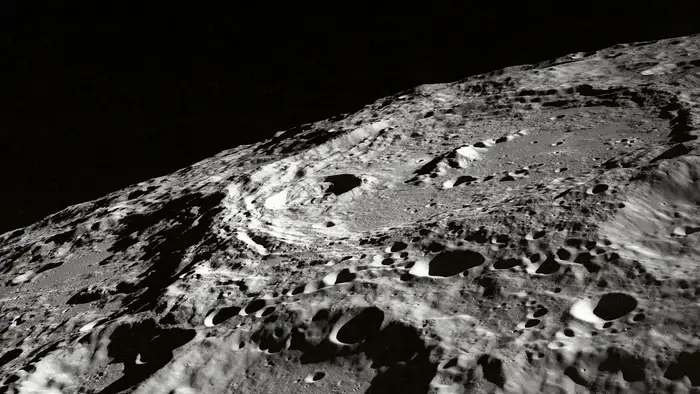
The Moon itself is only part of the challenge: the radiation environment on the way there, and during a stay on the surface, must be measured just as carefully as the destination. Image: Unsplash.