NASA's Artemis Acceleration: the 2028 Moon Landing Plan After the Big October Update
The plan comes into focus
Fifty-four years after the last footprints were pressed into the lunar dust, NASA has put its clearest plan yet for going back on the table. At a press briefing at the Kennedy Space Center in Florida on Friday, October 23, 2026, NASA Administrator Jared Isaacman, Associate Administrator Amit Kshatriya, and Artemis Program Manager Jeremy Parsons walked through the agency’s “Artemis Acceleration” strategy — a restructured campaign that aims to send four astronauts through an orbital dress rehearsal next year and land American boots near the Moon’s south pole in 2028.
The centerpiece of the new timeline is a reshuffled flight manifest. Artemis III, once conceived as a lunar flyby, has been recast as a roughly 14-day mission in low Earth orbit targeted for no earlier than summer 2027. Artemis IV is now the designated landing mission, scheduled for 2028, with NASA keeping two parallel paths open so that either SpaceX’s Starship or Blue Origin’s Blue Moon can take the crew down to the surface. The agency will wait as long as possible before choosing between them.
“Likely the most complicated launch campaign ever undertaken” — that was Parsons’ description of Artemis III, and the number behind the phrase is striking: three major rockets, two commercial lunar lander test articles, and one crew capsule, all stitched together in orbit over two weeks. By putting the hardest parts of the choreography in Earth orbit first — where rescue is possible and abort options exist — NASA is betting that 2027 will buy down the risk of 2028.
The briefing covered far more than the flight manifest. Officials detailed progress on assembling the Space Launch System rocket for Artemis III, described a stubby test configuration built to hunt down the hydrogen leaks that have plagued the program, revealed a slimmed-down “sortie” version of the lunar spacesuit to protect the 2028 schedule, and showed the first public images of crew cabin hardware from both lander contractors. It also made explicit the strategic pressure driving the pace: a new space race with China that, in Isaacman’s words, will be “much closer than it ever needed to be.”

The Moon remains the destination, but NASA’s revised plan runs its hardest rehearsals in Earth orbit first. Image: Unsplash.
Artemis III: the most complicated campaign ever
The four astronauts flying Artemis III were announced earlier this year: Commander Randy Bresnik of NASA, Pilot Luca Parmitano of the European Space Agency — the first European named to an Artemis crew — and Mission Specialists Andre Douglas and Frank Rubio, also of NASA, with Bob Hines as backup. The crew has already logged hundreds of hours of training. On the revised flight, they will not go to the Moon at all. Instead, they will spend about two weeks in low Earth orbit practicing the rendezvous and docking operations that the landing mission will depend on.
The mission script laid out at the briefing is intricate. Blue Origin opens the launch campaign by sending its Blue Moon test lander into orbit, where the company will check its condition and prepare for rendezvous. The SLS then launches Orion with the crew. After docking is set up, the astronauts spend two days checking out Orion’s systems and preparing for close-range maneuvers, then move the capsule into a 237-nautical-mile rendezvous orbit. On roughly the third day of the mission, Orion docks with the Blue Moon test lander — one of the flight’s central tests.
Over the following two days, the crew will actually go inside Blue Moon and work through operational procedures with mission control, getting hands-on experience with hardware resembling what future lunar missions will carry. Blue Moon Mk2 can loiter up to 14 days in low Earth orbit, giving the team margin if schedules slip; the mission itself could stretch from 14 days to as many as 17 if weather or other launch delays intervene.
Then comes act two. After undocking from Blue Moon, Orion will head for its next planned meeting: a rendezvous on about day eight with SpaceX’s Starship, launched from Florida. Unlike the Blue Moon exercise, the Starship test is brief — about two hours — and the astronauts will remain inside Orion rather than entering the vehicle. The final days of the mission are reserved for additional tests and the trip home.
The differences between the two exercises reflect real engineering differences. Blue Moon Mk2’s crew cabin is designed so astronauts can enter and assess systems similar to those intended for lunar missions. Starship HLS, a vastly larger vehicle, presents different crew-transfer considerations, and NASA noted that the approach draws on experience from prior Dragon operations. The briefing showed the first public images of crew cabin hardware from both providers: a photograph of Blue Origin’s lander test-article crew cabin and SpaceX’s “Cabin 1,” a full-scale, flight-like crew compartment mockup built inside the company’s Starfactory.
Parsons emphasized the relentless pace behind the scenes. “Every time we run into a supplier issue, a priority issue across the industry,” he said, “Administrator Isaacman [and Associate Administrator] Amit [Kshatriya] are immediately on the phone. They’re immediately putting pressure. We’re immediately going out and helping to make things happen.” The next major milestone is expected in early 2027, when SpaceX aims to demonstrate the transfer of fuel between spacecraft in orbit — the capability its lunar lander will need to reach the Moon.
According to Isaacman, Artemis III is currently running about 90 days behind its planned schedule on paper, though he stressed that the slip reflects the scale of the undertaking rather than any lack of effort. The schedule pressure is real, but so is the rationale: there will be multiple Starship launches and multiple New Glenn launches from the rebuilt pad before Artemis III flies, and Parsons said that accumulated flight experience “is going to give us a lot of confidence” heading into 2028.
Two roads to the surface
The most consequential announcement of the briefing was how NASA will handle the first landing itself. For Artemis IV, the agency has laid out two entirely different architectures — and it intends to keep both alive for as long as possible.
Under the SpaceX option, a depot Starship would launch to low Earth orbit and be refueled by multiple tanker flights. The lunar lander Starship would then launch, dock with the depot to refuel, and climb to a higher staging orbit. The depot would itself be refueled again before raising to the same high orbit, where the lander Starship would dock once more for a final refueling before climbing toward the Moon. Orion would launch into Earth orbit and dock with the lander Starship; the combined stack would then perform the trans-lunar injection burn and circularize into low lunar orbit, after which crew transfer and the descent would follow. NASA is evaluating modifications to Orion to preserve propellant for the return burn under this approach.
The Blue Origin option works differently. Three transfer stages derived from the Blue Moon Mk1 design would first assemble in low Earth orbit. The Blue Moon Mk2 crew lander would launch on a New Glenn 9×4 vehicle and dock with the transfer stages, then depart for the Moon and insert into an elliptical polar lunar orbit. Two of the transfer stages would separate en route, leaving one attached. Orion would then launch directly to the Moon and dock with the stack in polar orbit. Two astronauts would transfer into Blue Moon, Orion would undock, the remaining transfer stage would lower the lander to low lunar orbit, and Blue Moon would perform the final descent. The convoluted sequence is required because Orion’s service module lacks the performance to reach low lunar orbit on its own.
NASA said the two-provider strategy is deliberate insurance. The dual paths provide an alternative route to a south-polar landing in 2028 if either company hits supply chain problems, significant technical trouble, or other issues that could trigger major delays. Parsons noted that both companies are planning for lunar landing missions in 2028 regardless of which one flies the first crew down, and the agency will wait as long as possible before deciding which provider ultimately carries the first American astronauts back to the surface.
Neither contractor has had an easy year, and the briefing did not hide that. Blue Origin’s New Glenn has not flown since it exploded on the launch pad in May. Starship completed its first uncrewed orbital flight only in September. Isaacman said Blue Origin has been open about targeting the end of the year for New Glenn’s return to flight and praised the team’s pace: “I think they’ve been very open about targeting the end of the year… they are moving with purpose. So, whether they hit December or they wind up in January, they’re breaking everyone’s records.”
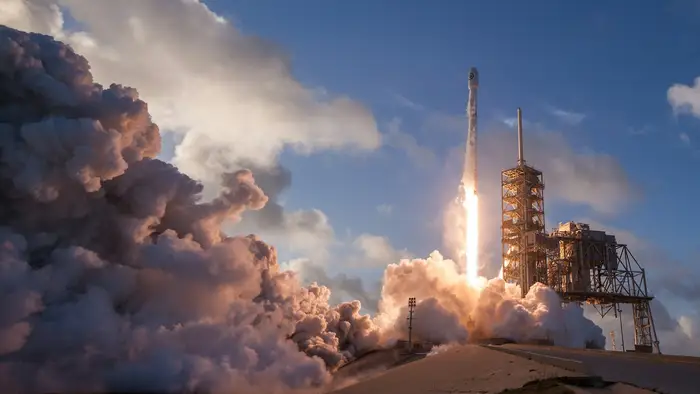
NASA’s Space Launch System remains the crew launch vehicle for the Artemis program. Image: Unsplash.
The stubby SLS and the hydrogen hunt
Three major elements remain essential for the first crewed Artemis landing: the launch vehicle, the lunar lander, and the spacesuit. On the launch vehicle front, the briefing offered unusually granular hardware detail.
Inside the Vehicle Assembly Building, NASA teams have completed the initial phase of stacking the twin solid rocket boosters for Artemis III. The agency confirmed that the Core Stage — the element that gives the vehicle its distinctive orange appearance — is scheduled to be integrated between the boosters next week. Officials even displayed a live feed from the VAB during the briefing showing the work in progress.
Unlike the full stacks prepared for Artemis I and II, this vehicle will not receive an upper stage or the Orion spacecraft. The resulting “stubby” configuration will roll out to Launch Complex 39B for tanking tests — and the reason is one of the program’s longest-running headaches. The tests are intended to address hydrogen leakage issues experienced at the Tail Service Mast Umbilical interfaces during preparations for the first two missions. Those interfaces have undergone redesign work since April, and the tanking test, once expected around the present timeframe, is now planned for several months from now.
The upper stage story is its own saga. Because Artemis III uses a low-Earth-orbit profile, no upper stage is required at all: a cylindrical spacer will position Orion so that it still mates with existing ground support equipment. Artemis IV, however, will need one. Three Interim Cryogenic Propulsion Stages were manufactured for the original Block 1 configuration; two have already flown, and the third was reassigned to Artemis IV after the low-Earth-orbit mission was added to the manifest.
The longer-term picture is where the restructuring bites. The Exploration Upper Stage that would have created the Block 1B configuration was canceled earlier this year amid cost and schedule overruns, and the ICPS itself is derived from the Delta Cryogenic Second Stage, whose production line has been closed. NASA has therefore selected United Launch Alliance’s Centaur V as the standardized upper stage going forward. Multiple Centaur V variants exist, including the original high-energy configuration and a low-Earth-orbit-optimized version developed in connection with Amazon’s Leo constellation, and the briefing formally confirmed a stretched-tank variant previously indicated only in job postings. NASA will transition to the stretched Centaur while leaving the exact timing open: Artemis IV could fly either the final ICPS or a stretched Centaur V, with the decision point set for next summer near the Artemis III launch window. Choosing Centaur V would require modifications to the Mobile Launcher for ground support connections.
The briefing also touched on how Orion will meet the landers at the Moon. After the Lunar Gateway was paused earlier this year, the original near-rectilinear-halo-orbit rendezvous was set aside in favor of low lunar orbit — considered safer, but requiring additional propellant. Orion’s European Service Module provides limited performance for a lunar round trip, which is one factor driving the upper-stage upgrade.
A lighter suit to protect the timeline
The spacesuit remains the critical path item for any surface mission, and the briefing’s candor here was striking. In 2022, NASA awarded firm-fixed-price service contracts to Axiom Space and Collins Aerospace covering both lunar and International Space Station suits, aiming to introduce competition and redundancy. Axiom later presented its Axiom Extravehicular Mobility Unit, but the 2024 Preliminary Design Review determined the suit already exceeded its mass allocation. Collins Aerospace withdrew from the contract in 2024, leaving Axiom responsible for both the lunar and zero-g suits. Suit testing originally targeted for 2025 was deferred to 2027. NASA’s Office of Inspector General subsequently described the earlier timeline as “overly optimistic,” noting that if delays matched historical averages, the suits might not be ready until 2031 — too late for a 2028 landing goal.
NASA’s answer is the “Sortie suit”: a lighter, simpler derivative of the AxEMU, slimmed down in part by reducing mass and simplifying interfaces with the landers. The sortie suit will be certified for shorter surface durations — a minimum of two hours at a time. It will not be rated for the permanently shadowed regions near the lunar south pole, and it will not support the longer, multi-EVA campaigns planned for the full AxEMU. For reference, Apollo 11’s single EVA lasted approximately two and a half hours, while Apollo 17 conducted three excursions totaling more than seven hours. The full-capability AxEMU remains in development for later missions.
The tradeoff is a familiar one in spaceflight: scope the first mission to what can be built and certified in time, then grow capability afterward. A two-hour sortie is enough to put American boots on the surface, plant a flag, and gather initial science. It is not enough to build a base. But given the alternative — waiting for a full-specification suit while the calendar burns — NASA has chosen to walk first.

Artemis III will send Orion to practice docking with two commercial lunar landers in low Earth orbit before anyone goes to the surface. Image: Unsplash.
The new space race
Looming over every technical decision was the strategic one. Earlier this year, Isaacman suggested that China may send a crewed mission around the Moon in 2027, and noted that NASA may have avoided a close call after China’s uncrewed Chang’e-6 lander fell behind schedule this year — the lander was originally planned to head to the Moon’s south pole, the region near resources both countries want.
“Here we are today, very much in a new space race, and despite decades of accumulated knowledge and extraordinary advancements in technology, this race will be much closer than it ever needed to be,” Isaacman said at the briefing. He added that NASA will not launch until it is ready, but the agency will also not “sit idly by and watch one of the most consequential moments of this new century pass [to] our overseas competitors.”
That framing explains the acceleration philosophy: streamlined lander designs, simplified requirements for commercial providers, and a competitive approach that keeps both SpaceX and Blue Origin racing toward 2028. “What we are undertaking is ambitious. It’s extraordinarily difficult, and years of decisions both within and beyond the walls of this agency have cost us time and resources that we never had to spare,” Isaacman said. “But we are reinvigorating, and the extraordinary vehicles our industry partners are building, are worth every bit of that effort.”
The briefing also offered a glimpse of what comes after the landing. Asked about meteor strike risks for Moon base plans, Isaacman referenced a newly identified asteroid strike and said, “Fortunately, that’s a once-in-a-century type of an event, so we’re fortunate in that regard.” But he acknowledged that much smaller meteor strikes will hit the lunar surface with greater frequency, and said observations from the Artemis II crew provided additional data: “So, we are giving a lot of thought to that for the Moon base.” A fleet of lunar rovers would be deployed to scout and chart the surface before permanent infrastructure is designed. “We’re going to learn and we’re going to gradually scale up capabilities because I guarantee you we’re going to need surface improvement,” he said. “It’s why we’re not locking in the design for habitation modules today. We’re doing our science of survival, lots of uncrewed robotic landers, lots of demos, see what we like to build up to it.”
That is perhaps the most revealing line of the briefing. For all the schedule discipline of the Artemis Acceleration plan — the 90-day-behind-on-paper transparency, the dual lander hedge, the lighter suit — NASA is explicitly refusing to over-design the future. The habitat modules will wait until the rovers and robotic landers have taught the agency what the lunar environment actually demands. It is the same philosophy applied at every level of the October update: prove it in orbit before you bet a crew on it, prove it at the surface before you build a city on it.
What to watch
The next twelve months will test whether the acceleration is real. Key markers are already on the calendar: the Core Stage stacking next week in the VAB, the stubby SLS rolling to 39B for tanking tests within the next few months, SpaceX’s orbital fuel-transfer demonstration in early 2027, New Glenn’s targeted return to flight by the end of this year or January, and the Artemis III launch window next summer — the deadline that anchors the upper-stage decision, the lander downselect, and the entire 2028 landing bid.
Artemis III’s mission designers face genuine unknowns: no crew has ever docked an Orion to two different commercial landers in a single two-week flight, and the campaign’s choreography — three rockets, dozens of launch windows that must line up, hundreds of docking procedures — leaves little slack. But that is precisely the point of the October 23 briefing. The old plan put astronauts on a new lander around a new Moon with limited rehearsal. The new plan rehearses the hard parts where rescue is still possible.

Two landers, one deadline: SpaceX’s Starship and Blue Origin’s Blue Moon are both targeted at a 2028 lunar landing. Image: Unsplash.
If the acceleration holds, 2028 could witness something no living person has seen: human footprints forming in fresh lunar dust. Isaacman himself warned that the undertaking is extraordinarily difficult, and the recent history — pad explosions, slipped suits, hydrogen leaks — gives no one room for complacency. But for the first time since Artemis began, there is a plan that rehearses the landing before attempting it, hedges the lander bet, and names the price of failure openly. After half a century of waiting, the Moon is starting to feel close again.

The road to 2028 runs through 2027’s orbital dress rehearsal — and through a competition NASA intends to win. Image: Unsplash.