USSF-627 Falcon 9 Launch November 12 2026: Classified Space Force Mission Slips a Second Time
The rocket is ready. The booster is ready. The pad is ready. The only thing that keeps moving is the date. SpaceX has slipped the classified USSF-627 mission for the United States Space Force a second time, and the Falcon 9 now standing at Vandenberg Space Force Base in California is targeted to lift off on Wednesday evening, November 11, local time — Thursday morning, November 12, for readers in Jakarta. The four-hour window opens at 6:35 p.m. Pacific Time, which is 02:35 UTC and 09:35 WIB on Thursday, November 12.
It is the third target date for a mission that was supposed to fly on November 8. The first preview of this flight, published by SpaceNews on November 9, described a launch window opening at 10:03 WIB on Tuesday, November 10. That attempt did not fly. On November 10, SpaceX moved the target to Wednesday, November 11, with a window opening at 09:49 WIB. That attempt did not fly either — or rather, it never got the chance, because SpaceX has now moved the target again, by almost exactly 24 hours, to Thursday morning WIB. No reason has been given for either delay, in any public statement from SpaceX or the Space Force. That silence is normal for a classified mission, but it leaves the public record with a simple, stubborn fact: a rocket that has been ready for days is still on the ground, and the countdown now points at a new day.
The delay matters beyond the inconvenience. USSF-627 is the middle flight of a remarkable run of military launches from Vandenberg. Its predecessor, USSF-432, flew successfully on November 7. Its successor, USSF-317, is already windowed for Friday, November 13. Between them sits a classified payload that the Space Force wants in orbit and a launch schedule that has now slipped twice in three days. Every day USSF-627 waits, the margin around the rest of the week’s manifest gets thinner — and Friday is already one of the busiest days of the year, with a United Launch Alliance Vulcan rocket and SpaceX’s Starship both targeted to fly.
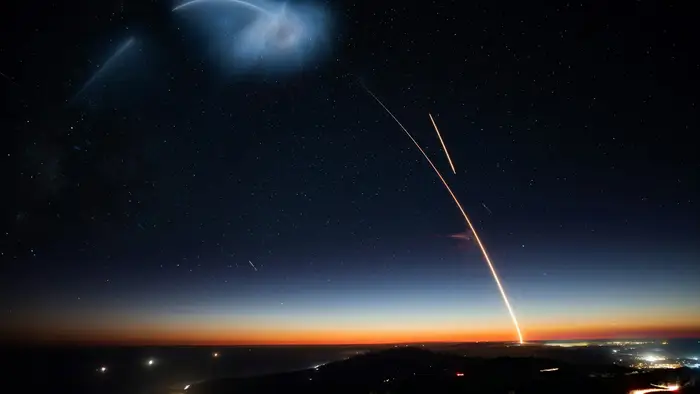
A second slip in three days
Launch delays are the most ordinary thing in spaceflight, and the most easily misread. A slip of a day is usually weather, a technical check, or a range conflict — one of the hundred small things that must all be right before nine engines light. What makes the USSF-627 slips worth noting is not that they happened, but how little is known about why. For a commercial Starlink launch, SpaceX will often say the word: weather, a valve, a boat in the hazard zone. For a classified national-security mission, the company says nothing at all, and the launch schedule simply changes.
The public record of the mission’s movements is therefore a record of dates, not causes. Maritime hazard warnings for the flight were issued on November 2, covering a window from November 9 to November 15 — a seven-day span that already suggested the launch team expected to need room to manoeuvre. The original target was November 8. It slipped one day, to the evening of Monday, November 9, Pacific Time. That attempt became the subject of SpaceNews’ first preview, USSF-627 Falcon 9 Launch November 10 2026: Classified Space Force Mission Rides a Seventh-Flight Booster, which described a four-hour window opening at 10:03 WIB on Tuesday, November 10. Then, on November 10, the target moved again, to a window opening at 09:49 WIB on Wednesday, November 11. Now SpaceX’s mission page lists Wednesday, November 11, at 6:35 p.m. Pacific Time — 09:35 WIB on Thursday, November 12 — with a backup opportunity on Thursday, November 12, at 6:21 p.m. Pacific Time, or 09:21 WIB on Friday, November 13.
Readers should note the shape of that backup. If the Thursday morning WIB attempt does not fly, the next chance falls on Friday morning WIB — the same day USSF-317 is windowed to launch from the same pad, in a window running from 11:23 to 15:23 WIB. Two classified Falcon 9 missions from the same launch complex on the same day is not impossible — Vandenberg has turned rockets around quickly before — but it would be a demanding day for the pad crews, the range, and the recovery fleet. The backup exists because the schedule demands it. Whether it would actually be used is another question.
It is also worth saying plainly what a delay is not. A one-day slip is not a sign of trouble with the rocket. Falcon 9 boosters are routinely held for weather or range availability, and a classified payload adds a layer of caution: the Space Force does not gamble a top-secret mission on a marginal forecast. The booster assigned to this flight, B1103, has already flown six times without incident. Nothing in the public record suggests the hardware is the problem. The most likely explanations are the most boring ones — weather on the California coast in November, or a range scheduling conflict — and the least likely is the one that makes the best headline.
The new target: Thursday morning in Jakarta
For readers following the mission from Indonesia, the arithmetic is simple but easy to get wrong, because the launch keeps crossing the international date line in the retelling. The window opens at 6:35 p.m. Pacific Time on Wednesday, November 11. California is eight hours behind Coordinated Universal Time in November, so that is 02:35 UTC on Thursday, November 12. Western Indonesian Time is seven hours ahead of UTC, so the window opens at 09:35 WIB on Thursday, November 12, and runs for four hours, until 13:35 WIB. The backup opportunity opens at 6:21 p.m. Pacific Time on Thursday, November 12 — 02:21 UTC and 09:21 WIB on Friday, November 13.
The launch site is Space Launch Complex 4E at Vandenberg Space Force Base, the Falcon 9’s West Coast home, on a stretch of California coastline where the rocket climbs south over the Pacific. The vehicle is a Falcon 9 Block 5, the workhorse variant that has now flown more than 700 times overall. The mission is a classified one for the United States Space Force, flown under the National Security Space Launch programme, and the payload — officially unnamed and undescribed — is believed by independent trackers to be a batch of classified satellites built on SpaceX’s Starshield bus, a judgement based on the rocket’s stage drop zones matching those of previous Starlink Group 15 launches almost exactly.
Mission at a glance
| Item | Detail |
|---|---|
| Mission | USSF-627, classified mission for the United States Space Force |
| Rocket | Falcon 9 Block 5 |
| Booster | B1103, seventh flight |
| Launch site | Space Launch Complex 4E, Vandenberg Space Force Base, California |
| Target liftoff | Wednesday, November 11, 6:35 p.m. PT / Thursday, November 12, 02:35 UTC / 09:35 WIB |
| Launch window | Four hours, until 10:35 p.m. PT / 06:35 UTC / 13:35 WIB |
| Backup opportunity | Thursday, November 12, 6:21 p.m. PT / Friday, November 13, 02:21 UTC / 09:21 WIB |
| Target orbit | Low Earth orbit |
| Booster landing | Of Course I Still Love You droneship, about 574 km downrange in the Pacific |
| Booster landing time | About 8 minutes 22 seconds after liftoff |
| Payload | Classified; believed to be a batch of Starshield-derived satellites |
The table above is the whole mission as the public is allowed to know it: a time, a place, a booster, a landing plan, and a blank where the payload should be. Everything else is inference, and the inference has been consistent since the mission first appeared on the manifest. The drop zones — the patches of ocean where the rocket’s stages are allowed to fall — are an exact fit with the Starlink Group 15 launches that fly from the same pad into a 70-degree-inclination shell. A classified payload flying the same profile as a Starlink batch, from the same pad, with the same drop zones, is most plausibly a batch of satellites built on the same bus. Neither SpaceX nor the Space Force has confirmed a payload count or a Starshield identity, and neither is likely to.

What has not changed: the booster, the droneship, the secrecy
Delays change dates. They do not change hardware, and the hardware assigned to USSF-627 is worth a closer look, because it tells a story about how military spaceflight has changed. The first stage booster, B1103, is making its seventh flight. SpaceX’s mission page lists its previous missions: NROL-179, a classified launch for the National Reconnaissance Office; SDA-T1TL-E and SDA-T1TL-A, two tranches of the Space Development Agency’s Transport Layer missile-warning constellation; and three Starlink missions. Its last flight was on October 10, 2026, and it has landed successfully six times out of six.
A decade ago, that résumé would have disqualified the booster from a classified mission. The assumption then was that a top-secret payload deserved a brand-new rocket, and that reuse was a risk to be managed rather than a capability to be bought. The Space Force’s own record has settled the argument the other way. B1103 has already carried intelligence and missile-warning payloads, and nobody involved seems to think a seventh flight carrying a top-secret mission is remarkable. The reliability record of the Falcon 9 has made reuse the baseline: the Space Force buys launches on price, schedule and proven performance, and a flown booster that has landed six times is, by that measure, a known quantity.
The economics reinforce the point. Launch schedule data puts the cost of this mission at about 52 million dollars — a figure covering the rocket, the range and the recovery, and a fraction of what a single expendable national-security launch cost a generation ago. That price is what makes proliferation affordable. When a launch costs tens of millions rather than hundreds, a constellation of hundreds of satellites stops being a fantasy and becomes a procurement plan. USSF-627, whatever it carries, is a purchase made possible by that arithmetic.
After stage separation, B1103 will fly itself back to the Of Course I Still Love You droneship, stationed in the Pacific Ocean about 574 kilometres downrange from the pad. The landing is scheduled for about eight minutes and 22 seconds after liftoff. The droneship is the same vessel that has caught boosters from Vandenberg throughout the year, and a clean recovery would keep B1103 available for an eighth flight. The rocket that flies on Thursday morning WIB is the same one that flew three Starlink missions and two SDA tranches — and if the pattern of this year holds, it will fly again.
The secrecy, too, is unchanged. SpaceX will webcast the launch, with coverage beginning about ten minutes before liftoff on the company’s website and on X at @SpaceX. The broadcast will stay live through stage separation and the booster’s landing — the part of the mission the public is invited to see. After that, for a classified mission, the feed ends. There will be no views from the second stage, no fairing deployment on camera, and no announcement of what the payload is. Confirmation of success will come the way it always does for these missions: a brief statement, some hours later, that the payload reached its intended orbit. Independent trackers will then begin cataloguing new objects in low Earth orbit, and their count — how many satellites appeared, and in what orbit — will be the first public evidence of what USSF-627 actually carried.
One detail from SpaceX’s mission page is worth passing on to readers on the California coast: residents of Santa Barbara, San Luis Obispo and Ventura counties may hear one or more sonic booms during the launch, depending on weather and other conditions. The booms come from the returning booster, not the ascending rocket, and they are the sound of a reusable first stage coming home.
The flight, minute by minute
SpaceX publishes a countdown and flight timeline for every Falcon 9 mission, and USSF-627’s is unchanged by the delay. The sequence below is taken from the company’s mission page, and it is the same sequence the launch team will run whenever the rocket finally leaves the pad.
| Time after liftoff | Event |
|---|---|
| T-38:00 | SpaceX Launch Director verifies go for propellant load |
| T-35:00 | RP-1 and first-stage liquid oxygen loading begins |
| T-16:00 | Second-stage liquid oxygen loading begins |
| T-07:00 | Falcon 9 begins engine chill |
| T-01:00 | Flight computer begins final prelaunch checks; propellant tanks pressurise |
| T-00:45 | Launch Director verifies go for launch |
| T-00:03 | Engine ignition sequence starts |
| T+00:00 | Liftoff |
| T+01:07 | Max Q, the moment of peak mechanical stress |
| T+02:25 | First-stage main engine cutoff (MECO) |
| T+02:29 | First and second stages separate |
| T+02:36 | Second-stage engine starts |
| T+02:56 | Fairing separation |
| T+06:03 | First-stage entry burn begins |
| T+06:26 | First-stage entry burn ends |
| T+08:00 | First-stage landing burn begins |
| T+08:22 | First-stage landing |
The timeline is a reminder of how compressed a Falcon 9 flight is. Less than three minutes after liftoff, the first stage has finished its work and separated. Less than nine minutes after liftoff, it is standing on a ship in the Pacific. The second stage, carrying the classified payload, continues alone and out of sight — which is exactly the point of a classified launch. The public part of the flight is over in under nine minutes. The secret part takes the rest of the day.
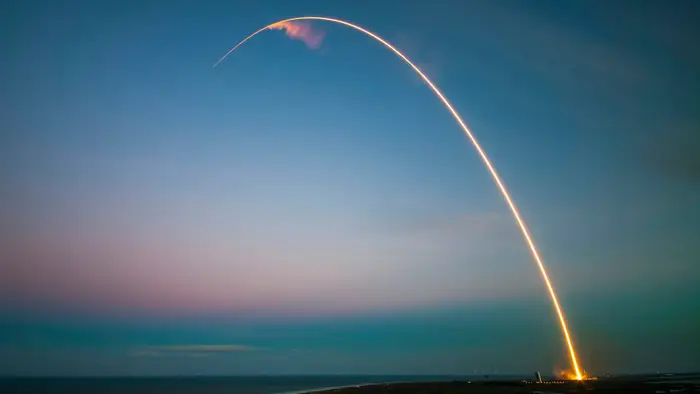
Starshield and the quiet constellation
If the trackers are right and USSF-627 is carrying Starshield satellites, it would be the latest chapter in one of the least-discussed stories in spaceflight. Starshield began as a SpaceX product line announced in December 2022, offering government customers satellites built on the Starlink bus with three capabilities: Earth observation, communications and hosted payloads. The National Reconnaissance Office has been the most visible customer, flying Starshield batches on Falcon 9 under the NROL designation — NROL-179, which B1103 itself launched, was one of them — and the Space Force has flown its own Starshield-derived missions under the USSF designation. SpaceNews covered one of them in September: Fog, Secrecy, and Starshield: SpaceX’s USSF-385 Launch Caps a Frenetic September for Military Space.
What makes Starshield significant is not any single launch but the accumulation. Each batch adds satellites to a classified constellation whose size, capabilities and even existence are only partly public. The satellites are thought to carry imaging and sensing payloads alongside their communications role, giving the intelligence community a persistent, low-orbit eye that can be replenished as often as a Falcon 9 can fly. The programme’s budget is classified, its satellite count is classified, and its imagery is classified — but its launch cadence is not, because rockets cannot be hidden. Counting the launches is the closest the public gets to counting the constellation.
The cadence is the evidence. USSF-432 flew successfully on November 7, just four days before USSF-627’s new target date — SpaceNews covered that flight in USSF-432 Falcon 9 Launch November 7 2026: Classified Space Force Payload Reaches Orbit — and USSF-317 is already windowed for Friday, November 13. Three classified Falcon 9 missions from the same pad in the space of a week is a tempo that would have exhausted the old expendable fleet in months. The reusable Falcon 9, the droneship in the Pacific, and the pad crews at Vandenberg are what make that tempo possible, and the two one-day slips on USSF-627 are the price of running a schedule that tight: when the manifest is this crowded, there is no slack anywhere, and a day lost to weather or range availability is a day the whole queue feels.
There is a tension in the arrangement that will only grow. The same reusable rockets and mass-produced satellites that make proliferated constellations affordable also make them visible: every Falcon 9 that flies a Starshield batch leaves a public trail of hazard warnings, tracking data and amateur observations. The secrecy is real, but it is partial — a classified payload on a very public rocket, launched from a pad that anyone can watch from the highway. USSF-627 will be no different: the world will see it go up, watch the booster come back, and be left to guess at what is riding on top.
A crowded week, on both coasts
USSF-627 is not the only launch that Friday will decide. November 13 is shaping up to be one of the busiest single days in the history of American spaceflight, and the slip of USSF-627 to Thursday morning WIB is part of the reason the week feels so compressed.
On Friday, November 13, United Launch Alliance is scheduled to launch its Vulcan rocket from Cape Canaveral in Florida, carrying 40 satellites for Amazon’s Leo broadband constellation. Liftoff is targeted for 12:54 p.m. Eastern Time. It will be Vulcan’s first flight since February, when — for the second time — one of the rocket’s Northrop Grumman solid rocket boosters malfunctioned. The return to flight matters to ULA, to Amazon, and to the Space Force, which has Vulcan missions of its own on the manifest.
Also on Friday, November 13, SpaceX is targeting the 15th integrated flight test of Starship, the largest rocket ever flown. The flight is preparing to launch as soon as Friday, pending regulatory approval, with a 75-minute window opening at 4:45 p.m. Central Time. It is planned as the first flight to return both Starship and the Super Heavy booster to Starbase for a catch by the launch tower’s arms, and to deploy 26 Starlink V3 satellites. No launch licence from the Federal Aviation Administration had been issued at the last public update, and the ship catch — the first ever attempted — would take place at the second launch pad, after a single-engine deorbit burn, only if the regulator’s conditions are met. If it flies, it will be the spectacle of the week. If it slips, it will join USSF-627 in the growing list of November launches that needed one more day.
And between them, USSF-317: another classified Space Force Falcon 9 from Vandenberg, windowed for Friday, November 13, from 11:23 to 15:23 WIB, on booster B1100. Three launch providers, two coasts, four missions, one week — and a classified payload that has already waited four days to fly. The week that began with a secret is ending with a spectacle, and both, in their own way, are the new normal for spaceflight in 2026.

Timeline: USSF-627’s road to the pad
- November 2, 2026 — Maritime hazard warnings issued for the USSF-627 launch window, covering November 9–15.
- November 8, 2026 — Original launch target. The mission slips one day.
- November 9, 2026, 19:03 PT — Four-hour window opens at Vandenberg SLC-4E; liftoff targeted for the start of the window, 10:03 WIB on November 10. The attempt does not fly.
- November 10, 2026 — SpaceX moves the target to November 11, with a window opening at 02:49 UTC, or 09:49 WIB. No reason is given for the delay.
- November 11, 2026 — SpaceX’s mission page now lists Wednesday, November 11, at 6:35 p.m. PT — Thursday, November 12, at 02:35 UTC, or 09:35 WIB — as the target, with a backup on Thursday, November 12, at 6:21 p.m. PT, or Friday, November 13, at 09:21 WIB. No reason is given for the second delay.
- November 12, 2026, 09:35 WIB — Current target: window opens at Vandenberg. Booster B1103 scheduled to land on the Of Course I Still Love You droneship at about T+8:22.
- November 13, 2026, 09:21 WIB — Backup opportunity, if the Thursday attempt does not fly.
What to watch for
The first thing to watch is the clock. The window opens at 09:35 WIB on Thursday, November 12, and the launch team has four hours to work with. SpaceX’s webcast begins about ten minutes before liftoff, and the feed will stay live through stage separation and the booster’s landing. After that, the broadcast ends, and confirmation of success will come the way it always does for these missions: a brief statement, a few hours later, that the payload reached its intended orbit.
The second thing to watch is the booster. B1103’s seventh landing would extend a reuse record that already spans intelligence, missile-warning and commercial missions. A clean recovery keeps the booster available for an eighth flight, and the month-long turnaround since its October 10 flight is a reminder that the bottleneck in military spaceflight is no longer the rocket — it is the range, the weather and the manifest.
The third thing to watch is what happens after. Independent trackers will begin cataloguing new objects in low Earth orbit within a day or so, and their count — how many satellites appeared, and in what orbit — will be the first public evidence of what USSF-627 actually carried. If the count matches a Starlink-style batch, the Starshield theory gains another data point. If it does not, the mystery deepens, and the guessing starts again.
And the fourth thing to watch is the queue behind it. USSF-317 is windowed for Friday. Vulcan and Starship are targeted for Friday. A third slip on USSF-627 would push it into the same day as all three, and the week’s manifest would have to absorb the collision. The launch business runs on margins measured in hours, and this mission has now spent two of them.

For now, the facts are simple and the countdown is real: a proven booster on its seventh flight, a coastal pad, a four-hour window on a Wednesday night in California and a Thursday morning in Jakarta, and a payload that nobody will name. When the Falcon 9 finally climbs away from Vandenberg, it will be carrying more than a classified satellite or two. It will be carrying the latest instalment of the Pentagon’s bet that the future of military space is not a few exquisite spacecraft, but many ordinary ones, launched often, on rockets that come back — delivered, as ever, nine minutes at a time, with the interesting part happening off camera. The only question left is the one the launch schedule has already answered twice: which morning.