USSF-317 Falcon 9 Launch November 19: SpaceX's Classified Starshield Mission Finally Gets Its Window
After three slips in four days, the classified Space Force mission USSF-317 is finally on the verge of flying. SpaceX is targeting Thursday, November 19, for a Falcon 9 launch from Space Launch Complex 4E at Vandenberg Space Force Base in California, with a four-hour window that opens in the early evening Pacific time — which means the middle of the night for watchers in much of the world, and late morning on Friday for readers in Indonesia.
The mission has become a familiar story at Vandenberg: a classified payload, a veteran booster, and a launch date that keeps moving. USSF-317 was first targeted for Sunday, November 15, then slipped to Tuesday, November 17, then to Wednesday, November 18, and now to Thursday, November 19. Neither SpaceX nor the Space Force has given a public reason for any of the delays, and none should be invented. What is certain is that the rocket is now vertical, the range is booked, and every public tracker currently shows the mission as go for launch.
What will actually ride to orbit remains officially undisclosed. The payload is classified, as is typical for national-security space missions, and the webcast — when it happens — will end early, before the second stage does its classified work. But the clues in public view are unusually strong this time, and they point to the same conclusion that launch analysts have drawn for the last three missions in this campaign: USSF-317 is very likely another batch of Starshield satellites, the government-built sibling of SpaceX’s Starlink constellation, deployed to expand a fast-growing orbital surveillance network.
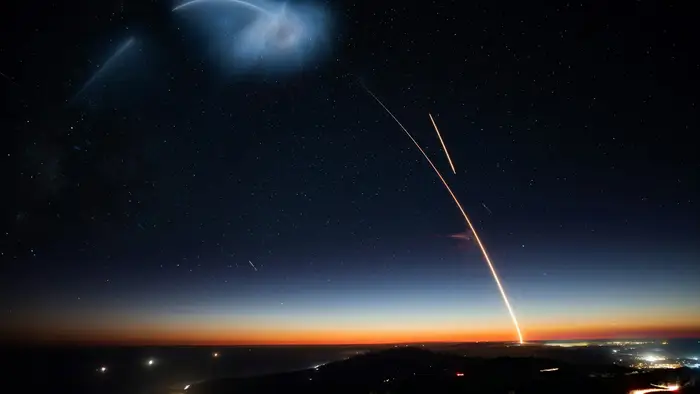
A Falcon 9 launch arc lights up the night sky. USSF-317 is targeting a Thursday evening window from Vandenberg. Image: Unsplash.
The window, the wait, and a small mystery in the time
The launch window is where the first complication appears — not in the rocket, but in the paperwork. SpaceX’s own mission page lists the window in its header as November 19, 2026, 18:46 to 22:46 PT. That is 6:46 p.m. to 10:46 p.m. Pacific time, or 02:46 to 06:46 UTC on Friday, November 20 — which converts to 09:46 to 13:46 WIB on Friday, November 20, in Indonesia. The same 6:46 p.m. opening is confirmed by the Vandenberg launch alert from Space Launch Delta 30, by Launch Library 2, and by the trade press reporting on the mission.
But the body text on that same SpaceX page says something different: “The four-hour launch window opens at 8:28 p.m. PT.” That is nearly two hours later than the header time, and it does not match any independent tracker. The likeliest explanation is the one that has applied to this mission before — the body text is stale, left over from an earlier version of the page, while the header carries the current target. SpaceNews has seen exactly this pattern with USSF-317 in the past week, when the page’s body text lagged behind its header through earlier date changes. The honest position is to report both, and to trust the figure that every independent source agrees on: liftoff is targeted for 6:46 p.m. PT on Thursday, November 19, with the window running four hours to 10:46 p.m. PT.
If Thursday does not work, there is a backup opportunity on Friday, November 20, at 8:26 p.m. PT, according to SpaceX — 04:26 UTC on Saturday, November 21, or 11:26 WIB on Saturday morning in Indonesia. The Vandenberg alert likewise confirms a backup date on Friday. Whether the mission needs it will be known only in the small hours: the window stretches across the Pacific evening, and a scrub at any point would push the attempt to that backup slot.
For viewers, the rhythm is familiar. A live webcast will begin about ten minutes before liftoff, on SpaceX’s website and on X at @SpaceX, and it will cover the ascent and the booster landing before signing off — standard practice when the customer is the U.S. government and the cargo is classified. Residents of Santa Barbara, San Luis Obispo, and Ventura counties may hear one or more sonic booms during the launch, SpaceX says, though what people actually experience will depend on weather and other conditions. Vandenberg’s evening launches are often visible for hundreds of kilometres along the California coast, and a 6:46 p.m. liftoff in November means darkness will have fallen over the pad — the best possible conditions for a visible launch arc.
What we know, and what nobody will say
Officially, USSF-317 is a classified mission for the United States Space Force, and that is where the official description ends. No satellite count, no orbital parameters, no mission patch details have been released. The Space Force’s Space Systems Command has said nothing beyond the launch itself, and SpaceX’s mission page confines itself to the rocket, the booster, and the landing.
Unofficially, the picture is far clearer — not because anyone has leaked a manifest, but because the mission’s public footprint matches an established pattern with unusual precision. Independent launch trackers note that the drop zones designated for this flight’s spent stages are exact fits with previous Starlink Group 15 launches from the same pad: the same corridor, the same profile, the same destination region in low Earth orbit. When a classified mission flies an identical trajectory to a Starlink deployment, observers draw the obvious conclusion. The mission is, in the words used by multiple trackers, possibly a batch of classified low Earth orbit satellites based on SpaceX’s Starshield satellite bus.
That reading is strengthened by the company the mission keeps. USSF-317’s booster, B1100, flew the two most recent missions in this same campaign. It carried NROL-105 in January 2026 — the twelfth launch of the National Reconnaissance Office’s proliferated architecture — and it carried USSF-385 in September, which analysts believe was the third deployment in the Space Force’s Space Based Sensing and Targeting series. A booster does not prove a payload, but the assignment is suggestive: the same veteran first stage, the same pad, the same corridor, the same customer, four months apart.
The pattern of the wider campaign is worth setting out, because it is the context in which USSF-317 makes sense. The first satellites of this particular constellation are believed to have gone up on USSF-366 on August 15, 2026, followed by USSF-153 on September 10. After each of those two launches, the Space Force catalogued 23 new satellites in orbit — a remarkably consistent number that suggests a standardized deployment of roughly two dozen spacecraft per flight, dispensed from the Falcon 9’s upper stage into a shared orbital plane. USSF-385 followed on September 26, lifting off through dense coastal fog at Vandenberg. A related mission, USSF-259, flew on September 17 to a different orbit and appeared to carry about 17 satellites — a sibling effort, but a distinct one, suggesting the Space Force is building more than a single constellation, populating multiple orbital shells or serving multiple mission needs in parallel.
None of that tells us how many satellites USSF-317 carries, and this article will not claim a number. The payload is classified, and the satellite count for a classified mission cannot be known until the Space Force catalogues whatever reaches orbit — which itself may take days, and may never be fully disclosed. What can be said is that the mission fits a deployment rhythm of roughly one launch a month in this series, and that if it follows the pattern of its predecessors, it will add another batch of spacecraft to a constellation that is growing fast.
B1100: the fleet veteran on its eleventh flight
The rocket assigned to USSF-317 is a familiar one. The first-stage booster is B1100, and this will be its eleventh flight — a figure that would have been unthinkable for an orbital-class booster a decade ago and is now, remarkably, routine for SpaceX. According to SpaceX, B1100 previously launched NROL-105, USSF-385, and eight Starlink missions. Its tenth flight was USSF-385 on September 26, when it lifted off through Vandenberg’s coastal fog and landed on the droneship Of Course I Still Love You about eight and a half minutes after liftoff.
After stage separation on Thursday, the plan is the same again: B1100 will flip, fire its engines to reverse course, and guide itself to a pinpoint touchdown on Of Course I Still Love You, stationed in the Pacific Ocean about 574 kilometres downrange from the pad. The droneship landing, rather than a return to land, is itself a clue about the mission: boosters land at sea when the mission’s performance demands leave insufficient propellant for a boost-back burn to the launch site. Heavier payloads and demanding orbits — exactly the profile of a classified deployment to low Earth orbit — are the classic reason.
The flight profile, as published by SpaceX, runs on a tight and well-rehearsed clock. The launch director verifies go for propellant load at T-minus 38 minutes; RP-1 kerosene and first-stage liquid oxygen loading begin at T-minus 35 minutes; second-stage liquid oxygen loading starts at T-minus 16 minutes; the Falcon 9 begins engine chill at T-minus 7 minutes; the flight computer takes over final prelaunch checks at T-minus 1 minute; the launch director verifies go for launch at T-minus 45 seconds; and the engine ignition sequence starts three seconds before liftoff. After liftoff, the rocket passes through maximum aerodynamic pressure at about 67 seconds, the first-stage engines cut off at 2 minutes 26 seconds, the stages separate three seconds later, the second-stage engine ignites at 2 minutes 36 seconds, and the payload fairing separates at 2 minutes 58 seconds. The booster’s entry burn runs from 6 minutes 6 seconds to 6 minutes 30 seconds, the landing burn begins at 7 minutes 52 seconds, and touchdown is scheduled for 8 minutes 11 seconds after liftoff.
That timeline is, by now, almost a metronome for Falcon 9 flights from Vandenberg. What makes it worth reading closely on this mission is what it does not contain: the second stage’s later burns, the payload deployment sequence, and the orbit itself are all absent from the public timeline. For a commercial Starlink launch, SpaceX publishes those details. For USSF-317, the public record ends at the booster landing — and the classified part of the mission begins.
The bigger picture: a constellation built in plain sight
To understand why a single classified launch matters, it helps to step back from the pad and look at the architecture it serves. USSF-317 sits at the intersection of two of the largest shifts in American military spaceflight: the Space Force’s Space Based Sensing and Targeting programme, and the National Reconnaissance Office’s proliferated architecture. Both are built on the same insight — that dozens or hundreds of small, cheap satellites in low Earth orbit can do work that once required a handful of enormous, expensive ones — and both are being built largely on SpaceX hardware.
Starshield is the name for the government-facing side of that hardware. SpaceX made the business public in December 2022, describing it as a government-focused service built on the same satellite bus as Starlink but adapted for national-security missions. The company’s own description groups Starshield into three pillars: secure communications, Earth observation, and hosted payloads — spacecraft built to carry customer sensors into orbit. The satellites are built on the same mass-produced, flat-panel design as Starlink, assembled in partnership with Northrop Grumman, and fitted with classified mission-specific sensors that can range from high-resolution optical imagers to signals-intelligence receivers and infrared missile-warning detectors. They are linked by optical inter-satellite laser terminals, allowing data to move between spacecraft at near-light speed without routing through ground relay stations.
The scale of the effort became public in March 2024, when Reuters reported that SpaceX’s Starshield unit was building a network of hundreds of reconnaissance satellites under a classified 2021 contract with the National Reconnaissance Office worth 1.8 billion dollars. The NRO did not confirm the report point by point, but its subsequent actions have matched it. On May 22, 2024, the agency launched NROL-146 and described it as the first proliferated architecture mission, saying the new architecture would increase revisit rates, diversify communications pathways, improve the speed of data delivery, and remove single points of failure. The launches that followed came in quick succession — NROL-186 in June 2024, NROL-113 that September, NROL-167 in October, NROL-126 in November, NROL-149 in December, NROL-153 in January 2025, and more through 2025 and 2026. Public NRO materials described NROL-105, launched in January 2026 on this same booster B1100, as the twelfth proliferated architecture mission, and NROL-179 in June 2026 as the fourteenth. The agency has said its government constellation now numbers in the hundreds of satellites, and that launches for the proliferated architecture will continue through 2029.
The Space Force’s own sensing programme runs in parallel. The missions in the USSF-366, USSF-153, and USSF-385 series are understood to fall under the Space Based Sensing and Targeting portfolio, a programme office created to oversee the Pentagon’s growing appetite for orbital sensors that can detect, track, and target threats in near real time. Public launch manifests list USSF-153 as “SBST R-2,” the second of a planned series, which makes USSF-385 the likely “SBST R-3” — and USSF-317, if it belongs to the same series, the next instalment. Reporting around the programme describes an 18-launch task order structure under a contract valued at approximately 1.6 billion dollars, running from Vandenberg through 2027.
The money around the programme is large and growing. The Space Force has separately awarded SpaceX a 2.29 billion dollar contract for the Space Data Network Backbone — previously known as MILNET — a mesh of optically interconnected satellites designed to function as a military internet in space, hauling sensor and targeting data between spacecraft, ground stations, and weapons platforms without relying on terrestrial relays. Press reporting has also linked the growing low Earth orbit surveillance constellation to the Pentagon’s Golden Dome missile-defence effort. SpaceX leadership has told analysts that the company won more than 6 billion dollars in U.S. government contracts in a single recent quarter, with Starshield a major driver. The federal budget request for fiscal year 2027 includes 9.8 billion dollars for satellite communications and 10.8 billion dollars for space-based sensing and targeting — the exact mission areas Starshield is built to serve.
None of that makes USSF-317 itself any less secret. But it does explain why the secrecy is worth the effort, and why a launch that will be over in nine minutes, with its payload never named, still matters. The Pentagon is building a layered orbital infrastructure — sensors to see, networks to move the data, all in low Earth orbit, all proliferated across hundreds of satellites so that no single failure can blind the system. Every flight in the series is another brick in that wall, and Thursday’s is the latest.
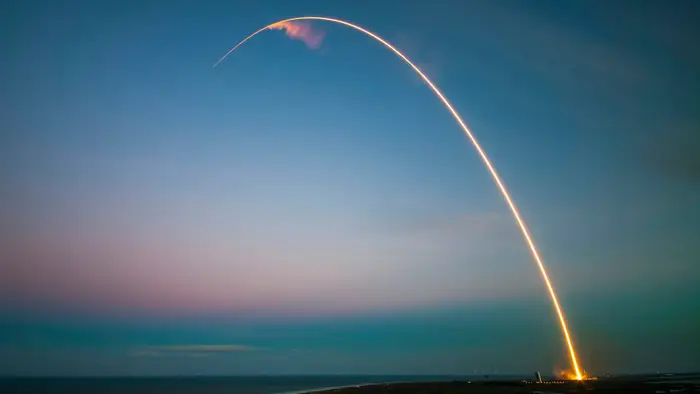
A long-exposure launch arc at dusk. Vandenberg’s evening window gives Thursday’s attempt ideal conditions for a visible ascent. Image: Unsplash.
USSF-317 at a glance
| Item | Detail |
|---|---|
| Mission | USSF-317, classified U.S. Space Force mission to low Earth orbit |
| Rocket | Falcon 9 Block 5 |
| Launch site | Space Launch Complex 4E, Vandenberg Space Force Base, California |
| Launch window | Thursday, November 19, 2026, 6:46–10:46 p.m. PT (02:46–06:46 UTC Nov 20; 09:46–13:46 WIB Nov 20) |
| Backup opportunity | Friday, November 20, 2026, 8:26 p.m. PT (04:26 UTC Nov 21; 11:26 WIB Nov 21) |
| Booster | B1100, 11th flight (previously NROL-105, USSF-385, eight Starlink missions) |
| Booster landing | Droneship Of Course I Still Love You, about 574 km downrange in the Pacific |
| Landing time | About 8 minutes 11 seconds after liftoff |
| Payload | Classified; widely assessed as a batch of Starshield-based satellites |
| Webcast | Begins about 10 minutes before liftoff on spacex.com and X @SpaceX |
The road to Thursday: a timeline of delays
- Sunday, November 15, 2026 — USSF-317 is first targeted for launch from Vandenberg’s SLC-4E. The date slips before the attempt.
- Tuesday, November 17, 2026 — The mission is retargeted for Tuesday. It slips again, with no public reason given.
- Wednesday, November 18, 2026 — A second retargeted date comes and goes. Trackers now show the mission as delayed from both Tuesday and Wednesday.
- Wednesday, November 18, 2026 — SpaceX confirms the new target: Thursday, November 19. The Vandenberg launch alert is updated to a window of 6:46 p.m. to 10:46 p.m. PT, with a backup date on Friday, November 20.
- Thursday, November 19, 2026, 6:46 p.m. PT — The four-hour launch window opens (09:46 WIB Friday, November 20). The webcast begins about ten minutes earlier.
- Thursday, November 19, 2026, about T+8:11 — Booster B1100 is scheduled to land on the droneship Of Course I Still Love You, about 574 kilometres downrange.
- Friday, November 20, 2026, 8:26 p.m. PT — Backup launch opportunity, if Thursday’s attempt scrubs (11:26 WIB Saturday, November 21).
How Thursday fits into a busy autumn at Vandenberg
USSF-317 is not an isolated event. It is the latest in a run of classified Space Force launches from Vandenberg that has defined the second half of 2026 at the California base. Less than two weeks ago, on November 12, the USSF-627 Falcon 9 launch result saw SpaceX’s Falcon 9 lift off at 11:36 WIB after three slips in four days, with booster B1103 landing on the same droneship, Of Course I Still Love You, about eight and a half minutes later. A week earlier, the USSF-432 Falcon 9 launch November 7 2026 sent another classified Space Force payload to low Earth orbit aboard booster B1095 on its eighth flight. And in September, the USSF-385 Starshield launch lifted off through dense fog on this same booster, B1100, on its tenth flight — the mission USSF-317 now follows.
The cadence tells its own story. Vandenberg has become the Falcon 9’s main stage: in September, six Falcon 9 launches flew from the California base against a single flight from Cape Canaveral in Florida, as SpaceX concentrated its Florida operations on Starship development. The classified missions are a large part of that drumbeat, and they are increasingly flown on veteran boosters — B1100 on its eleventh flight, B1103 on its seventh for USSF-627, B1095 on its eighth for USSF-432. For national-security missions, that reuse is itself a statement: the Space Force would not entrust classified payloads to boosters it did not trust, and each successful recovery adds another entry to a reliability record that now spans hundreds of landings.
There is also a symmetry worth noting. USSF-627, the mission that flew twelve days ago, also slipped three times before it flew — and when it finally did, it flew cleanly, on time, inside its window. USSF-317 has followed the same pattern of delay, and the hope at Vandenberg will be that it follows the same pattern of recovery. Delays on the West Coast are often weather, often range scheduling, often something in the rocket that needs another look — and the public is rarely told which. What matters is that the rocket is ready, the window is open, and the countdown can begin.
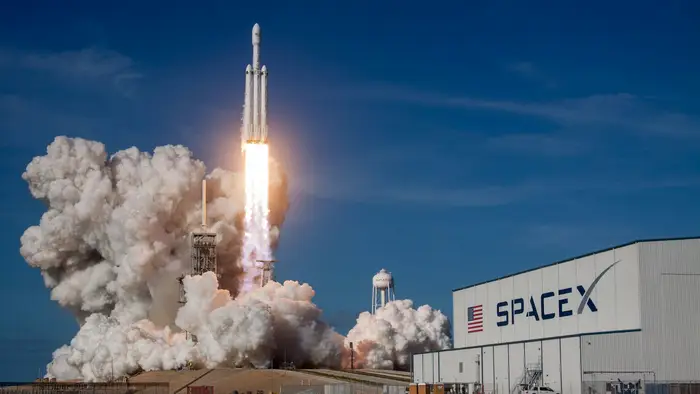
A heavy-lift rocket climbs from its pad. USSF-317 flies on the smaller Falcon 9, but the physics — and the stakes — are the same. Image: Unsplash.
What to watch for, and what comes next
The first thing to watch on Thursday evening is simply whether the rocket leaves the pad inside its window. A classified mission’s success is confirmed in stages: liftoff, booster landing, and then — usually hours later, sometimes days — the appearance of new objects in the Space Force’s satellite catalogue. SpaceX will confirm the booster landing live; the payload’s fate will be confirmed only by the quiet accumulation of tracked objects in low Earth orbit. If the pattern of USSF-366 and USSF-153 holds, observers will be watching for a batch of roughly two dozen new satellites. But that is a pattern, not a promise, and the honest count will come from the catalogue, not from a preview.
The second thing to watch is the booster. B1100’s eleventh flight would extend an already remarkable service record, and every additional flight on a veteran booster adds data on how reusable hardware ages — data that feeds directly into the design of fully reusable vehicles like Starship. A successful landing on Of Course I Still Love You would also keep Vandenberg’s recovery streak intact after USSF-627’s clean landing twelve days ago.
The third is the weather and the range. Vandenberg’s coastal fog is legendary among launch watchers, and November evenings on the Central Coast can turn quickly. The four-hour window gives the team room to wait out a passing concern; the Friday backup gives them a second day. Both are there because this mission has already used up its patience for delays — a fourth slip would push the campaign’s schedule further into a manifest that has no slack to spare.
Whatever happens on Thursday, SpaceNews will carry the result. The next scheduled coverage follows the launch itself: a status update after the window, and a full result report once the booster has landed and the payload’s fate can be assessed. If Thursday scrubs, the backup opportunity on Friday evening becomes the story. Either way, the mission that has waited since Sunday will get its answer — on the pad, in the dark, with the whole California coast watching the sky.

A Falcon 9 climbs through a clear sky. B1100 will attempt its eleventh landing on the droneship Of Course I Still Love You. Image: Unsplash.
Why a secret launch is still worth covering
There is a reasonable question to ask about a mission like USSF-317: if the payload is secret, the orbit is secret, and the webcast ends before anything interesting happens, what is there to cover? The answer is that the secrecy is itself only partial, and the part that is public is substantial. The rocket is public. The booster and its history are public. The launch window, the pad, the landing plan, and the sonic booms are public. The campaign it belongs to — the satellites, the contracts, the architecture — is documented in public reporting, public budgets, and the public record of launches that anyone can count. The classified part is a hole in the middle of a very visible picture, and the shape of the hole tells you a great deal about what fills it.
That is the paradox of modern military spaceflight. The constellations are too big to hide — hundreds of satellites, launched in batches of two dozen, on a monthly drumbeat from a single pad — even as each individual payload remains classified. The United States is building an orbital sensing and communications infrastructure in the open, one Falcon 9 at a time, and the only secret left is the precise inventory. USSF-317 is the next delivery in that build-out. Whether it flies on Thursday or slips to Friday, it will be worth watching — not for what SpaceX says about it, which will be very little, but for what the launch itself says about the pace and scale of the programme it serves.
Three delays in four days is a frustrating start. But the rocket is ready, the booster is proven, and the window is open. After a week of waiting, Thursday evening at Vandenberg is the moment this mission has been working toward. The countdown, when it finally runs, will last 38 minutes from propellant load to liftoff. The flight will last eight minutes to the booster landing. And the constellation it may be building will be watching the Earth for years.

Earth from orbit — the view the growing low Earth orbit surveillance constellation is built to provide, day and night, in near real time. Image: Unsplash.