USSF-627 Falcon 9 Launch Result: SpaceX Lands B1103 After Classified Mission Finally Flies
The rocket is finally in orbit. After three slips in four days, SpaceX launched the classified USSF-627 mission for the United States Space Force from Vandenberg Space Force Base in California on Thursday, November 12, 2026, at 11:36 WIB — 04:36 UTC, and 8:36 p.m. local time on Wednesday evening in California. The Falcon 9 climbed away from Space Launch Complex 4 East into a clear night sky, and about eight and a half minutes later its first-stage booster, B1103, settled onto the droneship Of Course I Still Love You in the Pacific Ocean. Trackers reported a nominal orbit insertion, and with that, a mission that had spent the better part of a week waiting on the ground was finally on its way.
The launch closed a strange week for a rocket that had been ready for days. USSF-627 was originally supposed to fly on November 8. It slipped to November 10, then to November 11, and then to November 12, each time by almost exactly a day, with no reason given for any of the moves in any public statement from SpaceX or the Space Force. SpaceNews covered the second of those slips in USSF-627 Falcon 9 Launch November 12 2026: Classified Space Force Mission Slips a Second Time, when the target moved to Thursday morning in Jakarta. The silence is normal for a classified mission, but it left the public record with a simple, stubborn fact: a rocket that was ready, a booster that was ready, and a pad that was ready, all waiting while the calendar kept moving. On the third new date, the countdown finally ran to zero.
Even the final day held one more surprise. The four-hour launch window opened at 09:35 WIB, but the target liftoff time inside that window moved two hours later during the countdown, from 02:36 UTC to 04:36 UTC. Launch trackers recorded the change late on November 11, and the rocket eventually lifted off at the revised time, 11:36 WIB. The window stayed open until 13:35 WIB, so the shift cost the mission nothing but patience. For the launch teams at Vandenberg, the evening had already been long before the engines lit.
The webcast, as with other classified Space Force flights, ended shortly after the booster came back. SpaceX showed the ascent through stage separation and the first stage’s return, and then the coverage stopped. There were no views from the second stage and no pictures of the payload, because there never are on a mission like this. What the public saw was the part SpaceX is allowed to show: a rocket going up, and a booster coming home.
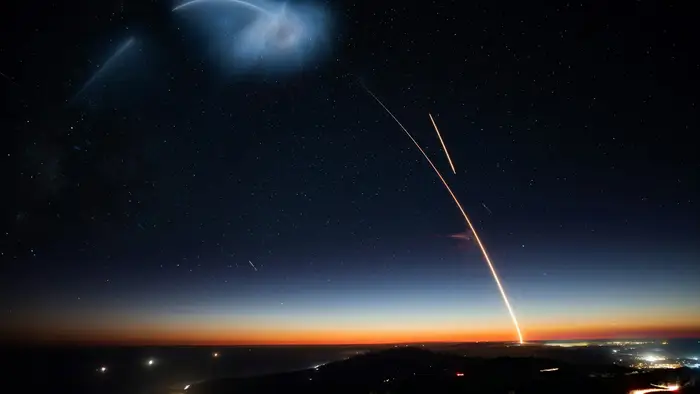
The launch at last
The Falcon 9 lifted off from Space Launch Complex 4 East, the workhorse pad on California’s central coast that has become the busiest military launch site in the country. The rocket flew a south-easterly trajectory out over the Pacific, the standard departure for Vandenberg missions heading to low Earth orbit, and the first minutes of flight followed the timeline SpaceX publishes for every Falcon 9 mission. Maximum aerodynamic pressure, the moment engineers call Max Q, came at about one minute and seven seconds into the flight. The nine Merlin engines of the first stage shut down at two minutes and twenty-five seconds, the stages separated four seconds later, and the second stage’s single Merlin Vacuum engine ignited at two minutes and thirty-six seconds. The payload fairing, the two-piece shell that protects the satellite during ascent, separated at two minutes and fifty-six seconds.
Those numbers are routine, and that is the point. Nothing about the ascent was unusual, which is exactly what a classified mission needs: a normal ride to orbit, with the attention focused on the parts of the flight the public is allowed to watch. The first stage began its entry burn at six minutes and three seconds, finished it at six minutes and twenty-six seconds, started its landing burn at eight minutes, and touched down on the droneship at eight minutes and twenty-two seconds after liftoff. SpaceX’s own mission page lists the landing at T+8:22, and launch reports put the touchdown at about eight and a half minutes, the two accounts agreeing within seconds of each other.
Residents of Santa Barbara, San Luis Obispo, and Ventura counties had been warned they might hear one or more sonic booms during the launch, as the returning booster went supersonic on its way back to the droneship. What any one person heard depended on the weather and on exactly where they were standing, but the warning itself was a small reminder that a Vandenberg launch is a local event as well as a national one. The rocket leaves from a community’s backyard, and the community hears it come home.
The droneship Of Course I Still Love You was stationed in the Pacific Ocean, roughly 574 kilometres downrange from the launch site, according to launch trackers. That distance is the standard geometry of a Vandenberg droneship landing: far enough out to sea that the booster can fly a safe return trajectory, close enough that the ship can hold station and the recovery crew can secure the rocket quickly once it is aboard. The ship has now caught a Falcon 9 first stage on both of the Space Force missions flown from Vandenberg this month, and it will be back in port soon, carrying a booster that has now flown seven times.
What happened after stage separation is not public, and it will stay that way. The second stage carried the classified payload onward to low Earth orbit, and SpaceX’s coverage ended before it got there. Launch trackers reported a nominal orbit insertion, which means the rocket did what it was supposed to do, but the details — the orbit, the number of spacecraft, the time of deployment — were not released. For a mission whose entire purpose is secret, that is the expected outcome, and it is also the whole story: the rocket flew, the booster landed, and the rest belongs to the Space Force.
B1103’s seventh flight
The booster that flew USSF-627 has become a familiar face at Vandenberg. B1103, a Falcon 9 Block 5 first stage, made its seventh flight on this mission, and its career so far reads like a tour of the modern American national-security launch manifest. It previously launched NROL-179, a classified mission for the National Reconnaissance Office; SDA-T1TL-E and SDA-T1TL-A, two tranches of the Space Development Agency’s missile-tracking and data-transport constellation; and three Starlink missions, the commercial broadband flights that fill out most of SpaceX’s manifest. The mix is the point: the same booster, the same pad, the same recovery ship, carrying spy satellites one month and internet satellites the next.
The turnaround was quick even by SpaceX’s standards. B1103’s previous flight was on October 10, 2026, which puts the gap between its sixth and seventh flights at 32 days. That is the kind of tempo that makes reusability real rather than theoretical: a booster that comes back, gets inspected and refurbished, and goes again inside five weeks, carrying a completely different kind of payload the second time around. It is also the tempo that the Space Force now depends on. When the launch date slipped three times, the booster did not need to be swapped or retested. It waited on the pad, and when the countdown finally ran, it flew.
Seven flights is a long way from the early days of booster recovery, when a single landing was a headline and a second flight was an experiment. SpaceX’s fleet now includes boosters that have flown far more often, and the company has built its entire launch business around the idea that the first stage is not a consumable but an asset. USSF-627 was the 120th Falcon 9 launch of 2026, according to Space.com’s report on the mission, and the 15th national-security flight of the year. Eighty-five of those 120 flights were devoted to building out the Starlink broadband constellation, which now consists of more than 11,000 satellites in low Earth orbit. In 2025, the Falcon 9 flew 165 missions, and 122 of them were Starlink flights. The classified missions are a small slice of the manifest by number, but they are the slice that matters most to the customer that launched this one.
That the same booster can serve both worlds is not an accident. It is the result of a design choice SpaceX made more than a decade ago, to build a rocket that lands itself and flies again, and of a procurement choice the Space Force made more recently, to buy launches on that rocket the way a commercial customer would. The Space Force does not own the rocket. It buys a ride, and the ride happens to be reusable. B1103’s seventh flight is evidence that the arrangement works, and the three-day delay is evidence that it works even when the schedule does not.

What flew — and what we still do not know
The payload of USSF-627 is classified, and neither SpaceX nor the United States Space Force has said what it is. That much is certain. Everything else about the spacecraft is informed guesswork, and it should be read that way.
What the experts have speculated, and what Space.com reported in its coverage of the launch, is that USSF-627 carried a batch of SpaceX’s Starshield satellites for the Space Force’s Space Based Sensing and Targeting portfolio, the programme that helps the military track potential targets around the world. The speculation is not baseless. Launch trackers have noted that the drop zones for the rocket’s stages fit the pattern of previous Starlink Group 15 launches, the family of missions that fly from Vandenberg into the same kind of orbit, and Starshield is built on the same satellite bus as Starlink. If the payload is a Starshield batch, it would be a constellation of small satellites designed to watch the Earth and pass what they see to the people who need it, quickly.
A commercial satellite catalog, Skybrokers, lists 23 spacecraft under the USSF-627 mission, designated USA-749 through USA-771, and describes them as a batch of small military and intelligence satellites. That listing is a catalog entry, not an official confirmation. Neither SpaceX nor the Space Force has confirmed a satellite count, a spacecraft type, or a mission purpose, and a catalog listing is not the same as a government statement. The number 23 should be treated as an unconfirmed tracker figure, not as a fact about the mission, and the Starshield connection should be treated as the leading theory, not as the answer.
The secrecy is not unusual, and it is not new. Classified launches have always kept their payloads quiet, from the earliest reconnaissance satellites of the Cold War to the present day. What has changed is the shape of the secrecy. In the past, a classified launch often meant a single large satellite, built over many years at enormous cost, riding a rocket that flew once and was thrown away. Today, a classified launch can mean a batch of small satellites, built on a commercial production line, riding a reusable rocket that has already flown six times. The secret is the same — what the satellites do — but the way they get to orbit has been transformed.
That transformation is visible in the way USSF-627 was covered. SpaceX ended its webcast shortly after the booster landed, and there was no live commentary on the second stage, no deployment callouts, no orbital parameters. The company did the same for USSF-432 six days earlier, and it will do the same for the next classified flight. The public gets the liftoff, the landing, and the confirmation that the rocket worked. Everything else is between SpaceX and its customer.
There is a temptation, when the facts run out, to fill the gap with certainty. It should be resisted. The honest account of USSF-627 is that a Falcon 9 launched from Vandenberg, a booster landed on a droneship, and a classified payload reached low Earth orbit. The rest — the number of satellites, their purpose, their orbit — is unconfirmed, and any report that presents those details as settled fact is going further than the evidence allows.
Mission by the numbers
The facts that are public about USSF-627 can be stated plainly, and they are worth setting out together, because the story of this mission is in large part a story of numbers: dates that moved, a booster that flew again, and a launch rate that keeps climbing.
| Item | Detail |
|---|---|
| Mission | USSF-627 |
| Customer | United States Space Force |
| Launch provider | SpaceX |
| Vehicle | Falcon 9 Block 5 |
| Booster | B1103, 7th flight |
| Launch site | Space Launch Complex 4 East (SLC-4E), Vandenberg Space Force Base, California |
| Liftoff | Thursday, November 12, 2026, 04:36 UTC (11:36 WIB; Wednesday, November 11, 8:36 p.m. PT) |
| Launch window | 02:35–06:35 UTC (09:35–13:35 WIB), four hours |
| Target orbit | Low Earth orbit |
| Booster landing | Droneship Of Course I Still Love You (OCISLY), about 574 km downrange |
| Landing time | T+8:22, about eight and a half minutes after liftoff |
| Booster’s previous flights | NROL-179, SDA-T1TL-E, SDA-T1TL-A, three Starlink missions |
| Booster turnaround | 32 days since previous flight on October 10, 2026 |
| Falcon 9 launches in 2026 | 120th, per Space.com |
| National-security flights in 2026 | 15th |
| Starlink flights among the 120 | 85, with the constellation above 11,000 satellites |
| Previous Space Force flight from Vandenberg | USSF-432, November 6, 2026 |
The table makes the scale of the operation clear. A single booster, flying for the seventh time, carried a classified payload on the 120th Falcon 9 launch of a year that is not yet over, and did it from a pad that had hosted another Space Force launch less than a week earlier. The numbers are not decoration. They are the evidence that reusable rockets and high launch cadence have become the normal way the United States puts military spacecraft into orbit.
From November 8 to November 12: a timeline
USSF-627 was supposed to be a straightforward launch. It became a four-day exercise in patience instead. The dates tell the story more clearly than any paragraph can.
- November 8, 2026 — The original target date. USSF-627 was scheduled to fly from Vandenberg, carrying its classified payload on booster B1103’s seventh flight. It did not fly.
- November 10, 2026 — The first new target. SpaceX moved the launch to Tuesday, November 10, with a window opening at 10:03 WIB — the target described in USSF-627 Falcon 9 Launch November 10 2026: Classified Space Force Mission Rides a Seventh-Flight Booster. That attempt did not fly either, and on November 10 the company moved the target again.
- November 11, 2026 — The second new target. The launch was rescheduled for Wednesday, November 11, with a window opening at 09:49 WIB. The rocket stayed on the ground, and SpaceX moved the target a third time, to Thursday, November 12, with a window of 09:35–13:35 WIB.
- November 11, 2026, late evening — The target time inside the November 12 window moved two hours later, from 02:36 UTC to 04:36 UTC. Launch trackers recorded the change, and the new liftoff time became 11:36 WIB.
- November 12, 2026, 11:36 WIB — Liftoff. The Falcon 9 left Space Launch Complex 4 East at 04:36 UTC, at the revised target time, and climbed toward low Earth orbit.
- November 12, 2026, T+8:22 — Booster B1103 landed on the droneship Of Course I Still Love You in the Pacific Ocean, completing its seventh flight. Trackers reported a nominal orbit insertion for the classified payload.
Three slips, one two-hour shift inside the final window, and a liftoff that came four days after the original date. No reason was given for any of the delays, in any public statement. For a mission that was supposed to be routine, the schedule was anything but — and for the people watching the launch manifest, the lesson is an old one. A launch date is a target, not a promise, and a classified mission can move without explanation until the day it finally goes.

A six-day double at Vandenberg
USSF-627 was the second Space Force mission SpaceX has flown from Vandenberg in six days, and the pairing is worth noting, because it shows how the launch business now works at the country’s busiest military spaceport. On November 6, a Falcon 9 sent USSF-432 Falcon 9 Launch November 7 2026: Classified Space Force Payload Reaches Orbit skyward from the same pad, Space Launch Complex 4 East, carrying another classified payload. Like USSF-627, it flew on a reused booster, and like USSF-627, its webcast ended after the first stage came back. Neither mission’s payload has been described in public. Both are classified. The two flights, taken together, are a snapshot of the modern national-security launch programme: frequent, reusable, and quiet about the details.
The comparison between the two missions is instructive. USSF-432 flew on its first scheduled date and went straight to orbit. USSF-627 needed four days and three new target dates to get off the ground. The difference is not a sign that something was wrong with either flight. It is a sign that launch schedules are fragile, and that the same pad, the same rocket family, and the same recovery ship can produce a smooth launch one week and a delayed one the next. Weather, range availability, technical checks, and the customer’s own readiness all play a part, and on a classified mission the public is not told which one caused the delay. What matters is the outcome, and on both flights the outcome was the same: the rocket flew, the booster landed, and the payload reached orbit.
The six-day gap between the two launches is also a measure of Vandenberg’s tempo. The base has become the centre of American military spaceflight, and the pace of launches from its pads has risen sharply in recent years. A single pad hosting two national-security missions in six days, with a third — USSF-317 — already scheduled for the weekend, would have been remarkable a decade ago. Today it is the routine, and the routine is the story. The Space Force is launching more often, on reusable rockets, from a base that has learned to turn flights around in days rather than weeks.
That tempo is driven by the numbers in the mission table. One hundred and twenty Falcon 9 launches in a single year, fifteen of them for national security, eighty-five of them for Starlink. The Starlink flights are the engine of the cadence: they keep the pads busy, the boosters flying, and the recovery ships at sea, and the classified missions ride on the infrastructure that the commercial flights pay for. It is a system in which a military launch is no longer a special event that stops everything else, but one flight among many, scheduled alongside the rest and flown with the same hardware.
There is a cost to that speed, and it is visible in the schedule. When a rocket flies 120 times a year, delays are inevitable, and when a mission slips three times in four days, the manifest behind it feels the pressure. USSF-317, the next Space Force flight from Vandenberg, is already windowed for Sunday, November 15, and every day USSF-627 waited was a day closer to that launch. The system absorbed the delay, as it was designed to do, but the margin is not infinite. The more often rockets fly, the more the schedule matters, and the more a single slipped mission can ripple through the week behind it.
Why the secrecy is normal
It is worth saying plainly, because readers who are new to military spaceflight sometimes find it strange, that the secrecy around USSF-627 is not a cover-up and not a failure of transparency. It is the normal operating condition of a classified launch, and it has been for as long as the United States has flown reconnaissance satellites.
The Space Force does not publish the purpose of a classified mission, the number of spacecraft it carries, or the orbit they will occupy, because those details are the mission. A surveillance satellite’s value depends on what it can see and where it can see it from, and publishing that information would hand it to the people the satellite is meant to watch. The rocket is public. The booster is public. The launch time is public, down to the minute, because a rocket leaving Vandenberg cannot be hidden from the people who live near the pad. The payload is not public, and it will not become public, because the payload is the reason the mission exists.
What has changed, and what makes USSF-627 interesting beyond its own launch, is the way the secret is now carried. A decade ago, a classified payload rode a rocket that was built for a single flight and thrown away, and the launch was a rare, expensive, carefully staged event. Today, the same kind of payload rides a rocket that has already flown six times, on a booster that will fly again, from a pad that hosted another classified launch six days earlier. The secrecy has not changed. The logistics have, and the logistics are what make the current pace possible.
The Starshield theory, if it is right, fits that picture. Starshield is SpaceX’s military adaptation of its Starlink satellite bus, and the Space Based Sensing and Targeting programme it would serve is about putting many small eyes in orbit rather than a few large ones. A constellation of small satellites, launched in batches on reusable rockets, is a different kind of military space capability from the single large satellites of the past: cheaper to build, faster to replace, and harder to disable. If USSF-627 carried such a batch, it would be one more step in a shift that has been underway for several years, from a small number of exquisite spacecraft to a large number of good-enough ones. But it remains a theory, and it should be reported as one, until someone with the authority to say so confirms it.
The other thing that has not changed is the public’s role. The launch was visible, the booster landing was visible, and the confirmation that the payload reached orbit was reported by trackers within hours. The public knows the rocket flew, and it knows the booster came home. That is a meaningful amount of information about a classified mission, and it is more than the public got in the early decades of military spaceflight, when launches were announced after the fact or not at all. The balance between secrecy and openness has shifted, even if the payload itself remains hidden.
What comes next
The Vandenberg manifest does not pause for USSF-627. The next Space Force flight from the base, USSF-317, is already windowed for Sunday, November 15, 2026, with a launch window of 10:55–14:55 WIB, and its booster, B1100, is already assigned. That flight will follow the same pattern as the two that came before it: a Falcon 9 from Space Launch Complex 4 East, a classified payload, a droneship landing in the Pacific, and a webcast that ends after the booster comes home. The details will be confirmed closer to the day, as they always are, and the date may move, as dates at Vandenberg often do.
For the people who track the manifest, the weekend will bring the same questions USSF-627 raised all week. Will the rocket fly on its first date, or will it slip? Will the booster land, as it almost always does? Will the payload be described, or will it stay classified? The answers will come one at a time, in the order the countdown dictates, and the only honest way to cover them is to wait for the rocket to fly and then say what happened.
USSF-627’s own story is now complete, at least as far as the public record goes. The rocket launched, the booster landed, and the payload is in orbit. The three slips and the two-hour shift inside the final window are part of that story, not a footnote to it, because they are a reminder that spaceflight is still hard, even when the rocket is reusable and the pad is busy and the company has flown 120 times in a year. A launch date is a target. A countdown is a plan. And sometimes, after four days of waiting, the plan works.

The booster is back on the droneship, the rocket’s second stage is somewhere above the Pacific with a payload nobody will describe, and the pad at Vandenberg is already being prepared for the next flight. That is the rhythm of the place now: launch, land, reset, launch again. USSF-627 took four days longer than planned to join it, and then it joined it all the same. The mission that would not fly, flew.