USSF-317 Falcon 9 Launch November 21 2026: Classified Mission Gets Its Sixth Shot at Liftoff
After five scrubs, four slipped target times in a single Friday, and a countdown that has been reset more often than any mission in recent memory, the classified Space Force mission USSF-317 is finally in the final hours before liftoff. SpaceX is targeting Saturday, November 21, 2026, for a Falcon 9 launch from Space Launch Complex 4E at Vandenberg Space Force Base in California, with liftoff set for 04:20 UTC — 11:20 in the morning in Jakarta, 8:20 on Friday evening in California — inside a four-hour window that opens at 02:32 UTC, or 09:32 WIB. Trackers list the launch status as GO, the countdown is active, and the time has been confirmed by the launch provider, according to Launch Library 2. For a mission that has spent the better part of a week waiting on the ground, that is the most encouraging status it has carried in days.
The payload, as ever with this mission, is a secret. The United States Space Force has said nothing about what USSF-317 carries, how many satellites are inside the Falcon 9’s payload fairing, or what they are meant to do once they reach low Earth orbit. What is known is the shape of the mission around that secret: a south-easterly trajectory out of Vandenberg, a veteran booster flying for the eleventh time, a droneship waiting in the Pacific, and a place in a quiet, rapid-fire series of classified launches that has now put more than a hundred satellites into orbit in barely three months — without the Space Force ever confirming a single one of them.
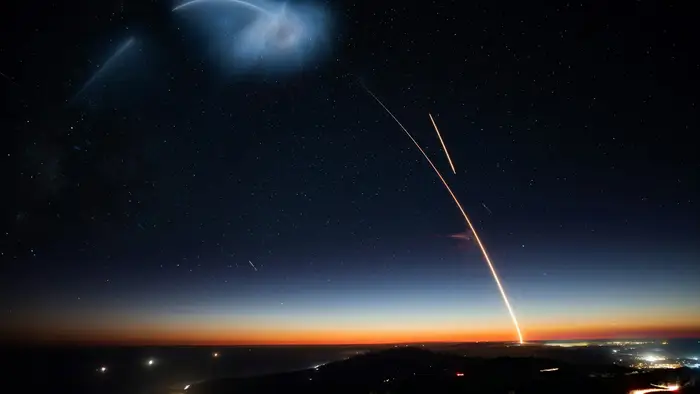
The window, the rocket, and the countdown
The numbers for Saturday are now stable enough to plan around, which is itself news for this mission. Liftoff is targeted for 04:20 UTC on Saturday, November 21 — 11:20 WIB in Indonesia, 04:20 in London, and 8:20 p.m. on Friday evening in California, where the launch will take place. The launch window runs from 02:32 UTC to 06:32 UTC, which is 09:32 to 13:32 WIB, giving SpaceX four hours of flexibility if the countdown hits a snag. Launch Library 2, the tracking service that aggregates provider data, lists the time as confirmed by the launch provider, with minute-level precision, and records that the launch status was set to GO in the early hours of Saturday, at 00:15 UTC.
That GO status matters because it is not the first time this mission has looked ready. The schedule history kept by the trackers tells the story in miniature: on Friday, November 20, at 17:15 UTC, the targeted time moved from 02:32 UTC to 04:20 UTC, a delay of about an hour and fifty minutes, and the status moved with it. The window itself did not change — it still opens at 02:32 UTC — but the moment SpaceX is actually aiming for inside that window slid later. Anyone planning to watch should treat 04:20 UTC as the target and the window as the fallback, not the other way around.
Spaceflight Now, which will carry live coverage beginning about thirty minutes before liftoff, notes that the rocket will fly on a south-easterly trajectory upon leaving the pad. That direction is consistent with the mission’s expected destination in low Earth orbit and with the recovery plan: a little more than eight minutes after liftoff, the first-stage booster is expected to land on the droneship Of Course I Still Love You, stationed in the Pacific Ocean. If that landing succeeds, it will be the 235th landing on that particular vessel and the 679th Falcon booster landing to date — two more milestones in a recovery programme that has turned what was once a spectacle into routine.
The rocket itself is a Falcon 9 Block 5, the workhorse variant that has now flown 646 times with 645 successes, a success rate of 99.8 percent according to Space Launch Live’s tally. USSF-317 is a government mission, classified Top Secret, and it is operated by SpaceX on behalf of the United States Space Force. Nothing about the payload has been disclosed, and the Space Force has not issued a statement about the mission at all — a silence that has held through all five of the previous R-series launches.
A fifth scrub, then a Friday of slipping times
To understand why Saturday morning feels like a small victory in itself, it helps to retrace the week. USSF-317 was first aimed at Thursday, November 19. That attempt ended in a scrub: SpaceX called off the Thursday night launch at 10:16 p.m. Eastern time — 03:16 UTC on Friday, or 10:16 WIB on Friday morning — and did not state a reason. Spaceflight Now’s live coverage page recorded the scrub in a brief update and noted that SpaceX was retargeting Friday, with the window opening at 6:32 p.m. Pacific time, or 02:32 UTC. It was the fifth time the mission had been scrubbed, and by then the delays had become the story as much as the launch.
Friday did not go to plan either. The target time for the Friday attempt began the day at 11:32 WIB, then slipped to 13:43 WIB, and then — hours before that revised time — the mission moved again, all the way to Saturday, with the window opening at 09:32 WIB. That is the sequence recorded in SpaceNews’ own launch-day coverage on Friday, and it captures the particular frustration of this mission: not one dramatic failure, but a slow accumulation of small slips, each one pushing the rocket a little further from the pad.
The pattern is not new for this series. The previous mission in the same programme, USSF-627, also slipped three times in four days before finally lifting off on Thursday, November 12, at 11:36 WIB, when booster B1103 — flying for the seventh time — climbed away from the same pad and landed on the same droneship about eight and a half minutes later. USSF-317 has now exceeded that record of patience. It has been scrubbed five times, rescheduled repeatedly, and has spent more days on the pad than any of its sister missions managed before flying. The question on Saturday morning is whether the sixth attempt is finally the one that sticks.
There is reason for cautious optimism beyond the GO status. The weather and range picture for Vandenberg on a Saturday morning in late November is workable, the rocket has been through the countdown process so many times this week that the ground teams have rehearsed every step of it, and the booster — B1100 — is a veteran that has already flown this exact kind of mission before. But the week has taught everyone following this launch the same lesson: a GO status and a confirmed time are not a guarantee. The launch is real only when the rocket leaves the pad, and until then, every time in this article should be read as a target, not a promise.

What is USSF-317?
The honest answer is that almost nobody outside the Space Force and SpaceX knows. USSF-317 is a classified mission for the United States Space Force, and the payload is described in every public listing with the same careful wording: an undisclosed number of satellites, a classified mission, low Earth orbit. The Space Force has not confirmed details about the satellites, has not said how many there are, and has not made statements following any of the previous launches in this series to confirm that the deployments succeeded.
That silence is deliberate, and it is part of what makes this series of missions so closely watched. The one widely discussed assessment of what USSF-317 probably carries comes from the mission description maintained by Launch Library 2, which notes that the mission is possibly a batch of classified satellites built on SpaceX’s Starshield satellite bus — the military variant of the Starlink platform. The reasoning behind that assessment is circumstantial but specific: the locations of the rocket stage drop zones for these missions are exact fits with previous Starlink Group 15 launches, suggesting the same orbital destination and the same kind of payload. It is an analyst’s inference, not a confirmation, and it should be read as such. No official source has confirmed that USSF-317, or any of its sister missions, carries Starshield satellites.
What is certain is the context. USSF-317 is the sixth in a series of missions the Space Force has assigned to SpaceX and designated with the letter R — a series that has moved with remarkable speed and remarkable secrecy. The five previous missions are listed by Spaceflight Now as follows: USSF-366, designated R-1, on August 16; USSF-153, designated R-2, on September 10; USSF-385, designated R-3, on September 26; USSF-432, designated R-4, on November 6; and USSF-627, designated R-5, on November 12. USSF-317, if it flies on Saturday, becomes R-6 — the sixth such mission in barely three months.
The tempo is the point. Five classified missions in 88 days, from the same pad, on the same rocket, with the same recovery profile, represents a launch cadence for military space that would have been unthinkable a decade ago. And the series has been productive in a measurable way: following each of the five previous launches, 23 satellites have been catalogued in orbit, according to Spaceflight Now. If that pattern holds for USSF-317, Saturday’s launch would add another 23 satellites to the tally, bringing the series total to 138. But the Space Force has not confirmed that the satellites catalogued after each launch belong to these missions, or what they do. The catalogue numbers are a fact; the ownership is an inference.
That ambiguity is not an accident. A proliferated constellation of small satellites in low Earth orbit — many eyes, many nodes, no single point of failure — is widely understood to be the direction of American military space architecture, and the Starshield concept, as described by SpaceX, is a government variant of its Starlink satellite bus, adapted for national-security payloads. Whether USSF-317 carries Starshield satellites or something else entirely, the mission fits the pattern of a Space Force that is building resilience through numbers and speed, and doing it without announcing its work.
The R-series so far
The table below brings the series together, using the dates and designations reported by Spaceflight Now and the satellite counts catalogued after each launch. Every figure in it comes from the reporting cited in this article — nothing has been estimated or filled in.
| Mission | R-series | Launch date | Booster | Satellites catalogued after launch |
|---|---|---|---|---|
| USSF-366 | R-1 | Aug 16, 2026 | Not disclosed | 23 |
| USSF-153 | R-2 | Sep 10, 2026 | Not disclosed | 23 |
| USSF-385 | R-3 | Sep 26, 2026 | B1100 (flown) | 23 |
| USSF-432 | R-4 | Nov 6–7, 2026 | B1095 (8th flight) | 23 |
| USSF-627 | R-5 | Nov 12, 2026 | B1103 (7th flight) | 23 |
| USSF-317 | R-6 | Nov 21, 2026 (target) | B1100 (11th flight) | To be determined |
The uniformity of the satellite counts is the most striking feature of the series. Twenty-three satellites after each of five launches is not a coincidence of tracking; it is the signature of a standardised deployment — the same number of spacecraft, from the same kind of dispenser, into the same kind of orbit, five times in a row. If USSF-317 follows the pattern, the count after Saturday should be 23 again, and the series total would reach 138 satellites in just over three months. But until the cataloguers report, that remains a prediction, not a fact — and the Space Force, as always, will say nothing either way.
The earlier missions in the series have their own histories on this site. USSF-385, the third mission in the series, lifted off through dense fog at Vandenberg on September 26, carrying what was believed to be the third Starshield satellite deployment in six weeks. USSF-627, the fifth mission, finally flew on November 12 after three slips in four days, with booster B1103 landing on the droneship Of Course I Still Love You about eight and a half minutes after liftoff. And the long wait for this mission itself was documented in SpaceNews’ launch-day coverage on Friday, when the target slipped twice in a single morning before moving to Saturday.

B1100: a veteran booster on its eleventh flight
The rocket assigned to USSF-317 is, by any measure, a veteran. Booster B1100 will be flying for the eleventh time on Saturday, according to Spaceflight Now — a flight count that places it among the most-flown boosters in SpaceX’s fleet, and a record that explains why SpaceX trusts it with a classified national-security payload. Its previous ten flights, as listed by Spaceflight Now, were the NROL-105 mission, the USSF-385 mission — the third launch in this very R-series, on September 26 — and eight batches of Starlink satellites.
That history is worth pausing over. B1100 has already flown one of these classified missions before, and it has done the workhorse job of deploying Starlink batches eight times — the same kind of deployment profile, the same orbital regime, and very likely the same dispenser hardware that USSF-317 will use. If the payload is indeed a batch of Starshield satellites, as the drop-zone analysis suggests, then B1100 is flying a mission it has effectively already flown, with a payload type it has already carried, to an orbit it has already visited. There is a reason SpaceX assigns its most-flown boosters to its most routine missions: the risk is in the new, not in the repeated.
The landing plan is equally familiar. A little more than eight minutes after liftoff, B1100 will target a landing on the droneship Of Course I Still Love You. If it succeeds, it will be the 235th landing on that vessel and the 679th Falcon booster landing to date, according to Spaceflight Now’s tally. Those numbers are worth a moment’s reflection. The 679th landing of a Falcon booster means that returning a first stage to a ship at sea — a feat that was a headline event a decade ago — has become a statistical routine, counted in the hundreds. And the 235th landing on a single droneship means that one vessel, sailing the same patch of Pacific, has caught more rockets than most space agencies have ever launched.
For B1100 itself, a successful landing on Saturday would also be a small piece of personal history: its eleventh recovery, and the continuation of a career that has already spanned a classified reconnaissance launch, a classified Space Force launch, and eight commercial constellation deployments. The booster is, in a very real sense, the through-line of this story — the one piece of hardware that connects the R-series to the Starlink programme, and the classified world to the commercial one.
The road to Saturday: a timeline of delays
The path to the launch pad has been long enough to deserve its own record. Here are the dated milestones of USSF-317’s troubled countdown, drawn from Spaceflight Now’s live coverage, Launch Library 2’s schedule history, and SpaceNews’ own reporting:
- Aug 16, 2026 — USSF-366 (R-1) launches, the first mission in the R-series. Twenty-three satellites are catalogued afterwards.
- Sep 10, 2026 — USSF-153 (R-2) launches. Twenty-three more satellites are catalogued.
- Sep 26, 2026 — USSF-385 (R-3) launches through dense fog at Vandenberg, flown by booster B1100. Twenty-three satellites catalogued.
- Nov 6–7, 2026 — USSF-432 (R-4) launches, flown by booster B1095 on its eighth flight. Twenty-three satellites catalogued.
- Nov 12, 2026, 11:36 WIB — USSF-627 (R-5) launches after three slips in four days; booster B1103 lands on Of Course I Still Love You. Twenty-three satellites catalogued.
- Thu, Nov 19, 10:16 p.m. EDT (Fri, Nov 20, 10:16 WIB) — The USSF-317 attempt is scrubbed for the fifth time. SpaceX gives no reason and retargets Friday.
- Fri, Nov 20, morning — The Friday target slips from 11:32 WIB to 13:43 WIB, then the mission moves to Saturday, with the window opening at 09:32 WIB.
- Fri, Nov 20, 17:15 UTC — Launch Library 2 records the targeted time moving from 02:32 UTC to 04:20 UTC, a delay of about one hour and fifty minutes.
- Sat, Nov 21, 00:15 UTC — The launch status is set to GO for launch.
- Sat, Nov 21, 04:20 UTC (11:20 WIB) — Targeted liftoff from SLC-4E at Vandenberg, inside a window running 02:32–06:32 UTC (09:32–13:32 WIB).
- Sat, Nov 21, about T+8 minutes — Booster B1100 targets a landing on the droneship Of Course I Still Love You.
- Sat, Nov 21, evening — Vandenberg hosts the second launch of the day: NROL-136, a Falcon 9 carrying a classified National Reconnaissance Office payload, is scheduled for the evening, making Saturday a double-header at the California spaceport.
That final entry deserves emphasis. Saturday is not just USSF-317’s day at Vandenberg; it is a double-header. Later on Saturday evening, a second Falcon 9 is scheduled to lift off from the same Space Launch Complex 4E carrying NROL-136, a classified mission for the National Reconnaissance Office, with booster B1097 flying for the fourteenth time and a planned landing at Landing Zone 4 on the base itself. Two classified Falcon 9 launches from the same pad on the same day is a measure of how far Vandenberg’s launch tempo has come — and a reminder that USSF-317, for all its delays, is only the first half of the day’s work.

How to watch, and what happens after liftoff
For readers in Indonesia, the timing is unusually convenient for a Vandenberg launch. Liftoff is targeted for 11:20 WIB on Saturday morning — late morning, not the middle of the night — because the launch takes place on Friday evening in California. The window opens at 09:32 WIB and closes at 13:32 WIB, so even a delay of an hour or two would still leave the launch inside the morning. Spaceflight Now will begin its live coverage about thirty minutes before liftoff, and the trackers will update the countdown in real time.
What viewers will actually see is limited, and that is by design. Classified missions do not come with the long, chatty webcasts that accompany a Starlink deployment or a crewed launch. SpaceX typically provides a brief stream of the launch itself, and coverage of the payload deployment — if it is shown at all — is minimal. The booster landing, however, is usually visible, and for USSF-317 the landing is one of the more interesting parts of the mission: B1100 coming home for the eleventh time, to a ship that has already caught 234 boosters before it.
After liftoff, the story moves into the quiet phase that has defined this whole series. The Falcon 9’s second stage will carry the payload — or payloads — into low Earth orbit, and then, most likely, nothing will be announced. The Space Force did not confirm the deployments after any of the five previous R-series launches, and there is no reason to expect a statement after this one. What will happen instead is the slow, public work of the satellite trackers: in the hours and days after launch, independent observers will catalogue new objects in orbit, compare them with the expected deployment plane, and count them. If the pattern holds, the count will be 23, and the series total will stand at 138. If it is not 23, that will itself be news — a break in a pattern that has held five times in a row.
There is also the question of what comes next. Spaceflight Now reports that SpaceX is scheduled to launch at least two more missions for the United States Space Force before the end of the month — and the calendar bears that out, with USSF-266 targeted for Monday, November 23, and USSF-380 listed for November 28. The R-series, in other words, is not ending with USSF-317. It is a programme, not a single launch, and Saturday’s flight is a waypoint in a campaign that has been running since August and shows no sign of slowing down. Each launch adds another layer to a constellation that the Space Force will not describe, and each successful deployment makes the next one easier to justify.
Why this launch matters
It is tempting, with a classified payload and no official statements, to treat USSF-317 as a non-story — a rocket going up with a secret inside, and nothing to report beyond the time and the booster number. That would be a mistake, and the reason is the pattern. Five launches, 115 catalogued satellites, one pad, one rocket family, one recovery ship, three months. That is not a series of individual missions. It is a production line, and it is the clearest public evidence available of how the United States Space Force is choosing to build its space architecture: quickly, quietly, in large numbers, and on commercial hardware.
The speed matters because the threat environment that drives it is not slowing down. The Space Force’s turn toward proliferated low Earth orbit constellations — many small satellites instead of a few large, expensive ones — is a response to a world in which satellites are targets as well as tools, and in which resilience comes from having so many nodes that losing any one of them does not matter. A constellation built 23 satellites at a time, on a rocket that flies every few weeks from the same pad, is a constellation that can be replenished faster than an adversary can degrade it. That is the logic of the R-series, whether or not any official will say so on the record.
The secrecy matters too, but not in the way it first appears. The Space Force’s refusal to confirm even the number of satellites on these missions is not a quirk; it is the point. A proliferated constellation is most useful when an adversary cannot be sure which satellites do what, how many there are, or how quickly they can be replaced. The silence is a capability in itself, and the trackers’ catalogues — 23 after every launch — are the only window into it. That is why the counting matters, and why Saturday’s count, when it comes, will be read as carefully as any press release.
And the delays matter, in their own way. A mission scrubbed five times is a mission that has been tested by its own ground campaign, and a booster that has waited on the pad through five scrubs is a booster whose teams have rehearsed the countdown until it is muscle memory. The history of spaceflight is full of launches that failed because the ground teams were rushed; it has very few examples of launches that failed because the ground teams waited too long. USSF-317 has waited. On Saturday morning, at 11:20 WIB, the waiting may finally end — and if it does, the rocket that lifts off will carry with it not just a classified payload, but the accumulated patience of a week that refused to hurry.
SpaceNews will carry the result of the launch in the next edition. Until then, the countdown is active, the status is GO, and the sixth attempt is underway.

Sources
- Spaceflight Now: SpaceX scrubs launch of classified payload for the U.S. Space Force, targets Friday
- Space Launch Live: Falcon 9 Block 5 | USSF-317 launch countdown and status
- Space Launch Schedule: SpaceX USSF-317 Falcon 9 Block 5 rocket launch
- KeepTrack: Space Brief, November 20, 2026 — USSF-317 scrub and R-series status