USSF-317 Falcon 9 Launch Delayed to November 21: Classified Space Force Mission Slips a Fifth Time
After four delays and five reschedules, the wait was supposed to be over — and then, on Friday morning, it was not. The USSF-317 Falcon 9 launch November 21 is the new target after the classified U.S. Space Force mission slipped twice in a single morning: first from 11:32 WIB to 13:43 WIB, and then, hours before that revised time, all the way to Saturday, November 21 at 09:32 WIB. The rocket is still on the pad at Vandenberg Space Force Base in California, the booster is still B1100, and the payload is still a secret — but the launch day that was meant to end a month of waiting has become another waiting day instead.
This is the fifth time USSF-317 has slipped, and the second time it has slipped on what was supposed to be launch day itself. The mission was first targeted for the middle of November, then pushed through a series of dates that launch trackers logged again and again before the schedule finally settled on Friday, November 20. Friday morning began with the countdown live and the status reading “Go for Launch.” By late morning in Indonesia, the target had moved to Saturday. For the Space Force, for SpaceX, and for the watchers who have followed every slip, the question is no longer whether the mission will fly — it is whether Saturday will finally be the day, or whether the wait will stretch into a sixth delay.
What exactly is flying is, as ever with these missions, a secret. The Space Force has said nothing about the payload beyond its designation, and SpaceX’s own mission page is silent on what sits inside the fairing. What is known is the vehicle, the booster, the trajectory, and the timetable — and those details alone tell a story about how the United States now puts its most sensitive satellites into orbit: quickly, quietly, and on reusable rockets that have already flown the same kind of mission before.
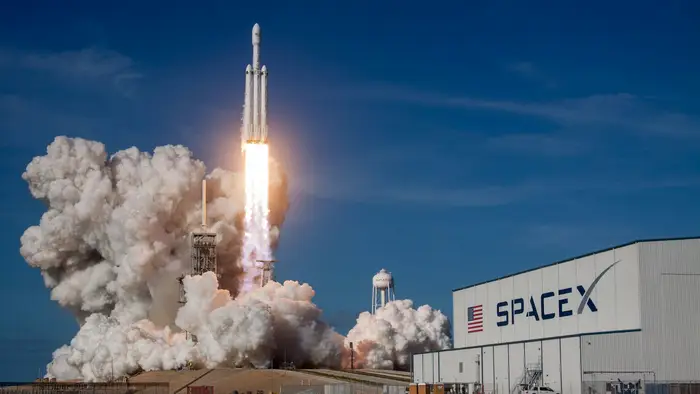
A Falcon Heavy lifts off from its launch pad. USSF-317 flies on a Falcon 9 from the same California coast. Image: Unsplash.
When and where to watch
The numbers that matter most now are the new times. SpaceX and the launch trackers now list liftoff for Saturday, November 21 at 09:32 WIB — 7:32 p.m. Pacific time on Friday evening at the launch site, and 02:32 UTC. That is the mission’s fifth delay, and it arrived in two steps on Friday morning: at 00:35 UTC (07:35 WIB), trackers recorded a 2.2-hour slip that moved liftoff from 04:32 UTC to 06:43 UTC (11:32 to 13:43 WIB); then at 03:30 UTC (10:30 WIB), a second slip of 19.8 hours pushed the target from 06:43 UTC on Friday to 02:32 UTC on Saturday. The status still reads “Go for Launch,” and the countdown is active — but it is now a countdown to Saturday morning, not Friday.
SpaceX will carry a live webcast beginning about ten minutes before liftoff, on its website and on X at @SpaceX. For viewers in Indonesia, that means the broadcast starts at around 09:22 WIB on Saturday, shortly before the window opens. The coverage of a classified mission is usually brief: the webcast typically follows the ascent through stage separation and the booster landing, then ends well before the payload is deployed, because the second stage’s later flight is not shown. Even so, the first nine minutes — liftoff, the climb through maximum aerodynamic pressure, engine cutoff, separation, and the booster’s return — are the part of the mission the public gets to see, and they are worth watching.
One thing to watch for in the weather: light rain is expected at the launch site around liftoff, according to launch trackers. Falcon 9 can fly through light rain, and a wet countdown is not unusual at Vandenberg, where the marine layer and coastal weather are part of every campaign. The constraints that matter more are lightning within ten nautical miles, strong upper-level winds, thick cloud layers, and poor visibility — the usual list that has scrubbed Vandenberg launches before. As of Friday morning, the mission’s status on the trackers reads “Go for Launch,” which means no weather or technical constraint has yet forced a hold.
People living near the coast should also be ready for sound. SpaceX notes that residents of Santa Barbara, San Luis Obispo, and Ventura counties may hear one or more sonic booms during the launch, depending on the weather and other conditions. The booms come from the returning first stage as it descends toward the droneship, and on a clear morning they can carry a long way inland. The rocket will fly on a south-easterly trajectory after leaving the pad, heading out over the Pacific — the standard corridor for Vandenberg launches bound for low Earth orbit.
If Saturday does not work out, the fallback is already known. SpaceX’s mission page lists a backup opportunity on Friday, November 20 at 8:14 p.m. Pacific time — Saturday, November 21 at 11:14 WIB — which now sits less than two hours after the refined Saturday target of 09:32 WIB. Given how many times this mission has already slipped, nobody at Vandenberg will be surprised if the backup is needed. But after a fifth delay, the expectation is that the rocket finally goes on Saturday — and if it does not, the wait begins a sixth time.
The rocket and the booster
USSF-317 flies on a Falcon 9 Block 5, the workhorse that has carried the overwhelming majority of SpaceX’s national-security missions. The Block 5 is the final and most reusable version of the Falcon 9, designed for rapid turnaround, and by now its record speaks for itself: hundreds of flights, a long string of successful booster recoveries, and a cadence that no other orbital rocket in service can match. Launch trackers count this flight as SpaceX’s 747th launch overall, a number that says as much about the scale of the company’s operations as any single mission can.
The first stage for this flight is booster B1100, and it is a veteran even by Falcon 9 standards. Saturday’s launch will be its eleventh flight. According to SpaceX, B1100 previously launched NROL-105, USSF-385, and eight Starlink missions — a career that already spans the exact two worlds this mission sits between: classified national-security payloads and the commercial Starlink constellation. That history matters, because the booster that carries USSF-317 has already flown the mission it most closely resembles. USSF-385, its earlier classified flight, is part of the same family of launches that trackers believe USSF-317 belongs to, and B1100 flew it too.
After stage separation, B1100 will attempt to land on the droneship Of Course I Still Love You, stationed in the Pacific Ocean. The landing is scheduled for about eight minutes and twenty-one seconds after liftoff, following an entry burn and a landing burn that slow the booster from hypersonic speed to a gentle touchdown on the deck. Droneship landings from Vandenberg are routine now, but they are never trivial: the booster must hit a moving target the size of a football field after falling from the edge of space, and the Pacific swell adds a variable that land landings do not have. B1100 has done this before, and the expectation is that it will do it again — then sail back to port, be inspected, and in time fly a twelfth mission.
The choice of a flight-proven booster for a classified mission is itself a statement about how far reusability has come. A decade ago, the idea of entrusting a top-secret military payload to a rocket stage that had already flown ten times would have been unthinkable. Today it is the default. The Space Force has flown national-security missions on reused boosters for years, and the practice is now so normal that SpaceX barely remarks on it. The risk calculus has inverted: a booster with ten successful flights behind it is, in the eyes of its operators, a known quantity.
What is USSF-317?
Here the story runs into the wall that every report on a classified launch hits: nobody outside the mission will say what the payload is. The Space Force has not confirmed any details about the satellites, has not said how many there are, and has not made statements after similar launches to confirm successful deployments. The mission is designated government and top secret, and the official information ends at the rocket, the booster, the launch site, and the orbit: low Earth orbit, nothing more specific.
That has not stopped analysts from drawing a careful inference, and it is one worth reporting with its limits stated plainly. Launch trackers note that the locations of the rocket stage drop zones for USSF-317 are an exact fit with previous Starlink Group 15 launches, and that the mission is possibly a batch of classified low Earth orbit satellites based on SpaceX’s Starshield satellite bus. Starshield is the government and military variant of the Starlink platform — the same basic satellite design, adapted for national-security customers. The reasoning is circumstantial but specific: the trajectory, the drop zones, and the orbital profile all match a pattern established by earlier classified launches in the same series.
There is also a number attached to that pattern, though it must be handled with care. According to Spaceflight Now, following each of these earlier launches, 23 satellites have been catalogued in orbit. That figure describes what observers were able to track after previous missions in the same family — not what USSF-317 carries, which remains unconfirmed. It is included here because it is the best public clue to the scale of the mission, and because it illustrates the odd position these launches occupy: the satellites are classified, but the sky is public, and independent trackers can count what goes up even when no one will say what it is.
It is worth being explicit about what is not known. The number of satellites on USSF-317 has not been confirmed. Whether they are Starshield spacecraft has not been confirmed. What they are for — communications, surveillance, missile warning, or something else entirely — has not been confirmed, and any report that claims otherwise is guessing. The honest account of this mission is that a Falcon 9 is taking a secret to orbit, that the secret probably resembles the secrets that went up before it, and that the details will stay secret until the objects themselves are found and catalogued by the people who watch the sky for a living.
That secrecy is not a quirk of this one launch. It is the normal condition of the Space Force’s proliferated-constellation programmes, which are building large numbers of small satellites in low Earth orbit rather than a handful of large, exquisite ones in high orbits. The philosophy is resilience through numbers: many satellites, spread across many launches, so that no single failure and no single attack can take the capability down. USSF-317, whatever it carries, is one launch in that larger build-out — and the fact that it flies on a reused booster, on a rocket that launches weekly, is part of the point. The architecture only works if launches are cheap and frequent, and this mission is evidence that they now are.
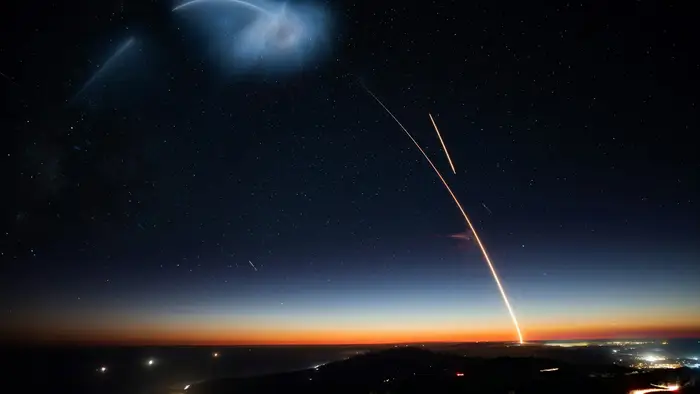
A rocket’s launch arc against the night sky. USSF-317’s window now opens on Saturday morning in Indonesia, Friday evening at the California launch site. Image: Unsplash.
The road to launch day
Few launches in recent memory have taken as long to get off the ground as USSF-317. The mission was first targeted for the middle of November, then slipped through a series of dates that launch trackers logged as five separate reschedules. Each slip pushed the flight a little further into the month, and each time the reason was the same one that covers almost every delay in this business: no reason given. SpaceX and the Space Force do not explain classified-mission delays, and the trackers simply record the new date and move on.
The timeline below traces the path this mission has taken so far. It is a reminder that a launch date is a target, not a promise — and that the date a mission finally flies is often the least interesting thing about it, until it becomes the story itself.
USSF-317: the road to launch day
- Mid-November (original target): USSF-317 is first scheduled for a Sunday launch from Vandenberg, with booster B1100 assigned and the droneship in position.
- Sunday, November 15: The first target date passes without a launch. The mission slips to the following week.
- Wednesday, November 18: The second target date. USSF-317 is now expected to fly midweek. It does not.
- Thursday, November 19: SpaceX’s mission page is updated to target Thursday, November 19, with the window opening at 8:32 p.m. Pacific time. The date holds through the day — in California. In Indonesia, that is already Friday morning.
- Thursday, November 19, afternoon (UTC): Launch trackers refine the target inside the window, moving liftoff four minutes later, from 04:28 UTC to 04:32 UTC — 11:28 to 11:32 WIB.
- Friday, November 20, 07:35 WIB: Trackers record a 2.2-hour slip, moving liftoff from 04:32 UTC to 06:43 UTC — 11:32 to 13:43 WIB. The Friday launch is still on, but later in its window.
- Friday, November 20, 10:30 WIB: A second slip of 19.8 hours pushes the target from 06:43 UTC on Friday to 02:32 UTC on Saturday. The mission is delayed a fifth time.
- Saturday, November 21, 09:32 WIB: The new target. USSF-317 is go for launch, with SpaceX’s listed backup opportunity at 11:14 WIB the same morning if needed.
Five reschedules for one launch is unusual but not extraordinary, and it is worth putting in context. The same month has already seen a Vulcan rocket scrub twice before finally flying, a Starship catch attempt aborted and then accomplished a day later, and a string of Falcon 9 launches that went on time. Delays cluster around particular missions for reasons that are rarely visible from outside: range availability, upper-level winds, a technical issue found in a final check, a payload that is not quite ready. For a classified mission, even the category of the reason is classified. What can be said is that the repeated slips did not shake the manifest — the rocket stayed assigned, the booster stayed B1100, the droneship stayed in the Pacific — and that persistence is usually a sign that the delay is about scheduling rather than a problem with the vehicle.
There is also a human side to a five-times-delayed launch that rarely makes it into coverage. Every slip means a team that has run the countdown to a hold and then stood down, a droneship crew that has sailed out and sailed back, and a set of watchers who have rearranged their mornings. By the fifth delay, the mood around a launch shifts from anticipation to a kind of weary determination. Saturday morning is the payoff for that patience — or the start of a sixth wait.
Mission profile: eight minutes to a droneship landing
The flight itself, once it begins, follows the choreography that Falcon 9 has performed hundreds of times. SpaceX publishes a minute-by-minute timeline for every mission, and USSF-317’s is no exception. The countdown milestones and the first eight minutes of flight are listed below, exactly as the company lays them out — because for a mission whose payload is secret, the flight plan is the most detailed public document that exists.
The countdown’s final hour is a sequence of verifications and loadings that must all go right. The launch director verifies the go for propellant load at 38 minutes before liftoff; rocket-grade kerosene and liquid oxygen loading begin at 35 minutes; second-stage liquid oxygen loading follows at 16 minutes; the engines begin their chill at seven minutes; and in the final minute the flight computer runs its last prelaunch checks, the tanks are pressurised to flight pressure, and the launch director gives the final go at 45 seconds. Engine ignition begins three seconds before zero. Then the hold-downs release and the rocket is committed.
| Time | Event |
|---|---|
| T-38:00 | SpaceX Launch Director verifies go for propellant load |
| T-35:00 | RP-1 (rocket grade kerosene) loading begins |
| T-35:00 | 1st stage LOX (liquid oxygen) loading begins |
| T-16:00 | 2nd stage LOX loading begins |
| T-07:00 | Falcon 9 begins engine chill prior to launch |
| T-01:00 | Command flight computer begins final prelaunch checks |
| T-01:00 | Propellant tank pressurisation to flight pressure begins |
| T-00:45 | SpaceX Launch Director verifies go for launch |
| T-00:03 | Engine ignition sequence starts |
| T+00:00 | Falcon 9 liftoff |
| T+01:07 | Max Q (moment of peak mechanical stress) |
| T+02:25 | 1st stage main engine cutoff (MECO) |
| T+02:28 | 1st and 2nd stages separate |
| T+02:35 | 2nd stage engine starts (SES-1) |
| T+02:56 | Fairing separation |
| T+06:03 | 1st stage entry burn begins |
| T+06:27 | 1st stage entry burn ends |
| T+07:59 | 1st stage landing burn begins |
| T+08:21 | 1st stage landing on Of Course I Still Love You |
The most dramatic minute is the one between main engine cutoff and fairing separation. In ninety-one seconds, the first stage shuts down, the two stages separate, the second stage ignites, and the fairing halves that protected the payload fall away — the last moment at which the classified satellites are visible to anyone, and the last moment at which the public webcast is likely to show anything at all. After fairing separation, the second stage continues alone toward orbit while the first stage turns around, falls back through the atmosphere, and aims for the droneship. The webcast usually follows the booster home. What happens to the payload after that is, by design, not broadcast.
For viewers, the landing is the second act of the show. The entry burn at six minutes slows the booster as it re-enters the atmosphere; the landing burn at just under eight minutes brings it to a hover over the deck; and at eight minutes and twenty-one seconds, if all goes well, B1100 will be standing on Of Course I Still Love You, eleven flights into its career and one flight richer. The droneship’s name, borrowed from the science-fiction novels of Iain M. Banks, has become one of the most familiar sights in spaceflight — a floating landing pad that makes the impossible look routine.
USSF-317 mission data
| Item | Detail |
|---|---|
| Mission | USSF-317 (United States Space Force) |
| Launch vehicle | SpaceX Falcon 9 Block 5 |
| Launch site | Space Launch Complex 4E (SLC-4E), Vandenberg Space Force Base, California |
| Liftoff (target) | Saturday, November 21, 2026, 09:32 WIB (02:32 UTC; 7:32 p.m. PT, Nov 20) |
| Launch window | 4 hours (per SpaceX mission page; previous attempt’s window ran 09:46–13:46 WIB) |
| Backup opportunity | Saturday, November 21, 2026, 11:14 WIB (8:14 p.m. PT, Nov 20) |
| Target orbit | Low Earth orbit |
| First stage | Booster B1100, 11th flight |
| Booster history | NROL-105, USSF-385, and eight Starlink missions |
| Landing | Droneship Of Course I Still Love You, Pacific Ocean, T+8:21 |
| Payload | Classified; possibly Starshield-based LEO satellites (unconfirmed) |
| Trajectory | South-easterly from Vandenberg |
| Webcast | From ~10 minutes before liftoff, on spacex.com and X @SpaceX |
| Weather note | Light rain expected at the launch site around liftoff |
| Reschedules | Five delays; 11 schedule changes logged by launch trackers |
A busy week for national security space
USSF-317 does not fly in isolation. It is the second classified Space Force launch in eight days, following USSF-627 Falcon 9 launch result November 12, which lifted off from the same pad on November 12 with booster B1103 on its seventh flight and landed on the same droneship. That mission, too, carried a classified payload, and it too went up without the Space Force saying what it was. The two launches, eight days apart, are a measure of the tempo the Space Force now sustains: a national-security launch every week or so, on a cadence that would have been unimaginable a decade ago.
The booster tells the same story from a different angle. B1100’s previous classified flight was USSF-385 Starshield launch Vandenberg, another mission in the same family of low Earth orbit launches that trackers associate with the Starshield platform. That B1100 has now flown two missions in this series — and that it is flying a third on Saturday — is the strongest public evidence available that USSF-317 belongs to the same programme, even though nobody will confirm it. The hardware keeps the record that the press releases do not.
The wider November manifest reinforces the point. USSF-432 launch success November 7 flew earlier in the month, and the schedule does not let up after Saturday: NROL-136, another classified Falcon 9 launch from Vandenberg, is targeted for Saturday evening, November 21, with booster B1097 on its fourteenth flight and a landing planned back at Landing Zone 4 rather than at sea. Then, on Monday night, USSF-266 is scheduled to fly at 23:04 WIB, again on a Falcon 9, again with a classified payload. Three national-security launches in four days, from the same coast, on the same rocket — that is the shape of the modern military space programme, and USSF-317 is its leading edge this week.
It is worth pausing on what that tempo means. The Space Force’s proliferated constellations are not built in a single dramatic launch. They are built the way this week is built: one Falcon 9 at a time, each carrying a batch of small satellites, each launch barely distinguishable from the last except by its designation. The secrecy around each individual payload is real, but the pattern is visible to anyone who watches the manifest. The United States is putting a lot of small satellites into low Earth orbit, very quickly, and it is doing so on rockets that land and fly again. USSF-317 is one tile in that mosaic. Saturday morning will add another.
What happens next
The next attempt is Saturday, November 21 at 09:32 WIB, and the pattern of this mission says to treat that time as a target, not a promise. If the launch goes ahead, the first confirmation will come within minutes: SpaceX’s webcast will show the ascent and the booster landing, and the company will confirm a successful liftoff on X. A fuller account — whether the payload reached its intended orbit — will take longer, because the Space Force does not announce deployments for classified missions. The independent confirmation usually comes later, from the satellite trackers who catalogue new objects in orbit and match them against the launch. If the pattern of earlier missions in this family holds, those catalogues will eventually list a batch of new satellites, and the count will tell its own story.
If Saturday does not go either, the next slot is already known: the backup opportunity at 11:14 WIB the same morning. A scrub on Saturday would be the sixth delay for this mission, and the wait would begin again — but the manifest has room for it, and the booster and the droneship would simply be readied once more. That is the least dramatic outcome, and the one that everyone involved will be hoping to avoid after five delays.
Either way, this story continues. A launch-day status becomes a result story once the rocket has flown, and the next editions will carry the outcome — the liftoff, the landing, and whatever the trackers find in orbit afterwards. For now, the facts are these: a Falcon 9 stands at Vandenberg, a veteran booster is ready for its eleventh flight, a new target of Saturday, November 21 at 09:32 WIB is set, and a classified payload is waiting to go to orbit. After a month of waiting, that is enough. The countdown, at last, is real — it is just counting to Saturday now.

An astronaut’s view of Earth from orbit. USSF-317 is bound for low Earth orbit, where its classified payload will join a growing constellation. Image: Unsplash.

Earth seen as a full disk from space. USSF-317’s payload is bound for low Earth orbit, a few hundred kilometres above the surface. Image: Unsplash.

A rocket stands on its launch pad at dawn. After five delays, USSF-317’s window is now set to open on Saturday morning. Image: Unsplash.
Sources
- SpaceX: USSF-317 Mission
- Space Launch Live: Falcon 9 Block 5 | USSF-317 (Launch Library 2 tracker)
- Spaceflight Now via AeroHaber: Live Coverage — SpaceX To Launch Classified Payload For The U.S. Space Force
- Space Launch Schedule: SpaceX USSF-317 Falcon 9 Block 5 Rocket Launch
- Everything Space: Falcon 9 Block 5 | USSF-317