Starship Flight 15 Booster Catch Aborted: Ship 42 Orbits With 26 Starlink V3 Satellites
SpaceX launched the most ambitious Starship test flight ever attempted on Friday, November 13, 2026, and within seven minutes the plan had already split in two. The Super Heavy booster that was supposed to fly back to its launch tower and be caught in midair was diverted to the Gulf of Mexico instead, where it broke apart in the sea. The upper stage, Ship 42, sailed on without it — reaching orbit, releasing all 26 of its Starlink V3 satellites, and settling into a 22-hour flight that could still end with a piece of history: the first-ever recovery of a Starship upper stage at its launch site.
The flight, the fifteenth test of the Starship system and the first of the new Version 3 design, lifted off from Starbase in South Texas at 4:47 p.m. Central Time (05:47 WIB on Saturday, November 14). It was the first time SpaceX had ever attempted to catch both stages of an orbital rocket on a single mission, using the giant mechanical arms — nicknamed the chopsticks — of the launch tower at Pad 2. Half of that plan is now gone. The other half is still flying, and SpaceX has kept it on course for the catch attempt expected around 04:17 WIB on Sunday, November 15.

Ship 42 is now circling Earth on a 22-hour flight that could end with a first-ever upper-stage catch. Image: Unsplash.
The booster catch that wasn’t
For the first six minutes, Flight 15 looked like the plan. The 407-foot (124-metre) rocket — the largest and most powerful ever flown, producing 17 million pounds of thrust at liftoff from 33 Raptor engines burning liquid methane and liquid oxygen — thundered off Orbital Launch Pad 2 at the opening of a 75-minute window that had opened at 4:45 p.m. Central Time. Stage separation went cleanly, and Ship 42 ignited all six of its Raptor engines for the climb to orbit.
Behind it, Booster 22 fired a boostback burn of about 41 seconds to turn itself around and head back toward the launch site, exactly as it had on the three previous test flights on which SpaceX successfully caught a Super Heavy booster. This time, the return never happened. Roughly six and a half minutes into the flight, telemetry showed that specific catch criteria had not been met, and SpaceX’s automated safety system executed a pre-programmed abort. The booster adjusted its trajectory eastward, flew a controlled landing burn over open water, and splashed down in the Gulf of Mexico, where it exploded moments before impact and broke apart, as planned for a water landing.
Observers at Starbase could hear the sonic boom and see the fiery plunge from the South Texas coast. “Wow, you could feel the rumble of that splashdown there,” launch commentator Jessie Anderson said on the broadcast.
SpaceX did not immediately explain what went wrong. Spokesperson Dan Huot could not say for sure why the catch maneuver was not attempted, and the company had given no public detail about which system triggered the abort in the hours after liftoff. What is known is that the decision was a safety call, not a failure of the rocket to fly: the booster was deliberately diverted to a pre-cleared offshore zone rather than allowed to continue toward the tower with a parameter out of limits. That is precisely what the abort system is designed to do, and it is why the tower, the pad, and the people at Starbase were never in danger.
The loss matters, even so. A caught booster can be inspected, refuelled, and flown again; a booster at the bottom of the Gulf cannot. Rapid reuse of both stages is the core of the Starship business case, and Friday was meant to be the first demonstration that the whole stack — not just the booster — could come home. The booster half of that demonstration will have to wait for a later flight.
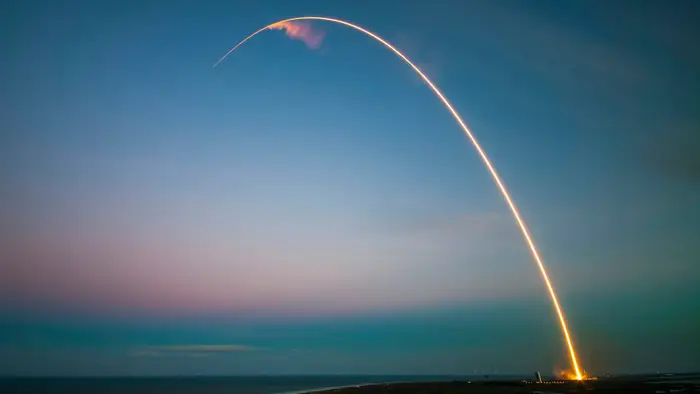
Starship lifted off from Starbase at 4:47 p.m. Central Time on November 13, at the start of a 75-minute window. Image: Unsplash.
Ship 42: the mission continues
If the booster was the disappointment of Flight 15, Ship 42 has so far been the vindication. The upper stage, nicknamed “Don’t Panic,” performed a clean ascent burn, received the go for its orbital insertion burn, and completed a second engine burn lasting about 20 seconds at 26 minutes and 10 seconds after launch, entering low Earth orbit at an altitude of about 275 kilometres. It is only the second Starship upper stage ever to reach orbit, after Ship 41 on Flight 14 in September.
Once in orbit, Ship 42 opened its payload bay and began deploying its cargo: 26 next-generation Starlink V3 broadband satellites. The deployment began about 35 minutes after launch and ran for roughly 42 minutes, with the final satellite released at about T+1 hour, 17 minutes and 40 seconds. SpaceX later confirmed that all 26 satellites had been deployed and that all 26 were in contact — the central payload objective of the flight, achieved in full.
The deployment itself carried a small experiment with large implications. After the first two satellites were released, Ship 42 paused and executed a 360-degree rotation so that three of the satellites, equipped with suites of cameras, could photograph the ship’s heatshield tiles from the outside. It was the first in-flight inspection of a Starship heatshield by its own payload, and the imagery will feed directly into the engineering of the heatshield that must survive the much harder reentry still to come at the end of this flight. The V3 satellites are larger and heavier than the versions Falcon 9 carries, designed specifically to launch aboard Starship rather than on the smaller rocket, and this batch alone adds about 1 terabit of data capacity to the Starlink network, which already counts more than 11,000 active satellites in low Earth orbit. SpaceX has said a single Starship can carry up to 60 Starlink V3 satellites at a time.
Ship 42 has since passed the first of its return checkpoints, a decision point off the coast of Hawaii at which SpaceX could have ended the flight early and sent the ship to a controlled ocean splashdown. Spokesperson Dan Huot confirmed the ship was greenlit to proceed past that checkpoint, and the flight remains on its planned profile: about 14 orbits of Earth over roughly 22 hours, ending with a return to Starbase for a catch attempt by the tower’s arms.
Flight 15 by the numbers
| Figure | Value |
|---|---|
| Flight | Starship Flight 15, first flight of the Version 3 (V3) system |
| Liftoff | Friday, November 13, 2026, 4:47 p.m. CT (05:47 WIB, Saturday, November 14) |
| Launch site | Starbase, Texas — Orbital Launch Pad 2 |
| Launch window | Opened 4:45 p.m. CT, 75 minutes |
| Vehicle | Super Heavy Booster 22 + Ship 42 (“Don’t Panic”) |
| Height / thrust | 407 ft (124 m); 17 million lb of thrust at liftoff |
| Engines | 33 Raptor engines on the booster; 6 on Ship 42 |
| Booster outcome | Catch aborted ~6.5 minutes after liftoff; diverted to the Gulf of Mexico |
| Ship 42 orbit | Low Earth orbit, ~275 km altitude, after a ~20-second burn at T+26:10 |
| Payload | 26 Starlink V3 satellites, all deployed and in contact |
| Deployment | Began ~T+35 minutes; complete at ~T+1:17:40 |
| Planned duration | ~22 hours, about 14 orbits |
| Ship catch attempt | Around 04:17 WIB, Sunday, November 15, at Pad 2 |
| Starlink capacity added | ~1 terabit per second from this batch of 26 satellites |
| Previous booster catches | 3 successful tower catches before Flight 15 |
Every figure in this table comes from the flight reporting published on November 13 and 14, and from SpaceX’s own flight timeline.
The road to the catch: Ship 42’s 22-hour flight
Timeline: Starship Flight 15
- 4:45 p.m. CT, November 13 — The 75-minute launch window opens at Starbase, Texas.
- 4:47 p.m. CT, November 13 — Starship lifts off from Orbital Launch Pad 2, the first flight of the V3 system.
- ~T+6 minutes 30 seconds — The catch attempt for Booster 22 is called off; the booster is diverted to a splashdown in the Gulf of Mexico, where it breaks apart on impact.
- T+26 minutes 10 seconds — Ship 42 completes a ~20-second second engine burn and enters low Earth orbit at about 275 kilometres.
- ~T+35 minutes — Deployment of the 26 Starlink V3 satellites begins.
- ~T+1 hour 17 minutes 40 seconds — Deployment complete; SpaceX confirms all 26 satellites are in orbit and in contact.
- ~T+7 hours 15 minutes — Second return checkpoint: SpaceX decides whether Ship 42 continues or diverts to a pre-cleared ocean zone.
- ~T+20 hours 41 minutes 55 seconds — Final checkpoint: the last decision on whether the ship returns over land for a catch or splashes down in the North Pacific.
- ~T+21 hours 35 minutes 57 seconds — Deorbit burn, lasting about 10 seconds, begins the journey home.
- ~T+22 hours 10 minutes 46 seconds — Reentry begins; Ship 42 performs its dynamic banking maneuver and turns out over the Gulf before heading back toward Pad 2.
- ~T+22 hours 32 minutes 16 seconds — Landing burn startup, the flip above the tower, and — if all goes to plan — the first-ever catch of a Starship upper stage, around 04:17 WIB on Sunday, November 15.
Three checkpoints are built into the orbital flight precisely because a ship returning over land is a different risk from a booster doing the same. At each one, SpaceX’s mission team can end the flight early and send Ship 42 to a controlled ocean splashdown — near Hawaii or off the coast of Chile — if anything looks unsafe. The final turn over the Gulf, just before the landing burn, is the last abort point: if something goes wrong there, the ship can still be diverted into the Gulf rather than toward the tower. SpaceX, as one report put it, is going to be extremely conservative in deciding whether to go ahead with the maneuver.
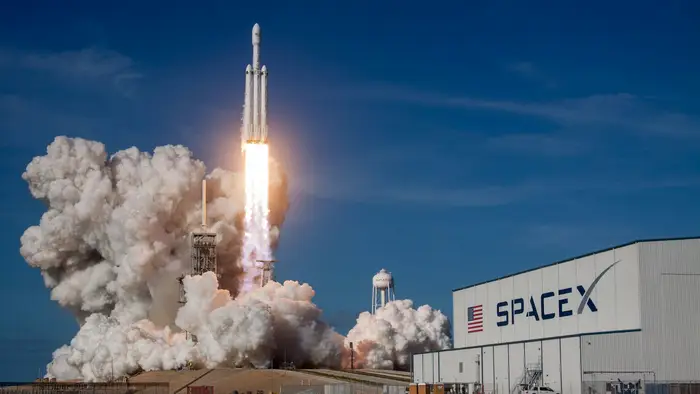
The double catch was the headline goal of Flight 15: recovering both stages of an orbital rocket on one mission. Image: Unsplash.
Why the double catch mattered
To understand why Friday’s flight was billed as SpaceX’s boldest test yet, it helps to remember what a catch actually is. A Super Heavy booster does not land on legs. It flies itself back to the launch mount, hovers, and is grabbed out of the air by two giant arms on the tower — the chopsticks — which then set it down on the pad, ready, in principle, to be refuelled and flown again within days. SpaceX has done this with a booster three times. It has never done it with the upper stage, the part of the rocket that actually goes to orbit, endures the heat of reentry, and comes home at orbital speed.
That is why Flight 15 was planned as a 22-hour mission rather than the shorter hops of earlier tests. The long coast gave Ship 42 time to prove its systems in orbit — deploying a full batch of satellites, testing its heatshield inspection cameras, and flying the thermal and power profiles of a real operational mission — before attempting the hardest part of the flight at the very end. A Starship that can launch, deploy a commercial payload, and then land both of its stages back on the pad is a different machine from one that merely reaches orbit. It is the machine SpaceX needs to make Starship cheap enough for Moon and Mars missions, and it is the machine NASA is counting on to land astronauts on the Moon.
The Artemis connection is direct. NASA is paying SpaceX billions of dollars to develop a Starship-based system to land Artemis astronauts on the lunar surface by as early as 2028, and NASA Administrator Jared Isaacman marked the launch with a public message of congratulations. “Congratulations to the SpaceX team on another spectacular launch,” Isaacman wrote. “Very much appreciate how you bring the world along in high resolution. We are looking forward to some of that on-orbit Starlink capability on Artemis III.” As a preparatory step, NASA is planning to test Starship as well as Blue Origin’s Blue Moon landing system in low Earth orbit next year — a test Isaacman has associated with the Artemis 3 mission. Readers who want the background on that programme can start with our earlier reporting: Starship Flight 15 Double Catch: SpaceX’s Boldest Test Yet, Isaacman SLS Path 2030s: NASA’s Plan to Standardize the Moon Rocket, and Artemis II Crew Retire November 2026: All Four Astronauts Step Away After Historic Moon Flyby.
There is also a commercial logic that has nothing to do with the Moon. Starlink is now SpaceX’s profit centre, and Starship is the only vehicle that can loft the big V3 satellites in bulk — up to 60 at a time, against the smaller loads Falcon 9 carries. Every Starship flight that deploys a full batch of V3 satellites is simultaneously a test flight and a revenue flight, and Friday’s deployment of 26 satellites in contact is the second such batch in a row. The first V3 batch flew on Flight 14, and the cadence is the point: SpaceX is using its test programme to build its constellation.
The launch went ahead against an unusual backdrop. On Friday, the US Federal Aviation Administration issued a nationwide ground stop after reporting communication problems affecting air traffic, according to the Times of India — a disruption that grounded commercial flights across the country. Starship, flying from its own range at Starbase under its own launch licence, lifted off anyway.
What Flight 14 taught SpaceX
Flight 15 did not come out of nowhere; it was built directly on the two flights before it, and the comparison shows how fast the programme is moving — and where its weak points still are.
Flight 13, flown by Ship 40, was the cleanest of the recent series: a clean ascent, deployment of all 20 Starlink V3 satellites, the unfurling of their solar arrays for testing, and then a clean reentry and splashdown, intact, in the Indian Ocean. Flight 14, on September 28, went further — Ship 41 became the first upper stage to reach orbit and deployed all 26 of its Starlink V3 satellites — but then a helium leak and an engine loss forced SpaceX to cut the planned near-10-hour mission short and bring the ship down in a contingency zone in the North Pacific.
Flight 15 is the answer to both. It took Flight 14’s orbital success and stretched it into a full 22-hour, 14-orbit mission with a catch attempt at the end, and it took Flight 13’s clean deployment record and repeated it with a larger batch and a new trick — the heatshield inspection cameras carried by three of the satellites. The booster abort is the one place where Flight 15 went backwards relative to its predecessors: the three successful booster catches before it show the maneuver works, but Friday showed it does not work every time, and that the abort criteria are strict enough to throw away a booster rather than risk the tower.
That strictness is itself a data point. A catch system that aborts at the first sign of trouble is a catch system that protects the pad — and the pad, with its tower and arms, is the single most expensive and hardest-to-replace piece of the whole operation. SpaceX will review the booster telemetry to identify the specific trigger behind the abort, and the fix, whatever it is, will be tested on the next flight. The programme’s history suggests the wait will not be long.
What happens next
As this article is published, Ship 42 is still in orbit, and the decisive hours of Flight 15 are still ahead. The ship must pass its remaining checkpoints — the second return decision about seven hours into the flight, and the final one at about T+20 hours 41 minutes — before the deorbit burn at about T+21 hours 35 minutes begins the journey home. Reentry follows at about T+22 hours 10 minutes, and then the landing burn, the flip above the tower, and the catch, at about T+22 hours 32 minutes.
If the catch succeeds, Flight 15 will still make history — just a different history from the one planned. It will be the first time any rocket’s upper stage has been recovered at its launch site after an orbital flight, the first full demonstration that a Starship can go to orbit, work there, and come home to the pad. If SpaceX waves it off at any checkpoint, Ship 42 will splash down in the ocean instead, and the catch will wait for Flight 16.
Either way, Friday has already answered one question and sharpened another. The answer: Starship can fly its longest, most operational mission yet and deliver its payload even when half the recovery plan fails. The sharpened question: how reliably can the booster be brought home? SpaceX has caught three. It has now lost one to an abort. The ratio, and the reason, will decide how quickly the double catch — the flight this mission was named for — gets its second attempt.

Ship 42 will complete about 14 orbits before its deorbit burn begins the journey home. Image: Unsplash.
The Starship programme has always been a public experiment, flown in the open with the failures visible alongside the successes. Friday was no exception: a booster lost to the sea, a ship still flying, and a catch attempt still to come. By Sunday morning, Jakarta time, we will know whether the second half of the plan lands — or whether the chopsticks will have to wait for another day.

From orbit, Ship 42’s 26 Starlink V3 satellites join a constellation of more than 11,000 active spacecraft. Image: Unsplash.
Sources
- Cosmic Log: Starship soars, but SpaceX misses out on booster catch
- NASASpaceFlight: Starship Flight 15 — Ship 42 orbital, Booster diverts to ocean
- Starlust: SpaceX launches Starship Flight 15 — Booster catch called off, history still on the cards
- Digital Today: SpaceX Starship 15th launch successful, booster catch aborted