Isaacman SLS Path 2030s: NASA's Plan to Standardize the Moon Rocket
NASA’s most expensive rocket is about to get simpler, cheaper to fly, and — if Administrator Jared Isaacman gets his way — a lot busier. In a wide-ranging interview on NASASpaceflight’s The Flame Trench show, Isaacman laid out the clearest picture yet of where the Space Launch System (SLS) is headed over the next decade: one standardized configuration, a borrowed upper stage, a single mobile launcher, and a flight rate the rocket has never achieved. The destination is not a retirement party for SLS. It is a bridge — a way to keep flying crews to the Moon through the 2020s while commercial systems mature enough to take over in the 2030s.
The interview, published on November 10, 2026, is the fullest explanation yet of decisions NASA announced in stages through October: the abandonment of SLS Block 1B and its Exploration Upper Stage (EUS), the move toward a stretched version of United Launch Alliance’s Centaur V upper stage, and the halt of work on Mobile Launcher 2 (ML-2). Each of those choices was controversial in its own right. Taken together, Isaacman argued, they add up to a single strategy: stop redesigning the rocket, start flying it, and let frequency do what redesigns could not — bring the cost per flight down.
“There are a lot of ways to shake the $4 billion disposable rocket label that SLS has carried and one of which is launch more frequently,” Isaacman said. “There is nothing about pushing it off into next year that makes anything cost less.”
That sentence is the thesis of NASA’s current lunar policy. For years, SLS has been attacked on two fronts at once: it costs too much, and it flies too rarely. Isaacman’s answer is that the two criticisms are really one problem. A rocket that flies once every year or two carries the full weight of its factories, its workforce, and its ground systems on every launch. A rocket that flies on a regular rhythm spreads those fixed costs across more missions — and, just as importantly, keeps the people who build and fly it practiced. The plan he described is built around that logic, and it reaches from the rocket’s upper stage all the way to the concrete tower that carries it to the pad.
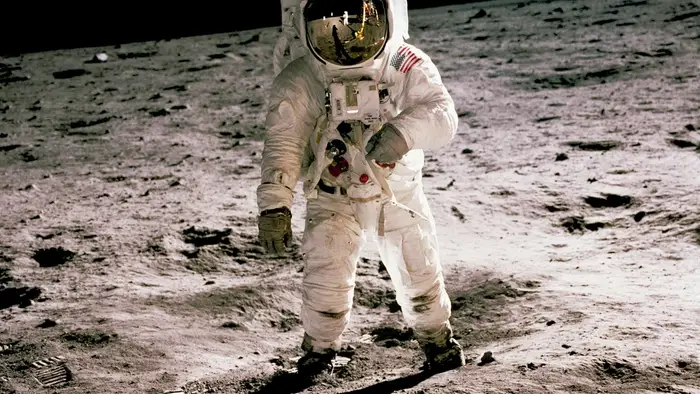
An Apollo astronaut on the lunar surface. NASA’s current plan keeps SLS flying crews into the 2030s while commercial lunar transport matures. Image: Unsplash.
The $4 Billion Label NASA Wants to Shake
The “$4 billion disposable rocket” figure has shadowed SLS for years, repeated by critics in Congress, in the press, and across the space community. The number is an estimate of the cost of a single SLS launch once the price of the rocket, the ground systems, and the program’s fixed costs are all counted — and it has stuck because the rocket’s flight rate has made it hard to argue with. Artemis I flew uncrewed in 2022. Artemis II, the first crewed flight, looped around the Moon in April 2026, ending a 53-year gap since humans last travelled beyond low Earth orbit. Between those milestones stretched years of quiet, during which the rocket’s factories and launch teams were sustained by a trickle of work.
Isaacman’s argument is that delay is itself a cost driver. Every year a rocket sits on the ground, its production line still needs to be maintained, its engineers still need to be paid, and its suppliers still need to be kept warm — all without a launch to show for it. Pushing a flight into next year, in his telling, does not make the program cheaper. It makes each flight carry more overhead. The remedy is the opposite of what NASA has often done when costs rose: instead of pausing to redesign, fly the rocket you have, fly it on a steady cadence, and improve the operations around it.
That is why the word Isaacman kept coming back to was “standardize.” A standardized SLS means the same core stage, the same boosters, and the same upper stage, flight after flight — no more bespoke configurations for each mission, no more one-off development programs layered on top of the vehicle. Standardization is what lets a production line find its rhythm, and rhythm is what lets costs fall. It is also, notably, the approach that commercial launch providers have used to drive their own costs down: build the same rocket, over and over, and let the learning curve do its work.
The plan is not without risk. Standardization means committing to a configuration before every question about it is answered — including the question of which upper stage the rocket will ultimately fly. That is where Centaur V comes in.
Centaur V and a Standardized SLS
The biggest technical decision in Isaacman’s outline concerns the top of the rocket. Artemis IV was previously intended to introduce SLS Block 1B, with the powerful Exploration Upper Stage taking the place of the smaller Interim Cryogenic Propulsion Stage (ICPS) used on the first Artemis flights. NASA has now abandoned Block 1B and the EUS entirely. In their place, the agency is moving toward a near-Block 1 configuration that uses a stretched version of ULA’s Centaur V upper stage — a stage that already exists, already flies, and is already in production for another rocket.
Centaur V is the upper stage of ULA’s Vulcan rocket. It first flew on Vulcan’s Cert-1 mission in January 2024, and the broader Centaur family carries decades of flight heritage stretching back to the earliest days of American spaceflight. That heritage is the point: rather than continuing to develop an upper stage dedicated to SLS alone, NASA would adopt a stage whose production line, supply chain, and flight record already exist. The stretched version planned for NASA remains in development, and Isaacman said the agency had originally intended to use the existing Centaur configuration before deciding to pursue the higher-performance stretched version — part of an effort to move Orion closer to the Moon and simplify the job of the lunar landers waiting there.
The choice carries a deliberate trade-off. A dedicated stage, built to SLS’s exact requirements, could in theory be optimized for the job. But it would also be a stage that flies only on SLS, at SLS’s flight rate, with all of its development and production costs borne by a single program. Centaur V spreads those costs across two rockets. Isaacman also expects the stretched stage to fly on Vulcan for Department of Defense missions, not just on SLS — a second customer that helps keep the production line warm between NASA flights.
Development is proceeding in parallel where practical. Isaacman said material testing was progressing, with NASA and ULA carrying out development activities side by side, and NASA was helping address production constraints by finding personnel and equipment across its centers. The first mission to use the new stage remains undecided. As NASASpaceflight reported following NASA’s October update, the revised Artemis III mission — now a low-Earth-orbit test flight — will not need an upper stage at all, which leaves the final ICPS available for Artemis IV. NASA’s November 4 update confirms that both ICPS and a stretched Centaur V remain options for Artemis IV, giving the agency a fallback if the new stage is not ready in time.

A blood-red Moon during a total lunar eclipse. Artemis IV is targeted to return astronauts to the lunar surface in 2028. Image: Unsplash.
The New SLS Configuration at a Glance
| Element | The Plan as Laid Out by Isaacman |
|---|---|
| Core stage and boosters | Standardized Block 1 configuration, flown the same way on every mission |
| Upper stage | Stretched Centaur V, in development with ULA; ICPS remains an option for Artemis IV |
| Upper stage heritage | Centaur V first flew on Vulcan Cert-1 in January 2024; Centaur family has decades of flight history |
| Mobile launcher | ML-1 modified for the new configuration; work on ML-2 stopped |
| Flight cadence goal | Crewed flights at least once a year, ideally less than 12 months apart |
| 2028 ambition | Preserve the possibility of two launches in a single year |
| Long-term goal | Two transportation pathways supporting crewed lunar missions every six months |
| Orion’s future | Likely to remain part of the architecture into the 2030s, possibly on other launch vehicles |
ML-2: Largely Built, Years From Ready
If the Centaur V decision was the most technical of Isaacman’s announcements, the fate of Mobile Launcher 2 was the most emotional. ML-2 is the giant steel tower that was supposed to carry the Block 1B version of SLS to the pad. It is a conspicuous structure at Kennedy Space Center — visibly, substantially built — and its cancellation has been read by many observers as the most visible symbol of the Block 1B decision. Isaacman acknowledged the disappointment directly, but he argued that the tower’s appearance is misleading.
“If you’re going to launch even on an eight-month cadence, you do not need the second mobile launcher. I know that’s heartbreaking for some out there and believe me that was nowhere near as ready as people believe it to be,” he said.
The point, as NASASpaceflight’s earlier coverage of the tower’s final module also noted, is that construction milestones are not the same thing as operational readiness. A tower can be structurally complete and still be years away from supporting a launch: the umbilicals, the propellant lines, the electrical systems, the software, and the testing all come after the steel. Isaacman said NASA should instead concentrate on getting very good at operating a single mobile launcher — ML-1 — and the modifications to ML-1 are already being designed, with hardware on order. Work that would not affect Artemis III can proceed in parallel, while changes that would remove the ability to fly ICPS will be deferred as long as practical, preserving the fallback option for Artemis IV.
Work on ML-2 has stopped. The partly built structure remains outside for now, but NASASpaceflight understands it will eventually be moved into the Vehicle Assembly Building. Its story does not end with abandonment, though. Isaacman said NASA has been using parts from the tower — along with hardware from the canceled EUS — as government-furnished equipment to help Blue Origin with its pad rebuild and its landers. Blue Origin is still recovering from the explosion at Launch Complex 36 in May, and its rebuilt Vehicle Access Tower was fully restacked on October 24, with the company aiming to fly again by the end of the year. NASA is also using the hardware to give younger engineers and technicians hands-on experience before they move on to other parts of the lunar architecture. Isaacman did not rule out using ML-2 again, but he described that prospect as highly unlikely.
The episode captures something important about how NASA is now managing its lunar program: hardware is being treated as a shared resource across the Artemis architecture rather than as the property of a single vehicle. Parts built for a canceled rocket stage are now helping rebuild a commercial company’s launch pad. A tower built for a canceled configuration is being mined for components and training value. It is a pragmatic approach, and it is a long way from the era in which each element of the lunar program was developed in isolation.
Cadence and Competition Beyond Artemis V
The goal Isaacman set out is specific: fly crews at least once a year, ideally with less than 12 months between missions. Improving production and ground operations, he said, would also preserve the possibility of two launches in 2028 — the year Artemis IV is targeted to return astronauts to the lunar surface. That is a striking ambition for a program that has flown once every few years, and it is the clearest sign yet that NASA’s leadership sees flight rate, not just vehicle performance, as the measure of the program’s health.
He linked the work to rebuilding NASA’s operational experience, including the skills needed for more complex missions involving Orion, transfer stages, and a lunar base. That last phrase matters. The Artemis program’s stated end state is not a series of flags-and-footprints landings but a sustained presence — a lunar base, regular surface operations, and eventually a foundation for crewed missions to Mars. Getting there requires a workforce that has actually flown complex missions recently, not one that relearns its craft between flights years apart. Cadence, in this view, is not just an efficiency measure. It is how an agency keeps its skills alive.
The competitive backdrop is never far from Isaacman’s remarks. In the October 23 update, he warned that “the campaign must move with urgency as strategic competitors pursue a permanent presence beyond Earth.” China has stated its own crewed lunar landing ambitions for around 2030, and its Long March 10 rocket and lunar program are advancing on a public schedule. NASA’s accelerated Artemis plan — the 2027 orbital rehearsal for Artemis III, the 2028 landing target for Artemis IV — is framed inside the agency as a race not just to return, but to stay.
The full Moon. NASA’s plan aims for crewed flights at least once a year, with two launches possible in 2028. Image: Unsplash.
What Artemis III and IV Actually Look Like Now
To understand the SLS decisions, it helps to see the missions the rocket will actually fly. The Artemis program has been reworked substantially since the October updates, and the two missions at the front of the queue look very different from the original plan.
Artemis III, now planned for 2027, is no longer a Moon landing. It is a 14-day test flight in low Earth orbit, carrying four astronauts aboard Orion, that will rehearse the rendezvous and docking operations the landing missions will depend on. The mission will unfold as a carefully sequenced campaign across three launches from three providers: Blue Origin will launch a Blue Moon lander test article into Earth orbit first, and SLS will only launch Orion and its crew once that lander is confirmed on orbit and checked out — a test article that can loiter for up to about 30 days. Then SpaceX will launch a Version 3 Starship lander test article while Orion undocks from Blue Moon and docks with Starship. The crew will enter Blue Moon; the Starship docking test will run for up to two hours without crew entry. The lander, Isaacman has said, is the mission’s main schedule bottleneck: Blue Origin does not yet have a fully assembled test article, and hull welding on it is expected to finish around January 2027.
Artemis IV, targeted for 2028, is the mission that returns astronauts to the lunar surface. Astronauts will launch aboard Orion on SLS from Kennedy Space Center, and NASA is working with SpaceX and Blue Origin to develop the landers that will carry them down. Both companies have redesigned their approaches to simplify the missions: SpaceX’s Starship will refuel in Earth orbit, rendezvous with Orion, and then carry the spacecraft toward the Moon, while Blue Origin’s approach involves transfer stages in Earth orbit to push its Blue Moon Mark 2 lander toward the Moon, where it will meet Orion in a closer lunar orbit before descending to the surface. Both companies are targeting the ability to support a crewed lunar landing in 2028.
The SLS that flies these missions will be a shorter, simpler rocket than the one originally planned. The Artemis III core stage has already been mated with its twin solid rocket boosters inside the Vehicle Assembly Building, completing the Moon rocket’s short-stack configuration ahead of checkouts and a tanking test at Launch Pad 39B — a story SpaceNews covered in October, when the stacking was completed. And the program’s processing timelines have been sharply reduced — by about half, according to NASA’s October update — while a critical fuel-line component was redesigned, built, and tested in-house in five months at roughly a tenth of the cost of an earlier outside-vendor estimate. “NASA should be expected to do this kind of work,” Artemis program manager Jeremy Parsons said at the time, “and we have some of the best technical knowledge in the world on rocket hardware and operations to do it.”
For readers catching up on how the program reached this point, SpaceNews has followed the reworked plan in detail: Artemis III Blue Moon First Launch 2027: NASA Will Not Commit SLS Until the Lander Is in Orbit explains the sequencing and the go/no-go logic, while NASA’s Artemis Acceleration: the 2028 Moon Landing Plan After the Big October Update covers the October 23 briefing in full.
The Commercial Handoff
The most consequential part of Isaacman’s interview may be the part that looks furthest ahead. NASA issued a request for information (RFI) on commercial lunar transportation in March, with responses due in April. The RFI asked industry what future systems could support a sustained lunar presence. It was not a contract award, and Isaacman was careful to say so. But the responses, he revealed, pointed to the 2030s rather than an immediate replacement for the existing system — industry did not offer an end-to-end solution for 2028 or 2029.
That finding is the reason SLS has a future at all in Isaacman’s plan. If commercial providers had been ready to take over lunar transport by the end of this decade, the argument for continuing to invest in SLS would have been far weaker. Instead, the RFI results gave NASA a timeline: keep SLS flying through the 2020s, standardize it and fly it often enough to bring costs down, and prepare for a transition in the 2030s when commercial systems are ready. The longer-term objective is two transportation pathways supporting crewed lunar missions every six months — a cadence no single system could sustain alone, and a redundancy that would protect the program if one provider stumbled.
Crucially, Isaacman did not describe the eventual transition as an abrupt replacement. Orion, he said, was likely to remain part of the architecture into the 2030s, potentially using other launch vehicles and transfer stages. That is a significant statement about the spacecraft that has been, until now, inseparable from SLS in the public imagination. Orion as a spacecraft and SLS as a rocket may be decoupled in the 2030s: the crew vehicle could fly on a commercial launcher, or on a mixed architecture of transfer stages, while SLS itself is retired or repurposed. The idea is consistent with the broader direction of the Artemis program, in which NASA has steadily shifted from owning every element of the architecture to buying services from commercial providers — landers, spacesuits, and now, eventually, transportation itself.
The shift is already visible in the hardware around the program. NASA announced plans with spacesuit provider Axiom Space to develop a second, lighter suit design called the “Sortie suit” to enable the first moonwalks. The Sortie suit will not replace Axiom’s primary suit, which will be used for longer, more demanding missions in the future — it is roughly half the weight of the larger suit and lets NASA move faster on the earliest surface missions. It is the same pattern as Centaur V: use what exists, adapt it, and avoid building a bespoke system where a shared one will do.

Astronaut training preparations. NASA says rebuilding operational experience is a central goal of flying SLS more often. Image: Unsplash.
The Road to the 2030s: Key Dates
- March 2026 — NASA issues a request for information on commercial lunar transportation; industry responses are due in April.
- April 2026 — Artemis II carries a crew around the Moon, ending a 53-year gap since humans last travelled beyond low Earth orbit.
- October 23, 2026 — NASA’s acceleration update: Artemis III becomes a 2027 low-Earth-orbit test flight, Artemis IV targets a 2028 Moon landing, and two upper-stage options are announced for SLS.
- October 24, 2026 — Blue Origin’s rebuilt Vehicle Access Tower is fully restacked after the May pad explosion, with the company aiming to fly again by the end of the year.
- October 31, 2026 — Isaacman tells NASASpaceflight that SLS will not launch for Artemis III until Blue Origin’s Blue Moon test lander is in orbit and checked out.
- November 4, 2026 — NASA’s update confirms both ICPS and a stretched Centaur V remain options for Artemis IV.
- November 10, 2026 — Isaacman lays out the SLS path to the 2030s on NASASpaceflight’s The Flame Trench: standardized SLS, stretched Centaur V, ML-2 stopped, annual crewed flights.
- 2027 — Artemis III: a 14-day, four-astronaut Earth-orbit rehearsal with Blue Moon and Starship lander test articles.
- 2028 — Artemis IV: targeted crewed Moon landing, with the possibility of two SLS launches in the year.
- 2030s — Commercial lunar transportation pathways come online; crewed lunar missions every six months become the goal, with Orion likely still flying.
Why Standardization Matters
Step back from the details and the shape of the decision becomes clear. For most of its life, SLS has been a program defined by its exceptions: a different upper stage for each block, a second mobile launcher for a configuration that had not yet flown, a flight rate measured in years. Each exception was justified on its own terms — a more powerful stage for heavier payloads, a second launcher to protect the schedule — but together they produced a rocket that was always being redesigned and rarely flying.
Isaacman’s plan inverts that logic. The rocket’s configuration is frozen, more or less, so that the organization around it can improve. The upper stage is borrowed from a rocket that already flies. The second launcher is abandoned so the first one can be mastered. The savings, if they come, will come from repetition: the same vehicle, the same ground systems, the same teams, doing the same job often enough to get good at it. It is a bet that operational learning matters more than paper performance — and it is a bet the commercial launch industry has already won, several times over.
Whether the bet pays off will be measurable in the most concrete way possible: the gap between launches. If Artemis III flies in 2027, Artemis IV in 2028, and a successor mission follows within twelve months of that, the plan will have done what no SLS plan before it has done — produce a rhythm. If the gaps stretch again, the “$4 billion disposable rocket” label will return, and the argument for an earlier commercial handoff will grow louder. The next few years will answer the question, one launch at a time.
For now, the direction is set, and it is the clearest the program has had in years. NASA will fly the rocket it has, as often as it can, while building the commercial future that will eventually replace it. As Isaacman put it, there is nothing about pushing a flight off into next year that makes anything cost less — so the agency, at last, has stopped pushing.

A reddish full moon among the stars. The Moon is the proving ground for the deeper-space ambitions that follow. Image: Unsplash.
For the wider context of how NASA’s lunar plan was reworked this year — from the scrapping of the Lunar Gateway to the repurposed Artemis III rehearsal and the race between two commercial landers — see Six Months After Artemis II: Inside NASA’s Reworked Plan to Put Astronauts Back on the Moon.