Starship Flight 15 Double Catch: SpaceX's Boldest Test Yet
On Friday, November 13, 2026, the world’s largest rocket will attempt something no launch system has ever done. SpaceX’s Starship Flight 15 is targeting a 75-minute window that opens at 4:45 p.m. Central Standard Time — 22:45 UTC, or 05:45 WIB on Saturday, November 14 — from Orbital Launch Pad 2 at Starbase, Texas. If the plan holds, the flight will deploy 26 next-generation Starlink V3 satellites into low Earth orbit, then bring both stages of the vehicle home to be caught by the launch tower’s mechanical arms. The Super Heavy booster is due back about six and a half minutes after liftoff. The Ship will not return for more than 22 hours, after circling the planet roughly 14 times.
No orbital rocket has ever been fully recovered. SpaceX has caught the Super Heavy booster three times, but never a Starship upper stage, and never both stages on the same flight. Flight 15 is the attempt to close that gap in a single mission — and it is also the first operational payload flight for the new Block 3, or V3, generation of Starship hardware. The stakes are correspondingly high: success would prove the architecture that SpaceX intends to fly to the Moon and Mars, and that it plans to begin reusing routinely from 2027. Failure, at any of a dozen decision points, would send the mission to one of five pre-planned ocean splashdown zones instead.
The launch remains pending regulatory approval as of November 12. SpaceX published its Flight 15 mission page and announced the window on November 7, and the hardware has been at the pad for days — Booster 22 was rolled out and lifted onto the launch mount on November 10, and Ship 42 was moved to the pad on November 13. But the Federal Aviation Administration licence that covered Flight 14 applied to that flight only, and Flight 15 requires a modification, including permission for the Ship to return to Starbase on a trajectory that overflies populated areas. Until that approval lands, the window is a target, not a guarantee.
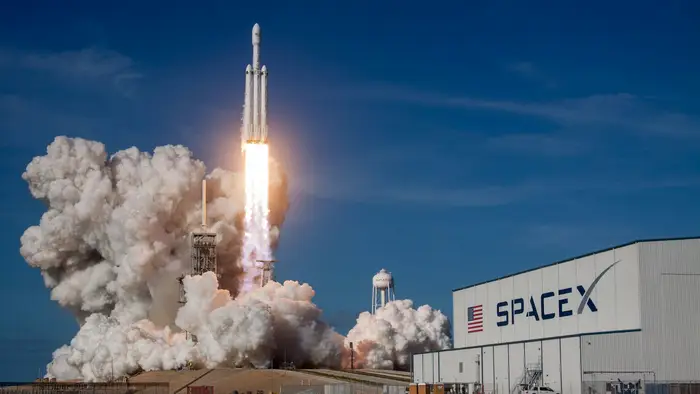
Starship Flight 15 will lift off from Orbital Launch Pad 2 at Starbase, Texas, in the most ambitious test of the programme so far. Image: Unsplash.
The Double Catch, in Plain Terms
Catching a rocket booster with a tower sounds like a stunt. It is, in fact, the core of SpaceX’s plan to make Starship fully and rapidly reusable. A conventional reusable booster needs landing legs, which add mass and complexity, and it needs to be transported back to the pad after landing. The Mechazilla tower at Starbase does away with both: two mechanical arms — nicknamed chopsticks — close around the booster as it descends, guided by the grid fins on its upper section, and hold it in place on the mount. The booster can, in principle, be refuelled and reflown from the same structure.
SpaceX has already proved the booster half of that idea. The tower has caught Super Heavy three times, all with V1 boosters, and two of those boosters were reflown. The last catch came in March 2025, which means Flight 15 would end a gap of about 20 months — and it would be the first catch of a V3 booster, the new Block 3 generation powered by Raptor 3 engines and flying from an entirely new launch pad.
The Ship half is new territory. No Starship upper stage has ever been caught. The upper stage is a far harder target than the booster: it returns from orbit at roughly 27,000 kilometres per hour, survives re-entry heating on its heat shield, and must arrive at the tower with its engines, flaps and guidance all working after more than 22 hours in space. SpaceX has said flight controllers will only permit the Ship to return to Starbase if the vehicle’s status meets conditions developed internally and approved by the FAA. If anything is off, the Ship will divert to the ocean instead.
That conditional return is the defining feature of Flight 15. The booster catch is scheduled for about six minutes and 35 seconds after liftoff — a manoeuvre SpaceX has done before, albeit not with this generation of hardware. The Ship catch is scheduled for about 22 hours and 32 minutes after liftoff, on Saturday, November 14, at a planned 21:17 UTC (3:17 p.m. CST, or 04:17 WIB on Sunday, November 15). Between those two moments lies a full day of orbital operations, and the second catch is the one that has never been attempted.
Flight 15 by the Numbers
The mission profile published by SpaceX is precise, and it is worth laying out in full, because every number in it is a test objective.
| Mission element | Flight 15 figure |
|---|---|
| Launch vehicle | Starship Block 3 (V3) |
| Booster | Super Heavy Booster 22 |
| Ship | Ship 42, named Don’t Panic |
| Launch site | Orbital Launch Pad 2, Starbase, Texas |
| Launch window | Nov 13, 2026, 4:45–6:00 p.m. CST (22:45 UTC; 05:45 WIB Nov 14) |
| Window length | 75 minutes |
| Payload | 26 Starlink V3 satellites |
| Capacity per V3 satellite | About 1 terabit |
| Equivalent Falcon 9 launches | About 10 Starlink V2 Mini launches |
| Stage separation | About T+2 minutes 21 seconds |
| Booster catch | About T+6 minutes 35 seconds |
| Orbital altitude | About 275 km (170 miles) |
| Orbits planned | About 14 |
| Planned mission duration | 22 hours 33 minutes |
| Ship catch | About T+22 hours 32 minutes (Nov 14, 21:17 UTC) |
| Contingency splashdown zones | 5 (Indian Ocean, Pacific, Gulf of Mexico, offshore Hawaii, offshore Chile) |
| Previous full-stack flights | 14, since April 2023 |
| Previous booster catches | 3, all V1 boosters |
The payload deserves attention on its own. The 26 Starlink V3 satellites are the first operational cargo Starship has ever carried, and each one adds roughly a terabit of capacity to the Starlink constellation. Taken together, the 26 satellites equal about ten Falcon 9 launches’ worth of V2 Mini satellites — a measure of how much the larger Starship payload bay changes the economics of building a megaconstellation. Flight 15 is therefore not only a reusability demonstration; it is the first time Starship does a paying job while proving itself. That combination is deliberate. SpaceX has described the flight as the mission designed to demonstrate the fully reusable operational architecture of the Starship stack, and the satellite deployment is the operational half of that sentence.
The Block 3 designation matters too. Booster 22 and Ship 42 are the fourth pair of Block 3 vehicles to fly, and the V3 generation brings Raptor 3 engines, upgraded heatshield tile configurations — including curved tiles tested on this flight — and a new launch pad in the form of OLP-2. Flight 15 is the first V3 booster return attempt, and the Ship will spend its long orbital coast testing long-duration thermal protection, which is exactly the kind of endurance that a vehicle flying to the Moon or Mars will need.
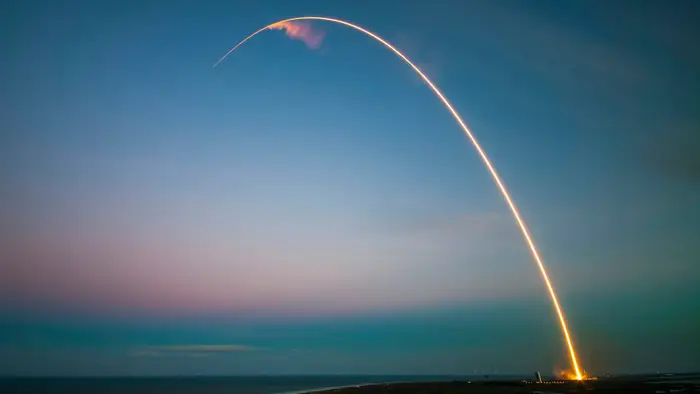
The launch arc of a heavy rocket at dusk — Flight 15’s booster is due back at the tower about six and a half minutes after liftoff. Image: Unsplash.
Why the Ship Catch Is the Hard Part
The booster catch, for all its drama, is a solved problem in outline. Super Heavy separates about two minutes and 21 seconds after liftoff, performs a boostback burn to return to the launch site, and descends to the tower, where the arms catch it by its grid fins. SpaceX has done this three times. The variables on Flight 15 are the new V3 hardware and the new pad, not the manoeuvre itself.
The Ship catch is a different order of difficulty, and the mission profile is built around managing it. After deploying its 26 satellites, Ship 42 will coast in orbit for roughly another 21 hours until its orbit aligns with Starbase for the return. During that long coast it will test its upgraded heatshield in the environment that matters — sustained orbital flight, not a brief suborbital hop. Then comes a precision deorbit burn, a re-entry over inhabited areas of northern Mexico and southern Texas, and a final approach to the tower that must be aborted to the ocean if any system is not ready.
That overflight of populated areas is the reason the FAA approval is not a formality. The licence for Flight 14 covered only that flight, and Flight 15 needs a modification that explicitly permits the Ship’s return trajectory. SpaceX has said the return will only be permitted if the vehicle meets internally developed, FAA-approved conditions, and residents of Cameron County in Texas may hear one or more sonic booms as the Ship comes home. The company has marked five contingency landing areas — in the Indian Ocean, the Pacific Ocean, the Gulf of Mexico, and offshore of Hawaii and Chile — and the Ship can also be destroyed in the air if proceeding with the mission is no longer feasible.
The contingency planning is not pessimism; it is the lesson of Flight 14. That flight, on September 28, 2026, was the first Starship to reach orbit, but it was planned as a nearly 10-hour mission and had to be cut short after the upper stage encountered problems with its engines. Ship 41 splashed down in the Pacific about three hours after liftoff and tipped over in a fireball. Flight 15’s Ship is being asked to do more than twice that duration, with a far more demanding ending. The five splashdown zones exist because SpaceX knows, from direct experience, that the long orbital profile is where things can go wrong.
There is also the simple matter of endurance. A Ship that spends 22 hours in orbit must keep its propellant, power, thermal control and avionics healthy through 14 day-night cycles, then fire its engines for a deorbit burn after a day of coasting. That is the difference between a demonstration flight and an operational spacecraft, and it is the capability that lunar and Mars missions will depend on. The heatshield work is part of the same story: the upgraded curved tile configurations on Ship 42 are being tested precisely because a vehicle returning from the Moon or Mars will face far harsher re-entry heating than a vehicle returning from low Earth orbit.
Timeline: From Static Fires to the Catch
Flight 15 has been building for weeks, and the milestones along the way explain why SpaceX is confident enough to attempt the double catch now.
- October 20, 2026 — Reporting confirms the double-catch plan: both stages targeted for tower recovery, with the booster due back on November 13 and the Ship on November 14.
- October 25, 2026 — Booster 22 completes its static fire at Pad 2, Starbase.
- October 26, 2026 — Ship 42 completes a single-engine static fire at Massey’s test site.
- October 27, 2026 — Ship 42 completes a full-duration six-engine static fire at Massey’s, with all six engines firing.
- October 28, 2026 — SpaceX confirms completion of the Ship 42 static fires in a post on X.
- November 7, 2026 — SpaceX publishes the Flight 15 mission page and announces the launch window in a post on X, noting that the flight is pending regulatory approval.
- November 10, 2026 — Booster 22 is rolled to the launch pad, lifted onto the launch mount at Pad 2, and used for final catch testing, including a suspended squeeze test at catch height.
- November 11, 2026 — SpaceX’s Flight 15 mission page confirms the flight will be the first return and catch attempt for a Super Heavy V3 booster.
- November 12, 2026 — Fresh NOTAMs confirm active preparations, with airspace closures filed for Starbase on November 14 and for the Oakland Oceanic flight information region on November 15, aligning with Ship 42’s expected re-entry and splashdown corridor. The launch is still pending regulatory approval.
- November 13, 2026 — Ship 42 is moved to the Starbase pad, and SpaceX confirms the stack is in position for the launch window opening at 4:45 p.m. CST.
- November 13, 2026, about T+6:35 — Planned booster catch at the Mechazilla tower.
- November 14, 2026, 21:17 UTC — Planned Ship catch at Starbase, about 22 hours and 32 minutes after liftoff, if the vehicle passes its return checks.
The static-fire sequence is worth noting because it is the most concrete evidence of readiness. A single-engine firing proves the plumbing; a full-duration six-engine firing proves the Ship can run all of its engines together for the length of a burn. Booster 22’s static fire at the pad, followed by the suspended squeeze test — in which the booster is held at catch height to verify the tower arms can take its weight — is the same kind of end-to-end verification. None of this guarantees a clean flight, but it is the reason the double catch is an attempt rather than a hope.

Ship 42 will spend more than 22 hours in orbit at about 275 kilometres altitude before its return attempt. Image: Unsplash.
The Regulatory Hurdle
The most uncertain part of Flight 15 is not the hardware. It is the paperwork. As of November 12, the launch was still pending regulatory approval, and the FAA licence for Flight 14 covered only that flight. The modification SpaceX needs is not a rubber stamp: it includes permission for Ship 42 to return to Starbase on a trajectory that passes over inhabited areas, which is a different safety case from the ocean splashdowns that ended earlier flights.
This is the part of the story that is easy to overlook and hard to overstate. The double catch is only possible if the Ship is allowed to come home over land. Every previous Starship flight ended with the upper stage in the ocean, and the shift to a land return is a regulatory decision as much as an engineering one. The FAA-approved conditions for the return — the internal criteria SpaceX says flight controllers will apply before permitting the Ship to head for the tower — are the mechanism that makes the attempt licensable. If the Ship’s status does not meet those conditions at the decision point, it goes to the ocean, and the catch attempt is over before it begins.
There is precedent for the schedule slipping on exactly this point. Previous Starship flights have slipped days or weeks when approval was not ready, and SpaceX itself has noted that the schedule is dynamic. The window opening on November 13 is the target, and the fresh NOTAMs filed on November 12 — airspace closures for Starbase on November 14 and for the Oakland Oceanic region on November 15 — show the machinery of a launch in motion. But until the licence modification is issued, the mission remains conditional, and any report of the flight should say so plainly.
That conditionality is also why the coverage of Flight 15 matters. A launch that is “targeting” a window is not a launch that has happened, and the history of this programme is full of windows that moved. The honest framing is that SpaceX has the hardware at the pad, the test campaign behind it, and the airspace reserved — and is waiting on the final signature.
Flight 14: The Baseline That Fell Short
Flight 15 only makes sense against Flight 14, which flew on September 28, 2026. That flight was the first Starship to reach orbit, and it deployed 26 Starlink satellites, as Flight 15 is planned to do. But it was supposed to last nearly 10 hours, and it was cut short after the upper stage developed engine problems during ascent. Ship 41 came down in the Pacific about three hours after liftoff and was lost in a fireball after tipping over on splashdown.
The contrast with Flight 15 is deliberate and instructive. Flight 14 proved Starship could reach orbit and deploy satellites; it did not prove the vehicle could survive a long orbital coast, and it never attempted a Ship catch. Flight 15 doubles the planned duration to more than 22 hours, adds the heatshield upgrades, and ends with the catch that Flight 14 never tried. In that sense Flight 15 is not a repeat of Flight 14 with a new number. It is the flight that tests whether the orbital Starship is a spacecraft that can come home, rather than a rocket that can reach space and be thrown away.
The comparison also puts the booster side in perspective. The tower caught V1 boosters three times, with the last catch in March 2025. Flight 15 would be the fourth catch overall, the first since that March flight, and the first for the V3 generation. Two of the three previously caught boosters were reflown, which is the other half of the reusability claim: catching a booster is only useful if it can fly again. The V3 booster on Flight 15 carries the Raptor 3 engines and the redesigned structure that SpaceX intends to standardise on, so its catch — and its condition afterwards — will say more about the future of the programme than any of the V1 catches did.
A Triple Header Weekend
Flight 15 is the headline, but it is not the only launch of the weekend, and the other two flights put the Starship attempt in context. On Friday, November 13, United Launch Alliance is targeting 12:54 p.m. EST for Vulcan Leo 1 from Space Launch Complex 41 at Cape Canaveral, carrying 40 satellites for Amazon Leo, the broadband megaconstellation formerly known as Project Kuiper. It is Vulcan’s first flight in nine months, after a nozzle failure during February’s USSF-87 mission grounded the rocket, and ULA says the boosters now carry a redesigned nozzle. It is also Vulcan’s first flight for Amazon.
Then, in the early hours of Saturday, November 14 — 12:30 a.m. EST, or 05:30 UTC — Rocket Lab will attempt its 100th Electron launch, lofting the QPS-SAR-19 Earth-observation satellite to a 575-kilometre orbit from New Zealand on a mission called The Mountain God Rises. That flight, covered in detail in our earlier report on the Rocket Lab Electron 100th Launch November 14 2026, would make Electron the first commercial small-lift rocket ever to reach 100 flights.
Three launches in about 24 hours, from three different companies, on two continents, carrying three different kinds of payload — broadband satellites for Amazon, radar imaging for iQPS, and a reusability demonstration plus Starlink deployment for SpaceX. It is a snapshot of a launch industry that now runs at a tempo no single company could sustain alone. For SpaceX, the context is useful: even as Starship attempts its most ambitious flight, the company’s workhorse Falcon 9 is flying classified national-security missions, as our report on the USSF-627 Falcon 9 Launch Result showed this week, and the reusable-rocket race is widening, with newcomers such as Stoke Space building fully reusable vehicles of their own, as described in our report on the Stoke Space Nova Second Launch Pad November 2026.
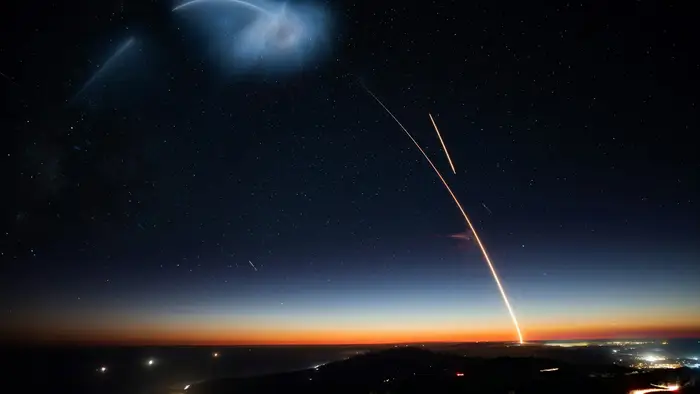
Starship’s launch window opens at 4:45 p.m. CST on November 13 — the first of three major launches in a single weekend. Image: Unsplash.
What Success Would Unlock
If both catches succeed, Flight 15 will be the first full recovery of an orbital launch system — a phrase SpaceX has used deliberately, because it captures what is different here. Recovering a booster is now routine for Falcon 9. Recovering both stages of a vehicle that reached orbit is not routine for anyone, and it is the precondition for the flight rate SpaceX needs for its larger ambitions.
The practical consequence is the one SpaceX has stated: if the Ship catch works, the company may routinely start catching upper stages and reflying them on future missions starting in 2027. That would turn Starship from a vehicle that is assembled, flown once, and discarded into a vehicle that is caught, inspected, refuelled and flown again — the airline model that has been the stated goal of the programme since its inception. The Starlink deployment on this flight is the commercial proof of that model: a reusable Starship that can carry 26 V3 satellites per flight changes the cost of building and replenishing a constellation of thousands of satellites.
The implications reach beyond Starlink. Starship is the vehicle NASA has selected for the Artemis lunar landings, and it is the vehicle SpaceX intends to send to Mars. Both missions require a Starship that can survive long durations in space, manage its propellant and thermal state over days rather than hours, and return through an atmosphere — all of which Flight 15 tests in miniature. A 22-hour orbital coast with a successful return is a small step toward a months-long transit to Mars, but it is a step that has to be taken before the larger ones can be attempted with confidence.
There is also a competitive dimension. The fully reusable rocket is no longer a SpaceX-only idea: Stoke Space is building Nova as a fully reusable vehicle, and the Pentagon has committed hundreds of millions of dollars in loans to Rocket Lab and Stoke Space to accelerate their programmes. A successful double catch would put SpaceX a full generation ahead of that competition, with a flown and recovered orbital system while its rivals are still building their first reusable vehicles. A failure — particularly a failure of the Ship catch — would narrow that lead and give the rest of the industry time to catch up.
How to Watch
SpaceX will stream the launch live on its website and on X, with coverage beginning about 30 minutes before liftoff — around 4:15 p.m. CST on November 13, or 05:15 WIB on Saturday, November 14. The company says coverage will continue through the Ship catch and may include hours of live views from Starship as it orbits Earth, which would make this one of the longest launch broadcasts ever attempted.
The viewing schedule, in brief: liftoff in the 75-minute window opening at 4:45 p.m. CST (05:45 WIB Saturday), the booster catch about six and a half minutes later, satellite deployment during the first orbit, and then a long, quiet coast of roughly 21 hours before the Ship returns to Starbase on Saturday afternoon, November 14, at about 3:17 p.m. CST (04:17 WIB on Sunday, November 15). Residents of Cameron County, Texas, may hear sonic booms as the Ship comes in.
The honest caveat, repeated once more because it matters: the launch is pending regulatory approval, and the Ship will only be permitted to return to the tower if it meets the FAA-approved conditions at the decision point. Watch for the approval first, then the liftoff, then the booster — and only then, a day later, the catch that has never been tried.
Fourteen orbits, more than 22 hours, and two catches stand between Starship and full reusability. Image: Unsplash.
If Flight 15 works, the story of spaceflight changes in a single weekend: the largest rocket ever flown will have gone to orbit, done a job, and come home in two pieces, both caught by the same tower. If it does not, the programme will have learned — as it did from Flight 14 — and will fly again. Either way, the attempt itself is the news. No one has ever tried to catch an orbital spacecraft out of the sky with a pair of mechanical arms. On Friday, SpaceX will try to do it twice.