GSLV-F18 NVS-03 Mission Success: India's NavIC Returns to Four Satellites
India’s home-grown navigation system is whole again, at least on paper. Shortly after midnight on Saturday, October 31, 2026, the Indian Space Research Organisation declared success for a mission that had become a test of patience for the country’s space programme: the launch of NVS-03, the third satellite in India’s second-generation navigation series, aboard the Geosynchronous Satellite Launch Vehicle known as GSLV-F18. The rocket lifted off from the Satish Dhawan Space Centre at Sriharikota at 11:51 p.m. Indian Standard Time on Friday, October 30 — 01:21 WIB on Saturday in Jakarta — and, about half an hour later, ISRO announced that the satellite had reached the orbit it was aiming for.
“Mission Success! GSLV-F18 has successfully placed NVS-03 in the intended orbit,” ISRO said in a post on X at 12:23 a.m. IST on October 31, or 01:53 WIB. The liftoff itself had been announced at exactly the targeted time, 11:51 p.m. IST, from the centre’s Second Launch Pad on the Andhra Pradesh coast. ISRO streamed the launch live, and the night flight closed a launch campaign that the agency’s chairman would later describe as one of the fastest the programme has ever run.
For most people, a single navigation satellite joining a constellation will never make the evening news in their own country, let alone abroad. But NVS-03 matters more than its modest size suggests, because of what it restores. For months, India’s Navigation with Indian Constellation, better known as NavIC, had been operating below the threshold at which it can stand on its own. A satellite navigation receiver needs signals from at least four satellites to solve for latitude, longitude, altitude, and the error in its own clock. With only three NavIC satellites giving positioning, navigation, and timing services, the system could not offer a fully independent position fix. NVS-03 is designed to become the fourth. If the satellite completes its orbit-raising and commissioning in the coming days and weeks, India will once again have a positioning service that answers to no one else — a capability its government has repeatedly described as a strategic national asset.

A rocket climbs away from its launch pad into the night sky. Image: Unsplash.
A night launch that went to plan
The flight itself, by all public accounts so far, was unremarkable in the best possible sense. GSLV-F18 rose from the Second Launch Pad at Sriharikota, ISRO’s launch centre on the coast of Andhra Pradesh, and carried NVS-03 toward a geosynchronous transfer orbit — an elongated stepping-stone orbit from which the satellite will use its own engine to climb to a circular geosynchronous slot. ISRO has not yet published a stage-by-stage account of the flight or the exact orbit achieved, according to launch trackers following the mission, but its declaration was unambiguous: the satellite was placed in the intended orbit.
The planned transfer orbit, published in ISRO’s mission brochure, had a lowest point of about 170 kilometres, a highest point of 37,023 kilometres, and an inclination of 20.75 degrees, with a launch azimuth of 106 degrees. The satellite itself weighs about 2,250 kilograms, according to the same brochure. Those numbers describe the starting point, not the destination. The rocket’s job ends at the transfer orbit. From there, NVS-03 must fire its own engine to lift the low point of its orbit and circularise it into the geosynchronous arc where navigation satellites do their work, tens of thousands of kilometres above the equator.
By one independent count, GSLV-F18 was the 246th successful orbital launch in the world in 2026, the third from India, and ISRO’s second of the year. The tally counts successful orbital launches only, and it underlines how routine — and how crowded — the global launch business has become. Yet for India, this particular flight carried weight that no tally can capture, because the previous attempt at the same job had ended in a very public failure, and because the constellation it serves had been slowly running down for years.
Readers who followed the run-up to this launch will recall the preview of the mission published here earlier in the week: ISRO NVS-03 Launch October 30: India’s NavIC Comeback Satellite. That article laid out why the launch mattered before it flew. This one records what actually happened when it did — and what still has to go right before NavIC can be called restored in full.
Why four satellites matter
Satellite navigation looks like magic from the user’s side of the screen: a phone draws a blue dot on a map and the dot moves as you walk. Underneath that simplicity sits a strict piece of geometry. A receiver measures how long signals took to arrive from satellites overhead, converts those travel times into distances, and then solves for its own position. Three satellites are enough to narrow the answer to two possible points, one of which is usually absurd. The fourth satellite resolves the ambiguity and, just as importantly, corrects for the receiver’s own clock error. Without a fourth satellite in view, a constellation cannot deliver a standalone three-dimensional fix.
That is the arithmetic India had been living with. In July 2026, the government told Parliament that only three NavIC satellites were providing positioning, navigation, and timing services: IRNSS-1B, IRNSS-1I, and NVS-01. The shortfall was not sudden. It was the accumulated result of ageing spacecraft, failing atomic clocks, and one outright mission failure, spread across a decade. In March 2026, matters got worse when the atomic clock on IRNSS-1F stopped, three days after that satellite finished its ten-year design life, according to ISRO. A navigation satellite without a working clock is a radio beacon without a metronome: it can transmit, but it cannot tell a receiver precisely when it transmitted, and precision timing is the whole game.
ISRO chairman V. Narayanan, speaking after the launch, said the success had returned the constellation to the minimum operational configuration of four satellites. “With the success of this launch, the NavIC constellation is restored to the minimum operational configuration with 4 satellites,” he said, in remarks reported by the ANI news agency. “NavIC constellation is a strategic national asset that provides the nation independent access to position, navigation and timing services. The NavIC satellites are also used for civilian applications,” he added. The phrasing matters. Narayanan did not claim the job was finished. He claimed the constellation was restored to its minimum — the floor, not the ceiling. A four-satellite constellation can give a position fix, but it has little margin. Lose one satellite, and the system is short-handed again. That is why India is already building NVS-04 and NVS-05, which the government has said are in advanced stages of development.
NavIC, formerly called the Indian Regional Navigation Satellite System, covers India and a region extending about 1,500 kilometres beyond its borders. That regional footprint is deliberate. Unlike the United States’ GPS, Russia’s GLONASS, Europe’s Galileo, or China’s BeiDou, which aim for global coverage, NavIC was designed to serve India and its neighbourhood with a smaller, cheaper constellation in a mix of geosynchronous and inclined geosynchronous orbits. The trade-off is coverage: outside its service region, NavIC is of little use, and receivers that want worldwide navigation still need other constellations. The advantage is independence within the region that matters most to India — for civilian users, for disaster response, for surveying and agriculture, and for the armed forces, which would rather not depend on a foreign system in a crisis.
The ghost of NVS-02
No honest account of NVS-03 can skip NVS-02, because the shadow of that mission hung over every minute of the launch campaign. NVS-02 launched on GSLV-F15 on January 29, 2025. The rocket did its job. The satellite separated cleanly, deployed its solar panels, and entered the same kind of transfer orbit that NVS-03 reached on Friday night. Then the mission unravelled. The satellite’s orbit-raising engine never fired, so NVS-02 never reached its working orbit and never entered navigation service.
The subsequent review found that the signal to open a valve on the engine’s oxidiser line never arrived, most likely because a connector came loose. It was, in the cruellest sense, a small failure: not an explosion, not a guidance error, but a loose connector standing between a healthy satellite and its working orbit. ISRO said it changed its pyro systems — the small explosive devices that trigger valves and separations — after the failure, and that the changes worked on the CMS-03 mission in November 2025. The same fixes were to be carried forward on future missions, including NVS-03.
That history is why experienced launch watchers drew a careful distinction on Friday night, even amid the celebrations. The launch phase went to plan. The real test for NavIC, as one tracker put it, is the orbit-raising burns in the coming days. NVS-03 must now do precisely what NVS-02 could not: fire its engine, repeatedly if needed, lift the low point of its elongated orbit, and settle into its circular geosynchronous slot. Only after orbit-raising, health checks, and commissioning can the satellite begin contributing navigation services. Until then, the constellation’s restoration is a launch success, not yet an operational one — and ISRO’s own statements have been careful to keep those two things separate.
The distinction also explains the intensity of the launch campaign itself. When a programme has lost a satellite to a connector, it does not rush the replacement. It checks, rechecks, and checks again. The fact that the campaign still finished in record time says something about how much institutional effort went into making this flight boring.

A satellite in orbit above Earth, solar panels extended. Image: Unsplash.
Inside NVS-03
NVS-03 is the third spacecraft in the second-generation NVS series, numbered NVS-01 through NVS-05, and the twelfth satellite overall in the Indian Regional Navigation Satellite System family, where it also carries the designation IRNSS-1L. Its predecessors have had mixed fortunes. NVS-01 launched successfully in May 2023 and remains in service. NVS-02, as described above, never entered service. NVS-03 was delivered to the Satish Dhawan Space Centre and declared ready for launch as of August 14, 2026, and its launch campaign formally began on September 14, with stacking of the rocket’s first stage completed by September 21. An earlier tentative window running from October 15 to 20 slipped, and the October 30 date was attributed to ISRO chairman V. Narayanan in an Indian Express report on October 22.
Two features of the satellite deserve attention, because they address the exact weaknesses that have dogged NavIC. The first is its clocks. NVS-03 carries an atomic clock built in India, along with imported, or procured, atomic clocks. Faulty clocks are the main reason NavIC has lost satellites: the first-generation constellation was plagued by failures of its rubidium atomic clocks, the exquisitely precise timekeepers at the heart of any satellite navigation system, and the loss of the IRNSS-1H satellite in a launch failure compounded the problem. An indigenous clock matters for the same reason the constellation itself matters — independence. A navigation system that depends on imported clocks is only partly independent, and India has been working for years to close that gap.
The second feature is its signals. NVS-03 adds the L1 navigation signal to NavIC’s existing L5 and S-band signals. L1 is the band most phones and civilian receivers already use for GPS, and adding it is the single most important step toward making NavIC useful in ordinary smartphones rather than specialised receivers. Earlier reporting on the mission noted that the L1 signal strengthens smartphone availability and urban accuracy across India and nearby regions, where tall buildings and narrow streets make satellite signals hard to hold. There is, as of now, no nationwide mandate requiring NavIC in all smartphones sold in India, and multi-constellation receivers remain the best option for most users. But a satellite that speaks L1 is a satellite that ordinary devices can hear without exotic hardware, and that changes the practical value of the whole system.
It is worth pausing on what “civilian applications” means in Narayanan’s remark, because navigation satellites are often discussed as if they belonged only to soldiers and surveyors. In practice, the users of a system like NavIC include farmers guiding tractors, fishermen finding their way home in bad weather, ambulance dispatchers routing vehicles through unfamiliar cities, power grid operators synchronising their networks, banks timestamping transactions, and disaster-response teams coordinating relief after a flood or earthquake. Timing, in particular, is easy to overlook and impossible to replace: modern power grids, telecom networks, and financial systems all depend on precise, shared time, and much of that time currently arrives via satellite navigation signals. A country that cannot guarantee its own timing is a country with a quiet vulnerability running through its infrastructure.
The rocket: GSLV Mk II
The vehicle that carried NVS-03 to its transfer orbit is the Geosynchronous Satellite Launch Vehicle Mark II, a workhorse with a long and occasionally bruising history. GSLV-F18 was the twentieth GSLV flight. Of the nineteen that came before it, four did not succeed, according to ISRO’s launch list. The previous flight, GSLV-F17 carrying EOS-05, launched on September 4, 2026 — a gap of just 56 days that Narayanan highlighted as the shortest interval between successive GSLV missions so far.
The rocket stands about 50 metres tall and has a liftoff mass of about 420 tonnes, according to ISRO’s brochure. Its architecture is a study in pragmatic engineering. The first stage pairs a solid-fuel core with four liquid-fuelled strap-on boosters, known as L40s, which burn alongside the core to lift the vehicle off the pad. The second stage is liquid-fuelled. The third stage is cryogenic, burning liquid hydrogen and liquid oxygen — the most efficient chemical propellant combination available, and also the hardest to handle, since liquid hydrogen must be kept colder than minus 250 degrees Celsius. NVS-03 flew inside a 3.4-metre metal nose fairing, the protective shell that shields a satellite from aerodynamic forces and heating during ascent before splitting away once the air thins.
For a rocket family that has flown twenty times, the GSLV’s record invites a fair question: why keep flying a vehicle with four failures in nineteen previous flights when newer rockets exist? The answer is partly that those failures belong mostly to the programme’s early years, when the cryogenic upper stage was still being mastered, and partly that the GSLV fills a specific niche. It is ISRO’s three-stage rocket for satellites of about two tonnes heading toward geosynchronous orbit. Heavier missions go to the LVM3; lighter ones to the Polar Satellite Launch Vehicle. The GSLV is the right-sized tool for NavIC, and after the F17 flight in September and the F18 success on Friday, it has now flown twice in two months without incident — a cadence that suggests the vehicle has settled into reliable middle age.
The broader launch landscape makes that cadence more striking. Constellation launches dominate the global manifest in 2026: SpaceX’s Starlink flights depart Vandenberg and Florida at a relentless pace, as covered in Starlink 15-16 Launch: SpaceX’s 700th Falcon 9 Flight Sends 27 Satellites Skyward, while Amazon’s Leo broadband constellation is being deployed by rockets on three continents, including the heavyweight European flight described in The Heavyweight Debut: Ariane 64’s New P160C Boosters Haul 36 Amazon Leo Satellites to Orbit. Against that backdrop, a single-satellite government launch can look almost old-fashioned. But the comparison cuts both ways. The mega-constellations are commercial networks chasing global broadband markets. NavIC is a sovereign utility, built to guarantee that one country can find its way and keep its time without asking permission. Different missions, different measures of success — and for NavIC, success is measured in satellites that work, not satellites launched.
A campaign run at record pace
If the flight was unremarkable, the campaign that produced it was not. Narayanan and mission director Thomas Kurian highlighted the pace of preparations in remarks after the launch: the launch campaign was completed in 47 days, the gap of 56 days since the previous GSLV flight was the shortest such interval so far, and the four L40 strap-on boosters were prepared in a record 37 days. “We completed the launch campaign in just 47 days and achieved this GSLV launch within 56 days of the previous launch. We also completed the preparation of the four L40 strap-ons within a record time of 37 days,” Narayanan said, according to ANI.
Those numbers are worth unpacking, because launch campaigns are where space programmes usually lose time. A campaign includes stacking the vehicle, integrating the satellite, testing every interface between rocket and spacecraft, rehearsing the countdown, and clearing the range. Forty-seven days from formal campaign start to liftoff is brisk for a geosynchronous mission, and doing it 56 days after the previous GSLV flight means the teams at Sriharikota barely had time to reset before starting again. The 37-day strap-on preparation is the most telling figure of all: the L40 boosters are large, liquid-fuelled stages that must be assembled, tested, and mated to the core, and compressing that work into five weeks without cutting corners is a logistical achievement in its own right.
There is a temptation to read speed as haste, especially for a programme still living down the NVS-02 connector failure. The evidence available so far points the other way. The campaign’s speed followed months of earlier preparation — the satellite was ready in August, the first stage was stacked in September — and the October 30 date itself had been flagged publicly more than a week in advance. A tentative October 15 to 20 window slipped, and the final date held once set. That is the pattern of a programme that moved fast because it was ready, not because it was rushed. The orbit-raising phase now under way will be the real audit of that claim.

Stars fill the night sky above the launch range. Image: Unsplash.
What happens next
The hours and days after a successful launch are, paradoxically, when the mission is most fragile. NVS-03 is now off the rocket and in its intended transfer orbit, but it is not yet a working navigation satellite. The sequence from here is well established from previous NVS missions. First, the satellite’s controllers will verify its health: power, thermal control, communications, and attitude. Then comes orbit-raising, in which the satellite fires its own engine to lift the low point of its orbit from about 170 kilometres to geosynchronous altitude, turning the elongated transfer ellipse into a near-circular orbit above the equator. Earlier reporting put the planned final slot at about 32.5 degrees East, though ISRO has not yet published the schedule for NVS-03’s burns or confirmed the final slot for this flight. After the orbit is circularised, the satellite drifts to its assigned longitude, its navigation payload is switched on and calibrated, and its signals are tested against ground receivers before it is declared operational.
Each of those steps carries risk, and the NVS-02 experience has taught Indian space watchers to withhold full celebration until the satellite is actually broadcasting usable navigation signals from its working orbit. The pyro-system changes made after NVS-02, validated on CMS-03 in November 2025, are supposed to ensure the orbit-raising engine receives its firing commands. If they work as designed, NVS-03 should reach its slot within days to weeks, depending on the burn plan. If anything goes wrong, India will have spent a flawless launch and still be short a satellite — a reminder that in spaceflight, reaching orbit is a milestone, not a destination.
Beyond NVS-03, ISRO’s manifest offers a sense of where the programme goes next. The agency has talked about Gaganyaan G1, the first uncrewed test flight of India’s human spaceflight programme, on the human-rated LVM3 rocket, targeted for 2026, with the chairman saying in late October that it would fly in about two months. A PSLV flight carrying the TDS-01 technology demonstration satellite is also listed among planned missions by the Department of Space, though it has not yet flown. And the NavIC pipeline continues: NVS-04 and NVS-05 are in advanced stages of development, and their eventual launches will determine whether the constellation grows from its restored minimum toward genuine redundancy — the point at which losing one satellite no longer threatens the service.
That redundancy is the real prize. A navigation constellation with exactly four working satellites is a system with no spare. A constellation with six or seven can lose one to a clock failure or a propulsion fault and keep serving users without interruption. India learned that lesson the hard way, one failed clock and one loose connector at a time. NVS-03 restores the floor. NVS-04 and NVS-05, if they fly and work, will build the margin on top of it.
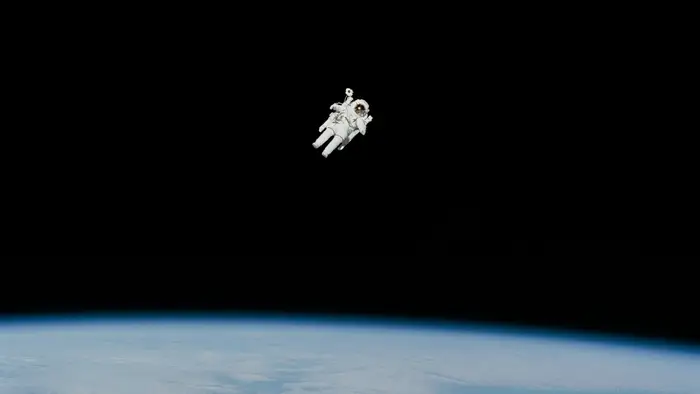
Earth from orbit, the view navigation satellites serve from high above. Image: Unsplash.
What this means for India
It is easy, from outside India, to treat NavIC as a technical footnote — a regional system in a world of global ones. That misses the point of why countries build their own navigation systems at all. GPS is a gift to the world, but it is also an American military system, operated by the United States Space Force, and its availability in a crisis is ultimately an American decision. Galileo, BeiDou, and GLONASS exist for the same reason NavIC does: no major power wants its transport, its banking, its power grid, and its military to depend entirely on another country’s goodwill. Sovereignty in navigation is not about rejecting other systems — most receivers listen to several constellations at once, and multi-constellation use remains the best option for accuracy and resilience. It is about having a fallback that works when the others do not, and about guaranteeing that the fallback is yours.
For ordinary Indians, the most visible change from NVS-03 will be gradual rather than dramatic. If the satellite commissions successfully, NavIC’s standalone positioning becomes available again across its service region, and the L1 signal gives phone makers one more reason to include NavIC support in handsets sold in India. Urban accuracy should improve as receivers gain access to a fuller set of signals in the L1 band they already use. Farmers, fishermen, drivers, and emergency responders will not see a headline when their position fix gets a little more reliable. They will simply find that the blue dot behaves a little better — which is, in the end, the only measure of a navigation system that matters.
For ISRO, the mission is also a statement about tempo. Two GSLV flights in 56 days, a 47-day campaign, strap-ons prepared in 37 days: these are the numbers of an agency that is learning to launch more often without losing the caution that a failure like NVS-02 demands. The human spaceflight programme, the NavIC follow-ons, and the technology demonstrators waiting in the queue will all benefit if that tempo holds. And if it does not — if orbit-raising falters, or if the satellite’s clocks disappoint — the programme will have learned, again, that the hardest part of a space mission is rarely the part that makes the brightest flame on launch night.

A launch vehicle on its pad, awaiting its moment. Image: Unsplash.
The quiet work ahead
There is a final, unglamorous truth about this mission that deserves a place in any honest account of it. The launch is over. The headlines, including this one, will move on. What remains is weeks of quiet engineering: burn plans executed in the dark, telemetry pored over by controllers on night shifts, signal tests run against ground stations, and a satellite slowly nudged from a stretched ellipse into the steady circle where it will spend its working life. Nobody will stream that work. No crowds will gather for it. But it is the work that decides whether October 30, 2026, is remembered as the night NavIC came back — or merely the night a rocket flew beautifully and a satellite stopped short again.
India has earned the right to celebrate a clean launch, and ISRO’s engineers have earned the credit for a campaign run at record pace. The constellation, though, keeps its own counsel. It will not be restored by a press release or a post on X. It will be restored when NVS-03, high above the equator, switches on its clocks and its L1, L5, and S-band signals, and a receiver somewhere in India — a phone, a tractor, a ship at sea — hears a fourth satellite and draws its position without help from anyone else. That moment has not happened yet. When it does, it will arrive without fanfare, as a blue dot settling, steady and sure, on a map. And that, quietly, will be the real mission success.