Vulcan Leo 1 Scrubbed November 13: Nitrogen Plant Failure Delays ULA's Six-Booster Comeback to Saturday
United Launch Alliance called off the return to flight of its Vulcan rocket on Friday morning, November 13, 2026, after a power interruption at a supplier’s nitrogen plant cut off the high-pressure pumps that feed the launch pad — a scrub that arrived with the countdown already deep into its final hours and the rocket already being loaded with propellant. The mission, Vulcan Leo 1, will now try again on Saturday, November 14, at 12:32:30 p.m. EST, carrying 40 broadband satellites for Amazon’s Leo constellation on what remains one of the most closely watched launches of the year.
The delay was announced at 8:41 a.m. EST, a little more than four hours before the originally scheduled 12:54 p.m. liftoff from Space Launch Complex 41 at Cape Canaveral Space Force Station in Florida. By then the launch team had already begun loading liquid oxygen into the rocket’s Centaur V upper stage. ULA said the rocket and the 40 Amazon Leo satellites it carries remain healthy, and the team turned the mission around in a single day, realigning to the backup opportunity on Saturday.
“The launch of a United Launch Alliance Vulcan rocket carrying the Amazon [LV-01] mission is delayed due to a power interruption in the Air Liquide gaseous nitrogen plant which resulted in the loss of their high-pressure pumps,” ULA said in a statement on Friday morning. “Without confirmation of sustained commodity flow, the team has decided to realign the launch to the back-up opportunity.”
It was, by the standards of launch scrubs, an unusually mundane cause for an unusually consequential delay. No engine misbehaved. No sensor tripped. No weather front rolled in off the Atlantic. The rocket was fine; the ground equipment that keeps it alive on the pad was not. Gaseous nitrogen is used to purge and pressurize systems on both the rocket and the launch pad, and without confirmation that the supply would keep flowing, ULA chose not to commit a fully fuelled rocket to a countdown it could not guarantee.
A one-day slip with nine months behind it
The one-day delay extends a nine-month wait. Vulcan has not flown since February 12, 2026, when a solid rocket booster nozzle failed during the USSF-87 national security mission for the U.S. Space Force. The rocket rolled noticeably as it pitched over in the first half-minute of flight, but the boosters separated normally and the Centaur upper stage delivered its payload to the planned orbit. It was the second such booster problem in four Vulcan flights: the first occurred on October 4, 2024, during the rocket’s second flight, when a nozzle on one of its GEM-63XL solid rocket boosters was lost, producing reduced and asymmetrical thrust that the vehicle again flew through successfully.
All four Vulcan flights to date have reached their planned orbits. That record is precisely why the grounding that followed the February anomaly was so striking: the rocket kept succeeding, and yet the U.S. government stopped flying national security missions on it. By early March 2026, the Space Force had said it would not launch national security payloads aboard Vulcan until the anomaly was resolved. The pause was not a verdict on the rocket’s ability to reach orbit; it was a verdict on the margin. A launcher that survives a booster failure is not the same as a launcher whose boosters can be trusted not to fail, and for the missions that carry the country’s most sensitive satellites, that distinction matters.
The investigation that followed was conducted by an integrated team of ULA, solid rocket booster supplier Northrop Grumman, the U.S. Space Force, and other government agencies. According to ULA, the work included analysis, laboratory-level material testing, component testing, and a full-scale hot fire of a GEM 63XL motor in Utah. The team identified three credible causes for the nozzle failures and took steps to mitigate all three. The changes to the nozzle — its design and how it is built — have been tested thoroughly and are incorporated into the solid rocket boosters that will fly on this mission.
The investigation itself is not finished. ULA has said that while proceeding into flight, the work continues with additional analysis and tests, with the aim of increasing understanding of the nozzle’s behaviour, the effectiveness of the corrective actions, and the potential identification of additional design improvements for the future. Proceeding down parallel paths — continuing the investigation while obtaining flight data on the new, improved design — is, in ULA’s view, the best path for the company and its customers.
“As with any new rocket, there are risks associated with every launch, and particularly as we are early in this phase of introduction of Vulcan to the market and working to a regular operational tempo,” said Mark Peller, ULA’s president and CEO. “Every flight generates data and every flight teaches us something. And we’re going to look to this flight to get some more useful data in a flight environment on the effectiveness of the corrective action that we’ve implemented.”
“During our first four Vulcan missions, the robustness of Vulcan served us well,” Peller added. “It flew through some difficult environments associated with the SRB anomalies and successfully completed all of those missions, giving the spacecraft both a smooth ride and precise, bullseye orbital injections.”
What flies on Saturday
The rocket waiting on the pad at Space Launch Complex 41 is designated V-012, and it is the most powerful Vulcan ever assembled. It will fly in the VC6L configuration — a single core stage with a full complement of six GEM-63XL solid rocket boosters, the maximum the vehicle can carry, and the first time Vulcan has flown with all six. The fully assembled rocket stands 215 feet tall (65.5 metres) and will weigh 1.99 million pounds (903,500 kilograms) once fuelled with cryogenic propellants. At liftoff, its two Blue Origin BE-4 main engines and six side-mounted boosters will generate 3.9 million pounds (17.2 megaNewtons) of thrust.
Each GEM 63XL booster consumes more than 100,000 pounds (45,400 kilograms) of propellant and together the six provide three-quarters of the total liftoff thrust. Burnout comes about a minute and a half into flight, followed by jettison of the spent casings. The first stage then burns for another three minutes at full throttle, throttling back once the vehicle reaches 4 Gs to hold a constant acceleration, and performs booster engine cutoff about five minutes after liftoff, with stage separation east of Charleston, South Carolina.
Above the core stage sits a new piece of hardware that matters as much as the boosters: the first low Earth orbit-optimized Centaur V upper stage. At 35 feet tall, it is approximately six feet (1.8 metres) shorter than the high-energy Centaur V that flew Vulcan’s initial missions, and it carries a third less propellant. The weight savings translate directly into additional satellites on every mission, because the upper stage itself accounts for less of the mass the rocket must lift. The shortened Centaur was created specifically to match Amazon’s need to deploy large quantities of spacecraft in a single mission, and Vulcan Leo 1 is its debut.
The payload sits inside a 70-foot-long (21.3-metre) fairing: 40 Amazon Leo broadband satellites, the largest number of satellites carried on a single Amazon launch to date. In total, the mission will deliver more than 50,000 pounds (22,700 kilograms) of payload to orbit, setting a new record for ULA. The configuration can lift up to 27,200 kilograms (60,000 pounds) to low Earth orbit, a figure that puts a single-core Vulcan with six boosters in heavy-lift territory comparable to the much larger and more expensive three-core Delta IV Heavy it replaced.
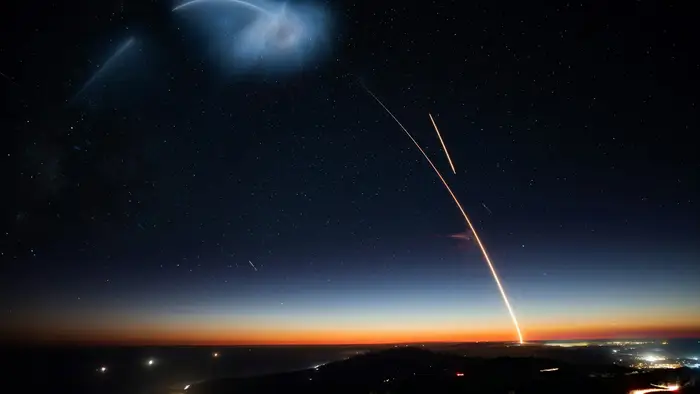
A rocket’s exhaust trail arcs across the night sky. Image: Unsplash.
The flight plan, minute by minute
If Saturday’s attempt goes ahead, the sequence will be familiar to anyone who has watched a Vulcan fly, with one difference that only the engineers will notice: the shortened Centaur. Vulcan goes supersonic 37 seconds after liftoff and passes through the region of maximum dynamic pressure at 55 seconds, flying a northeasterly trajectory to reach a 51.9-degree orbit. The dual RL10C-1-1A engines on the Centaur V ignite after stage separation, and shortly after the first main engine start, the 70-foot payload fairing is jettisoned.
The initial burn by Centaur lasts nearly 12 minutes to achieve a preliminary parking orbit, with the engines shut down by a guidance-calculated command over the North Atlantic. The upper stage then embarks on a 50-minute coast in this elliptical orbit, reaching the high point for a brief second firing south of New Zealand. The second main engine start, at 66 minutes, occurs near apogee and serves to circularize the orbit at approximately 285 miles (about 460 kilometres) above Earth, completing the powered phase of the flight.
Only then does the real work of the mission begin. The satellite deployments are initiated 70 minutes into flight and last for 25 minutes as the rocket crosses the Pacific Ocean. In all, there will be 16 separation events to release the 40 satellites from the customer-provided dispensing system riding atop the Centaur V. Each of the first four events will release one satellite, and the final 12 events will separate three satellites at a time. It is a carefully choreographed sequence: 40 spacecraft, released in batches, into an orbit where they will spend the coming weeks raising themselves to their operational slots and joining a constellation that already has nearly 400 satellites in orbit.
For readers in Indonesia, Saturday’s liftoff at 12:32:30 p.m. EST falls at 00:32:30 WIB on Sunday, November 15, with the 29-minute window closing at about 01:01 WIB. Spaceflight Now will stream live coverage beginning 30 minutes before liftoff, and ULA will carry its own live webcast starting 20 minutes before launch.
Why this launch matters beyond Saturday
Vulcan Leo 1 is the first of 38 Vulcan launches Amazon has contracted with ULA to build out its Leo constellation — the broadband network formerly known as Project Kuiper, now renamed Amazon Leo. The constellation is planned at 3,232 satellites under its Federal Communications Commission licence, which requires all of them to be launched by July 2029. About 400 have reached space to date across 15 launches conducted by three different rockets: ULA’s Atlas V, SpaceX’s Falcon 9, and Arianespace’s Ariane 6. Saturday’s flight will be the first such mission for Vulcan, which is why ULA calls the mission Vulcan Leo 1.
The stakes for Amazon are measured in deadlines as much as in satellites. The company has said it remains on track to begin initial service this year, and the cadence of Vulcan flights will determine whether that schedule holds. A second Vulcan is already being prepared in another integration facility, and Amazon anticipates it could fly within weeks of a nominal LV-01 mission. The first few Leo-Vulcan missions will each carry 40 satellites, with larger payloads planned for later flights as the configuration is proven.
The mission also inaugurates a dedicated processing lane for Amazon’s satellites. The rocket was assembled in Amazon’s new Vertical Integration Facility (VIF-A) aboard the Amazon Vulcan Launch Platform (VLP-A), creating a second launch processing lane for ULA operations at the Cape. Dual facilities will enable a higher launch cadence in support of all of ULA’s customers, and the Amazon-funded infrastructure is aimed at allowing the next Vulcan Leo launch within weeks of this one.
For ULA, the stakes are existential in a quieter way. Vulcan is the successor to the Atlas V, which has just a half-dozen launches left on its manifest, and to the Delta IV Heavy, now retired. It is the rocket the company will fly for the next decade, and it is one of three rockets the Space Force has chosen for its most demanding national-security launches through 2032. Every Vulcan flight that goes well rebuilds the confidence the February anomaly cost; every delay, even one caused by a supplier’s power cut rather than the rocket itself, is a reminder of how thin the margin is when a new launcher is still earning its reputation.
The connection reaches beyond commercial broadband, too. NASA has its own reason to watch Vulcan closely. ULA built the interim upper stage that sends the Orion spacecraft toward the Moon on the Space Launch System, then retired that production line to build Vulcan’s Centaur V. With the more powerful Exploration Upper Stage cancelled, NASA approved a sole-source approach in March 2026 to buy Vulcan’s Centaur V instead, for the Artemis IV and V missions. A reliable Centaur V is now part of the architecture that will carry astronauts back toward the Moon — which makes the shortened, LEO-optimized variant flying on Saturday a close cousin of hardware with a lunar future.
That link is worth keeping in mind when the scrub is judged. A one-day delay caused by a nitrogen plant is, in the end, the system working as designed: a ground-support problem was caught before it became a flight problem, the countdown was stopped while the rocket was still safe on the pad, and the backup opportunity was used within 24 hours. The alternative — pressing ahead without confirmation that the pad’s purge and pressurization supply would hold — would have been a gamble with a rocket carrying 40 satellites and a nine-month investigation behind it. ULA chose the boring option, and in launch operations, boring is usually right.
The view from the Cape
For spectators, Saturday’s attempt offers one of the better viewing opportunities of the year. The 215-foot rocket, flying a northeasterly trajectory, will be visible across much of Florida and up the East Coast, and ULA has published a visibility map showing the launch could be seen as far north as Tallahassee, about five minutes after liftoff. The six solid boosters will make for a bright, loud climb — the most powerful Vulcan configuration ever flown, on a clear November afternoon, with a full day’s worth of anticipation behind it.
That anticipation is the other casualty of Friday’s scrub. Thousands of people had planned their day around a 12:54 p.m. liftoff; some had travelled to the Space Coast for it. They will have to decide whether to stay for Saturday, or to watch the webcast from home. For the launch team, the calculus is simpler: the rocket is healthy, the satellites are healthy, the weather for the backup window was the reason it was chosen, and the only thing that changed is the date on the countdown clock.
There is a small irony in the timing. Friday, November 13, is a date that invites superstition, and the scrub arrived early enough in the day that the jokes practically wrote themselves. But nothing about the delay was unlucky in the usual sense. A power interruption at an industrial gas plant is the kind of failure that has nothing to do with rockets and everything to do with the sprawling, interdependent infrastructure that a launch depends on: the commodity suppliers, the high-pressure pumps, the purge lines, the pad systems that must all work in concert for the few minutes that matter. A rocket is only as reliable as the least reliable thing connected to it on the ground.
That is also why the one-day turnaround matters. ULA’s ability to realign to the backup opportunity within 24 hours — safing the vehicle, confirming the nitrogen supply, and resetting the countdown — is the kind of operational tempo the company will need if it is to fly 38 Amazon missions, plus national security flights, plus the cadence its manifest demands. The scrub tested the ground infrastructure; the turnaround tests the organization. Both are part of what a return to flight actually means.

A stargazer watches the Milky Way. Image: Unsplash.
What to watch for on Saturday
The most important moment of Saturday’s flight will not be liftoff. It will come about 90 seconds in, when the six GEM 63XL boosters burn out and separate. That is the phase of flight where the nozzle failures occurred on the previous two anomalous missions, and it is the moment the redesigned nozzle will face its first real test in the flight environment. ULA’s engineers will be watching thrust traces, chamber pressures, and vehicle dynamics for any sign of the asymmetry that marked the earlier flights. A clean booster separation, on time and on profile, will be the first and most important data point of the mission.
The second moment to watch comes later, when the shortened Centaur V performs its second burn at 66 minutes to circularize the orbit. The LEO-optimized upper stage is new hardware flying its first mission, and its performance will determine whether the 40 satellites reach the orbit Amazon needs. The deployment sequence that follows — 16 separation events over 25 minutes — is the payoff for the whole flight, and confirmation that the satellites are healthy and communicating will likely come hours after liftoff, once they have been acquired by ground stations.
There is also the question of what comes next. If Saturday’s flight is nominal, LV-02 is already being prepared and could fly within weeks. The next Amazon Leo mission after that, Leo Europe 4, is scheduled to carry 36 satellites aboard an Ariane 6 from Kourou in French Guiana, no earlier than November 23. The constellation’s build-out is a multi-rocket effort, and Vulcan’s share of it — 38 launches — is the largest single commitment in the programme. A successful return to flight does not just put 40 satellites in orbit; it unlocks the schedule for the next three years of Amazon’s constellation.
Vulcan’s road so far
The rocket that waits on the pad on Saturday has a short but eventful history, and the scrub belongs in that history alongside the flights themselves. Vulcan’s first launch, on January 8, 2024, carried Astrobotic’s Peregrine lunar lander, the first flight of NASA’s Commercial Lunar Payload Services initiative. Its second flight, on October 4, 2024, was part of the Space Force’s National Security Space Launch certification process and achieved its planned orbit despite the loss of a booster nozzle. The Space Force certified Vulcan for national-security launches in March 2025, and the rocket flew its first such mission that August. Then came February 12, 2026, and the USSF-87 nozzle failure that grounded the fleet.
Our earlier coverage traced the arc from that grounding to this weekend. Vulcan Leo 1 Return to Flight November 13: ULA Bets Six Boosters on Its Comeback laid out the stakes of the six-booster configuration and the redesigned nozzle, while Space Force Moves Six Launches to SpaceX as ULA’s Vulcan Stays Grounded covered the cost of the grounding in lost national security missions. The shortened Centaur V flying on Saturday also has a future beyond low Earth orbit, as Isaacman SLS Path 2030s: NASA’s Plan to Standardize the Moon Rocket explains in the context of NASA’s lunar plans.
Vulcan Leo 1: mission key figures
| Item | Figure |
|---|---|
| Mission | Vulcan Leo 1 (LV-01), ULA flight V-012 |
| Rocket | Vulcan Centaur VC6L |
| Payload | 40 Amazon Leo broadband satellites |
| Original liftoff | Friday, November 13, 2026, 12:54 p.m. EST (17:54 UTC) |
| Scrub announced | Friday, November 13, 2026, 8:41 a.m. EST |
| Scrub cause | Power interruption at Air Liquide gaseous nitrogen plant; loss of high-pressure pumps |
| New liftoff | Saturday, November 14, 2026, 12:32:30 p.m. EST (17:32:30 UTC) |
| Launch window | 29 minutes (12:32–13:01 p.m. EST) |
| Launch site | Space Launch Complex 41, Cape Canaveral Space Force Station, Florida |
| Rocket height | 215 feet (65.5 metres) |
| Fuelled mass | 1.99 million pounds (903,500 kg) |
| Liftoff thrust | 3.9 million pounds (17.2 megaNewtons) |
| Solid boosters | 6 × Northrop Grumman GEM-63XL |
| Upper stage | LEO-optimized Centaur V, 35 feet tall, one-third less propellant |
| Payload to orbit | More than 50,000 pounds (22,700 kg) — a ULA record |
| Target orbit | ~285 miles (460 km), 51.9-degree inclination |
| Deployment | 16 separation events, 70–95 minutes after liftoff, over the Pacific |
| Constellation | Amazon Leo, 3,232 satellites planned; ~400 already in orbit |
| Vulcan missions for Amazon | 38 contracted, LV-01 is the first |
| Grounding | 9 months, since the USSF-87 nozzle failure on February 12, 2026 |
Vulcan’s road to Saturday: a timeline
- January 8, 2024 — Vulcan’s first flight carries Astrobotic’s Peregrine lunar lander; the rocket reaches orbit on its debut.
- October 4, 2024 — Second flight, part of Space Force certification, reaches its planned orbit despite losing a solid rocket booster nozzle.
- March 2025 — The Space Force certifies Vulcan for national-security launches.
- August 2025 — Vulcan flies its first national-security mission.
- February 12, 2026 — A booster nozzle fails less than 30 seconds after liftoff on the USSF-87 mission; the payload still reaches orbit, but the fleet is grounded.
- Early March 2026 — The Space Force says it will not fly national-security missions on Vulcan until the anomaly is resolved.
- 2026 — ULA, Northrop Grumman, and the Space Force investigate; three credible causes are identified and mitigated, including a full-scale hot fire of a GEM 63XL motor in Utah.
- November 9, 2026 — Amazon announces LV-01 for November 13: 40 satellites, the first of 38 Vulcan missions, the first six-booster Vulcan, and the debut of the LEO-optimized Centaur V.
- November 10, 2026 — ULA publishes its mission preview, confirming the 12:54 p.m. EST liftoff and the 29-minute window.
- November 13, 2026, 8:41 a.m. EST — ULA scrubs the attempt after a power interruption at the Air Liquide gaseous nitrogen plant knocks out the high-pressure pumps; liquid oxygen loading into Centaur V had already begun.
- November 14, 2026, 12:32:30 p.m. EST — The backup opportunity: Vulcan Leo 1 is scheduled to try again from Space Launch Complex 41.

Glowing gas clouds of a distant nebula. Image: Unsplash.
A delay, not a defeat
It is tempting to read a scrub as a failure, especially one that arrives after nine months of waiting, on a Friday the 13th, four hours before liftoff. But scrubs are part of the launch business in a way that has nothing to do with luck. Rockets are scrubbed for weather, for boats in the range, for a sensor reading a fraction outside its limit, and — as Friday showed — for a power cut at a supplier’s plant miles from the pad. The list of things that must go right for a launch is long, and it extends well beyond the rocket itself.
What matters is what happens next. ULA had a backup opportunity ready, the rocket and its satellites were healthy, and the team turned the mission around in a day. That is the operational tempo the company needs to prove — not just that Vulcan can fly, but that it can fly again, and again, on a schedule its customers can plan around. Thirty-eight Amazon missions, a national security manifest, and a lunar upper stage all depend on it.
On Saturday afternoon, a 215-foot rocket with six solid boosters will stand on the pad at Cape Canaveral for the second time in two days, and the countdown will run again from the beginning. The nitrogen will flow, the pumps will hold, and the rocket will have its chance to show that nine months of investigation, testing, and redesign were worth the wait. The first 90 seconds will tell the engineers what they most need to know. The 25 minutes of satellite deployments, an hour and a half later, will tell everyone else.
The comeback that was supposed to happen on Friday will happen on Saturday instead — one day late, and no less significant for it.

The band of the Milky Way glows above the horizon. Image: Unsplash.

Earth, the market the Leo constellation is built to serve. Image: Unsplash.
Sources
- Spaceflight Now: ULA delays to Saturday Vulcan rocket launch of 40 Leo satellites for Amazon
- ULA: Vulcan Leo 1 — Delivering 40 satellites to space
- Central Florida Public Media: Update — Vulcan’s Amazon delivery to orbit delayed for a day
- The Space Atlas: New Glenn and Vulcan — the return-to-flight context