Voyager 1 One Light-Day November 2026: A Signal Now Takes a Full Day to Reach Humanity's Farthest Probe
At 5:16:07 a.m. Eastern time on Wednesday, November 18, 2026, a spacecraft the size of a small car will cross a line no human-made object has ever crossed. Voyager 1, launched when Jimmy Carter was president and the first Star Wars film was still in cinemas, will be exactly one light-day from Earth: 16.09 billion miles, or 25.9 billion kilometres, away. At that distance, a radio command sent from Earth will need a full 24 hours to reach the probe. If Voyager 1 could answer instantly, its reply would need another 24 hours to come home.
Nothing on board will change at that moment. NASA has been clear about that. The spacecraft will not feel a jolt, cross a visible boundary, or register any difference in its surroundings. The milestone is a measure of distance, not a physical event — but it is a measure of something extraordinary all the same. Voyager 1 is the farthest thing humanity has ever built, and on November 18 it becomes the first object we have ever sent a full day’s light-travel away from home.
The timing is precise because the geometry is precise. The crossing is measured from Earth, which is itself moving around the Sun at about 30 kilometres per second, faster than Voyager 1 is pulling away. That means the gap between the two grows and shrinks slightly through the year, and the exact moment of the crossing can be timed to the second: 10:16:07 UTC, or 5:16:07 a.m. EST. NASA is marking the occasion the evening before, on Tuesday, November 17, with a worldwide public event called “Shine Bright for Voyager’s Light-Day,” inviting people everywhere to flash the spacecraft’s call sign, V-G-R, in Morse code toward the sky.
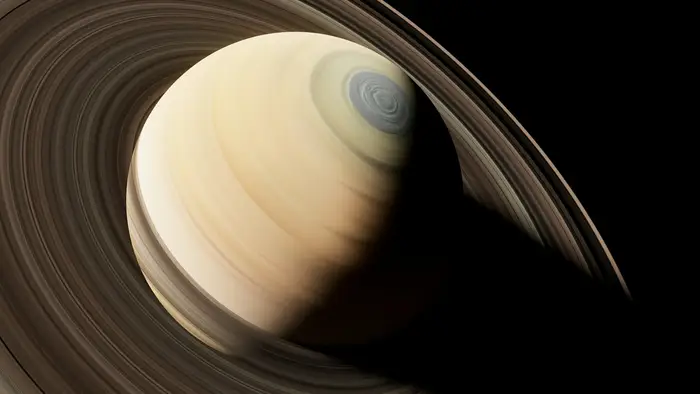
Saturn and its rings, photographed in the style of the ringed planet Voyager 1 flew past in November 1980 on its way out of the solar system. Image: Unsplash.
What One Light-Day Actually Means
A light-day is simply the distance light travels in 24 hours: 25,902,068,371 kilometres, or about 16.09 billion miles. Light is the fastest thing in the universe, and it still needs an entire day to cover that distance. Put another way, Voyager 1 will be about 173 times farther from Earth than Earth is from the Sun. Sunlight takes roughly 8.3 minutes to cross a single astronomical unit, the Earth-Sun distance. Multiply that by 173 and you get a day.
The practical consequence is a conversation conducted in slow motion. Every instruction NASA sends to Voyager 1 — a command to switch on a heater, to re-aim an antenna, to run a diagnostic — takes a full day to arrive. Every scrap of data the probe sends back, from its two remaining science instruments, takes a full day to reach the giant antennas of NASA’s Deep Space Network. A question and an answer, the fastest possible exchange, consumes two days. The engineers who operate the spacecraft work on a delay that no other mission in history has had to manage, and the delay grows by the day: Voyager 1 is receding at about 38,000 miles per hour, or 61,155 kilometres per hour.
That is why the milestone matters even though nothing physical happens at the crossing. It is a number that makes the scale of the achievement impossible to ignore. For 49 years, a machine built with 1970s electronics has been falling outward through the dark, and the distance it has covered is now measured in the time it takes light itself to travel. The spacecraft is heading in the general direction of the constellation Ophiuchus, the Serpent Bearer, about 35 degrees north of the plane of the planets, and it will keep going in that direction for as long as it has power.
There is a second light-day crossing coming soon after this one, and it is worth keeping straight. Measured from the Sun rather than from Earth, Voyager 1 reaches one light-day around February 3, 2027. The Earth-based crossing on November 18 is the one NASA is celebrating, because it is the distance from us — the distance a signal from home must travel.
The Moment, Timed to the Second
NASA’s Jet Propulsion Laboratory, which manages the Voyager mission, gives the crossing as 5:16:07 a.m. EST on November 18, 2026. Independent calculations using JPL’s own Horizons ephemeris system put it within about a minute of that time, at 10:17 UTC, confirming the agency’s figure. The small difference between the two numbers comes from the details of how the distance is measured — from Earth’s centre, from Earth’s surface, and with the spacecraft and the planet both in motion — but the message is the same: on the morning of November 18, Voyager 1 is one light-day away.
Because the moment itself falls in the small hours of the morning in the United States, NASA has scheduled its public celebration for the evening before. After sunset on Tuesday, November 17, the agency is inviting people around the world to “Shine Bright for Voyager’s Light-Day” by pointing a light skyward and flashing V-G-R, Voyager’s call sign, in Morse code. The letter V is three dots and a dash. NASA has built an automated flasher that runs in a phone or tablet browser and signals the call sign for you, and it has published step-by-step instructions for anyone who wants to do it by hand with a flashlight, a glow stick, a solar lantern, a bike light, or a phone screen. The idea is a wave of golden light circling the globe, aimed at a spacecraft that cannot see it — a gesture, not a transmission, in honour of a machine that has outlasted every expectation placed on it.
The celebration also points back to one of the most famous objects ever flown in space. Both Voyager spacecraft carry a Golden Record, a gold-plated copper disc inscribed with music, greetings in 55 languages, the sounds of Earth — wind, rain, thunder, whales, a mother’s first words to her newborn — and 115 images of life on our planet. It is a message in a bottle thrown into a cosmic ocean, and the light-day milestone is a reminder of just how far that bottle has now drifted from shore.
A 49-Year Journey in Six Stops
Voyager 1’s story is best told as a series of dates, because the dates themselves are the story: a machine launched for a five-year mission to two planets is still flying, still transmitting, 49 years later. The timeline below traces the journey from a Florida launch pad to the edge of interstellar space.
Timeline: From Cape Canaveral to One Light-Day
- September 5, 1977 — Launch. Voyager 1 lifts off from Launch Complex 41 at Cape Canaveral aboard a Titan IIIE-Centaur rocket, 16 days after its twin, Voyager 2. Although it launches second, it flies a faster trajectory and overtakes Voyager 2 on December 15, 1977.
- March 5, 1979 — Jupiter. Voyager 1 makes its closest approach to Jupiter, passing about 349,000 kilometres from the planet’s centre. Over a four-month encounter it returns some 19,000 photographs, discovers a thin ring around Jupiter and two new moons, Thebe and Metis, and watches erupting volcanoes on the moon Io.
- November 12, 1980 — Saturn. The spacecraft flies past Saturn at about 124,000 kilometres from the planet’s centre, and within 6,490 kilometres of the giant moon Titan. It finds five new moons and a new ring, the G-ring. Its primary mission ends a week later, on November 20, 1980.
- February 17, 1998 — Farthest human-made object. Voyager 1 overtakes NASA’s Pioneer 10 and becomes the most distant human-made object from Earth, a title it has held ever since.
- August 25, 2012 — Interstellar space. Voyager 1 crosses the heliopause, the boundary where the solar wind gives way to the interstellar medium, at about 121 astronomical units from the Sun. It is the first spacecraft to enter interstellar space. NASA confirms the crossing on September 12, 2013.
- November 18, 2026 — One light-day. At 5:16:07 a.m. EST, Voyager 1 reaches 16.09 billion miles from Earth, the distance light travels in one day. It is the first human-made object to get that far.
Two more dates belong on the same timeline, looking forward rather than back. Around February 3, 2027, Voyager 1 reaches one light-day from the Sun. And in November 2035, its twin, Voyager 2 — travelling more slowly and on a different path — is expected to reach one light-day from Earth. Voyager 1 got there first, as it has at almost every milestone since 1977.
The journey was only possible because of a rare alignment of the outer planets, one that occurs roughly once every 175 years. The alignment let the Voyagers use the gravity of one planet to slingshot themselves on to the next, a technique called a gravity assist. Without it, a mission to Jupiter and Saturn in the 1970s would have needed far more fuel than any rocket of the era could carry. Voyager 1 used Jupiter’s enormous gravity to bend its trajectory toward Saturn, and Saturn’s gravity to fling it upward, out of the plane of the planets, and on toward the stars.
The Grand Tour: Jupiter and Saturn
Voyager 1 began photographing Jupiter in January 1979, and its closest approach came on March 5 of that year. The encounter lasted four months, from January 6 to April 13, and it rewrote the textbooks. Before Voyager, Jupiter was a banded disc glimpsed through telescopes; after Voyager, it was a world with weather, with a Great Red Spot that turned out to be a storm larger than Earth, and with moons that were worlds in their own right. The spacecraft discovered that Io, the innermost of Jupiter’s large moons, is the most volcanically active body in the solar system, its surface constantly resurfaced by erupting sulphur volcanoes. It found a faint ring around Jupiter that no telescope on Earth had ever seen, and two small new moons, Thebe and Metis, hiding close to the planet.
Jupiter’s gravity then did the work of a rocket engine. The giant planet’s pull bent Voyager 1’s path and accelerated it onward, sending it across 17 months of empty space toward Saturn. The spacecraft began its long-range observations of Saturn on August 22, 1980, still 68 million miles from the planet, and made its closest approach on November 12, passing about 124,000 kilometres from Saturn’s centre. The encounter delivered the first close-up views of the ring system’s intricate structure, discovered five new moons and a new ring, and — in a close pass just 6,490 kilometres from Titan — gave scientists their first detailed look at the atmosphere of Saturn’s largest moon, a thick orange haze of nitrogen and methane that hid the surface completely.
The Titan flyby was the reason Voyager 1’s trajectory was bent upward and out of the solar system. The spacecraft’s path was deliberately aimed to pass close to Titan, and the gravity of that encounter flung Voyager 1 northward, away from the plane of the planets, on a course that would eventually carry it out of the Sun’s bubble entirely. Voyager 2, which had not been sent past Titan, continued on to Uranus and Neptune. Voyager 1’s planetary tour was over after two worlds. Its interstellar tour was just beginning.
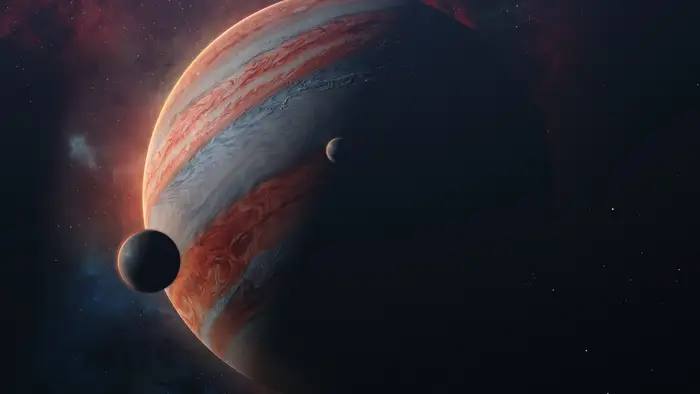
A gas giant and its moons. Voyager 1’s Jupiter encounter in 1979 returned some 19,000 photographs and discovered a thin ring and two new moons. Image: Unsplash.
Two Instruments Still Listening
Voyager 1 launched with ten science instruments. Four decades of planetary encounters, instrument failures, and a slowly dying power supply have reduced that number to two. The magnetometer, which measures magnetic fields, and the plasma wave subsystem, which listens for electrical oscillations in the surrounding plasma, are the only science instruments still operating on Voyager 1. Everything else has been switched off — some after the planetary encounters made them unnecessary, some as they degraded, and the most recent two as sacrifices to the power budget.
The table below summarises the state of the spacecraft’s science payload as of NASA’s latest instrument-status update, and the power system that keeps it alive.
Voyager 1 by the Numbers
| Item | Figure |
|---|---|
| Launch date | September 5, 1977 |
| Launch vehicle | Titan IIIE-Centaur, Cape Canaveral LC-41 |
| Spacecraft mass | 722 kg (1,592 lb) |
| Speed | About 38,000 mph (61,155 km/h) |
| Distance on November 18, 2026 | 16.09 billion miles (25.9 billion km), about 173 AU |
| One-way light time | 24 hours |
| Round-trip light time | About 48 hours |
| Science instruments launched with | 10 |
| Science instruments still operating | 2 — magnetometer and plasma wave subsystem |
| Cosmic ray subsystem | Switched off February 25, 2025 |
| Low-energy charged particles experiment | Switched off April 17, 2026 |
| Power source | 3 plutonium-238 radioisotope thermoelectric generators |
| RTG output at launch | About 158 watts each |
| Power loss | About 4 watts per year, per spacecraft |
| Heliopause crossing | August 25, 2012, at about 121 AU |
| Voyager 2 one light-day | Expected November 2035 |
NASA’s mission manager Kareem Badaruddin described the two survivors plainly: “Voyager 1 still has two remaining operating science instruments — one that listens to plasma waves and one that measures magnetic fields.” Between them, they are still sending back irreplaceable data from a place no other probe has ever reached: measurements of the magnetic field and the thin plasma of interstellar space, the medium between the stars.
The two instruments switched off most recently were the cosmic ray subsystem, turned off on February 25, 2025, and the low-energy charged particles experiment, turned off on April 17, 2026. The low-energy experiment had been running almost without interruption since 1977 — nearly 49 unbroken years of science. When engineers switched it off, they left one small motor running: the 0.5-watt spinner that sweeps the instrument’s sensor in all directions. It draws almost nothing, and keeping it alive preserves the option of switching the instrument back on if power is ever found.
That power comes from three radioisotope thermoelectric generators, which convert the heat of decaying plutonium-238 into electricity. Each generator produced about 158 watts at launch. But plutonium decays, and the generators lose about 4 watts of electrical output every year on each spacecraft. By November 2023 the twin Voyagers’ RTG systems were producing about 225 watts in total, and the number falls every year. Every watt is now rationed. Engineers must constantly balance two competing demands: keep the science instruments running, and keep the spacecraft warm enough that its fuel lines do not freeze solid in the cold of interstellar space.
The Big Bang and the 48-Hour Silence
The light-day milestone arrives just weeks after Voyager 1 gave its handlers two very different pieces of news: one reassuring, one alarming. Both say something about how close to the edge this mission now operates.
The reassuring news came first. In early September 2026, engineers completed a months-long effort the team nicknamed the “Big Bang”: they switched off three devices on Voyager 1 at once and replaced them with three lower-power alternatives, in a single coordinated operation. The devices help keep the spacecraft warm enough to work in deep space, and the swap was designed to stretch the shrinking power supply. The same operation had already been run on Voyager 2 about six weeks earlier, on August 4, 2026, as a safer test, and it worked. NASA says that without the Big Bang, another Voyager 1 science instrument would have had to be switched off as early as the summer of 2027. With it, the two remaining instruments can keep working longer than the team had budgeted for.
The alarming news came in October. During two scheduled contacts on October 18 and 19, 2026, NASA’s Deep Space Network — the system of giant antennas in California, Spain, and Australia — could not detect Voyager 1’s signal at all. For 48 hours, the farthest spacecraft humanity has ever built was silent. Then, on October 20, the signal came back on its own, before engineers had sent any troubleshooting commands. The link has been steady ever since.
The cause is still under investigation. What the team at the Jet Propulsion Laboratory has established so far is narrower: one group of the spacecraft’s thrusters, the small engines that keep the probe pointed at Earth, went offline, and the backup set switched on automatically. That automatic response is the spacecraft’s fault protection doing its job — putting Voyager 1 into a safe configuration and pausing normal operations while engineers work out what happened. The thrusters matter enormously, because a spacecraft that cannot point its antenna at Earth cannot be heard at all, no matter how healthy the rest of it is. In 2025, JPL revived a set of roll thrusters that had been considered unusable since 2004, precisely so Voyager 1 would have a working backup if residue clogged the primary set. That foresight may be part of why the October silence lasted 48 hours instead of forever.
The October episode is a reminder of the stakes. Voyager 1 is 49 years old, running on a power supply that loses 4 watts a year, operated across a communications delay of a full day each way, and every fix takes days to command and days to confirm. The spacecraft has survived this long because its engineers keep finding new ways to keep it alive — reviving dead thrusters, swapping heaters, sacrificing instruments one by one to save the others. The light-day milestone is a celebration, but it is also a measure of how far from help the spacecraft now is.
What Happens Next
Nothing on board Voyager 1 will change on November 18, and NASA has said so explicitly. The probe will not register any change in its surroundings. It will keep doing what it has done since 2012: drifting through interstellar space at 38,000 miles per hour, measuring magnetic fields and plasma waves, and sending the results home on a signal so faint that only the largest antennas on Earth can hear it.
The question is how much longer that can continue. NASA estimates that at least one science instrument could keep operating into the 2030s, but that is an engineering outlook, not a guarantee. Scientists estimate the generators will stop supplying enough power for the instruments within 10 to 15 years. After that, Voyager 1 falls silent for good and keeps going — a derelict ambassador, carrying its Golden Record, drifting through the galaxy long after the last signal fades.
There are milestones still to come before that day. Around February 3, 2027, Voyager 1 will be one light-day from the Sun. In November 2035, Voyager 2 is expected to reach one light-day from Earth, becoming the second human-made object to cross that line. And the distance keeps growing: after the November 18 crossing, the gap between Earth and Voyager 1 keeps widening until January, dips slightly until April as Earth’s orbit carries us closer, and then grows for good.
The mission’s legacy is already secure, whatever happens next. Voyager 1 gave humanity its first close look at Jupiter’s volcanoes and Saturn’s rings, its first measurements of the space between the stars, and a Golden Record that may outlast every other human artefact. It did all of that on a power budget smaller than a few household light bulbs, with 1970s onboard computers, operated by engineers who were not born when it launched.
For readers who want to follow the spacecraft’s remaining journey, NASA’s Voyager mission pages carry the live distance, the instrument status, and the Deep Space Network’s latest contact reports. The numbers there change every day, by about 1.5 million kilometres, and they will keep changing for as long as the spacecraft has power to spend.
How to Mark the Night
The November sky offers more than Voyager 1 this month, and the spacecraft’s milestone sits in the middle of a crowded calendar. On November 15 and 16, Mars and Jupiter appear just 1.2 degrees apart in the pre-dawn sky, slightly more than the width of two full Moons, bright enough to see with the naked eye. On the nights of November 17 and 18 — the same nights as the light-day crossing — the Leonid meteor shower peaks, with up to around 15 meteors per hour under ideal dark skies after the Moon sets. And on November 24, a full supermoon rises, the first of three consecutive supermoons running through January 2027.
But the Voyager celebration is the one that asks something of its audience. After sunset on Tuesday, November 17, NASA invites anyone with a light — a flashlight, a phone, a glow stick, a bike light — to point it at the sky and flash V-G-R in Morse code: dot-dot-dot-dash, dash-dash-dot, dot-dash-dot. The spacecraft is travelling in the direction of Ophiuchus, high in the western sky in the early evening, far too distant to see. The light you flash will never reach it. That is rather the point. The gesture is for us, not for the probe: a way for the species that built it to say, across 16 billion miles and 49 years, that we are still watching it go.
The full Moon against the black of space. Voyager 1 is now about 173 times farther from Earth than Earth is from the Sun. Image: Unsplash.
A Message That Takes Two Days
There is a simple way to feel the size of what Voyager 1 has done. Stand outside on the night of November 17, point a light at the sky, and imagine the signal you are sending. It travels at 300,000 kilometres per second, the fastest speed the universe allows, and it would still need a full day to reach the spacecraft — and another day for any answer to return. A conversation with Voyager 1 is a conversation conducted across two days, with a machine launched before most of the people reading this were born, in a place where the Sun is just another star.
That is what one light-day means. Not a line in space, but a measure of how far we have reached. Voyager 1 was built to fly past two planets and fall silent. Instead it became the first thing we ever made to leave the Sun’s protective bubble, the first to taste the wind between the stars, and now the first to be a full day’s light-travel from home. On November 18, at 5:16 in the morning, it crosses a distance measured in the time light itself needs to travel — and it keeps going, at 38,000 miles per hour, into a night that has no end.
A reddish Moon among the stars. On the night of November 17, NASA invites the public to shine a light skyward for Voyager 1. Image: Unsplash.
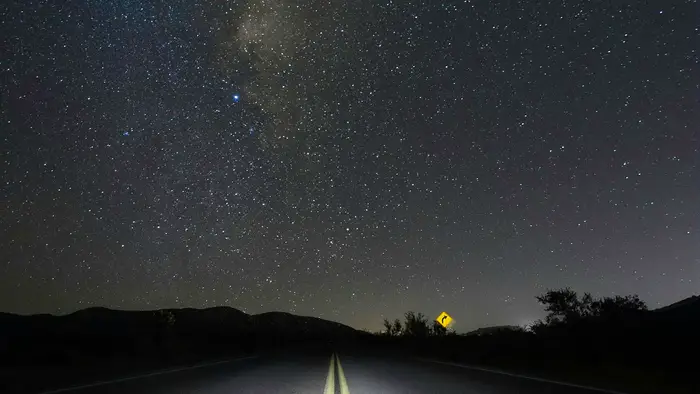
The Milky Way over a dark desert road. Voyager 1 is heading out of the solar system and into the galaxy beyond. Image: Unsplash.
For more on humanity’s other far-flung missions, see NASA Moon Base $10 Billion CLPS 2 Awards: Nuclear Rover PROMISE Targets 2028, Artemis II Ionosphere Hole: SLS Launch Carved a 5,000 km Scar in the Sky, and 2026 QQ8 Mini-Moon: Earth’s Tiny Temporary Second Moon.