USSF-432 Launch November 2 2026: A Classified Falcon 9 Flight and a Possible Space Jellyfish
A classified rocket is about to light up the California coast, and if the timing holds, much of the American West could watch its exhaust glow against the twilight sky. SpaceX is targeting Monday evening, November 2, 2026, for the launch of USSF-432, a mission for the United States Space Force that carries a payload the government has not described in public. The Falcon 9 rocket is scheduled to lift off from Space Launch Complex 4E at Vandenberg Space Force Base in California, inside a four-hour window that opens at 5:42 p.m. Pacific Time.
For the Space Force, this is business as usual in an extraordinary year. For skywatchers, it could be something rarer: a so-called space jellyfish, the luminous plume that appears when a rocket climbs into sunlight while the ground below sits in darkness. And for the launch industry, it is one more data point in a year in which a single rocket family has flown more than a hundred times while its rivals struggle to keep pace.
The details of USSF-432 are thin by design. SpaceX has released no payload description, and the Space Force rarely adds color to missions like this one. What can be said with confidence comes from the launch schedule itself, the booster’s flight history, and the recovery plan. That is still enough to say something useful about how reusable launch hardware now carries national security work, and about what to watch for when the countdown reaches zero.
The launch window: when and where to watch
Launch trackers list the primary target as November 2, 2026, at 5:42 p.m. PT, which is 8:42 p.m. Eastern Time. Because daylight saving time ended on November 1, that works out to 01:42 UTC on November 3, or 08:42 WIB on Tuesday, November 3, for readers in Indonesia. The window stays open for four hours, closing at 9:42 p.m. PT. A backup opportunity exists on November 3 starting at 5:28 p.m. PT, which is 8:28 p.m. Eastern, per the same tracking reports.
The rocket lifts off from SLC-4E, SpaceX’s West Coast pad. Falcon 9 will fly a southeastern trajectory to place a classified satellite in low Earth orbit, according to launch listings. SpaceX will stream the launch on its website and its X account, with the webcast starting about ten minutes before liftoff, according to the tracking report.
Launch times on classified missions can move. A weather call, a range conflict, or a hardware check can push liftoff to the backup slot, so anyone planning to watch should check SpaceX’s official channels on the day. That caveat applies to every mission, but it matters more than usual here: the twilight viewing geometry that could produce a space jellyfish depends on launching near the opening of the window, while the sky is still in that brief transition between day and night.
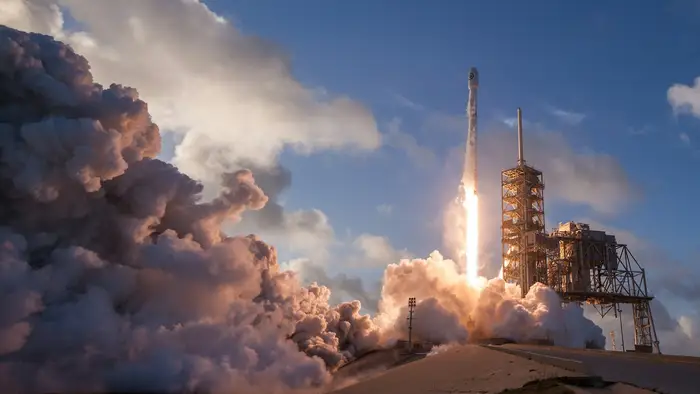
A Falcon 9 rocket climbing away from its launch pad. Image: Unsplash.
The space jellyfish: why tonight’s sky could glow
The spectacle that has forecasters and skywatchers talking is not the rocket itself but what its exhaust does high in the atmosphere. When a launch takes place near sunrise or sunset, observers on the ground are in darkness while the rocket climbs into air that is still sunlit. Sunlight catches the expanding exhaust plume and the gases vented by the upper stage, and the result is a glowing, billowing cloud that can look like a jellyfish drifting across the sky. The display can remain visible from hundreds of miles away.
The timing on November 2 is close to ideal. With the end of daylight saving time, sunset comes earlier in California, and the launch window falls squarely in evening twilight. A similar display followed a SpaceX launch just a couple of weeks earlier, and forecasters are flagging a repeat chance for Monday night. The launch will take place at Vandenberg, but much of the West could have a chance to spot the phenomenon if skies cooperate.
Visibility will depend heavily on local cloud cover and the path of recent weekend storms. Forecasters say southern Utah, Arizona, and New Mexico should have the clearest skies, with the weekend’s storms clearing out in time for the launch. Parts of southern California, including Los Angeles, as well as Las Vegas and Salt Lake City, are forecast to have some clouds, but there should be enough breaks to spot the glow. Northern California, including San Francisco, and western Nevada face a tougher outlook with cloudy skies, though no rain is forecast. Storms moving through Colorado on Monday evening, bringing rain and high-elevation snow, will probably keep observers there from catching a glimpse.
The phenomenon is a reminder of something easy to forget about rocket launches: they are visible events, not just engineering ones. A classified mission that the government will barely discuss can still paint the sky for millions of people, and that tension between secrecy and spectacle is part of what makes these flights fascinating to follow.
What is known about the classified payload: almost nothing
Officially, almost nothing is known about what USSF-432 carries. SpaceX released no payload details and did not disclose the target altitude. Launch listings describe a single classified satellite headed to low Earth orbit. One tracker lists the payload under the designation R-4 and says it may be a batch of classified satellites built on SpaceX’s Starshield bus. That is a tracker’s inference, not a statement from SpaceX or the Space Force, and it should be treated as such.
The distinction matters. A single satellite and a batch of satellites imply very different missions, and the available reporting does not settle it. Any claim about the spacecraft’s purpose, its owner agency, or its capabilities should be treated as unconfirmed until the government says otherwise.
The mission name offers one clue. USSF is the Space Force’s prefix for its launch designations, so the customer is the Space Force or one of its mission partners. The reports reviewed do not name a contract, a program office, or a dollar value for this flight, so this article does not guess at one. That restraint is not a gap in the reporting; it is the reporting. Classified launches are announced with a schedule and a rocket, and the rest stays behind a curtain.
Readers who have followed earlier classified flights from Vandenberg will recognize the pattern. SpaceX previously flew a classified USSF-481 mission from the same California base, and the USSF-385 Starshield launch from Vandenberg showed how the Space Force uses the company’s satellite bus for national security work. In both cases, the public record was a launch time, a rocket, and a landing — and then silence.
Booster reuse: an eighth flight for a proven first stage
The most concrete hardware fact about USSF-432 is the booster. Tracking reports agree that this mission will be the first stage’s eighth flight. The same booster previously flew GPS III-8, a Space Force navigation satellite, and six Starlink missions. One listing identifies it as B1095, making this its eighth flight.
That flight history is worth reading closely. Six of the seven earlier flights were Starlink launches, the high-cadence missions that fill much of SpaceX’s manifest. One was GPS III-8, a Space Force navigation satellite. So this booster has already carried a national security payload and now returns for a second one. The booster’s own record shows that a flown stage can take on a Space Force payload, and this flight repeats that pattern.
Eight flights is well short of the fleet’s leaders. On Halloween, booster B1093 flew its 18th mission with 27 Starlink satellites. An eighth flight is therefore mid-life for the fleet, not a stretch. For a customer, the draw is a booster with a clean, documented record that has been inspected after every landing.
Reuse also changes the economics behind these launches. A recovered booster spreads its build cost across many missions, letting SpaceX price national security flights competitively while still flying commercial work on the same hardware line. The reports do not state a price for USSF-432, but the structural advantage is plain. There is a practical side to the reuse story as well. Each landing gives engineers a chance to inspect the stage before the next flight, and over seven prior missions this booster has accumulated that inspection history — part of why a customer can accept a flown stage for a sensitive payload. The reports do not describe the specific refurbishment work done between flights, so this article stays general on that point.

A rocket climbing through the atmosphere, its exhaust trail catching the light. Image: Unsplash.
Droneship recovery and sonic booms on the Central Coast
SpaceX plans to land the booster on the droneship Of Course I Still Love You in the Pacific Ocean, according to tracking reports. West Coast missions on a southeast track typically rely on a ship because the trajectory carries the booster downrange, away from the launch site, rather than back toward land.
Residents of Santa Barbara, San Luis Obispo, and Ventura counties may hear sonic booms, the tracking report notes. That is standard for Vandenberg launches and landings, and it often draws local social media posts within minutes of liftoff. If you live on the Central Coast, expect the sound to follow the visible ascent by some time.
The tracking report adds that the livestream is expected to end shortly after liftoff, as it did on the previous classified mission. Viewers should not expect to see stage separation, fairing deployment, or payload release. SpaceX typically cuts coverage on missions where the customer limits public detail, and USSF-432 appears to be no exception. For viewers, that means the most dramatic part of the show may be the part that happens in the sky, not on the screen: the ascent and the glowing plume, visible from the ground long after the broadcast goes dark.
The 118th versus 119th flight count
One wrinkle in the reporting deserves a plain note. Launch listings call USSF-432 the 119th Falcon 9 mission of 2026, while one tracking article’s text describes it as SpaceX’s 118th Falcon 9 mission of the year. The tallies differ by one.
The gap likely comes from counting method. One tally may count flights already completed, and another may count this flight as the next in sequence. The reports do not let a reader confirm that from the outside, and this article flags the discrepancy rather than hiding it. Either number points to the same conclusion: Falcon 9 has flown more than a hundred times this year, and a classified flight is now one entry among many on the manifest.
Flight 119 in early November implies a pace of roughly one launch every three days across the calendar year so far. That math is simple division, not a reported figure, but it shows the scale. No other American rocket flies anything close to that rate, and the pace is colliding with demand and with regulators. Analyst firm Quilty Space has argued the industry faces a 150-launch shortfall through 2030, which makes every reliable Falcon 9 slot valuable. SpaceX, meanwhile, has pushed for far more flights per year, though the Federal Aviation Administration currently counts 195 licensed launches against the company’s far larger ambitions.
For national security customers, cadence is a feature. A high-flight-rate vehicle with several pads and a proven recovery fleet lets the Space Force schedule missions with some confidence. USSF-432 has a defined backup window one day later, a luxury that fleets with fewer boosters struggle to offer. Hardware watchers should also note the second-order effects: a busy Vandenberg manifest puts pressure on pad turnaround, range scheduling, and droneship availability. A droneship can only support one landing at a time, so each recovery sets the pace for the next West Coast booster return. The reports reviewed do not give turnaround times, but the constraint explains why the backup window sits only a day behind the primary.
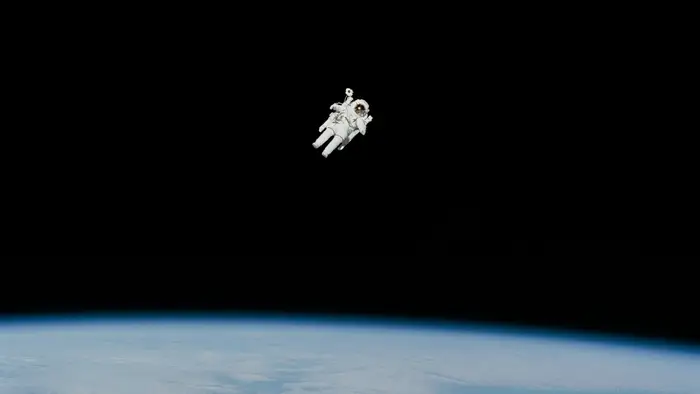
Earth from orbit, where the satellites launched from Vandenberg do their work. Image: Unsplash.
Why Vandenberg matters for Space Force missions
Vandenberg sits on the California coast and supports launches into polar and sun-synchronous orbits, plus southeastern tracks like this one. SLC-4E is SpaceX’s main West Coast pad, and using it for USSF-432 keeps the mission over open Pacific water on ascent. That geography is one reason the base has become the default departure point for so much of the country’s national security launch traffic.
The base also has history with classified payloads. The X-37B spaceplane mission known as OTV-7, which launched on a Falcon Heavy in December 2023, ended with a landing at Vandenberg on March 7, 2025, after 434 days in orbit. USSF-432 is a different vehicle and a different mission, but both illustrate how heavily the Space Force leans on this site.
The contrast between the two missions is instructive. OTV-7 came with published orbit numbers and named experiments. USSF-432 comes with a schedule and little else. That gap reflects the mission type, not the rocket: Falcon 9 serves both ends of the transparency range, from Starlink trains that anyone can watch cross the sky to payloads that the government will not even count in public.
Classified work on commercial rockets used to be rare. Now it is routine, and the change happened fast. A decade ago, a national security payload on a commercially operated, reused booster would have been a policy debate. Today it is a line item on a manifest that also includes Starlink batches, rideshares, and commercial satellite deliveries. The Starlink 15-16 launch from Vandenberg just days earlier, on October 27, flew 27 satellites on a booster making its 26th flight — the same pad, the same rocket family, a wholly different kind of mission.
A packed week at Vandenberg
USSF-432 does not fly in isolation. The week of October 25 to November 1 saw three completed orbital launches, all successful: India’s GSLV Mk II launch of NVS-03 on October 30, which mattered because the previous satellite in the series never reached its working orbit, and two SpaceX Starlink launches from Vandenberg, including Starlink Group 15-18 on October 31 at 04:04 UTC. SpaceX also ignited a Super Heavy booster’s engines ahead of its next Starship launch, though Starship does not appear on the next seven days of launch schedules.
Looking ahead, a second Falcon 9 mission is scheduled for Thursday, November 5: Starlink Group 15-21, set to launch from the same California base carrying 27 Starlink satellites into low Earth orbit. And United Launch Alliance’s Vulcan rocket is due to return to flight on November 13 with 40 Amazon Leo satellites, a commercial mission that will show how quickly Vulcan can rebuild a cadence after its grounding.
The contrast with Falcon 9 is stark. SpaceX will have flown its 119th mission of the year before Vulcan flies again. Vulcan is a capable heavy-lift vehicle, and the Space Force values having two providers. But in raw availability, a customer with a mid-November need and a classified payload has one clear option on the calendar. Competition still matters for the buyer: dual sourcing protects the government from a single-point failure and keeps pricing honest. Analysts will watch whether Vulcan’s return changes how the Space Force splits its manifest, but nothing in the USSF-432 reporting addresses that, so it remains a question rather than a finding.
What is still unknown
The list of open questions about USSF-432 is longer than the list of facts, and honesty about that is part of the story. The launch window and pad are reported by trackers. The booster’s eighth flight, its prior missions, and the droneship landing are reported. The Starshield-based payload is a tracker inference, unconfirmed. The number of satellites, the target altitude and inclination, and the contract value are not disclosed or not reported. The flight count is 118th or 119th depending on the source.
Expect that picture to stay mostly unchanged after launch. Classified missions usually produce a short confirmation of liftoff and booster recovery, then silence. If more detail emerges, it will come from the Space Force or SpaceX, not from trackers. That is not a failure of coverage; it is the nature of the mission. The public’s window into USSF-432 is the launch itself — the light in the sky, the sonic boom on the coast, and the brief webcast before the feed cuts.
There are also the forecasts that are analytical rather than reported. The booster will probably land, because recovery is routine for Falcon 9 and an eighth flight sits well inside the fleet’s demonstrated range. The webcast will probably cut early, matching the last classified flight. Payload details will probably stay sealed, because the government has given no indication it will describe the satellite. The backup slot will see use only if weather or range issues strike. Each of these could miss, and readers should hold them as predictions, not facts.

A dark western sky, the kind of sky that makes a twilight launch plume glow. Image: Unsplash.
How to watch the USSF-432 launch
For viewers in the western United States, the plan is simple: be outside, looking west or southwest, around the opening of the window at 5:42 p.m. PT, and keep watching for several minutes after liftoff. The rocket itself will be a bright point climbing fast; the jellyfish, if it forms, will bloom behind it as the plume expands and catches the last sunlight. Photographers should use a tripod and a wide lens, because the plume can span a large part of the sky. Viewers in Arizona, New Mexico, and southern Utah have the best forecast; viewers in Los Angeles, Las Vegas, and Salt Lake City should watch through breaks in the clouds; viewers in Colorado will likely be out of luck this time.
For viewers elsewhere, SpaceX’s webcast on its website and X account starts about ten minutes before liftoff, with the caveat that coverage is expected to end shortly after liftoff on this classified flight. Trackers will also post updates if the launch slips to the backup window on November 3.
The broader significance of USSF-432 is easy to miss in the glow. A reused booster carrying a secret satellite on a Monday evening, with a backup slot the next day and another Starlink launch three days later from the same pad, is the new normal of American spaceflight. The rocket that once would have been the story is now the routine. The payload that once would have been the story is now the secret. And the sky show that nobody planned — sunlight on exhaust, high above a darkened coastline — is the part everyone will remember. If the clouds cooperate and the countdown holds, look up on Monday evening. The most secretive launch of the week might also be the most visible.

A night launch lighting up the sky. Image: Unsplash.