TOI-2431b Hubble Secondary Eclipse: Lava World Glows at 2,524 K
For thirty-six years, the Hubble Space Telescope has watched planets cross in front of their stars, dimming starlight by a fraction of a percent and betraying their size, their orbit, and sometimes the chemistry of their skies. It has never once caught a rocky planet slipping behind its star. That changed with a world called TOI-2431b, a lava planet so close to its sun that a year there lasts five hours and twenty-two minutes, and so hot that its dayside glows at 2,524 kelvin — a temperature that sits almost exactly at the theoretical maximum for a world that absorbs every scrap of starlight that falls on it and sends none of it around to the night side.
The result, published in The Astrophysical Journal Letters on October 30, 2026, and highlighted by the American Astronomical Society on November 4, is the first detection of a secondary eclipse from a rocky exoplanet by Hubble. A secondary eclipse is the moment a planet disappears behind its star, and the tiny dip in the combined light of the system carries information no transit can offer: how hot the planet’s dayside is, how reflective its surface might be, and whether it holds any atmosphere at all. For gas giants, Hubble has measured dozens of secondary eclipses. For rocky worlds, the signal is far fainter — a few dozen parts per million of the star’s light — and until now it had stayed out of reach.
TOI-2431b is an extreme object even by the standards of the ultra-short-period planets, a class of worlds that hug their stars so tightly that their years are measured in hours. It orbits a dim orange K-type dwarf star about 36 parsecs — roughly 117 light-years — from Earth, completing a circuit every 5.4 hours. It is the shortest-period planet known with both a measured mass and a measured radius: 6.2 times the mass of Earth packed into a sphere 1.54 times Earth’s radius. Its equilibrium temperature, the temperature it would have if it simply soaked up starlight and re-radiated it evenly, is about 2,063 kelvin, or roughly 1,790 degrees Celsius. That alone is hot enough to melt rock. What Hubble found is hotter still.
What a Secondary Eclipse Actually Measures
Thousands of exoplanets have been discovered by the transit method, which watches for the small, regular dimming of a star as a planet passes in front of it. A transit tells astronomers a planet’s size and its orbital period, and if the planet’s mass is known from the wobble it induces in its star, the two together give a density and a first guess at composition. But a transit only ever shows the planet’s nightside — the dark face turned toward us as the world crosses its star.
A secondary eclipse is the opposite event. Half an orbit later, the planet passes behind its star, and for a short while the star hides the planet entirely. The light we receive drops by the exact amount the planet itself was contributing: its own thermal glow plus whatever starlight its surface reflects. That drop is the secondary eclipse depth, and it is a direct measurement of the planet’s dayside. For a hot gas giant, the dip can reach a tenth of a percent of the star’s light. For a rocky planet the size of Earth and a half, it is measured in parts per million — tens of millionths of the star’s brightness.
That is why the measurement reported by Sebastian Zieba of the Center for Astrophysics | Harvard & Smithsonian and his collaborators is a technical landmark as much as a scientific one. The team observed a complete phase curve of TOI-2431b with Hubble’s Wide Field Camera 3, using its G141 grism to record near-infrared light between 1.1 and 1.7 microns as the planet moved through an entire orbit: dayside, limb, nightside, and eclipse. The observations were taken on February 4, 2022, as part of a General Observer program, and the analysis took years to reach publication. The paper was received on August 4, 2026, revised on September 17, and accepted on September 25, before appearing in The Astrophysical Journal Letters as volume 1011, paper L32.
Hubble measured a planet-to-star flux ratio of 69 parts per million in its near-infrared band, with an uncertainty of plus 14 and minus 13 parts per million. Combined with visible-light data from NASA’s Transiting Exoplanet Survey Satellite, or TESS — the mission that first flagged TOI-2431b as a candidate in 2019 — the team also recovered an optical eclipse depth of 37 parts per million, plus or minus 10. Two independent telescopes, two wavelengths, one consistent story.
The joint fit of the TESS and Hubble data yields a dayside brightness temperature of 2,524 kelvin, with an uncertainty of plus 77 and minus 84 kelvin. In everyday units, that is about 2,251 degrees Celsius, or 4,084 degrees Fahrenheit. It is hot enough to melt most rocks, hot enough that the planet’s surface is expected to be wholly or partly molten — a lava world in the most literal sense.
TOI-2431b by the Numbers
Every figure below comes from the Zieba team’s paper and the mission data behind it. Together they describe a world balanced on the edge of what a rocky planet can be.
| Property | Value |
|---|---|
| Host star type | Late K-type dwarf |
| Distance from Earth | ~36 parsecs (~117 light-years) |
| Orbital period | 5.4 hours (5 hours 22 minutes) |
| Planet mass | 6.2 Earth masses |
| Planet radius | 1.54 Earth radii |
| Equilibrium temperature | ~2,063 ± 30 K |
| Dayside brightness temperature | 2,524 +77/−84 K |
| Theoretical maximum dayside temperature | 2,574 +36/−35 K |
| Temperature ratio (measured / maximum) | 0.980 +0.032/−0.034 |
| TESS optical eclipse depth | 37 ± 10 parts per million |
| Hubble near-infrared eclipse depth | 69 +14/−13 parts per million |
| Hubble instrument | Wide Field Camera 3, G141 grism (1.1–1.7 µm) |
| Nightside emission detected | None |
| First flagged by TESS | 2019 |
| Hubble phase-curve observation | February 4, 2022 |
| Paper published | October 30, 2026, ApJL 1011, L32 |
The most telling number in that table is the ratio: 0.980. The measured dayside temperature is 98 percent of the theoretical maximum for a planet with zero reflectivity and zero heat redistribution — a world that absorbs all the light that hits it and moves none of the resulting heat to its nightside. TOI-2431b is, within the measurement uncertainties, exactly that world.
A Year in 5.4 Hours
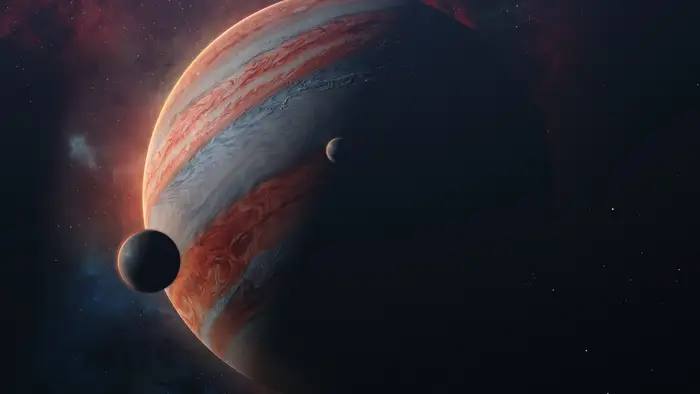
To understand why TOI-2431b is so hot, it helps to picture its orbit. Earth takes 365 days to circle the Sun at a distance of 150 million kilometres. TOI-2431b completes its year in less time than a single work shift, whipping around its star at a distance so small that the star must fill a huge fraction of its sky. At that proximity, the star’s gravity has almost certainly locked the planet’s rotation to its orbit, the way the Moon is locked to Earth: the same face always turned toward the star, one side in permanent daylight, the other in permanent night. The dayside bakes. The nightside freezes. Nothing in between gets a reprieve.
Planets this close to their stars live violent lives. Searing radiation and stellar winds strip away any primordial atmosphere a planet is born with — the light hydrogen and helium envelope that a young world might have captured from the nebula of its birth. What remains is bare rock, or rock that has melted under the bombardment and now circulates as lava. In the last few years, however, observations have shown that these scorched worlds can still have atmospheres of a deeply un-Earth-like kind: thin envelopes of vaporised rock, silicon and oxygen boiled off a molten surface, a sky made of stone.
That possibility is what makes lava worlds scientifically precious. They are the only rocky exoplanets whose surfaces and skies we can currently probe in any detail, and they are laboratories for the physics of planets that have no analogue in our solar system. Mercury, the closest thing the Sun offers, is a cold cinder by comparison, with a dayside temperature of about 700 kelvin. TOI-2431b is more than three times hotter — and it is far enough away that studying it requires the most sensitive instruments humanity has ever flown.
The planet’s host star matters too. K-type dwarfs, orange stars slightly cooler and smaller than the Sun, are among the most common stars in the galaxy and among the most promising hosts for planet hunters: they are bright enough to study in detail, calm enough that their planets’ signals are not drowned in stellar tantrums, and long-lived enough that their systems have had billions of years to settle. TOI-2431b’s star, at roughly 117 light-years away, is near enough that Hubble and the James Webb Space Telescope can both reach it — and far enough that every photon counts.
The Outlier Among Lava Worlds
The headline temperature is not the only surprise in the Zieba team’s result. It is the fact that TOI-2431b is so hot at all. Other lava worlds observed so far have generally turned out cooler than the theoretical maximum for a dark, airless rock. Something in those systems — a reflective surface, a cloudy atmosphere, or a mechanism that ferries heat efficiently from the dayside to the nightside — acts to hold the dayside temperature down. Their brightness temperatures fall short of the zero-albedo, no-redistribution limit, sometimes well short.
TOI-2431b does not. Its dayside brightness temperature is consistent, within the uncertainties, with the absolute ceiling: a planet that absorbs all incident energy and redistributes none of it. That places it at the extreme end of the lava-world population, and it makes the planet a benchmark — a clean, limiting case against which other lava worlds can be measured. If a lava world can be this hot, then the cooler ones must owe their moderation to something real: an atmosphere, a reflective surface, or a heat-transport mechanism that TOI-2431b lacks.
The phase curve supports the same picture. Hubble watched the planet through a full orbit, and the light curve is consistent with zero nightside emission. No detectable heat leaks around to the dark side. If TOI-2431b has an atmosphere thick enough to carry warmth from day to night, it is not showing it in these data. The nightside is dark, cold, and silent in Hubble’s near-infrared eye.
That does not settle the question of whether the planet has an atmosphere at all. It narrows the possibilities, and it sets up the next observation. A thin rock-vapour atmosphere could exist without transporting much heat, and the team’s models show that such an atmosphere would produce almost exactly the same emission at Hubble’s and TESS’s wavelengths as a bare, airless rock. The two scenarios are indistinguishable with the data in hand — which is precisely why the James Webb Space Telescope has been lined up to look next.
A Timeline Seven Years in the Making
The result announced in November 2026 is the payoff of a chain of observations and analyses stretching back nearly a decade. Each step depended on the one before it, and each took its own time.
From First Flash to First Eclipse
| Date | Milestone |
|---|---|
| 2019 | NASA’s TESS mission first detects TOI-2431b as a planet candidate |
| February 4, 2022 | Hubble observes a full-orbit phase curve with Wide Field Camera 3 (G141 grism) |
| March 2026 | Discovery and confirmation paper by Taş and collaborators published in Astronomy & Astrophysics |
| August 4, 2026 | Zieba team’s secondary-eclipse paper received by The Astrophysical Journal Letters |
| September 25, 2026 | Paper accepted after revision |
| October 30, 2026 | Paper published as ApJL 1011, L32 |
| November 4, 2026 | American Astronomical Society highlights the result as a first for Hubble |
The long gap between the Hubble observation in February 2022 and the paper’s publication in late 2026 is itself a story about how hard this measurement is. A signal of 69 parts per million sits at the edge of what Hubble’s instruments can reliably deliver. Extracting it from the telescope’s data meant modelling the instrument’s behaviour, the star’s variability, and the planet’s orbit with extraordinary care, then combining the result with TESS’s optical eclipse to break as much of the ambiguity as the two datasets allow. The team also ran forward models of what the James Webb Space Telescope should see, so that the next observer does not start from scratch.
Atmosphere or Bare Rock? The Degeneracy Hubble Cannot Break
The central scientific tension in the TOI-2431b result is a degeneracy — a place where two different physical realities produce the same observable signal. At the near-infrared and visible wavelengths that Hubble and TESS can see, a blazing-hot dark surface and a slightly cooler, partly reflective surface can yield the same eclipse depth. The same is true of an atmosphere: a thin envelope of rock vapour, boiled off a molten dayside, changes the planet’s emitted spectrum so little at these wavelengths that the team’s models cannot tell it apart from no atmosphere at all.
The numbers make the ambiguity concrete. If the planet’s surface reflects 10 percent of the light that hits it — a geometric albedo of 0.1 — then about 11 parts per million of the measured eclipse depth in each bandpass would be reflected starlight rather than thermal emission, and the inferred dayside temperature would fall from 2,524 kelvin to about 2,407 kelvin. That is still ferociously hot, but it is a meaningfully different planet: one with a surface that bounces light back into space, perhaps a reflective crust or a haze of condensed rock.
Similarly, the data are consistent with the planet having no atmosphere at all — the simplest reading, and the one the temperature ratio seems to favour — but they cannot rule out a rock-vapour atmosphere of the kind theorised for other lava worlds. In such an atmosphere, silicon monoxide and other vaporised minerals would rise from the molten surface on the dayside, flow toward the cooler terminator, and condense back into rock as they reached the nightside: a weather cycle in which it rains stone. That picture is speculative for TOI-2431b specifically, but it is grounded in models that have already been used to interpret other ultra-short-period planets, and the Zieba team modelled exactly this scenario for TOI-2431b.
What the data do rule out, or at least strongly disfavour, is a thick atmosphere that efficiently redistributes heat. Such an atmosphere would warm the nightside and cool the dayside, and Hubble’s phase curve shows no nightside glow and a dayside at the theoretical maximum. Whatever atmosphere TOI-2431b might have, it is not doing the job of a planetary blanket. The heat stays where the star puts it.
This is why the paper’s authors describe TOI-2431b as a benchmark target. A benchmark is not a finished answer; it is a reference point. Future observations of other lava worlds can now be compared against a planet that sits at the zero-albedo, no-redistribution limit, and the difference between TOI-2431b and its cooler cousins becomes a measurement in itself — a measurement of whatever mechanism cools them down.
Why the James Webb Space Telescope Comes Next
Hubble’s measurement ends at the edge of its wavelength range, and that edge is exactly where the most interesting physics lives. The James Webb Space Telescope observes at longer infrared wavelengths, where a rock-vapour atmosphere would leave spectral fingerprints that Hubble cannot see: absorption and emission features from silicon-bearing gases and other vaporised minerals, and a clearer separation between the planet’s thermal glow and reflected starlight. The Zieba team’s paper already includes a simulated Webb observation of TOI-2431b, and planned observations with Webb’s Mid-Infrared Instrument in its low-resolution spectroscopy mode are expected to test the atmosphere question directly.
Webb has already shown what it can do with this class of planet. Its infrared spectrographs have probed the daysides of other ultra-short-period worlds, and the telescope’s sensitivity at wavelengths beyond 5 microns opens a window onto the thermal emission that dominates a lava world’s energy budget. For TOI-2431b, a Webb spectrum could distinguish a bare rock from a rock-vapour atmosphere, measure the dayside temperature with less ambiguity, and search for the chemical signatures of a vaporised crust.
The handoff from Hubble to Webb is also a story about the two telescopes’ complementary roles. Hubble, launched in 1990, was never designed to measure the secondary eclipse of a rocky exoplanet; the fact that it now has is a tribute to three and a half decades of calibration, technique, and patience from the astronomers who use it. Webb, launched in 2021, was designed for exactly this kind of measurement. Together they bracket the problem: Hubble proves the signal exists and can be measured, and Webb will dissect it.
The same pattern is visible elsewhere in exoplanet science this year. A new glare-removal technique called FLIP, published in Nature on November 4, 2026, recently pulled the giant planet 51 Eridani b out of two-year-old Webb images that conventional processing could not read — a reminder that the archive of both telescopes still holds discoveries waiting for better methods. Webb FLIP 51 Eridani b November 2026: The Hidden Planet in Two-Year-Old Data And the flood of new worlds continues: NASA’s exoplanet catalogue added thirteen planets in a single batch on November 5, 2026, including the hot super-Jupiter TOI-1355 b, whose own transit window will close permanently by about 2033 as its orbit precesses out of alignment. TOI-1355 b Transit Window Closes 2033: NASA Adds 13 Exoplanets TOI-2431b belongs to that same accelerating story, but it occupies a special place in it: the first rocky world whose disappearance behind its star Hubble could see.
What This Means for Rocky Worlds Everywhere
It is tempting to file TOI-2431b away as a curiosity, a hell-world too hot for life and too strange to matter. That would miss the point. The rocky planets we most want to understand — the temperate, Earth-sized worlds that might hold oceans and air — are far harder to study than TOI-2431b. Their signals are smaller, their stars are brighter by comparison, and their atmospheres, if they exist, are thinner and subtler. Every technique that works on a lava world is a technique rehearsed for a temperate one. Secondary-eclipse photometry, phase-curve analysis, the careful separation of thermal emission from reflected light: these are the tools that will one day be turned on a planet where the temperature is 300 kelvin instead of 2,500.
There is also a deeper lesson in the result. For years, astronomers assumed that Hubble could not do this measurement — that the secondary eclipse of a rocky planet was a job for Webb alone, and that Hubble’s contribution to rocky-exoplanet science was limited to transits. TOI-2431b proves otherwise. It extends Hubble’s reach into a regime its builders never imagined, and it does so at a moment when the telescope’s every remaining year is precious. Hubble’s latest first is a reminder that old instruments, deeply understood, can still surprise us.
The result also sharpens the questions that will drive the next decade of lava-world science. Why is TOI-2431b at the thermal maximum while other lava worlds run cooler? Is the difference an atmosphere, a surface, or a history — a planet that lost its air early and never got it back, against cousins that held on to a thin veil of vapour? Or is it the star: a K dwarf whose steady output lets the planet settle into a bare-rock equilibrium, where a more active star might have driven different chemistry? The answers will come from comparing TOI-2431b with the growing census of ultra-short-period planets, and from Webb’s coming spectra.
Hubble’s own history with rocky planets is still being written. The same telescope that measured TOI-2431b’s eclipse has spent the past year surveying dwarf galaxies and finding them strangely short of oxygen — work that reshapes our picture of how the smallest galaxies build their stars. Hubble Dwarf Galaxies Missing Oxygen November 2026: The Cosmic Census That Found Only a Tenth Left From the chemistry of galaxies to the glow of a single lava world, Hubble’s range remains extraordinary for an observatory that has been flying since 1990.
TOI-2431b will never be visited, never be photographed up close, and never be anything but a point of light that dims by sixty-nine parts per million when it slips behind its star. But that dimming is now a measurement, and the measurement is now a benchmark. A planet with a year shorter than a night’s sleep, a surface hot enough to melt stone, and a dayside that holds almost exactly as much heat as physics allows has given astronomers something they did not have a week ago: the first proof that Hubble can see a rocky world vanish — and the knowledge that when Webb looks next, it will be looking at a world whose extremes are already mapped.
Sources
- AAS Nova: First Detection of a Rocky Exoplanet’s Secondary Eclipse by Hubble
- Zieba et al. 2026, ApJL 1011, L32: The First Hubble Detection of a Secondary Eclipse from a Rocky Exoplanet
- arXiv: The First Hubble Detection of a Secondary Eclipse from a Rocky Exoplanet (preprint)
- Tech Times: Hubble Finds Lava World at Theoretical Max Temperature in First Rocky Eclipse