Beta Pictoris Cat's Tail: Hubble Confirms the Wreckage of Two Colliding Dwarf Planets
Somewhere in the southern sky, about 63 light-years from Earth, a cloud of wreckage stretches across a distance so large that the numbers stop sounding real. It is roughly 93 billion miles long — about 1,000 times the distance between the Earth and the Sun, or, as the astronomers who study it like to put it, the equivalent of lining up some 200 trillion house cats nose to tail. It is called the Cat’s Tail, and for two years it has been one of the strangest unsolved puzzles in astronomy: a vast, dark structure that one great telescope could see and another could not, hanging off the edge of a young star system like a smear of smoke that refused to resolve into anything familiar.
Now the puzzle has a solution, and it is more violent than anyone expected. Using NASA’s Hubble Space Telescope, astronomers have captured the Cat’s Tail in visible light for the first time, and the images confirm what the first observers suspected: the tail is the debris of a collision between two worlds roughly the size of Pluto, icy bodies that smashed into each other sometime within the last 100 to 200 years — a blink of an eye by cosmic standards — and scattered their remains across a volume of space larger than our entire solar system many times over. The finding, published in The Astrophysical Journal Letters and led by University of Arizona planetary scientist Arin Avsar, does more than solve a two-year mystery. It gives astronomers a rare, close-up look at the kind of catastrophe that built the planets, including our own, billions of years ago.
The star at the centre of the story is Beta Pictoris, a young sun in the faint southern constellation Pictor, Latin for “painter.” It is only about 18.5 million years old — a newborn by stellar standards, barely out of the nursery — and it is surrounded by a vast disk of dust and rocky debris left over from its formation, along with three confirmed giant planets. For decades, Beta Pictoris has been one of the most studied planetary systems in the sky, precisely because it resembles our own solar system during its early development: a young star, a crowded disk of raw material, and planets still shaping their neighbourhood. The Cat’s Tail is part of that disk, a curved streamer of material poking out from its edge. When the James Webb Space Telescope first spotted it in 2024, in infrared light, astronomers proposed that it had formed when two large, planet-building chunks of ice and rock collided and threw off a cloud of debris still drifting through the system today. But a proposal is not a proof, and the tail’s behaviour in the two years since has been deeply odd.
A dense field of stars. Beta Pictoris lies about 63 light-years away in the southern constellation Pictor, and its debris disk is one of the most studied planetary nurseries in the sky. Image: Unsplash.
The tail that hid in plain sight
The strangest thing about the Cat’s Tail was not its size. It was its invisibility. Webb sees the universe in infrared light, the warm glow of dust and gas, and in that light the tail showed up clearly enough to earn a name and a hypothesis. But Hubble, which sees in visible light — the same kind of light our eyes use — could not find it at all. For two years, the feature that Webb had photographed was, as far as Hubble was concerned, not there.
“Oddly, this feature had previously only been seen with the James Webb Space Telescope, which detects infrared light, but remained invisible at shorter wavelengths, which has puzzled the community for a while,” said Avsar, a doctoral student working with the research groups of Daniel Apai and Kevin Wagner at the University of Arizona’s Lunar and Planetary Laboratory and Steward Observatory.
Avsar’s team set out to find the tail in visible light, and to do it they reached deep into Hubble’s archive. Spotting faint dust next to a bright star is, as astronomers often point out, a little like trying to see a wisp of smoke next to a spotlight: Beta Pictoris is several hundred times brighter than the disk surrounding it, so astronomers use a tiny mask inside the telescope to block the star’s glare and let the much dimmer material around it show through. The team combined six separate rounds of Hubble observations collected between 2012 and 2025 — more than 14 years of data, including brand-new observations from 2024 and 2025, adding up to roughly three hours of total exposure time. Buried inside the enormous, smooth halo of dust around the star, they found a faint extension reaching out in exactly the spot where Webb had spotted the tail. It was real. It was not an imaging artefact. And now that Hubble could see it, the tail began to give up its secrets.
The first secret was what it is made of — and the answer explains the two years of invisibility in a single stroke. The Cat’s Tail consists almost entirely of what astronomers call organic refractory material: complex, heavily carbon-based compounds that can withstand relatively harsh conditions in space. These long chains of carbon atoms absorb visible light, so the dust is, in Avsar’s words, “quite black.” Webb could see it because it glows in the infrared; Hubble could not see it because, in visible light, the material swallows almost everything that strikes it. The tail was hiding not behind anything, but in its own darkness.
The second secret was the size of the grains themselves. The Hubble observations support the finding that the Cat’s Tail is composed of extremely small, surprisingly porous dust particles. Individual grains measure only about a micron across — roughly one millionth of a metre — yet instead of being compact and solid, they appear remarkably fluffy, with substantial empty space within their structures. That combination is genuinely strange: dust grains that small are usually the product of grinding and shattering, processes that tend to produce dense fragments, not airy ones. “How you can get dust grains that small that are as porous as we see here, no one really understands, and that’s part of why we study this feature,” Avsar said.
What two worlds leave behind
The collision itself, if the team’s interpretation is right, was an event on a scale that has no real parallel in the modern solar system. Based on how much of that dark carbon material exists in the tail, each of the colliding objects likely weighed at least as much as the dwarf planets Charon or Makemake in the outer solar system — worlds hundreds of kilometres across, built of ice and rock, drifting through the crowded disk around a young star until their orbits crossed. When they met, the impact would have released an almost unimaginable amount of energy, shattering both bodies and throwing a plume of debris out into space, where it has been drifting and spreading ever since.
The timing is what makes the discovery so extraordinary. The collision happened sometime within the last 100 to 200 years. On the timescale of a star system that is 18.5 million years old, that is essentially yesterday. Astronomers are not looking at an ancient scar. They are looking at the still-expanding aftermath of a smashup that occurred while humans were building railways and inventing the telephone — a cosmic car crash whose wreckage is still coasting outward, fresh enough that its shape still records the violence of the impact.
That freshness is also what makes Beta Pictoris so valuable. In our own solar system, the era of giant collisions is long over. The Moon was born in one, when a Mars-sized body struck the young Earth some 4.5 billion years ago, and the battered surfaces of Mercury, Mars, and our own planet’s ancient crust all record a time when impacts were routine. But that was billions of years ago, and the evidence has been buried, melted, or eroded away. Around Beta Pictoris, the same processes are happening now, in a system young enough that the debris is still in the sky, and close enough — 63 light-years is next door by galactic standards — that our telescopes can photograph it.
The Cat’s Tail is not the first collision aftermath astronomers have caught in the act. Around the nearby star Fomalhaut, only 25 light-years away, researchers have directly imaged the aftermath of two massive collisions between large rocky bodies, first seen in 2004 and again in 2023 — the first time scientists had directly imaged collisions between large bodies in any planetary system beyond our own. The Fomalhaut events, witnessed by Hubble, showed dust clouds expanding and fading over years, sparkling like slow fireworks around a star about 440 million years old. What makes the Beta Pictoris case different is the scale: the colliding bodies were far larger, the debris cloud is far vaster, and the material it is made of — that black, carbon-rich dust — is unlike anything seen in the Fomalhaut system. Each system is writing its own version of the same story, and together they are teaching astronomers how often worlds collide while planets are being built.
An observatory dome above the clouds. Hubble’s observations of Beta Pictoris span more than 14 years, with six separate visits between 2012 and 2025. Image: Unsplash.
Why the dust is black — and fluffy
The most interesting scientific question raised by the new study is not whether the collision happened. It is how the collision produced dust like this. A violent impact between two Pluto-sized worlds should, on the face of it, produce shards and fragments — solid chips of ice and rock, ground down by repeated battering. What Hubble found instead is a cloud of microscopic, porous, carbon-black grains, each about a micron wide and full of empty space. Something about the impact transformed solid material into something closer to soot than to gravel, and the researchers have a hypothesis for how.
One possibility, the team suggests, is that the collision was powerful enough to vaporise some of the material involved. “It’s possible that the velocities involved in the collisions were so high that the carbon grains vaporized, turned into gas, and then recondensed as they cooled, and that’s how they became so porous,” said co-author Wagner, a NASA Sagan Postdoctoral Fellow at the University of Arizona’s Steward Observatory. In this scenario, the intense impact would have transformed solid carbon material into gas, and as the material cooled, it could have condensed back into solid particles with unusually open, lightweight structures — a cosmic version of the way smoke condenses from a fire, forming fluffy aggregates rather than solid lumps.
It is an elegant idea, but the researchers are careful to say it is not yet proven. The precise process remains uncertain, and additional observations will be needed to determine whether the vaporisation explanation is correct. That uncertainty is part of what makes the Cat’s Tail such a productive target: it is a natural experiment, running in real time, in which the ingredients (two icy worlds, rich in carbon) and the outcome (a cloud of black, fluffy, micron-sized grains) are both visible, and the physics in between is the mystery to be solved. Every further observation — in infrared with Webb, in visible light with Hubble, and eventually with the next generation of telescopes — narrows the range of possible explanations a little further.
The material also tells a story about where the colliding bodies came from. Organic refractory material — carbon-rich compounds built up over long exposure to radiation in the cold outer reaches of a planetary system — is the kind of substance expected deep inside large icy bodies, not on their surfaces. Finding a tail made almost entirely of it is consistent with a collision that did not merely chip the two worlds but tore them open, exposing and scattering their deep interiors. The darkness of the dust is, in that sense, a fingerprint: it says the wreckage came from the inside of something large, not from the dusty surface of something small.
Beta Pictoris: the system at a glance
| Item | Detail |
|---|---|
| Star | Beta Pictoris, in the constellation Pictor |
| Distance from Earth | About 63 light-years |
| Age of the system | About 18.5 million years |
| Known planets | Three confirmed giant planets, including Beta Pic b |
| Beta Pic b mass | About 10 times the mass of Jupiter |
| Debris disk | Vast disk of dust and fragments, approaching the final stages of planet formation |
| The Cat’s Tail | Curved streamer of dark dust poking out from the debris disk |
| Length of the tail | Up to 1,000 astronomical units — about 93 billion miles |
| Tail material | Almost entirely organic refractory material (heavily carbon-based, absorbs visible light) |
| Dust grain size | About 1 micron across, surprisingly porous and fluffy |
| Colliding bodies | Two icy worlds, each at least as massive as Charon or Makemake |
| When the collision happened | Within the last 100 to 200 years |
| First spotted | 2024, by the James Webb Space Telescope (infrared) |
| Confirmed in visible light | Hubble Space Telescope, six visits 2012–2025, about 3 hours total exposure |
| Study | The Astrophysical Journal Letters, led by Arin Avsar, University of Arizona |
| Bonus finding | A warp in the dust halo, possibly caused by Beta Pic b’s gravity |
A timeline of a cosmic crime scene
- About 18.5 million years ago: Beta Pictoris forms, surrounded by a swirling disk of gas and dust. Rocky and icy objects collide repeatedly, some breaking apart, some combining into larger bodies.
- Within the last 100 to 200 years: Two large icy worlds, each at least as massive as the dwarf planets Charon or Makemake, collide somewhere in the outer reaches of the Beta Pictoris system, throwing off a vast cloud of dark, carbon-rich debris.
- 2012–2025: Hubble observes Beta Pictoris six times over more than 14 years, building an archive of visible-light images of the system and its dust disk.
- 2024: The James Webb Space Telescope spots an odd, curving structure poking out from the debris disk in infrared light. Astronomers nickname it the “Cat’s Tail” and propose a collision origin — but Hubble cannot see it in visible light.
- 2024–2025: New Hubble observations are collected, adding fresh visible-light data to the archive.
- November 2026: Avsar’s team publishes the new study in The Astrophysical Journal Letters, confirming the Cat’s Tail in visible light for the first time, identifying its black carbon composition and fluffy micron-sized grains, and revising its three-dimensional shape.
The revised geometry is itself one of the study’s most surprising results. Earlier observations had suggested that the Cat’s Tail extended outward from Beta Pictoris and far behind the star from Earth’s perspective. Because the surrounding debris disk is viewed nearly edge-on, it was difficult to determine how much of the structure extended away from us rather than across our field of view. By combining visible-light observations from Hubble with infrared measurements from Webb, the researchers used computer modelling to reconstruct the structure’s possible three-dimensional arrangement — and the answer came out different from what anyone had assumed.
“We find that instead of extending for 1,000 astronomical units behind the star, the Cat’s Tail may extend straight sideways relative to us, and there is no third dimension to it,” Avsar said. “It’s essentially in the same plane of the sky as the star and possibly extends a little bit behind it.” The tail, in other words, is spread mainly across the sky as seen from Earth, like a banner unfurled sideways, rather than projecting deep into space behind the star. The revised geometry gives astronomers a better understanding of where the dust actually is located — and that, in turn, could help them reconstruct the event that produced it. A debris cloud’s shape is a record of the impact that made it: the direction the material was thrown, the speed it travelled, and the gravity that has pulled at it since. Getting the shape right is the first step toward reading that record.
A gas-giant planet with its moons. Beta Pic b, about ten times the mass of Jupiter, may be warping the dust halo around its star. Image: Unsplash.
The warp and the giant planet
The Cat’s Tail was not the only unusual feature revealed by the new observations. Using Hubble in a different observational configuration, Avsar and his colleagues also identified an unexpected distortion — a warp — in the broad halo of dust surrounding Beta Pictoris. And the prime suspect for causing it is one of the system’s own planets.
The researchers suspect the warp may be caused by the gravitational influence of Beta Pic b, one of three planets in the system. Beta Pic b is a massive gas giant estimated to be about 10 times the mass of Jupiter, and its powerful gravity may be disturbing the surrounding debris, altering the paths of dust particles, comets, and other icy objects across enormous distances. “This gives us another line of evidence into how giant planets influence comets through their immense gravitational force,” Avsar said. “It’s a testament of how much these massive planets really influence their surrounding dust and icy bodies out to hundreds of astronomical units.”
Beta Pic b is already one of the most famous exoplanets in the sky. It was among the first exoplanets ever directly photographed, a glowing young giant still radiating the heat of its formation, and it has been the subject of intense study ever since — including Radio Waves From Beta Pictoris b: Astronomers Make the First Direct Detection of an Exoplanet’s Magnetic Field, the first direct detection of an exoplanet’s magnetic field, made through its radio emissions. The new finding adds another dimension to its portrait: not just a giant planet with a magnetic field and a detectable atmosphere, but an active gravitational sculptor, bending the dust around its star out to distances of hundreds of astronomical units. The warp is a reminder that planets do not merely sit inside their systems. They shape them, the way Jupiter shapes the asteroid belt and the Kuiper Belt in our own solar system, sweeping gaps, herding debris, and occasionally flinging a comet toward the inner planets.
The finding also highlights a broader truth about planetary systems: the giant planets are the architects. In the early solar system, the giant planets’ gravity stirred the orbits of countless smaller bodies, driving collisions, scattering material, and eventually clearing out much of the crowded disk in which the planets themselves had formed. Around Beta Pictoris, that process is still under way, and Hubble can watch it happening. The warp in the halo and the tail of collision debris are two different symptoms of the same condition — a young system in which giant planets and violent impacts are still deciding what the final arrangement of worlds will look like.
A mirror of the young solar system
For researchers, Beta Pictoris offers more than an opportunity to investigate an unusual cosmic structure. It may also provide a window into the early history of our own solar system — a chance to see, in another star’s sky, the conditions that produced the planets we live among.
Consider the Kuiper Belt, the distant region beyond Neptune that contains Pluto and numerous other icy bodies. When the Kuiper Belt was only about 20 million years old — roughly the age Beta Pictoris is now — astronomers believe it was much more crowded than it is today. It may have contained hundreds of objects comparable in size to Pluto, drifting through a dense disk of debris, colliding, shattering, and reforming in the same kind of chaos that produced the Cat’s Tail. Over billions of years, the gravitational influence of the solar system’s outer giant planets changed that environment dramatically. By disturbing the orbits of smaller bodies, the giant planets may have pushed many objects into new regions or expelled them from the solar system entirely, effectively clearing out much of the original population. What remains today — Pluto, Makemake, Haumea, Eris, and their companions — is a sparse remnant of a much more crowded original.
The strange dust tail and the newly identified warp around Beta Pictoris may offer clues to similar processes unfolding in another planetary system, in real time. By studying these distant structures, astronomers hope to better understand how violent collisions, migrating debris, and the immense gravity of giant planets helped transform the chaos of the early solar system into the planetary arrangement we see today. The work connects directly to the biggest questions in planetary science: how common are collisions like this one, how quickly do young systems settle down, and how much of a system’s final architecture is decided by chance impacts rather than by orderly growth? Two Planetary Families, One Cosmic Parent: Scientists Discover a ‘Genetic Link’ Between Stars and Their Planets explored how the chemistry of a star is reflected in the planets that form around it; the Beta Pictoris story adds the violent, dynamic half of that picture, the collisions and gravitational sculpting that decide which worlds survive and which become dust.
It is worth pausing on the scale of what has been found. The Cat’s Tail stretches up to 1,000 astronomical units. One astronomical unit is the distance from the Earth to the Sun, about 93 million miles. Pluto orbits at roughly 40 astronomical units. The Voyager 1 spacecraft, the most distant human-made object, has travelled about 165 astronomical units in nearly half a century of flight. The Cat’s Tail is six times that distance long, a structure so large that light itself takes more than five days to cross it. And it was made, in an instant, by two worlds hitting each other. The violence of planet formation is easy to forget when we look at the orderly solar system of today, with its planets in their neat, near-circular orbits. Beta Pictoris is a reminder of what the process actually looks like while it is happening: dark, chaotic, and catastrophically energetic.
There is also a quieter lesson in the story, about how astronomy actually works. The Cat’s Tail was found by Webb, confirmed by Hubble, and understood by combining 14 years of observations from one telescope with new images from another — two great observatories, built decades apart, looking at the same patch of sky in different kinds of light and each supplying what the other could not see. Webb saw the warm infrared glow of the dust; Hubble revealed its composition and its true shape in visible light. Neither telescope alone could have told the whole story. It is a pattern that repeats across modern astronomy, from Roasted Alive: Webb Watches a Giant Planet Heat Up 1,100 Degrees in a Single Orbit to the deepest images of the early universe: the big questions are answered not by a single instrument, but by the patient combination of many.
Saturn and its rings. Giant planets like Beta Pic b shape the debris around them for hundreds of astronomical units, just as Saturn and Jupiter shaped the early solar system. Image: Unsplash.
What comes next
The Cat’s Tail will not stay mysterious for long, but it will stay interesting. The collision that made it happened within the last two centuries, which means the debris cloud is still young, still spreading, and still changing shape. Astronomers will keep watching it — with Hubble, with Webb, and with the telescopes that follow — to see how the tail evolves, whether the warp in the halo grows or shifts, and whether further observations support the vaporisation hypothesis for those strange, fluffy grains. Each new image is another frame in a slow-motion film of a planetary system being built, and the film is only just beginning.
There are open questions that the current data cannot answer. How exactly did the collision produce grains so small and so porous? Was the impact really between two Pluto-sized bodies, or could a larger number of smaller bodies have produced the same cloud? How long will the tail remain visible before the dust disperses into the broader disk and fades beyond detection? And is the warp really the work of Beta Pic b, or does it point to something else — another planet, perhaps, still undiscovered, tugging at the dust from the dark? Every one of those questions is a reason to keep looking, and Beta Pictoris, bright and close and endlessly photogenic, is one of the easiest targets in the sky to keep looking at.
For now, the picture is this: two worlds, each the size of a dwarf planet, met in the dark around a young star, and their destruction lit up — in infrared, then in visible light — a cloud of black dust 93 billion miles long. It is the largest crime scene in the nearby universe, and it is still fresh. The telescopes that found it were built to look at the beginning of everything. Around Beta Pictoris, they are watching a beginning happen all over again, one collision at a time.
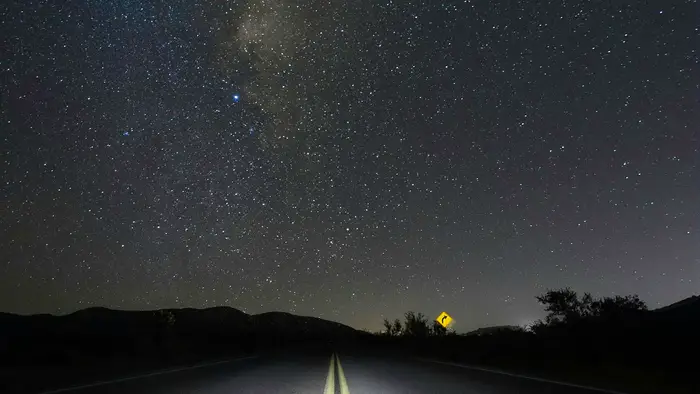
The Milky Way over a desert road. The Cat’s Tail is still spreading, still changing shape — and astronomers will keep watching it. Image: Unsplash.