LID-1166 Dual Black Holes at z 4.5: Webb and ALMA Catch Two Monsters Feeding Side by Side
Twelve billion years ago, when the universe was barely a tenth of its present age, two galaxies were already sliding into each other — and at the heart of the wreck, two supermassive black holes were feeding at the same time, less than five thousand light-years apart. Astronomers have now caught that double act in the act. The system, catalogued as LID-1166, is the first close pair of actively feeding supermassive black holes ever confirmed beyond the nearby universe, and it is already forcing a rethink of how fast black holes and their host galaxies grew up together.
The discovery, led by Hyewon Suh of the International Gemini Observatory and NSF NOIRLab and published in Nature Astronomy on 30 October 2026, used three of astronomy’s most powerful eyes at once: the James Webb Space Telescope, the Atacama Large Millimeter/submillimeter Array (ALMA) in Chile, and NASA’s Chandra X-ray Observatory. Each telescope saw the same story from a different angle, and together they left little room for doubt. Two black holes, both swallowing gas faster than the textbook limit allows, sit inside a single merging galaxy seen as it was about 1.3 billion years after the Big Bang.
That is the kind of result that matters far beyond one faint smudge of light. Pairs of black holes at kiloparsec separations — the late stage of a galaxy merger, when two giants have spiralled close enough to share a single host — are a critical missing chapter in the story of how galaxies and their central black holes grow together. Theory has long predicted that such pairs should have been common in the young, merger-rich universe. Until now, every confirmed close pair lived in the local universe, close to home. LID-1166 pushes the frontier out to redshift 4.5, and it suggests that a whole population of similar pairs has been hiding in plain sight, buried under dust.
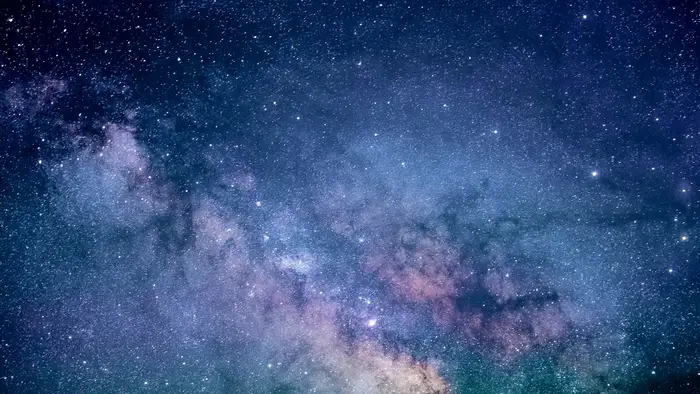
The glowing core of the Milky Way, where gas clouds and stars crowd around the galaxy’s central black hole. Image: Unsplash.
Two Monsters, One Galaxy
LID-1166 began its scientific life unremarkably enough, as an X-ray source in the Chandra COSMOS Legacy Survey, a deep map of a patch of sky that has become one of the most studied fields in astronomy. On paper it looked like a single active galactic nucleus — a single supermassive black hole, feeding and shining. What made it interesting was what it did not do: even in the deepest optical and near-infrared images ever taken by the Hubble Space Telescope, LID-1166 simply does not appear. Whatever is shining in X-rays is buried so deeply in gas and dust that Hubble’s sharpest eyes could not find it at all.
That invisibility was a clue, not a dead end. The team turned Webb’s Near-Infrared Spectrograph, NIRSpec, on the source in its integral-field mode — a technique that records a spectrum at every point across a small patch of sky, building a three-dimensional map of light in which position and velocity can be read off together. In that map, LID-1166 split in two. The Webb data revealed two distinct clumps of narrow emission lines, separated on the sky by just 0.23 arcseconds — about a quarter of an arcsecond, roughly two or three resolution elements of the instrument — and offset from each other in velocity by about 164 kilometres per second along the line of sight. Their measured redshifts came out as 4.502 and 4.499: two objects at essentially the same distance, moving relative to each other as two galaxies in the final stages of a merger would.
Position alone would not have been enough. Two glowing clumps could, in principle, be one black hole lighting up two clouds of gas. The decisive evidence was the shape of the hydrogen light. Both components show broad H-alpha emission — the signature of gas whipping around at high speed very close to a black hole, the fingerprint of an active nucleus. And one of those broad components sits off the main nucleus, squarely on the companion. A single black hole cannot produce a broad-line region in two places at once. The off-centre broad H-alpha component is what the paper treats as proof: LID-1166 hosts two actively feeding supermassive black holes, not one.
The projected separation between them is about 1.5 kiloparsecs, or roughly 4,900 light-years. That is close. For comparison, the Sun sits about 26,000 light-years from the centre of the Milky Way, so the two black holes in LID-1166 are separated by less than a fifth of the distance from the Sun to our own galaxy’s core — and both are feeding inside the same merging system. It is the first dual active galactic nucleus at a separation below three kiloparsecs ever confirmed beyond the local universe, and it fills a gap that theorists have been pointing at for years.
How Webb Separated the Pair
Separating two objects 0.23 arcseconds apart at a distance of more than 12 billion light-years is not a matter of simply pointing a telescope and looking. At that separation, the two nuclei sit inside the blur of Webb’s own optics, smeared together by the telescope’s point-spread function. The companion does not simply stand out in the raw data. To pull it out, the team built a model of that blur using WebbPSF, the standard software model of Webb’s optics, and subtracted it — a routine but delicate way of isolating faint sources beside brighter ones. The companion emerged from what was left behind.
The result is a small masterclass in what modern integral-field spectroscopy can do. Each spectrum in the NIRSpec data cube carries velocity information, so the team could show that the two clumps are not only in different places but moving differently, with a line-of-sight velocity offset of about 164 kilometres per second. The primary component also carries a narrow-line ratio of ionised nitrogen to H-alpha of about 0.51, consistent with gas excited by an active nucleus rather than by young stars. The observations were taken under Webb General Observer programme 1760, and the data are public — as are the ALMA data — so other teams can test the result themselves.
It is worth pausing on how much of this story depends on Webb seeing what Hubble could not. LID-1166’s absence from even the deepest Hubble images is not an accident of exposure time. It is the signature of obscuration: thick curtains of gas and dust that swallow optical and near-infrared light while letting X-rays, and Webb’s longer infrared wavelengths, through. The paper fits the Chandra X-ray spectrum with a model of a thick torus of gas and dust surrounding the black hole — the classic picture of an obscured active nucleus, in which the feeding black hole is wrapped in a doughnut of material that hides it from some lines of sight and not others. Webb, working in the infrared, could peer through enough of that dust to map the gas. Hubble, working at shorter wavelengths, could not.
A dense field of stars in deep space, the kind of crowded sky where distant merging galaxies hide. Image: Unsplash.
ALMA and Chandra Complete the Picture
A Webb detection on its own would have been striking. What makes LID-1166 convincing is that a completely independent telescope, looking at completely different light, found the same two objects in the same places. ALMA observed the system in the 158-micron line of singly ionised carbon, a tracer of cold gas — the raw material from which stars form and black holes feed. The ALMA data, taken under programme 2024.1.01025.S, turned up cold-gas components separated in the same way and associated with the same two nuclei, moving with the same relative velocities Webb had measured. Two telescopes, two kinds of light, one geometry. The authors read that agreement as proof that the system is a gas-rich merger in its late stages, with both nuclei still wrapped in the cold gas of the galaxies that are colliding.
Chandra provided the third leg. LID-1166 was first picked out as an X-ray source in the Chandra COSMOS Legacy Survey, and its X-ray spectrum is what allowed the team to estimate how much energy the system is actually radiating. Because the two nuclei cannot be separated in Chandra’s X-ray images, the team derived a single bolometric luminosity — the total energy output across all wavelengths — for the combined system, from the absorption-corrected X-ray luminosity. That number, compared with the combined Eddington luminosity of the two black holes together, is what yields the system’s headline figure: an Eddington ratio of about 3.7, with an uncertainty range stretching from roughly 2.4 to about 8.9. In other words, the pair as a whole is radiating several times more energy than the Eddington limit — the theoretical cap at which a black hole’s own radiation pressure should blow away its food supply — would permit for black holes of their combined mass.
The three facilities tell a coherent story precisely because each sees through a different part of the dust. Chandra’s X-rays punch through obscuring material and betray the feeding black holes. Webb’s infrared light maps the warm ionised gas around them and separates the two nuclei. ALMA’s millimetre waves trace the cold gas reservoir that feeds them both. It is a reminder that the most interesting objects in the early universe are often the ones no single telescope can fully describe — and that the era of multi-facility astronomy, in which Webb, ALMA and Chandra are used as a single instrument spread across the planet and above it, is now producing results none of them could reach alone.
LID-1166 by the Numbers
| Property | Value |
|---|---|
| Redshift | z ≈ 4.5 (4.502 and 4.499 for the two nuclei) |
| Cosmic age at that redshift | About 1.3 billion years after the Big Bang |
| Projected separation | About 1.5 kiloparsecs (roughly 4,900 light-years) |
| Angular separation on the sky | 0.23 arcseconds |
| Line-of-sight velocity offset | About −164 km/s |
| Primary black hole mass | log M/M☉ ≈ 7.8 (roughly 60 million solar masses) |
| Companion black hole mass | log M/M☉ ≈ 7.2 (roughly 16 million solar masses) |
| System Eddington ratio | About 3.7 (super-Eddington) |
| Primary narrow-line ratio [NII]/Hα | About 0.51 ± 0.02 |
| Webb observations | NIRSpec integral-field spectroscopy, GO programme 1760 |
| ALMA observations | [CII] 158 μm, programme 2024.1.01025.S |
| X-ray identification | Chandra COSMOS Legacy Survey |
| Publication | Nature Astronomy, 30 October 2026 |
Every figure in this table comes from the paper itself or from the reporting that followed it. The masses carry the usual uncertainties of broad-line estimates — they are inferred from the width and brightness of the broad H-alpha emission, a method calibrated on nearby black holes — but the ordering is clear: the primary is the larger of the two by roughly a factor of four, and both are firmly in the supermassive range, millions of times the mass of the Sun.
Feeding Above the Limit
The most provocative number in LID-1166 is not a mass but a rate. Both black holes are drawing in gas at super-Eddington rates — above the threshold at which radiation pressure from infalling matter should counteract gravity and choke off further accretion. The Eddington limit is one of the classic ideas in astrophysics, derived nearly a century ago: a black hole can only swallow so much gas so fast, because the light produced by the infalling gas pushes outward, and beyond a certain brightness that push balances the inward pull of gravity. Exceeding the limit is possible — gas can arrive through a flattened disc rather than a spherical rain, so that radiation escapes up and down while matter keeps flowing in along the plane — but it is supposed to be a brief, violent phase, not a steady state.
A system-wide Eddington ratio of about 3.7 means LID-1166’s two black holes are, together, radiating several times more energy than their combined mass would allow under the simplest spherical picture. That matters because the early universe has a timing problem. The first billion-solar-mass black holes appear in the record when the universe is less than a billion years old, and growing a black hole that large from a small seed by steady, Eddington-limited feeding takes uncomfortably long — the numbers barely fit, even if the black hole feeds at the limit without interruption from birth. Brief episodes of super-Eddington feeding, like the one LID-1166 is caught in, are one of the main ways theorists solve that problem: if black holes can gorge faster than the limit for short stretches, especially during gas-rich mergers that dump fresh fuel into their centres, they can reach enormous masses in the time available.
LID-1166 is a snapshot of exactly that process. It is a late-stage merger, gas-rich, with both black holes feeding hard at the same time. The paper describes super-Eddington accretion during the merger as a brief but efficient growth phase — intense, obscured, and triggered by the collision itself. The merger does two jobs at once: it drives gas into the centres of both galaxies, feeding both black holes, and it brings the black holes themselves closer together, setting up the next phase of their shared history.
It is also worth noting what super-Eddington feeding does not mean. It does not mean the black holes are breaking physics, and it does not by itself show whether they are outpacing their host galaxies. The limit is a statement about spherical symmetry, and real accretion flows are discs, winds and messy funnels of gas. What the measurement shows is that the system is in a rapid growth phase — and that the growth is happening while the merger is still under way, not after it has settled down.
The Milky Way arching over a dark desert road at night, above the ground-based telescopes that study distant galaxies. Image: Unsplash.
Already the Right Size
Here is the result that surprised even the team, and the one that gives the paper its title-like claim. Despite feeding far above the Eddington limit, despite being caught in the middle of a violent merger, and despite living just 1.3 billion years after the Big Bang, the two black holes in LID-1166 already lie on the local relation between black hole mass and host-galaxy mass — the tight correlation, measured in nearby massive elliptical galaxies, between the mass of a galaxy’s central black hole and the mass of the galaxy that hosts it.
That is not what a naive reading of the last few years of Webb results would have predicted. Several recent Webb studies at these redshifts have pointed the other way, toward black holes that look too big for the galaxies holding them — overmassive black holes that seem to have raced ahead of their hosts. The tension has become one of the liveliest arguments in early-universe astronomy: did black holes grow first and galaxies catch up, or did the two grow together from the start? LID-1166 lands squarely on the side of together. Its combined black hole mass sits close to the local relation for massive ellipticals, within the uncertainties, when the host’s dynamical mass is estimated from gas kinematics rather than from starlight — a necessary choice, since the host’s stars are hidden behind the same dust that hid the system from Hubble.
The authors put the ordering no more strongly than the evidence allows: rapid, obscured growth “may help establish this relation early in cosmic history.” One system does not settle an argument of that size, and the paper does not claim that it does. But it does show that the relation can already be in place at redshift 4.5, in a system that is still merging and still feeding hard — which suggests that the co-evolution of black holes and galaxies is not something that emerges only late, after the violence has subsided. It can be established during the violence itself, by the same merger-driven feeding that builds the black holes.
There is a lineage here worth noting. Suh, the lead author, has been working this seam for years: a 2020 study from the same group reported no significant change out to redshift 2.5 in how black hole mass tracks a galaxy’s stellar mass, and a 2025 paper in Nature Astronomy reported a super-Eddington-accreting black hole about 1.5 billion years after the Big Bang. LID-1166 extends that thread to an earlier epoch and to a dual system — two black holes, one merger, and a scaling relation that is already in place. It is a single data point, but it is a data point in exactly the place where the theories most needed one.
The contrast with other recent Webb results is part of what makes the field so lively right now. Webb has also turned up systems that look very different: a trio of feeding black holes in a single young galaxy, a runaway black hole fleeing its home at nearly a thousand kilometres per second, and a population of compact red sources whose true nature is still debated. SpaceNews covered the triple system in JWST Three Black Holes J0148-4214 and the runaway in RBH-1 Runaway Black Hole at 954 km/s, and the young star clusters that may be black hole nurseries in JWST Firefly Sparkle Black Hole Seeds. LID-1166 belongs to that same family of early-universe oddities — but it is the orderly one, the system that behaves as the local rules say it should, 12 billion years before the present. That, paradoxically, is what makes it so informative: if some early black holes are overmassive and this one is not, the difference between them is telling us something about how growth actually proceeds.
A Hidden Population
Perhaps the most consequential sentence in the paper is not about LID-1166 itself but about what it implies. The authors argue that the system “points to a missing population of heavily obscured, merger-driven dual AGNs at high redshift”: pairs growing fast while buried deeply enough to be missed. LID-1166 was found because it was bright in X-rays, in a field that has been observed by nearly every major telescope. How many similar pairs are sitting in fields nobody has looked at with Webb’s spectrograph, or in systems too faint in X-rays to have made the catalogues?
The paper’s own numbers hint at the scale of the problem. Confirmed pairs closer than three kiloparsecs, the paper notes, “remain rare, particularly in the merger-rich early Universe” — rare in the catalogues, that is, despite predictions that such systems should be common when mergers were frequent. The gap between prediction and catalogue is exactly what a hidden population would produce. If dual black holes in late-stage mergers spend much of their growth phase wrapped in dust — feeding hard, shining in X-rays and the infrared, invisible to optical telescopes — then the census of early black hole pairs has been systematically incomplete, and the true number could be far larger than the handful confirmed so far.
That has consequences beyond counting. The late stage of a merger, when two black holes sit a kiloparsec or two apart, is the on-ramp to the final act: the pair spirals inward, sheds energy, and eventually merges, releasing a burst of low-frequency gravitational waves. Those waves are the target of the Laser Interferometer Space Antenna, LISA, the space-based gravitational wave observatory now being built for launch in the 2030s. The rate at which LISA will hear black hole mergers in the early universe depends directly on how many dual black holes existed at each epoch and how quickly they sank together. A hidden population of merger-driven duals at redshift 4.5 and beyond would mean more sources for LISA — and a richer record of how galaxies assembled — than the current catalogues suggest.
It also reframes the search strategy. If the missing pairs are obscured, then the way to find them is not deeper optical imaging — Hubble already went as deep as it could, and LID-1166 still did not show up. The way to find them is the way this team found this one: X-ray selection to flag the feeding black holes, Webb infrared spectroscopy to separate the nuclei, and ALMA millimetre observations to confirm the cold gas. All three datasets for LID-1166 are public, and the recipe is now written down. Expect other teams to run it on other fields.
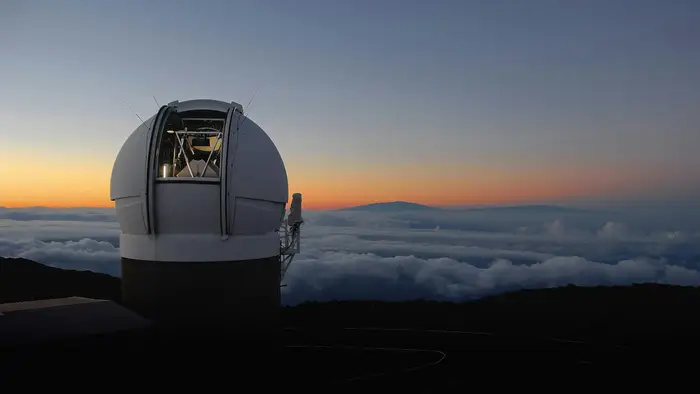
An observatory dome above the clouds at sunset, where astronomers study the light of distant galaxies. Image: Unsplash.
Why the Late Stage Matters
There is a reason the paper opens with the kiloparsec phase. The life of a pair of supermassive black holes has distinct chapters, and the kiloparsec chapter is the one that sets up everything that follows. Before it, two galaxies are approaching and their black holes are still tens of thousands of light-years apart, each feeding in its own galactic centre. After it, the black holes are close enough that their mutual gravity and the drag of surrounding gas and stars pull them together, through separations of parsecs and eventually to a merger that shakes spacetime itself. The kiloparsec stage is the bridge between galactic-scale events and black-hole-scale events — and it is the stage that has been hardest to observe at high redshift, because it demands both sharp vision and the ability to see through dust.
LID-1166 shows that the bridge exists at redshift 4.5, in a gas-rich system, with both black holes feeding above the limit. That is not a minor detail. Gas-rich mergers are efficient at driving black hole growth precisely because there is so much cold gas available to fall inward, and the ALMA detection of cold gas associated with both nuclei confirms that the fuel is there, in both places, right now. The system is not a fossil of a merger that happened long ago. It is a merger in progress, with the fuel still flowing.
What happens next, on cosmic timescales, is a slow fall together. The two black holes will continue to lose energy to the surrounding gas and stars, their orbit will shrink from kiloparsecs to parsecs, and — if the gas keeps flowing and the stars keep scattering — they will eventually merge. That final merger is billions of years in LID-1166’s future, far beyond anything Webb can observe directly. But the population LID-1166 represents is exactly the population whose mergers LISA will one day hear, and whose gravitational-wave signals will carry information about masses, spins and distances that light alone cannot provide. Finding the progenitors is how you know what to listen for.
There is also a quieter implication for the scaling relation itself. If merger-driven, super-Eddington feeding can build black hole mass rapidly while preserving the relation between black hole and host, then the relation is not a fragile thing that only emerges in calm, settled galaxies. It is robust — a product of the same violent processes that build galaxies in the first place. That is a cleaner story than one in which black holes and galaxies take turns growing, and it is a story that future observations can test: if LID-1166 is typical, then other obscured duals at similar redshifts should also sit near the local relation. If it is an outlier, the overmassive systems will need a different explanation. Either way, the next few years of Webb spectroscopy will tell.
What Comes Next
The immediate future for LID-1166 is more observation, not less. The paper’s datasets are public, and the system is bright enough in X-rays and the infrared that deeper spectroscopy could sharpen the mass estimates, map the gas motions in finer detail, and test whether the host galaxy’s dynamical mass — currently estimated from gas kinematics — holds up under closer scrutiny. ALMA follow-up could map the cold gas at higher resolution and show how the fuel is distributed between the two nuclei. And the search that found LID-1166 can be repeated: the same combination of X-ray selection, Webb integral-field spectroscopy and ALMA confirmation can be aimed at other fields, other catalogues, other redshifts.
The bigger question is whether LID-1166 is the first of many or a rare catch. If the missing population the authors propose is real, then the next few years should turn up more obscured duals at redshifts of four, five and beyond — and the census of early black hole pairs will start to match what theory has predicted all along. If they do not turn up, then LID-1166 will stand as an unusually fortunate find, and the theorists will have to explain why a process that should be common is so rarely seen. Science advances either way, but it advances faster when the first example is followed quickly by a second.
For now, LID-1166 holds a small record that is worth stating plainly: the first close pair of feeding supermassive black holes found beyond the local universe, caught in a gas-rich merger 1.3 billion years after the Big Bang, feeding above the limit, and already the right size for the galaxy they share. Two monsters, one galaxy, and a rulebook that was already written — twelve billion years before anyone was around to read it.
Stars scattered sparsely across the dark night sky, the deep field where the earliest galaxies are found. Image: Unsplash.