In the Dark of Night: SpaceX Launches the NROL-95 Spy Satellite as America's Secret Constellation Grows
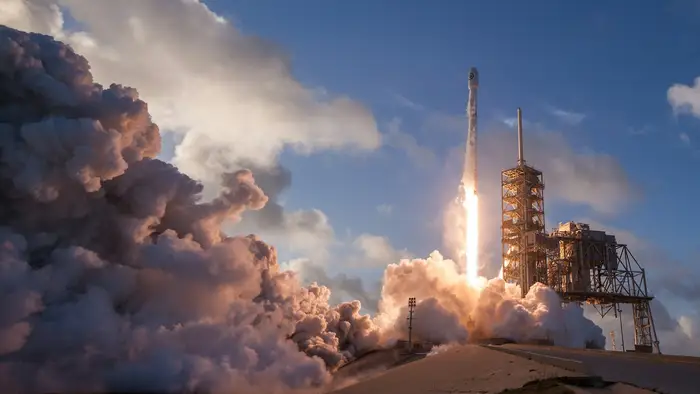
At 3:10 in the morning, when most of Florida’s Space Coast was asleep, a Falcon 9 lit up the sky over Cape Canaveral and climbed into the dark on a mission no one is allowed to describe. The rocket carried NROL-95, a classified payload for the National Reconnaissance Office — the agency that operates America’s fleet of spy satellites. SpaceX’s webcast showed the liftoff, the first-stage separation, and the booster’s return. Then, at the customer’s request, the cameras went dark. The second-stage burn, the fairing separation, the payload deployment: none of it for public eyes.
What happened in the visible half of the flight was, by now, almost routine. The booster — B1096, flying its seventh mission — flipped around after stage separation and planted itself on Landing Zone 2 at Cape Canaveral about eight and a half minutes after liftoff. It was the 18th time that particular patch of Florida ground had caught a returning booster, and it pushed SpaceX’s all-time booster landing tally to 642. The payload, whatever it is, was confirmed deployed later that morning.
NROL-95 was the third NRO mission flown by SpaceX under the National Security Space Launch (NSSL) Phase 2 contract, and the fourth NRO launch of 2026. The other three — NROL-105 in January, NROL-172 in May, and NROL-179 in June — all flew aboard Falcon 9s too, but from Vandenberg Space Force Base in California, and they were devoted to a different kind of mission: building out the NRO’s “proliferated architecture,” a constellation of hundreds of relatively small, cost-efficient reconnaissance satellites in Earth orbit.
NROL-95, by contrast, launched from the East Coast on a northeast trajectory into low Earth orbit — and the agency will say nothing more. In the taxonomy of American spy satellites, silence is itself a signal. This is the story of a launch you were allowed to watch halfway, and what the visible half tells us about the invisible whole.
Liftoff at 3:10 a.m.
The numbers of the launch are public even when the payload is not. Liftoff from Space Launch Complex 40 at Cape Canaveral Space Force Station came at 3:10 a.m. EDT (0710 UTC) on July 30, 2026, inside a window that stayed open until 3:21 a.m. The 45th Weather Squadron had forecast a 70 percent chance of favorable weather — decent odds for a Florida summer night, but with the usual overnight caveats. Launch weather officers warned of “significant weather model ambiguity” around remnant storms and cloud cover, the kind of hedge that keeps range safety officers awake during the humid months. In the end, the weather held.
The Falcon 9 performed its opening act flawlessly: nine Merlin engines on the first stage, stage separation, the boostback and entry burns, and the final landing burn onto LZ-2. About eight and a half minutes after leaving the ground, B1096 was standing upright on the landing zone, the 642nd successful booster recovery in SpaceX’s history. For a company that once celebrated a single landing as a historic first, the number has become a kind of metronome — the steady beat of an industry transformed.
Then came the part of the evening that belonged to the customer. SpaceX ended its public webcast after the landing, at the NRO’s request. No footage of the second stage, no fairing views, no payload deployment callouts. Hours later, the NRO confirmed the payload had been delivered. Beyond that: nothing. The agency’s entire public statement about the satellite’s purpose fits in a sentence: the payload was designed, built, and will be operated by the NRO.

The Veteran Booster
If the payload was a mystery, the booster was an open book — and a distinguished one. B1096 was flying its seventh mission, with a résumé that reads like a tour of the American space enterprise: KF-01, the IMAP interstellar-mapping probe, NROL-77 (another NRO mission), GPS III-9, CRS-34 (a cargo run to the International Space Station), and one Starlink flight. Seventy-five days separated its previous flight from this one.
That résumé is worth pausing over, because it captures something essential about the current era of American spaceflight. The same booster that lofted a NASA heliophysics mission and delivered cargo to the ISS also flies classified national-security payloads. The NSSL program — the Pentagon’s mechanism for buying launches — was built on exactly this premise: that a healthy commercial launch industry, flying the same hardware for everyone, produces the reliability and the flight rate that national security demands. B1096 is the premise made metal.
The booster fleet’s depth is the quiet enabler of the NRO’s 2026 tempo. When the same first stages can be turned around in weeks and reflown across civil, commercial, and classified missions, the launch manifest stops being a bottleneck. The NRO launched four times in the first seven months of 2026. A decade ago, that would have consumed a year’s worth of national-security launch capacity. Today it is a brisk but unremarkable pace — which is precisely the point.
A Patch, a Ferret, and No Answers
In the vacuum of official information, the mission patch becomes the primary text. The NRO has a long tradition of elaborate, often playful mission insignia, and NROL-95’s is a character: a snarling ferret set against a nighttime sky, with the words “We are the Champions” along the emblem’s lower border.
The agency’s official description leans into the symbolism. “The ferret, a clever creature, embodies agility and resilience — key traits for exploration. Its confident grin and bright eyes reflect a spirit of victory in a realm where determination meets adventure,” the NRO’s mission description reads. “The bold phrase ‘We are the Champions’ encapsulates the camaraderie and pride shared among those on this purposeful mission.”
Patch exegesis is a beloved pastime of the space press, and analysts will spend months debating what the ferret implies — ferrets hunt in burrows and tight spaces; they are, famously, tenacious. But the honest reading is that the patch tells us about the team, not the satellite. The NRO’s patches have commemorated everything from octopuses to dragons to Latin mottos, and their relationship to actual payload capabilities is deliberately oblique. The one firm inference available is the one the agency wants you to make: that the people behind NROL-95 are proud of it.
Beyond the patch, the cone of silence is total. No orbit has been officially disclosed, no satellite bus identified, no mission duration suggested. Amateur satellite trackers will, in time, catalog whatever object the NRO declines to name — they always do — but for now NROL-95 is a point of light with a ferret for a flag.
NSSL Phase 2 and the Pentagon’s Launch Machine
NROL-95’s bureaucratic identity is as revealing as anything else about it. It was the third NRO mission launched by SpaceX under the NSSL Phase 2 contract, the launch-services agreement awarded in August 2020 that split the Pentagon’s most critical launches between SpaceX and United Launch Alliance. NSSL — overseen by the Space Force’s Space Systems Command, specifically System Delta 80 headquartered at Cape Canaveral — is the government’s “assured access to space” program: the mechanism by which the United States guarantees that its most sensitive payloads can always get to orbit, on American rockets, on schedule.
Col. Kathryn Cantu, director of the NRO’s Office of Space Launch and the NROL-95 mission director, framed the flight in the language of partnership: “The collaboration between NRO, U.S. Space Force, and SSC continues to advance our nation’s intelligence architecture through next-generation satellite technology and integrated operations,” she said. “This collaboration enables us to swiftly field resilient intelligence, surveillance, and reconnaissance systems while preserving the flexibility and persistence required to counter evolving challenges.”
The statement is boilerplate, but the machinery behind it is not. NSSL Phase 2 was designed for an era of two providers and a handful of exquisite, expensive national-security launches per year. What it has actually produced, six years in, is something more dynamic: SpaceX flying NRO missions at a cadence the contract’s drafters could hardly have imagined, on boosters that also fly Starlinks on the weekends. The “assured access” of 2020 has become the abundant access of 2026.
That abundance is about to be tested and extended. The Space Force is deep into the NSSL Phase 3 procurement, which brings new entrants — Blue Origin’s New Glenn among them — into the national-security launch fold. The premise is the same as ever: competition and flight rate produce resilience. NROL-95, flying on a seven-times-flown booster at 3:10 in the morning, is what the premise looks like when it works.
The Proliferated Constellation
To understand NROL-95, you have to understand the three launches that came before it this year — because NROL-95 is, in an important sense, the exception that illuminates the rule.
NROL-105 (January), NROL-172 (May), and NROL-179 (June) all launched from Vandenberg, and all were devoted to the NRO’s “proliferated architecture”: a constellation, eventually hundreds strong, of relatively small and inexpensive reconnaissance satellites. The concept is a deliberate break from the agency’s Cold War heritage of a few enormous, exquisite, multibillion-dollar spy satellites. Instead of a handful of irreplaceable eyes, the NRO is building a swarm — cheaper per satellite, launched in batches, resilient by numbers. If an adversary blinds one satellite, a hundred more are watching.
The proliferated architecture is widely understood to be built with SpaceX — the satellites are believed to derive from the Starshield line, the government-focused sibling of Starlink — and its deployment has been one of the fastest-moving stories in American spacepower. Launches every few weeks, each adding another tranche of satellites to the constellation. It is the reconnaissance equivalent of what Starlink did to communications: mass production applied to orbit.
NROL-95 does not fit that pattern, and the differences are instructive. It launched from the East Coast, not Vandenberg. It flew on an NSSL Phase 2 mission — the contract vehicle for the government’s most critical, traditionally “exquisite” launches — rather than as a proliferated-architecture batch deployment. The northeast trajectory and the classified handling suggest a payload of a different class: possibly a large, capable, singular satellite in the tradition of the agency’s flagship systems, the kind of mission NSSL was originally built to protect.
The NRO, of course, will neither confirm nor deny any of this. But the architecture of American space reconnaissance in 2026 is increasingly legible even through the secrecy: a proliferated layer of hundreds of small satellites providing persistence and revisit, and beneath or above it — the agency won’t say — a layer of exquisite capabilities for the hardest intelligence problems. NROL-95 looks like the second layer. The ferret hunts where the swarm cannot go.

Nine Years From Monopoly to Metronome
It is worth remembering how recently a single NRO launch on a SpaceX rocket was itself the story. On May 1, 2017, a Falcon 9 lifted off from Launch Complex 39A carrying NROL-76 — SpaceX’s first mission for the National Reconnaissance Office, and its first dedicated flight for the U.S. military. The booster landed at Landing Zone 1 about ten minutes later, SpaceX’s fourth successful ground landing. The launch officially ended United Launch Alliance’s decade-long monopoly on American military and spy satellite launches.
That monopoly had not fallen without a fight. SpaceX had sued the Air Force over its exclusive block-buy contract with ULA, the Lockheed Martin–Boeing joint venture, and only won certification to compete for national-security launches in 2015. NROL-76 was the proof that the certification meant something — and the NRO, which had purchased the flight through a contract arranged by Ball Aerospace, declared itself satisfied with its new partner.
The missions accumulated slowly at first. NROL-108 followed in December 2020. NROL-87 in February 2022. NROL-85 in April 2022 carried a pair of ocean-surveillance satellites and was, at the time, only the fourth dedicated Falcon 9 mission SpaceX had ever flown for the agency. Each one was an event. Each one drew the full treatment: the webcast, the patch reveal, the careful official statements.
Compare that to 2026. Four NRO launches in seven months, and the fourth — NROL-95 — rates barely a ripple in the public consciousness. The booster that flew it had already flown six times, for customers ranging from NASA to the Space Force to Starlink. The landing was the 642nd. What was historic in 2017 is infrastructure in 2026. That is not a diminishment of NROL-95’s importance — if anything, the classified payload is likely more capable than anything the agency flew nine years ago. It is a measure of how completely SpaceX’s reusability revolution has been absorbed into the national-security establishment. The extraordinary became routine, and the routine became the foundation on which the proliferated constellation — hundreds of satellites, launched in batches, resilient by design — is being built.
The arc from NROL-76 to NROL-95 is, in miniature, the arc of American spacepower in the 21st century: from a monopoly launching a handful of exquisite satellites a year, to a competitive market launching them by the dozen. The ferret on the patch is snarling. It has reason to grin.
The 2026 National Security Cadence
Step back far enough and NROL-95 is one data point in the busiest national-security launch year in American history. Four NRO launches in seven months. A Space Force manifest crowded with GPS satellites, missile-warning spacecraft, and experimental payloads. ULA’s Vulcan settling into its own NSSL cadence. And looming over it all, the question of what comes next: Phase 3 awards, new entrants, and the continued migration of the intelligence community’s architecture toward proliferation.
There is also the adversary’s-eye view, which the NRO never discusses but which shapes every one of these launches. China is building its own proliferated constellations — Guowang’s planned 13,000 satellites, the Thousand Sails system — and lofting them on a rapidly modernizing fleet of rockets, including, as of this month, a partially reusable Long March-10B. Russia, diminished but still capable, continues to field anti-satellite rhetoric and occasional on-orbit provocations. The “evolving challenges” in Col. Cantu’s statement are not abstract. They are the reason the ferret is snarling.
For the public, NROL-95 offered ninety seconds of fire and thunder, a booster landing in the dark, and then a curtain. That is how it goes with the NRO’s most sensitive missions: the rocket is public, the payload is not, and the gap between the two is where American spacepower lives. Somewhere above the Earth tonight, a new satellite — ferret-emblazoned, champion-declared — is beginning its secret work. The launch was at 3:10 a.m. The mission, whatever it is, is just getting started.