China's GuoWang Network Grows Again as Long March 8A Launches Nine More Internet Satellites
A Long March 8A rocket climbed away from China’s southern coast on the morning of Sunday, October 25, 2026, carrying nine more satellites for GuoWang, the state-backed broadband constellation that Beijing is building as its answer to Starlink. Liftoff from Commercial Launch Pad 1 at the Wenchang Commercial Space Launch Site on Hainan Island came at 10:03 a.m. China Standard Time, or 02:03 UTC, and the flight deployed its payloads into low Earth orbit, marking the 28th launch group for the GuoWang network.
The mission was, by the standards of China’s increasingly busy launch calendar, a routine one. There was no new rocket to prove, no crew aboard, and no destination beyond the familiar belt of low Earth orbit a few hundred kilometres above the planet. Yet routine is precisely the point. GuoWang is not being built one spectacular mission at a time. It is being built the way a railway is built, section by section, launch by launch, until a network that barely existed a few years ago becomes something a country can rely on. Sunday’s flight added nine more sections to that railway, and it brought the constellation closer to a milestone its planners set for the end of this year.

A Long March rocket lifts off from the coast. The October 25 flight was GuoWang’s 28th launch group. Image: Unsplash.
A Sunday-morning launch from Hainan
The Long March 8A vehicle for the mission, designated Y12, departed from the commercial side of the Wenchang site, a spaceport that has become the workhorse of China’s constellation launches. Wenchang sits on the northeastern coast of Hainan, China’s southernmost province, at a latitude of about 19 degrees north. That low latitude is a genuine advantage: a rocket launched closer to the equator picks up more of Earth’s rotational speed for free, and it can carry a heavier payload to a given orbit than the same rocket launched from a site further north. For a programme that must put thousands of satellites into orbit, that advantage compounds with every flight.
The commercial launch site at Wenchang, with its dedicated pads for commercial vehicles, exists because the older, state-run Wenchang site next door could not carry the whole load alone. China’s launch rate has grown so fast that pads, integration buildings, and range capacity have become bottlenecks in their own right. The commercial site was built to relieve that pressure, and missions like Sunday’s are its daily business: a medium-lift rocket, a batch of near-identical satellites, and a quick turnaround to the next flight.
Sunday’s payloads were nine GuoWang satellites, also known in Chinese reporting as the 28th group of low-orbit internet satellites, or Weixing Hulianwang Digui 28. Specialist tracking of the mission identified the flight as Long March 8A Y12, the twelfth flight of the 8A variant. Manufacturing of the satellites was handled by the China Academy of Space Technology, according to specialist coverage of the launch. The satellites use GuoWang’s small satellite platform, each weighing about 695 kilograms, and they manoeuvre in orbit with electric propulsion, powered by two solar panels.
That last detail matters more than it sounds. Electric propulsion is weaker than chemical propulsion, but it is far more efficient, and it lets a satellite adjust its orbit, dodge debris, and eventually deorbit itself at the end of its life using a small amount of propellant. For a constellation that will eventually number in the thousands, the ability of each satellite to look after its own orbit is not a luxury. It is the difference between a manageable fleet and a traffic jam.
Nine satellites, one growing network
After Sunday’s launch, specialist tracker China in Space put the number of GuoWang spacecraft in orbit at 231, counting satellites still raising their orbits as well as those already in service. Other trackers count slightly differently, because not every satellite in a batch is always confirmed separately and some spacecraft are still climbing to their operational altitude, so totals in public reporting vary by a handful. The honest way to describe the constellation’s size is therefore about 230 satellites, with the exact figure depending on the tracker and the day. What is not in doubt is the direction of travel: GuoWang has roughly doubled in size during 2026, and it is on course for the deployment target its planners set for this year.
That target is 310 satellites by the end of 2026. From there, the plan accelerates sharply: 900 satellites in 2027, and then 3,600 satellites a year beginning in 2028, sustained through the following years, until the constellation reaches up to 13,000 satellites in operational orbit in the 2030s. Those numbers deserve a moment of reflection, because they describe an industrial effort on a scale that few space programmes have ever attempted. Launching 3,600 satellites in a single year means launching, on average, almost ten satellites a day, every day, for a year. It means factories, launch pads, tracking stations, and ground terminals all operating at a tempo that has no precedent outside SpaceX’s Starlink programme.
GuoWang is operated by China Satellite Network Group, known as China SatNet, a state-owned enterprise created to build and run the constellation. The company plans to provide internet connectivity services worldwide through the network, though for now the immediate priority is domestic: usage trials and agreements inside China are under way ahead of a general rollout to Chinese consumers. That sequence, domestic service first and global service later, mirrors how Starlink itself grew, beginning with customers in its home market before expanding to more than 170 markets around the world.
The rocket: Long March 8A
The Long March 8A is a two-and-a-half-stage, liquid-propellant rocket developed by the China Academy of Launch Vehicle Technology, based on the earlier Long March 8. It stands about 50.5 metres tall, weighs roughly 371 tonnes at liftoff, and uses a 3.35-metre-diameter core stage with two liquid boosters. Its second stage is also 3.35 metres in diameter and uses liquid hydrogen and liquid oxygen, with upgraded engines derived from the Long March 5 programme. A larger 5.2-metre payload fairing lets it carry a full batch of constellation satellites in a single flight.
The key number for the 8A is its capacity: up to 7 tonnes to a 700-kilometre sun-synchronous orbit, up from 5 tonnes for the original Long March 8. That two-tonne improvement is what makes the rocket a constellation workhorse. It is the difference between launching a partial batch and launching a full one, and across dozens of flights it is the difference between a constellation that grows slowly and one that grows fast. The rocket’s upper stage can also reignite multiple times, allowing it to coast in orbit and release satellites in phases, which matters when a batch must be spread across slightly different orbital slots.
The 8A made its maiden flight in February 2025, so Sunday’s mission came less than two years into the rocket’s operational life. Twelve flights in that time is a brisk pace for a new vehicle, and it reflects the demand placed on it. The Long March 8A is not China’s biggest rocket, nor its most famous. It is something more useful for the job at hand: a reliable, medium-lift vehicle sized almost exactly for the task of feeding a megaconstellation, flight after flight.

The Wenchang commercial site has become the workhorse of China’s constellation launches. Image: Unsplash.
Two constellations, one race
GuoWang is not China’s only broadband constellation. Alongside it, a commercial constellation called Qianfan, also known as Spacesail, is being built by a Shanghai-based company, and it had roughly 258 satellites in orbit as of September 2026, aiming for 648 by the end of the year on the way to a planned 15,000. The two programmes are sometimes confused, but they are distinct: GuoWang is state-run through China SatNet, while Qianfan is a commercial venture. Together, they mean China is building two Starlink-scale networks at the same time.
That dual track is worth understanding, because it shapes how the rest of the world should read missions like Sunday’s. In the United States, a single company, SpaceX, builds Starlink, and its constellation now counts more than 11,000 active spacecraft. In China, the state and the commercial sector are advancing in parallel, with different operators, different rockets, and different satellite designs, but with a shared national goal: that China should not depend on a foreign network for satellite broadband, and that Chinese companies should be able to compete in the global market for satellite internet when that market matures.
The competition is also about spectrum and orbital slots, which are finite resources allocated internationally on a first-come, first-served basis in many cases. A constellation that files for thousands of satellites and then launches them secures its place in the queue. A constellation that only files, without launching, risks losing it. That regulatory reality is one reason the launch cadence matters so much, and why a flight like Sunday’s, which adds just nine satellites, is still strategically significant. Each launch is evidence that the filings behind GuoWang are real, and each launch moves the network closer to the point where it can offer service rather than merely promise it.
There is a further dimension that analysts regularly note. GuoWang’s operator is a state enterprise, and the constellation’s architecture, with satellites carrying communications payloads in low Earth orbit, has obvious dual-use potential: the same network that serves a village broadband customer could, in principle, serve government and military users as well. China has not framed GuoWang as a military programme, and its public emphasis is on civilian connectivity. But the strategic interest of other governments in the constellation’s growth is easy to understand, and it is one reason every GuoWang launch is watched closely outside China, even when the mission itself is routine.
Why Wenchang matters
Wenchang’s rise as a constellation launch hub is one of the quieter stories of the Chinese space programme. The original Wenchang Satellite Launch Center, built on Hainan’s coast, was designed for China’s heaviest rockets, including the Long March 5, which launches space station modules and lunar missions. The commercial site beside it was built for a different kind of traffic: frequent, standardised launches of commercial and constellation payloads, operated with the tempo of an airport rather than the ceremony of a national mission.
That distinction is visible in the hardware. The commercial pads are designed for rockets like the Long March 8A and the Long March 12, both of which have carried GuoWang batches. Just weeks before Sunday’s flight, on October 10, a Long March 12 carried the 27th GuoWang group, also nine satellites, from Commercial Launch Pad 2 at the same site. The two flights, fifteen days apart, illustrate the rhythm the commercial site is designed to sustain: a batch every couple of weeks from one site alone, with other sites contributing their own batches in parallel.
The geography helps. Hainan’s coastal location means rockets can fly east over the sea, dropping spent stages into the ocean rather than over populated land, which simplifies range safety. The island’s seaport lets large rocket stages arrive by ship, a logistical advantage over inland sites that must move hardware by rail through tunnels and over bridges with strict size limits. And the low latitude, as noted, buys extra performance for every launch. None of these factors alone would make a spaceport, but together they explain why Wenchang, once a newcomer among Chinese launch sites, has become central to the constellation effort.
The road to 13,000
It is worth pausing on the sheer scale of what GuoWang’s planners have set out to do, because the numbers can blur into abstraction. Thirteen thousand satellites is more than the total number of active satellites in orbit today from all countries combined, excluding Starlink’s fleet. It is a network that would require, at the planned pace of 3,600 satellites a year, roughly four years of sustained launching at a rate no country other than the United States has ever achieved, and even then only by matching SpaceX’s current tempo.
That is not to say the plan will unfold exactly as written. Space programmes revise their schedules constantly, and a target of 3,600 satellites a year depends on factories producing satellites at that rate, rockets flying at that rate, and ground systems keeping up. Any one of those links can slip. The 2026 target of 310 satellites is the near-term test: GuoWang stood at about 230 satellites after Sunday’s launch, so roughly 80 more satellites, or about nine more batches of nine, would be needed before the year ends. That is a demanding but not implausible pace for the final two months of the year, given that China has been launching GuoWang batches every few weeks.
The 2027 target of 900 satellites is steeper still, requiring roughly 590 additional satellites in a single year, or about 65 batches. That would mean more than one GuoWang launch a week on average, sustained across the year. Whether China meets that target will depend on how many rockets it can dedicate to the constellation, and on whether the Long March 8A, the Long March 12, and the larger Long March 5B and Long March 6A, which carry the constellation’s bigger satellite platform of up to 1,000 kilograms, can all fly often enough. The larger platform, about thirty percent bigger than the small one, is designed for higher-capacity satellites, and mixing the two platforms lets the constellation balance coverage against capacity.
There is also the question of what happens after the constellation is built. Satellites in low Earth orbit last roughly five years, so a 13,000-satellite network would need more than 2,500 replacement satellites a year just to stand still. That is the treadmill every megaconstellation operator faces: building the network is only the first challenge, and maintaining it is a permanent one. GuoWang’s planners will have factored that into their long-term launch rates, and the 3,600-a-year figure, sustained over several years, begins to make sense in that light. It is not just a build-out rate. It is also, eventually, a replacement rate.

GuoWang satellites use electric propulsion to manoeuvre in low Earth orbit. Image: Unsplash.
A crowded sky, and the questions it raises
Every megaconstellation launch also raises a question that has nothing to do with any one country: how crowded can low Earth orbit get before it becomes a problem for everyone? Astronomers have raised concerns about bright satellite trains interfering with telescopes, and satellite operators have raised concerns about collision risk as the number of objects in orbit grows. GuoWang, Qianfan, Starlink, and other planned constellations together would put tens of thousands of satellites into a region of space that, a decade ago, held only a few thousand.
The operators’ answer is that modern satellites are designed to be good neighbours: they carry propulsion to dodge, they are tracked continuously, and they are designed to deorbit at the end of their lives rather than lingering as debris. GuoWang’s electric propulsion and its planned deorbit capability fit that description. The sceptics’ answer is that good design is necessary but not sufficient, and that the sheer number of objects raises the probability of accidents even when everyone behaves responsibly. That debate will not be settled by any single launch, but it will be shaped by how constellations like GuoWang operate in practice: how often they manoeuvre, how transparently they share tracking data, and how reliably their satellites come down at the end of their missions.
There is also the question of who benefits. Satellite broadband’s promise is that it can reach places where fibre-optic cables and mobile towers do not go: remote villages, ships at sea, aircraft in flight, and disaster zones where terrestrial networks have failed. GuoWang’s domestic trials are testing exactly that promise inside China, and its eventual global service, if it arrives, would extend it elsewhere. Whether GuoWang becomes a commercial competitor to Starlink in third countries, or remains primarily a domestic network with a strategic dimension, will depend on pricing, terminal availability, regulatory approvals, and the geopolitics of the countries where it seeks to operate. Those are commercial and diplomatic questions, not technical ones, and they will take years to answer.
What comes next
For now, the next milestones are straightforward to list. GuoWang’s operators will aim to close the gap to 310 satellites before the end of 2026, which means more Long March 8A and Long March 12 flights from Wenchang in the coming weeks. The first launch from the new commercial site’s expanding pad capacity, and the continued production of the small satellite platform at a rate of dozens per month, will be the practical indicators to watch. In 2027, the pace will need to roughly double to stay on track for 900 satellites, and the appearance of the larger satellite platform on more flights would signal that the constellation is moving from coverage to capacity.
Beyond GuoWang itself, the wider Chinese launch calendar for the rest of October and into November includes further Starlink-group flights from Vandenberg’s counterpart in the east, and other constellation missions that will keep the global launch rate high. The launch race that analysts tally each year, with SpaceX leading and China second, is not a race with a finish line. It is a measure of industrial capacity, and Sunday’s flight added one more point to China’s side of the ledger.
It is tempting to treat a nine-satellite launch as a footnote. Nine satellites, after all, are a rounding error next to 13,000. But megaconstellations are not built in footnotes or in headlines. They are built in the accumulation of ordinary flights, each one adding a small, countable increment to a network that did not exist before. Sunday’s flight was the 28th such increment for GuoWang. There will be a 29th, and a 30th, and many more after that, and each one will be, in its own way, as unremarkable and as significant as this one.
The Long March 8A has done its job and returned to the background. The nine satellites it carried are now climbing toward their operational orbits, where they will join more than 220 of their siblings in a network that is still, by its own planners’ standards, in its infancy. The sky above Hainan is quiet again. The constellation above it is a little larger than it was this morning, and that, for a programme built one batch at a time, is the whole story.

The night sky over a launch site. GuoWang aims for 900 satellites in 2027 on the way to 13,000. Image: Unsplash.
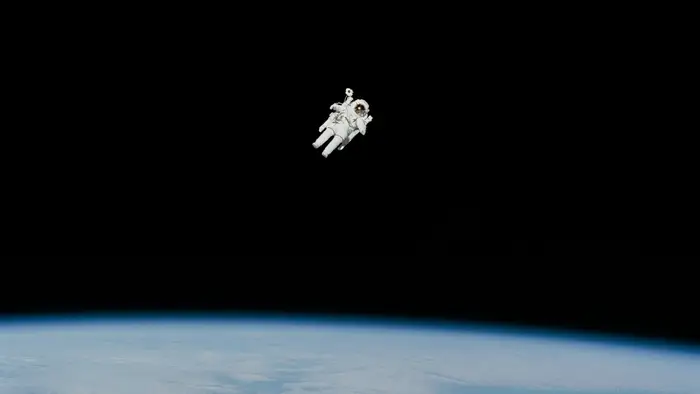
Deep space, where the next generation of satellite networks will compete for customers and orbital slots. Image: Unsplash.