Out of the Shadows: SpaceX's Starshield Steps Into the Light With Two Secretive June Launches
SpaceX does not usually talk about Starshield. The government variant of its Starlink satellite network — hardened, encrypted, and built for military and intelligence customers — has operated since 2022 under a veil of near-total secrecy, its launches absorbed anonymously into Starlink manifests or hidden behind classified mission names.
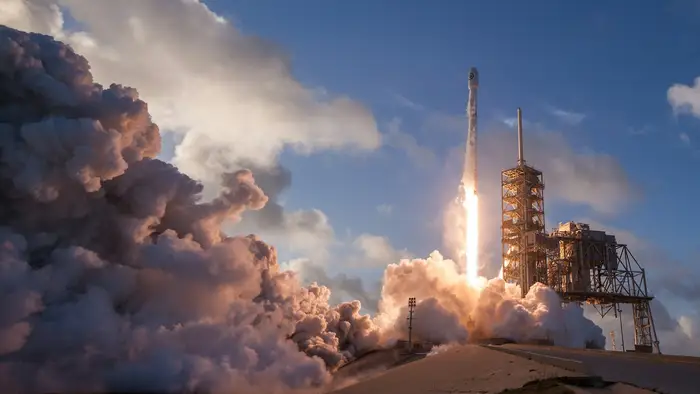
Which is why Saturday night, June 6, 2026, was so unusual. When a Falcon 9 lifted off from Space Launch Complex 4 East at Vandenberg Space Force Base at 9:24:45 p.m. PDT, SpaceX’s own launch manifest openly listed what was aboard: 21 standard Starlink internet satellites — and two Starshield satellites, named as such, flying as co-passengers on the Starlink 17-43 mission. For a program that has treated public acknowledgment as anathema, the disclosure was a small earthquake.

The Saturday night mission
The flight itself was, by SpaceX standards, routine. Liftoff of the Falcon 9 on the Starlink 17-43 mission occurred at 9:24:45 p.m. Pacific on Saturday, June 6 — 12:24:45 a.m. Eastern, or 04:24:45 UTC, on Sunday, June 7. The rocket headed for a 535-kilometer orbit inclined at 97.61 degrees, an altitude and inclination optimized for the government payloads rather than the standard Starlink shell.
The mission flew on first-stage booster B1097, making its tenth flight. The booster’s résumé tells a story of its own: it had previously launched the NROL-172 national security mission, the Twilight rideshare, and seven batches of Starlink satellites — a career that straddles the line between SpaceX’s commercial and government businesses. A little more than eight minutes after liftoff, B1097 touched down on the drone ship Of Course I Still Love You stationed in the Pacific. It was the 201st landing on that vessel and the 620th booster landing in SpaceX’s history — numbers that have become so large they risk losing their meaning, until you remember that a decade ago, landing an orbital booster at all was considered nearly impossible.
Satellite deployment was confirmed shortly after midnight Eastern time. The two Starshield spacecraft were logged by the U.S. Space Force as USA 608 and USA 609 — formal designations in the military satellite catalog, another quiet signal that these were no ordinary rideshares.
What Starshield is
To understand why the announcement mattered, it helps to understand what Starshield is. Built on the same fundamental satellite bus as Starlink, Starshield is a hardened, government-exclusive derivative designed to support U.S. military and intelligence community missions. The differences lie in the details that matter to a defense customer: additional encryption and security features, enhanced inter-satellite laser links for resilient mesh communications, and hosted payload options that let government sensors ride on the Starlink-derived platform.
SpaceX unveiled the Starshield business line in late 2022, positioning it as a way to sell the industrial logic of Starlink — mass-produced satellites, rapid replenishment, distributed resilience — to customers who could never use a commercial network. The pitch is straightforward: instead of a handful of exquisite, billion-dollar spy satellites, build a proliferated constellation of hundreds of smaller, cheaper spacecraft that is harder to degrade and faster to refresh.
Since then, the program has grown largely in the dark. Launches are typically unacknowledged or folded silently into broader Starlink manifests, with satellite trackers left to deduce the presence of government payloads from orbital data and catalog entries. SpaceX has never announced which U.S. government agency ordered any particular Starshield batch — or whether some are destined for foreign governments under U.S. export approvals. The June 6 pair was logged with the customer listed simply as an unknown U.S. government agency, and neither SpaceX nor any agency has said more.

A pattern of quiet co-manifests
The June 6 mission was not the first time Starshield satellites hitched rides on Starlink launches — but it was the most openly acknowledged. In 2025, SpaceX flew two missions, Starlink 13-1 and Starlink 13-4, that reportedly included two Starshield satellites each. Those spacecraft were logged by the U.S. Space Force as USA 485, 486, 549 and 550, and, like the June 2026 pair, were never publicly connected to a specific part of the U.S. government.
That history makes the June announcement read as a deliberate choice rather than an accident. SpaceX controls its manifests down to the word; naming Starshield on the Starlink 17-43 mission page was a decision someone made. Observers have offered several theories: a signal to government customers that the program is maturing, a response to growing public and congressional interest in the militarization of low Earth orbit, or simply a reflection of the fact that with hundreds of such satellites now in orbit, total secrecy was becoming impractical anyway.
Whatever the motive, satellite trackers took note. With the payloads publicly acknowledged, the amateur tracking community began watching to see whether the two Starshield spacecraft would maneuver independently of the Starlink batch and be catalogued separately — the kind of open-source verification that was impossible when the payloads were never admitted to exist.
NROL-179: the classified follow-up
If the June 6 mission was Starshield at its most transparent, the mission that followed less than two weeks later was the program at its most opaque.
On Friday, June 19, 2026, at 1:50:45 a.m. PDT — 4:50:45 a.m. Eastern, 08:50:45 UTC — another Falcon 9 lifted off from Vandenberg’s pad 4E. This was NROL-179, a dedicated mission for the National Reconnaissance Office, the agency that builds and operates America’s spy satellites. The payload: an undisclosed number of satellites, widely believed by independent analysts to be Starshield spacecraft feeding the NRO’s proliferated constellation — though neither the NRO nor SpaceX has confirmed that on the record.
The mission flew on booster B1103, a relatively young vehicle making only its third flight after launching Starlink 17-35 in April and Starlink 17-42 in May. Fewer than eight minutes after liftoff, the booster returned to the California coast for a landing at Landing Zone 4, the concrete pad at Vandenberg reserved for return-to-launch-site recoveries. It was the 35th landing at that site and the 626th booster landing for SpaceX overall.
The NRO confirmed deployment of its satellites later that morning. Beyond that, the agency said almost nothing — which, for the NRO, is standard operating procedure.

The proliferated architecture
Both June missions feed the same strategic project: the National Reconnaissance Office’s proliferated architecture, a wholesale reinvention of how America does space-based intelligence.
For most of the Space Age, U.S. spy satellites were exquisite and few: school-bus-sized spacecraft costing billions, parked in high orbits, each one a single point of failure. The proliferated architecture inverts that logic. The NRO now envisions, in its own words, “hundreds of small satellites on orbit” to provide greater revisit rates, wider coverage, and the elimination of single points of failure. If an adversary disables one satellite, dozens more are already overhead.
SpaceX’s Starshield-derived spacecraft are believed to form the communications and transport backbone of that architecture, while the agency’s Geospatial Intelligence Systems Acquisitions Directorate contributes other components. In April 2024, Reuters reported that Northrop Grumman “is providing sensors for some of the SpaceX satellites” — a rare public glimpse into the industrial team behind the constellation.
The launch tempo tells the story of the buildup. NROL-179 was SpaceX’s third launch of 2026 supporting the NRO’s low-Earth-orbit constellation and the 14th overall supporting the agency’s proliferated network. The year’s earlier missions included NROL-105 in January and NROL-172 on May 12 — the latter flown by the same B1097 booster that carried the openly acknowledged Starshield pair in June. Each mission adds another tranche of spacecraft to a constellation whose final size the NRO has declined to disclose.
SpaceX’s national security role in 2026
The two June launches also illustrate how completely SpaceX has embedded itself in America’s national security space enterprise. A decade ago, launching a military payload was a rare and politically fraught event for the company; it took a lawsuit against the Air Force and a formal certification process just to compete for Pentagon launches. In 2026, SpaceX flies NRO missions the way it flies Starlink missions: frequently, cheaply, and with boosters that have already flown multiple times.
That cadence is the point. The proliferated architecture only works if launches are routine and affordable — if replacing or augmenting the constellation is a matter of scheduling, not a national crisis. By landing and refllying boosters like B1097 ten times over, SpaceX has made the launch segment of the architecture the least exotic part of the whole enterprise. The June 6 mission’s booster had already flown a national security mission, a commercial rideshare, and seven Starlink batches; after dropping off two spy satellites, it landed on a drone ship to fly again.
Transparency, on someone’s terms
The contrast between the two June missions — one openly advertising its Starshield payload, the other saying nothing at all — captures the strange information politics of military spaceflight in 2026.
On one hand, the secrecy is eroding. Amateur trackers catalogue the satellites within days. Regulatory filings and catalog designations leak details. SpaceX itself occasionally names the program. The June 6 disclosure suggests that at least some stakeholders now see advantage in being seen: a demonstration to allies, adversaries and appropriators alike that the capability is real and growing.
On the other hand, the essential facts — who ordered the satellites, what exactly they do, how many are up there — remain classified, and are likely to stay that way. The NRO’s public statements about the proliferated architecture are carefully calibrated: enough detail to justify budgets, not enough to help an adversary.
What is not in doubt is the trajectory. Two Starshield launches in thirteen days, one of them publicly acknowledged for the first time, 626 booster landings and counting. The shadow constellation is stepping into the light — exactly as far as its owners want it to, and not an inch further.
From lawsuit to launchpad: how SpaceX won the Pentagon
The June missions look routine now, but the road to them was anything but. When SpaceX first sought to launch American military payloads, the Pentagon’s launch business was a closed shop: a single joint venture held a monopoly on national security launches, and its rockets cost hundreds of millions of dollars per flight. SpaceX sued the Air Force in 2014, arguing it was being unfairly frozen out of competition — and won the right to compete. In 2015, the Falcon 9 was formally certified for national security missions, and in May 2017, the NROL-76 mission became the first NRO launch ever flown by SpaceX, breaking the monopoly for good.
The economics that followed transformed the market. Where a legacy national security launch once cost well over $100 million, a reused Falcon 9 could do the job for a fraction of that — and fly far more often. The NRO’s proliferated architecture, with its hunger for dozens of launches to populate hundreds of orbital slots, is arguably only affordable because SpaceX spent the previous decade driving launch costs down through reuse. The June 2026 missions, with their tenth-flight and third-flight boosters, are the payoff of that decade-long bet.
Under the National Security Space Launch Phase 2 procurement framework, SpaceX and its rival split the Pentagon’s highest-priority launches — but the proliferated LEO constellation missions, bought through more flexible contracting channels, have become SpaceX’s particular stronghold. Fourteen launches and counting for the NRO’s low-Earth-orbit network, three of them in the first half of 2026 alone, tell the story of a customer that has found its preferred supplier.

The boosters’ second careers
One of the quiet subplots of the June launches is what they reveal about the maturity of SpaceX’s reusable fleet. Consider B1097: by June 6, it had flown ten times — a national security mission (NROL-172), a commercial rideshare (Twilight), and seven Starlink batches — before adding two military satellites to its manifest and landing for a tenth time. B1103, the NROL-179 booster, was younger but already alternating between commercial Starlink flights and classified NRO missions with no apparent distinction in how it was processed or flown.
This interchangeability is the real revolution. In the expendable era, a national security launch meant a bespoke rocket, built and checked over months for a single irreplaceable payload. In 2026, the NRO’s most sensitive new satellites ride boosters that last month were launching internet satellites for paying subscribers — and nobody involved seems to find that remarkable anymore. The 620th and 626th landings, logged within two weeks of each other, are not milestones anyone at SpaceX celebrated; they are simply the running total of a transportation system operating at industrial scale.
What the trackers see
For the open-source intelligence community, the June missions were a gift. When payloads are classified, analysts like Jonathan McDowell and the amateur satellite-tracking networks reconstruct missions from orbital mechanics: matching catalogued objects to launch trajectories, watching for maneuvers, and correlating deployment patterns with known constellation architectures. The public acknowledgment of the June 6 Starshield pair made that work easier — and the community quickly set about determining whether USA 608 and 609 would drift apart from the Starlink batch, raise or lower their orbits, or otherwise behave like spacecraft with a different mission.
This cat-and-mouse game between secrecy and observation has become a defining feature of modern spaceflight. Governments can classify a payload, but they cannot classify physics: anything in orbit can be seen, tracked and analyzed by anyone with a telescope and patience. The result is a strange equilibrium in which the NRO says nothing, SpaceX says the minimum, and a global community of volunteers publishes remarkably accurate accounts anyway.
The June 6 disclosure may reflect a grudging acceptance of that reality. If the trackers are going to identify the satellites regardless, there may be little operational cost — and some public-relations benefit — in naming them upfront.
The bigger picture
Step back, and the two June launches are data points in the largest military space buildup since the Cold War. The United States is not alone: China is assembling its own proliferated constellations, Russia talks of responsive space capabilities, and commercial imagery firms now sell what was once the exclusive province of spy agencies. Low Earth orbit, once a relatively empty frontier, is becoming contested, congested and competitive — the Pentagon’s oft-repeated triad.
In that environment, the NRO’s bet is that resilience comes from numbers. A constellation of hundreds of small, networked, rapidly replaceable satellites — launched on reusable rockets, refreshed at will — is harder to blind than a handful of exquisite systems. Starshield, whatever its specific payloads, is the connective tissue of that vision: the secure mesh that lets the architecture function as a single system rather than a collection of parts.
Whether the June 6 moment of openness becomes a trend or a one-off remains to be seen. But the launches themselves need no interpretation. Two rockets, thirteen days, a growing constellation overhead — and a booster fleet that keeps coming back for more.