NROL-136 Launch Result November 22 2026: Falcon 9 Lands B1097 as Vandenberg Smashes Its Pad Record
Thirty-two hours after one classified satellite left the same concrete, another one followed it into the dark. SpaceX launched the NROL-136 mission for the National Reconnaissance Office on Sunday, November 22, 2026, at 12:23 UTC — 19:23 WIB — sending an undisclosed batch of reconnaissance satellites toward low Earth orbit from Space Launch Complex 4E at Vandenberg Space Force Base in California, and landing first-stage booster B1097 back at Landing Zone 4 about seven and a half minutes later. The flight was the fifteenth launch supporting the NRO’s proliferated satellite architecture and the fourth such launch of the year, and it set a new record for how fast a single launch pad can be turned around between two orbital missions.
The launch had already slipped once. SpaceX originally targeted Saturday, November 21, with a window opening at 4:30 a.m. Pacific Time, and the NRO’s own launch page initially listed November 21 as the launch date. The attempt moved to Sunday, when the window opened at 4:16 a.m. Pacific (12:16 UTC) and ran through 4:46 a.m. Pacific (12:46 UTC), with liftoff targeted for 4:23 a.m. Pacific — 7:23 a.m. Eastern, 12:23 UTC, and 19:23 WIB. A backup opportunity was held for Monday, November 23, in case Sunday’s attempt did not go. In the end it was not needed. The weather that had threatened the weekend cooperated: a morning re-check found the launch window slightly cloudy with no rain expected at liftoff, a marked improvement on the previous afternoon’s forecast, which had called for heavy cloud and a high chance of rain.
For a mission whose payload is secret and whose countdown was conducted largely out of public view, the one-day slip was a footnote. What mattered was what happened at 12:23 UTC, when nine Merlin engines lit and a Falcon 9 climbed away from the California coast on a south-easterly trajectory, carrying the next layer of the most ambitious spy-satellite network ever built.

A Falcon 9 climbs through the dawn sky above the California coast. Image: Unsplash.
Liftoff in the dark, landing in the light
The flight followed the familiar Falcon 9 script, compressed into eight minutes of precisely choreographed violence. Max Q — the moment of peak mechanical stress on the rocket — came about 62 seconds after liftoff. Main engine cutoff followed at roughly two minutes and eleven seconds, and the first and second stages separated three seconds later. The second stage engine ignited, the boostback burn began at two minutes and twenty-seven seconds to send the booster home, and the payload fairing separated at two minutes and fifty-nine seconds.
Then came the part of the flight the public could actually watch. B1097’s entry burn began at five minutes and fifty-three seconds, the landing burn at seven minutes and nine seconds, and the booster touched down on Landing Zone 4 at seven minutes and thirty-four seconds after liftoff — upright, on the concrete pad a short distance from the launch mount it had left minutes earlier. It was the 38th landing at Landing Zone 4 and the 680th Falcon booster landing to date.
What happened after that, the public did not see. SpaceX ended its webcast coverage at stage separation, as it does for classified national-security missions, and there was no footage of the second stage, the fairing, or the payload deployment. That is normal for NRO flights: the satellites, their number, and their orbital destination are not announced. The agency does not publish satellite counts, so independent trackers will have to work out the deployment from catalog entries once the new objects are tracked and published. As of the morning after the launch, no public confirmation of the deployment had appeared, and the mission’s success, in the public record, rests on the liftoff, the landing, and the nominal orbital insertion reported by launch trackers.
That silence is part of the design. The NRO’s proliferated architecture is built to be observed in aggregate — hundreds of small satellites, launched in batches, forming a resilient mesh — while each individual launch stays opaque. The rocket’s job is public; the payload’s job is not.
A pad record falls: 32 hours, 3 minutes, 21 seconds
The most striking number from NROL-136 is not attached to the rocket at all. It is attached to the pad. Liftoff came 32 hours, 3 minutes, and 21 seconds after the launch of USSF-317 from the very same pad, Space Launch Complex 4E, on Saturday morning. That smashed the pad turnaround record at the site by more than 23 hours. The previous record had been set in June at 55 hours, 48 minutes, and 21 seconds. Before Sunday, SpaceX’s overall pad turnaround record stood at 45 hours, set by back-to-back Starlink flights from Cape Canaveral Space Force Base in Florida in January.
The comparison matters because a pad turnaround is not a single action. It is a chain of them: safing the pad after one launch, inspecting the mount and the ground systems, resetting the transporter-erector, rolling out a different rocket with a different booster for a different customer, loading propellant, and running a fresh countdown — all while the range, the weather, and the classified customer’s schedule hold. Doing that in 32 hours, after a launch that itself followed five scrubs, is a statement about the maturity of the operation at Vandenberg as much as it is about the hardware.
Pad turnaround records at SLC-4E
| Turnaround | Date | Missions | Record status |
|---|---|---|---|
| 55 hours, 48 minutes, 21 seconds | June 2026 | Back-to-back launches from SLC-4E | Previous SLC-4E record |
| 45 hours | January 2026 | Back-to-back Starlink flights, Cape Canaveral | Previous SpaceX overall record |
| 32 hours, 3 minutes, 21 seconds | November 22, 2026 | USSF-317, then NROL-136, both from SLC-4E | New SLC-4E record — and a new SpaceX record |
The record also reframes what happened on Saturday. USSF-317 finally flew on Saturday, November 21, at 11:20:35 WIB, on the sixth attempt after five scrubs, with booster B1100 on its eleventh flight landing on the droneship Of Course I Still Love You at T+8 minutes and 11 seconds. At the time it looked like the end of a long, frustrating campaign. In hindsight it was the first half of a double-header. The crew that recovered from Saturday’s launch had barely a day to reset the pad, and they did it with more than 23 hours to spare against the old record.
Vandenberg has become the busiest national-security spaceport in the United States, and SLC-4E — SpaceX’s workhorse pad at the base — now turns around classified launches with a cadence that would have been unthinkable a decade ago. The range, Space Launch Delta 30, and SpaceX’s ground teams share the credit, and the record is theirs jointly: a launch range is not a runway, and a 32-hour turnaround is not achieved by a rocket alone.

A rocket waits on the pad at dawn. SLC-4E turned around in 32 hours between two classified launches. Image: Unsplash.
B1097: the veteran booster
The booster that flew NROL-136 was no stranger to this kind of work. B1097 made its fourteenth flight on Sunday, having previously launched Sentinel-6B, Twilight, NROL-172, Transporter-17, USSF-259, and eight batches of Starlink satellites. Its first flight was on September 3, 2025, and its previous flight before Sunday was on September 17, 2026. Two of its thirteen earlier missions were for the NRO and the Space Force, which makes B1097 one of the most trusted airframes in the national-security fleet — a booster the government keeps coming back to for payloads it cannot afford to lose.
Fourteen flights is a milestone in itself, but it is worth putting in context. The Falcon 9 fleet as a whole had flown 647 times before Sunday’s launch, with 646 successes — a 99.8 percent success rate. B1097’s own record within that fleet is unblemished, and its return to Landing Zone 4 on Sunday extended a landing streak that has become so routine it risks being taken for granted. It should not be. Every return-to-launch-site landing is a 14-story building falling out of the sky, relighting its engines, and setting itself down on a pad the size of a helipad, and B1097 has now done it fourteen times.
NROL-136 mission at a glance
| Item | Detail |
|---|---|
| Mission | NROL-136 — 15th NRO proliferated architecture launch |
| Launch vehicle | Falcon 9 Block 5 |
| Liftoff | November 22, 2026, 12:23 UTC (04:23 PST, 07:23 EST, 19:23 WIB) |
| Launch site | Space Launch Complex 4E, Vandenberg Space Force Base, California |
| Booster | B1097, 14th flight |
| Booster previous missions | Sentinel-6B, Twilight, NROL-172, Transporter-17, USSF-259, 8 Starlink batches |
| Booster landing | Landing Zone 4, T+7 minutes 34 seconds |
| Landing milestones | 38th landing at LZ-4; 680th Falcon booster landing |
| Pad turnaround | 32 hours, 3 minutes, 21 seconds after USSF-317 — new SLC-4E record |
| Payload | Undisclosed number of reconnaissance satellites, built by SpaceX and Northrop Grumman |
| Target orbit | Low Earth orbit |
| Launch window | 12:16–12:46 UTC; backup November 23 |
What NROL-136 adds to the proliferated constellation
The mission is the fifteenth batch of satellites for the constellation the NRO calls its proliferated architecture, and the fourth such launch this year. The idea behind it is simple to state and hard to execute: replace a small number of large, expensive, exquisite spy satellites with a large number of smaller, cheaper ones, spread across low Earth orbit, so that the loss of any single satellite barely matters and the constellation as a whole can revisit targets far more often. The emblem on the NROL-136 launch page carries the tagline “Strength in Numbers,” which the agency says describes exactly that strategy — numerous, smaller satellites designed for capability and resilience.
The satellites are built by SpaceX and Northrop Grumman, and they provide imaging and other reconnaissance capabilities. The NRO has said it has launched more than 200 satellites over the past few years, many of them part of the proliferated architecture, and the system is shortening revisit times and improving resilience, with artificial intelligence and machine learning enabling adaptive tasking and autonomous operation. In an article dated April 14, 2026, Bill Adkins, the agency’s principal deputy director, told the Space Symposium in Colorado Springs that the proliferated architecture was operational and surpassing expectations. “Today, I can report that those goals are no longer aspirational,” Adkins said, referring to goals his predecessor, Dr. Troy Meink, had described at Space Symposium 2024. The NRO said the system captured more than 400,000 collections in 2025 alone — a figure that, if anything, understates the pace now, with four proliferated launches already flown in 2026 and more expected before the year ends.
The programme’s recent history shows the acceleration. In a press release dated July 30, 2026, the NRO said NROL-172, launched May 11, was its 13th proliferated mission and the second through National Security Space Launch Phase 3 Lane 1. The same release listed NROL-105, the 12th proliferated mission, on January 16, and NROL-179, the 14th, on June 19. The agency said it expected launch frequency to accelerate through the end of 2026. NROL-136, four months after NROL-179, is that acceleration arriving on schedule — and the 32-hour pad turnaround suggests the ground infrastructure is now keeping pace with the launch manifest, not holding it back.
The proliferated architecture’s 2026 launches
| Mission | Date | Significance |
|---|---|---|
| NROL-105 | January 16, 2026 | 12th proliferated mission |
| NROL-172 | May 11, 2026 | 13th proliferated mission; 2nd through NSSL Phase 3 Lane 1 |
| NROL-179 | June 19, 2026 | 14th proliferated mission |
| NROL-136 | November 22, 2026 | 15th proliferated mission; 4th of the year |
The industrial base behind the constellation has widened with it. The NRO has said it now works with more than 250 prime vendors and 5,000 sub-contractors, and that flexible acquisition approaches are opening contracting opportunities for startups and non-traditional suppliers. That is a deliberate feature of the proliferated model: a constellation built from many small satellites, launched often, creates a steadier drumbeat of work for a broader set of companies than a programme that launches one exquisite satellite every few years. The launch cadence is the industrial policy.
What we still do not know
For all the numbers Sunday produced, the mission’s core facts remain classified, and honest reporting has to say so. The number of satellites aboard NROL-136 has not been disclosed. Their exact orbit has not been announced. No public statement has confirmed their deployment, and none is expected soon. SpaceX’s webcast ended at stage separation, and the NRO’s launch page carries the mission emblem but does not describe the payload. Independent trackers will watch for new catalog entries in the days ahead, and the satellite count will eventually be inferred from the objects that appear in orbit — but that is inference, not confirmation, and it will take days, not hours.
That is also why the pad record and the booster landing matter more than they might seem. On a classified mission, the visible half of the flight — the liftoff, the landing, the turnaround — is the part the public can verify, and on Sunday all three went exactly as planned. The invisible half, the deployment, will be judged later, in orbit, by the people who operate the constellation. If the satellites join the more than 200 already flying, NROL-136 will have done precisely what it was built to do: add another layer to a network that is designed to be noticed in aggregate and invisible in detail.
There is a second unknown worth noting, and it concerns the pad itself. A 32-hour turnaround is a record, but records invite the question of whether they can be repeated — and whether the pace is sustainable when the range, the weather, and the classified manifest all have to align at once. Sunday’s flight benefited from cooperative weather and a booster that needed no drama. The next double-header may not be so kind. The Space Force and SpaceX will not announce a target for the next turnaround; they will simply try to beat it when the manifest demands it, and the manifest, by every indication, will keep demanding it.

A Falcon 9 lifts off at night. Classified missions end their public webcasts at stage separation. Image: Unsplash.
The week Vandenberg became a two-launch spaceport
Step back from Sunday’s flight and the week looks different. On Saturday morning, a Falcon 9 carried USSF-317 into orbit after five scrubs, with B1100 landing on a droneship at T+8 minutes and 11 seconds. Thirty-two hours later, another Falcon 9 carried NROL-136, with B1097 landing back on land. Two classified missions, two boosters recovered, one pad — and the pad, not the rockets, is the story. A spaceport that can launch twice in 32 hours is a different kind of asset from a spaceport that launches twice in a month, and the United States’ national-security launch enterprise has been moving toward that kind of asset for years. Sunday is the clearest evidence yet that it has arrived.
The comparison with earlier NRO launches sharpens the point. NROL-95, flown earlier in the programme, was one launch among many in a manifest that still treated each proliferated batch as an event. NROL-136 was treated as a turn of a wheel — scheduled, slipped a day, flown, landed, and followed by the expectation of more. The NRO has said it expects launch frequency to accelerate through the end of 2026, and the pad record suggests the constraint is no longer the ground. It is the satellites, the manifest, and the sky.
The same logic extends to the rest of the national-security fleet. USSF-385, a Starshield launch from Vandenberg, showed the same pattern from the Space Force’s side: classified payloads, reusable boosters, and a launch enterprise that treats rapid reuse as the default rather than the exception. NROL-136 is the NRO’s version of the same story, told with a record attached.
What comes next
The manifest does not pause. The next launch on the public schedule is LE-04, Amazon’s Leo constellation mission, due to fly on an Ariane 64 from Kourou on Monday, November 23, with a window opening at 18:09 WIB — a time carried by launch trackers, since Amazon’s own page still lists only a no-earlier-than date of November 23. Behind it comes USSF-266, a classified Space Force mission now targeted for Tuesday, November 24, at 22:55 WIB from the same pad that hosted the weekend’s double-header, SLC-4E, with booster B1081 on its 29th flight and a landing planned on the droneship Of Course I Still Love You. If that flight goes, SLC-4E will have hosted three launches in four days — and the 32-hour record set on Sunday may not survive the week.
For the NRO, the next step is quieter: the satellites from NROL-136 will be catalogued, checked out, and folded into the proliferated constellation, joining a network that already numbers more than 200 spacecraft and captured more than 400,000 collections last year. No announcement will mark the moment. The constellation grows the way it always does — one batch at a time, in the dark, with the only public evidence being a rocket that goes up and a booster that comes back down.
Sunday gave the public both. A Falcon 9 rose from Vandenberg at 19:23 WIB, a booster landed seven and a half minutes later, and a pad that had launched a classified satellite on Saturday launched another one on Sunday — 32 hours, 3 minutes, and 21 seconds apart. The satellites are secret. The pace is not. And the pace is the point.

Earth from orbit — the view the proliferated constellation watches from. Image: Unsplash.
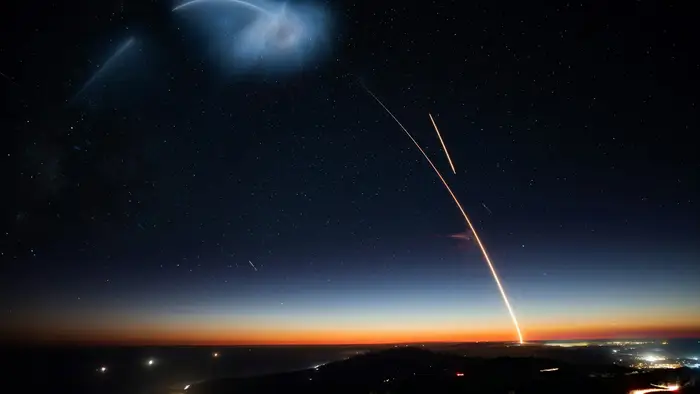
A launch arc cuts across the night sky. Vandenberg’s next classified launch, USSF-266, is due from the same pad on Tuesday. Image: Unsplash.