NASA Lucy Trojan Asteroid Region Reached After Five Years and 2.2 Billion Miles
Five years, two trips around the inner solar system, two Earth flybys, and two bonus asteroid encounters later, NASA’s Lucy spacecraft has arrived where it was always meant to go. The agency announced on October 28, 2026, that Lucy has become the first spacecraft ever to enter the region occupied by Jupiter’s Trojan asteroids, a vast and almost entirely unexplored population of primitive bodies that share the giant planet’s orbit around the Sun.
It is a milestone that is easy to understate and hard to overstate. No spacecraft has ever visited a Jupiter Trojan. Several have flown past Jupiter itself, and a few have used the giant planet’s gravity as a slingshot toward the outer solar system, but none had a reason to linger in the Trojans’ neighborhood. Lucy is the first mission built specifically to explore them, and after traveling more than 2.2 billion miles since its launch on October 16, 2021, it is now in their territory.
There is, however, no border crossing to photograph and no welcome sign in deep space. As NASA itself notes, space provides no marked boundary around an asteroid population. Mission engineers know Lucy is approaching Jupiter’s Lagrange point 4, known as L4, by tracking the spacecraft’s position through its radio signals and images of the surrounding stars. The achievement is a matter of orbital mechanics rather than geography: Lucy has reached the gravitational neighborhood where the Trojans live, and it will spend the coming years working its way through it.

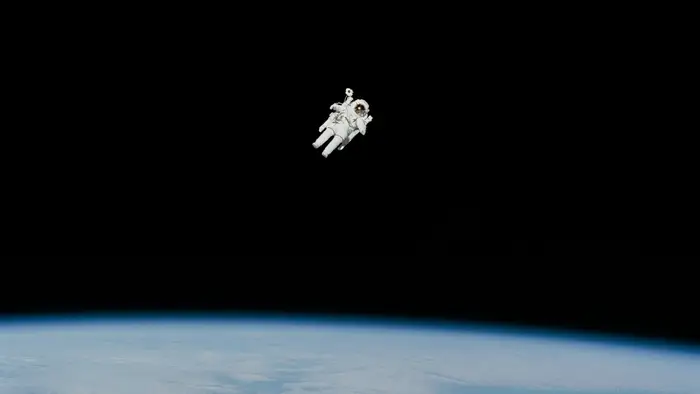
The deep-space realm Lucy now travels is more than five times farther from the Sun than Earth. Image: Unsplash.
Islands of stability in Jupiter’s orbit
The Jupiter Trojans are two great swarms of asteroids trapped in gravitationally stable zones that lead and trail Jupiter as it circles the Sun. The leading swarm gathers around Lagrange point 4, or L4, about 60 degrees ahead of the planet in its orbit. The trailing swarm gathers around Lagrange point 5, or L5, about 60 degrees behind it. In these spots, the combined gravitational pull of the Sun and Jupiter balances out, creating what NASA calls “islands of stability” where small bodies can remain parked for billions of years.
Thousands of Trojans are known, and astronomers believe many more remain undiscovered. They sit extraordinarily far from the planet they accompany: the Trojans in these clusters are roughly as far from Jupiter as Jupiter is from the Sun, about 484 million miles. They are also extraordinarily spread out. On average, individual Trojans are separated from one another by more than 6 million miles, which means that even now that Lucy is inside the region, its targets will appear as little more than pinpricks of light moving against a field of stars until the spacecraft bears down on them in the final days before each encounter.
That emptiness is part of the point. The Trojans are thought to be leftovers from the formation of the solar system, primitive bodies that have changed little since the planets were assembled some 4.5 billion years ago. Scientists expect that studying them up close will help refine theories of how the planets formed and how they ended up in their current configuration. One leading idea holds that the Trojans were captured from the outer solar system during a period when the giant planets migrated to their present orbits, which would make them refugees from the coldest reaches of the early solar system, preserved almost untouched ever since.
Lucy is designed to test those ideas by visiting both swarms. Its itinerary covers eight Trojan targets in total, counting three small moons alongside five asteroids, and the mission will run for 12 years from launch. It is the 13th mission in NASA’s Discovery Program, the line of relatively low-cost planetary missions selected through open competition, and it is named for the famous Lucy fossil, the 3.2-million-year-old hominin skeleton discovered in Ethiopia in 1974 that reshaped our understanding of human origins. The analogy is deliberate: just as the fossil Lucy illuminated human evolution, the spacecraft Lucy is meant to illuminate the evolution of the solar system.
Five years on the road
Lucy’s journey to the Trojans has been anything but a straight line. The spacecraft launched from Cape Canaveral on an Atlas V rocket on October 16, 2021, and almost immediately ran into trouble: one of its two enormous circular solar arrays, each wider than a school bus, failed to latch fully open. Engineers spent months diagnosing the problem and coaxing the array into a position that delivered enough power, ultimately saving the mission without sacrificing its science goals.
What followed was a carefully choreographed series of gravity assists. Lucy looped back past Earth in October 2022, skimming just 220 miles (350 kilometers) above the surface, and used the planet’s gravity to reshape its orbit. A second Earth flyby in December 2024 boosted its speed relative to the Sun by more than 16,000 miles per hour (25,750 kilometers per hour), putting it on course for the Trojan swarms. Along the way, Lucy also used its instruments to photograph Earth and the Moon as calibration targets, producing images that doubled as a reminder of how far the little spacecraft had already come.
The cruise was far from quiet. Lucy was designed to visit three main-belt asteroids en route, and it turned those dress rehearsals into genuine discoveries. In November 2023, it flew past the small main-belt asteroid Dinkinesh and discovered that the asteroid has a moon, later named Selam, which turned out to be a contact binary, two lobes stuck together like a peanut. In April 2025, Lucy flew past Donaldjohanson, another main-belt asteroid, and found that it, too, is an elongated, oddly shaped body that appears to wobble as it tumbles through space. Both encounters gave the science team a chance to rehearse the exacting choreography of a fast flyby, in which the spacecraft must pivot to track a small, dark target while its instruments gather data during a window of just a few hours.
By the time the Southwest Research Institute, which leads Lucy’s science team, marked five years of operations on October 19, 2026, the spacecraft had already changed how researchers think about small bodies, and it was still less than a year from the encounters it was built for. NASA’s Goddard Space Flight Center manages the mission, Lockheed Martin built the spacecraft, and principal investigator Hal Levison of the Southwest Research Institute has described the full plan as visits to 11 asteroids in all, counting the main-belt stops and the Trojan targets with their moons.

Lucy launched in October 2021 and used two Earth gravity assists to build the speed needed to reach Jupiter’s orbit. Image: Unsplash.
Why the Trojans matter
To understand why a mission would spend 12 years chasing a handful of dark rocks, it helps to think about what the Trojans are made of and where they came from. Unlike the planets, which have been melted, resurfaced, and battered by billions of years of geology, the Trojans are expected to be close to pristine. They are thought to be rich in carbon and other organic compounds, dark-surfaced bodies whose chemistry may resemble the building blocks that seeded the early planets with water and organic material.
That makes them time capsules. The leading theory of solar system history holds that the giant planets did not form where they now sit. Jupiter, Saturn, Uranus, and Neptune are thought to have migrated, scattering smaller bodies as they moved, and some of those scattered bodies were captured into the stable Lagrange zones, where they have remained ever since. If that picture is right, the Trojans are not local to Jupiter at all: they are samples of the outer solar system, delivered to Jupiter’s orbit and parked there for safekeeping. Visiting them is therefore a way of sampling the distant past without traveling all the way to the Kuiper Belt.
Lucy’s targets were chosen to test exactly this kind of idea. The spacecraft will visit Trojans of different types, including dark, reddish bodies and grayer ones, to see whether they really do come from different parts of the early solar system. It will look for craters that record billions of years of collisions, measure surface composition to identify minerals and ices, and study densities that reveal whether these bodies are solid rock, loose rubble piles, or something in between. Each target is a different data point, and together they should reveal whether the Trojan population is a single family with a shared history or a mixed crowd of immigrants from across the young solar system.
The mission also matters for a more practical reason. The same population of primitive asteroids that Lucy is studying is closely related to the near-Earth objects that occasionally threaten our planet, and the techniques for tracking, imaging, and characterizing small, dark bodies at high speed are directly relevant to planetary defense. NASA’s asteroid-hunting efforts elsewhere in the solar system, including the upcoming NASA NEO Surveyor sunshade tests that recently cleared a key milestone for that mission’s infrared telescope, share Lucy’s challenge of spotting faint objects against a crowded sky. Lucy’s close-up views will calibrate what telescopes see from afar.
The encounter calendar
The milestone announced on October 28 is not the destination but the doorway. Lucy’s first close Trojan encounter is still ahead, and the schedule that follows is one of the most densely packed flyby sequences ever attempted.
The first target is Eurybates, a roughly 40-mile-wide asteroid in the leading L4 swarm, which Lucy will fly past on August 11, 2027. The encounter will last only a few hours, but in that time the spacecraft will image both Eurybates and its small satellite Queta, a moon only about 3,200 feet wide. Eurybates is special because it is the largest member of the only known collisional family among the Trojans, a group of asteroids believed to share a common parent body shattered in an ancient impact. Studying it may reveal what happens when primitive bodies collide.
Weeks later, in September 2027, Lucy will visit Polymele, a smaller Trojan that was itself found to have a moon during preparations for the mission. Then comes Leucus in April 2028, a slow rotator that takes an unusually long time to spin once on its axis, and Orus in November 2028, a larger body whose surface may preserve a different chapter of Trojan history. Each flyby is a one-shot event: Lucy cannot slow down or turn back, so the science team has spent years refining encounter plans to make the most of a few hours of close-up observation.
After the L4 encounters, Lucy will swing back toward the inner solar system for a third and final Earth gravity assist in 2030, which will fling it toward Jupiter’s trailing L5 swarm. There, in March 2033, it will explore Patroclus and Menoetius, a binary pair of nearly equal-sized asteroids that orbit each other. The Patroclus-Menoetius system is one of the mission’s most anticipated targets because binary asteroids preserve clues about how such pairs form, and because the two bodies may be the most primitive of all Lucy’s destinations.
Lucy swung past Earth twice to gain speed, and will return for a final gravity assist in 2030 before heading to the trailing Trojan swarm. Image: Unsplash.
A spacecraft built for dim sunlight
Everything about Lucy’s design reflects the environment it now inhabits. At Jupiter’s distance, sunlight is only about 4 percent as strong as at Earth, and the spacecraft operates more than five times farther from the Sun than our planet. Its two giant solar arrays, each roughly 24 feet across, are sized to harvest that feeble light, and its instruments are built to work in the deep cold. As Lucy cruises deeper into space, NASA says, it has adapted to the gradually cooling temperatures and dimming light, and the spacecraft and its instruments continue to operate as expected.
Lucy carries three main science instruments. L’LORRI is a high-resolution camera that will photograph the Trojans in black and white, revealing craters, ridges, and fractures. L’Ralph is a color camera and infrared spectrometer that will map surface composition, identifying minerals and organic compounds. L’TES is a thermal infrared spectrometer that will measure surface temperatures, helping scientists infer what the surfaces are made of and how they respond to sunlight. Together, they will produce the first detailed portraits of a population that, until now, has been visible only as faint points of light in telescopes.
The team is already putting the final touches on the Eurybates encounter plans, and the work is exacting. Because the Trojans are so far apart and so dim, Lucy must navigate with extreme precision, using images of background stars to pin down its position and timing its observations to within seconds. The spacecraft will autonomously track Eurybates during the flyby, keeping its instruments pointed at a target that is moving relative to the spacecraft at thousands of miles per hour. There is no second chance: if an instrument misses its window, the data is gone.
This kind of precision navigation is becoming routine across NASA’s small-body program. The agency’s ‘Pedal to the Metal’: NASA’s Psyche Fires Its Thrusters Almost Nonstop on the Way to a Metal World mission is taking a very different approach to a different kind of asteroid, using near-continuous electric propulsion to cruise toward a metal-rich world, while Lucy’s ballistic trajectory relies on gravity and timing. Both missions, along with accidental discoveries like The Accidental Comet: How ESA’s Dark-Energy Telescope Stumbled Upon Its First New Comet, show how much remains to be learned from the solar system’s smallest inhabitants.
The data will not arrive all at once, either. At Jupiter’s distance, radio signals take roughly three-quarters of an hour to cross the gap between Lucy and Earth, so the spacecraft must operate largely on its own during each encounter, following sequences uploaded in advance and storing its observations for later transmission. The first images from Eurybates will therefore reach Earth hours after the flyby itself, trickling down over days as the spacecraft replays its recorders. For the scientists who have waited more than a decade since Lucy’s selection in 2017, that delay will be the final stretch of a very long countdown, and the first pictures will be worth every minute of it.
The long wait, and why it is worth it
There is a temptation to treat Lucy’s arrival in the Trojan region as the climax of the mission. It is not. The real science begins in August 2027, and it will unfold slowly, one flyby at a time, over six more years. That patience is built into the mission’s design and into the nature of the Trojans themselves. These are bodies that have waited 4.5 billion years to be seen up close; a few more months is nothing.
But the milestone announced this week matters for a reason that goes beyond the calendar. It confirms that the long, complicated trajectory worked. Five years after launch, after a balky solar array, two Earth flybys, and two bonus asteroid discoveries, Lucy is exactly where it needs to be, healthy and on course. The spacecraft has proven that a mission can be aimed at a population rather than a single target, threading its way through a swarm spread across millions of miles to visit one body after another.
For planetary science, that is a new capability. Previous missions have visited individual asteroids and comets, but Lucy is the first to tour a population, comparing multiple members of the same family to understand the whole. If it succeeds, it will set a template for future multi-target missions, whether to the Trojans, the Kuiper Belt, or the asteroid belt’s many families.
The Trojans have been patient. They have circled the Sun in Jupiter’s shadow for billions of years, holding the chemical memory of the solar system’s birth in their dark, battered surfaces. For the first time, a spacecraft built by human hands is among them, closing in on its first close look. In less than a year, Eurybates will fill Lucy’s cameras, and the pinpricks of light will become worlds.

Five years after launch, Lucy is healthy and on course, with its first Trojan encounter less than a year away. Image: Unsplash.

The Trojan asteroids are spread millions of miles apart, appearing to Lucy as pinpricks of light until each close flyby. Image: Unsplash.