Hera Is Braking for History: ESA's Asteroid Detective Arrives at the Scene of NASA's DART Crash
Four years ago, NASA deliberately crashed a spacecraft into an asteroid at nearly 22,000 kilometers per hour, just to see if humanity could nudge a space rock off course. This winter, Europe’s follow-up investigator reaches the crime scene — and it is burning the brakes right now.
The European Space Agency’s Hera spacecraft completed the first of its braking maneuvers on October 15, 2026, and mission controllers confirmed the burn the next day. A second braking burn was scheduled for today, October 22. Over the coming weeks, Hera will ease itself toward the Didymos asteroid system, some 195 million kilometers from Earth, where it will spend months documenting exactly what happened when NASA’s DART impactor slammed into the asteroid moonlet Dimorphos in September 2022.
It is a “crime scene investigation” four years in the making — and the evidence gathered may one day be the difference between a planetary catastrophe and a successfully deflected asteroid.

A heavily cratered rocky surface — the battered kind of terrain Hera will document up close at Didymos and Dimorphos. Image: Unsplash.
Hitting the Brakes in Deep Space
The first braking maneuver, designated BRM-1, was no quick tap on the brakes. For 93 minutes on October 15, three of Hera’s hydrazine-based Orbit Control Thrusters fired continuously, while Reaction Control Thrusters kept the spacecraft’s orientation steady. The goal: reduce Hera’s velocity relative to the Didymos system by several hundred meters per second — the first major step in matching speeds with a target that is racing around the Sun.
Mission controllers assessed the maneuver using telemetry, guidance and navigation measurements, ranging data, and Doppler observations. On October 16, ESA confirmed it had met its required parameters.
“The arrival is a challenging phase for the mission,” said Martin Jutzi, an astrophysicist at the University of Bern who participates in the mission. He told the Keystone-SDA news agency that the measurements Hera will collect are essential for working out the physics of asteroid deflection.
The second maneuver, BRM-2, was scheduled for October 22 — an approximately 31-minute burn — followed by three smaller transition maneuvers expected toward the end of October. Each one trims Hera’s trajectory a little closer to the rendezvous it has been chasing for more than two years.
Two Rocks, One Mystery
Hera’s destination is one of the most scientifically peculiar places a spacecraft has ever visited: a binary asteroid system. Didymos, the primary body, measures roughly 730 to 780 meters across — about the size of a large hill. Orbiting it is Dimorphos, a moonlet only about 150 to 160 meters wide. The pair has been described by mission scientists as a miniature Earth-Moon system, locked in a gravitational dance that has persisted for untold ages.
What makes this particular dance famous is that it no longer proceeds exactly as it did before. On September 26, 2022, NASA’s Double Asteroid Redirection Test — DART — crashed into Dimorphos at 6.1 kilometers per second. It was the first time in history that humans intentionally altered the motion of a celestial body. Ground-based telescopes quickly confirmed the experiment had worked: Dimorphos’ orbital period around Didymos shrank from 11 hours and 55 minutes to about 11 hours and 22 minutes — a reduction of roughly 33 minutes, corresponding to a velocity change of about 2.67 millimeters per second.
That 33 minutes made headlines around the world. But for planetary scientists, it opened a much deeper question: how efficiently did the impact transfer momentum? The answer depends on things nobody can measure from Earth — the moonlet’s exact mass, its density, its internal structure, and the size and shape of the crater DART carved.
“We need to determine how much energy and momentum are required to deflect an asteroid of a given mass,” Jutzi told Keystone-SDA. “The results will provide a better basis for determining how efficiently we can actually deflect an asteroid by colliding with it.”
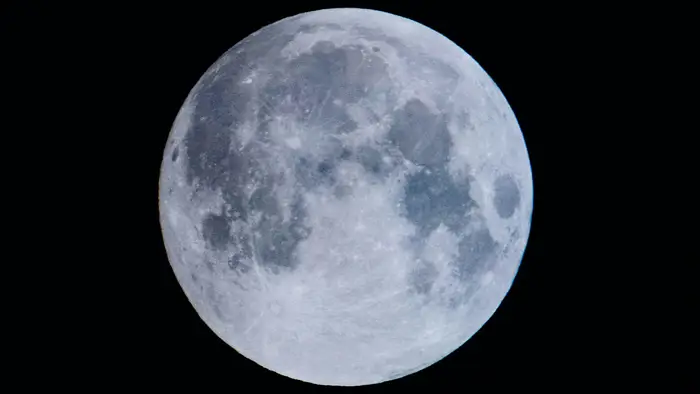
The Moon — a familiar face of the binary gravitational dance Hera will study at the far smaller Didymos and Dimorphos pair. Image: Unsplash.
A Rubble Pile Waiting to Be Weighed
One of the most tantalizing open questions is what Dimorphos is actually made of. Researchers affiliated with the University of Bern and the International Space Science Institute in Bern have modeled the DART collision, and their simulations suggest that Dimorphos consists of loosely bound debris rather than a solid block of rock — a “rubble pile” of boulders and dust held together by its own feeble gravity. If that is correct, the impact may have caused substantial deformation, crumpling the moonlet like a car hood.
Hera is built to test those predictions. The 1,150-kilogram spacecraft carries 11 science instruments that will map the surface, characterize the composition, and — critically — measure Dimorphos’ mass. With mass in hand, scientists can finally calculate how much of DART’s kinetic energy went into changing the moonlet’s orbit and how much was wasted shaking loose a cloud of debris (DART’s impact released a cloud that stretched some 10,000 kilometers into space, observed by Italy’s LICIACube companion satellite and observatories worldwide).
This is not academic bookkeeping. If astronomers ever discover an asteroid on a collision course with Earth, the deflection plan will likely rely on the kinetic impact technique — the same “ram it with a spacecraft” approach DART tested, chosen by space agencies as the least costly and most mature option. But mission planners would need to know how hard to hit, and that calculation lives or dies on the mass and structure data Hera is about to collect.
The complication is a physical quantity called the momentum enhancement factor — the ratio of the total momentum delivered to the asteroid to the momentum of the impactor itself. When DART struck, it did not just push Dimorphos like a billiard ball: the impact excavated tons of debris, and that ejecta flying off in the opposite direction added a “recoil” that pushed the moonlet even harder. Measurements suggested this enhancement was significant, which is good news for planetary defense — you get more deflection per kilogram of spacecraft than a simple collision would predict. But the size of the effect depends on the target’s structure, porosity, and cohesion. A rubble pile behaves nothing like a solid rock, and Hera’s job is to find out which one Dimorphos actually is. Only then can the 2.67-millimeters-per-second velocity change be translated into a universal recipe: so many kilograms of impactor, at so many kilometers per second, will deflect a rock of such-and-such a mass by a predictable amount.
The Long Road to the Rendezvous
Hera’s journey has been anything but a straight line. The mission was launched on October 7, 2024, aboard a Falcon 9 rocket from Cape Canaveral — returning the launcher to flight service for an ESA flagship mission — and embarked on a two-year deep-space cruise. In March 2025, Hera swung past Mars, using the planet’s gravity to bend its trajectory toward the Didymos system, and came within about 1,000 kilometers of the surface of the Martian moon Deimos along the way. A course-correction maneuver in February 2026 set the spacecraft on its final approach path.
The cruise itself has been a test of patience and precision. Hera will not simply “arrive” at Didymos — it must match the asteroid system’s speed and slip into a tightly choreographed sequence of approach orbits. According to the mission timeline reported by Swissinfo and Bluewin, Hera’s Early Characterization Phase was expected to begin in November. The spacecraft was scheduled to approach within approximately 30 kilometers of Dimorphos, where researchers anticipate obtaining the first usable images, before reducing the distance to about 10 kilometers by December.
The precision required is staggering. For most of the journey, Hera has been farther from the Sun than Earth, which is why its solar arrays had to be built unusually large — sunlight weakens with distance, and a spacecraft running 11 science instruments cannot afford to run cold. Between the propulsion system, the navigation cameras, and the star trackers, Hera must thread itself into a narrow corridor around a 160-meter moonlet that cannot be seen clearly until the spacecraft is nearly upon it. Jutzi’s characterization of arrival as “a challenging phase” is, if anything, an understatement: the gravity of Dimorphos is so weak that Hera’s orbit will be shaped less by the moonlet than by the Sun’s radiation pressure and the tug of Didymos itself, requiring constant, careful station-keeping.

A rocket lifts off from the Florida coast — Hera itself left for the Didymos system from Cape Canaveral in October 2024. Image: Unsplash.
Two Tiny Companions, One Landing Attempt
Hera will not work alone. Tucked aboard the mothership are two shoebox-sized CubeSats, Juventas and Milani — each weighing just 12 kilograms — that will be deployed gradually through specially designed Deep Space Deployers. Unlike standard CubeSat deployers, these must release their cargo slowly and precisely, because the asteroid system’s ultra-low gravity would let a carelessly released satellite simply drift away and miss its target. Over about 24 hours, each CubeSat will be pushed to the top of its deployer, kept connected through an umbilical for power and communications while its systems activate, and then gently released.
The pair have distinct specialties. Juventas carries a low-frequency radar that will send pulses into Dimorphos to probe its interior — the first attempt to see inside a small asteroid moonlet. It also carries a gravimeter and accelerometer to measure how equipment behaves in the asteroid’s ultra-low gravity, addressing a fundamental question: does Dimorphos have a solid core, or is it just a pile of rock held together by gravity? Juventas is scheduled to attempt a landing on Dimorphos in June 2027.
The landings matter more than they might sound. A conventional landing is impossible on a world whose gravity is measured in millionths of Earth’s — but the attempt itself is a scientific experiment, because the CubeSats’ final resting behavior will reveal the mechanical strength and cohesion of the surface. Juventas’ gravimeter will sense the gravitational field while descending, and the landing telemetry will show whether the moonlet’s surface is hard rock, loose gravel, or something in between — information that feeds directly into how a future deflection impact would propagate through such a body.
Milani, developed by the Italian company Tyvak, is the visual specialist. Its Navigation Camera — detailed in a recently published paper in Space Science Reviews — doubles as both a steering system and a scientific imager, photographing the Didymos–Dimorphos pair in visible light. Its hyperspectral imager will observe the surface at different wavelengths, spotting minerals and organic components invisible to the naked eye. Milani also carries the VISTA instrument, a dust analyzer built by an Italian consortium led by the National Institute for Astrophysics, which will study the dust and volatile environment around the asteroid pair — and the CubeSat is designed to collect samples of asteroid dust.
Milani’s trajectory design is aggressive for a six-unit CubeSat: a three-week Far-Range Operations Phase for global mapping, a four-week Close-Range Operations Phase for close-up observations of Dimorphos and the DART impact site, and an Experimental Phase in which the satellite descends along a self-stabilized terminator orbit and eventually attempts its own landing on Dimorphos. The CubeSats are expected to separate from Hera in January 2027, with three to six months of proximity operations to follow.
Why This Matters More Than Any Science Mission
The stakes behind Hera’s rendezvous are easy to underestimate because the threat it addresses is easy to dismiss. Asteroid impacts feel like movie plots — but Earth wears their scars. Sixty-six million years ago, a roughly 10-kilometer impactor wiped out the dinosaurs. In 1908, an airburst over Tunguska, Siberia, flattened 2,000 square kilometers of forest. In 2013, a meteor about 20 meters wide exploded over Chelyabinsk, Russia, shattering windows across the city and injuring more than a thousand people — from an object nobody saw coming.
The statistics that frame Hera’s mission come from Jutzi himself: objects measuring 10 to 20 meters across statistically strike Earth every few decades, while asteroids 100 to 200 meters wide — Dimorphos’ size class — could hit on timescales of 10,000 to 20,000 years, with devastating regional or global consequences. No immediate threat is known. But “no known threat” is not the same as “no threat,” and planetary defense is one of the few fields where practicing before the emergency is the whole point.
That is the lineage of Hera’s mission. The idea of a deflection mission was first formulated at ESA in 2007. The international AIDA (Asteroid Impact and Deflection Assessment) initiative was launched in 2013, with NASA and ESA coordinating. Hera itself started development in 2017, got the formal go-ahead in 2019, and construction began in 2020 under a consortium led by OHB. DART struck in 2022 — the kinetic impact half of the experiment. Hera is the measurement half, arriving December 2026 as the first mission ever to rendezvous with a binary asteroid system, and the first multi-satellite expedition devoted to deep-space asteroid exploration.

A shooting star streaks over snowy peaks — a fiery reminder of what Hera is helping humanity learn to deflect. Image: Unsplash.
What Happens Next
The coming months will unfold in carefully staged phases. After the braking burns complete, Hera begins its Early Characterization Phase in November, closing to within about 30 kilometers of Dimorphos for the first resolved images — the moment the DART impact site comes into view. By December, the spacecraft will be maneuvered to within about 10 kilometers, beginning its detailed survey operations.
In January 2027, Juventas and Milani separate for their independent proximity operations. Through spring 2027, Hera will cycle through progressively closer orbits — from tens of kilometers down to just a few kilometers — while its CubeSat companions map, sample, and eventually attempt landings on Dimorphos. Juventas’ landing attempt is scheduled for June 2027. The mission is currently slated to conclude in September 2027.
Every one of those steps builds toward a single deliverable: a validated deflection blueprint. The mass of Dimorphos. The shape of the crater. The structure of the interior. The efficiency of the momentum transfer. With those numbers, the 33 minutes that DART shaved off Dimorphos’ orbit stops being a headline and becomes a calibrated engineering tool — one that future generations could use, with confidence, when a real asteroid is coming.

The Milky Way — the deep-space backdrop through which Hera has cruised for two years on its way to Didymos. Image: Unsplash.
A Kicker Written Four Years Early
In September 2022, the world watched a NASA spacecraft vanish into a 160-meter rock in a burst of debris, and cheered when the orbit shortened by 33 minutes. It was an act of cosmic vandalism with a noble purpose — and it was only half the experiment.
Now the second half is arriving. Hera is braking, steadily and deliberately, toward a target 195 million kilometers away, to measure what a human-made collision does to an asteroid — its mass, its scars, its secrets. Somewhere in the coming weeks, as the spacecraft closes to within 30 kilometers of Dimorphos, cameras will finally resolve the crater that DART left behind, and scientists will see for the first time what our first punch against the heavens actually did.
The Solar System has been throwing rocks at Earth for four and a half billion years. For the first time, humanity is learning how to throw one back. Hera is the mission that turns a daring stunt into a science — and a science into a shield.