KOEN Kinosputnik Launch November 14 2026: Russia's First Private Satellites Reach Orbit
Russia launched its first privately built satellites as the main cargo of a rocket on Saturday, November 14, 2026 — and the state paid part of the bill. A Soyuz-2.1b rocket lifted off from the Vostochny Cosmodrome in Russia’s Far East at 04:16 Moscow time, carrying two Earth-imaging spacecraft, KOEN and Kinosputnik, into a Sun-synchronous orbit roughly 500 kilometres above the planet. Both satellites reached orbit and were accepted for control, according to Roscosmos, which described the flight as the first launch of private satellites subsidised under the national Kosmos project.
The launch matters less for the two satellites themselves than for what they represent: a deliberate attempt by Moscow to build a private space industry that remains firmly under state direction. The spacecraft are privately owned, built by two young Russian companies. But the launch was partly funded by Roscosmos, the imagery they produce is destined for a state-run federal data fund, and since the summer the space agency has been auditing private satellites for foreign-component dependence before government customers are allowed to buy their pictures. Private label, state control — that is the model Russia is now testing in orbit.
The flight was also a study in how much of the story is still unverified. Every performance figure attached to the two satellites — KOEN’s half-metre resolution, its twelve-kilometre swath, its five-year design life — comes from the companies that built them or from Russian media repeating their claims. No independent party has confirmed any of it. The satellites have delivered no customer imagery yet, and none is expected from Kinosputnik until 2027. What the launch proves, for now, is that the hardware works and the political machinery behind it is moving fast.

A pre-dawn liftoff from Vostochny
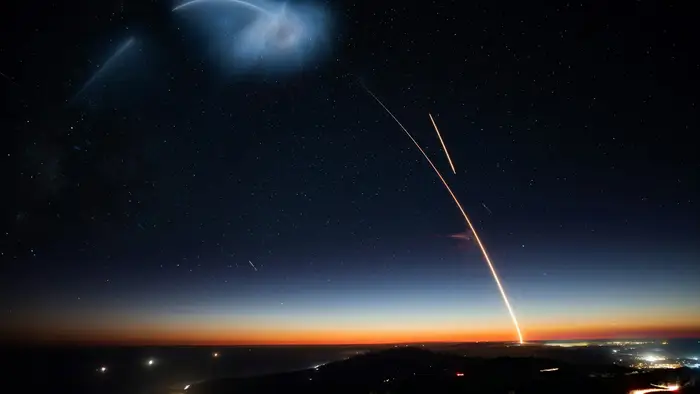
The rocket left Site 1S at Vostochny at 04:16:15 Moscow time on Saturday, November 14 — 01:16 UTC, 8:16 p.m. Eastern time on Friday, November 13, and 08:16 WIB on Saturday morning. The vehicle was a Soyuz-2.1b, built by the Progress Rocket and Space Centre, topped by a Fregat upper stage from NPO Lavochkin. Fregat is restartable, which lets it fire more than once to place payloads precisely; in one 2018 mission it fired seven times, including a final burn to deorbit itself. Launch trackers listed the flight as a success, with the payloads delivered into their target Sun-synchronous orbit.
According to the independent Russian space analyst Anatoly Zak, writing on RussianSpaceWeb, this was the first — and only — Soyuz launch from Vostochny in 2026, and it carried a cluster of twelve smaller payloads alongside the two headline satellites. Pre-launch listings named two cubesats from NPO Kaisant, a 6U spacecraft carrying a Germes modem and a 16U spacecraft carrying Gonets modems, as planned secondary payloads. The launch contractor Aerospeis Kapital reported that seven cubesats it had integrated for its customers were successfully deployed. Whether the two Kaisant cubesats were among the deployed payloads has not been confirmed in the reports reviewed.
Both primary satellites checked in quickly. MT-LAB, the company behind KOEN, reported normal telemetry from its spacecraft, according to Defense News. SPUTNIX, the company behind Kinosputnik, said its mission control centre in Skolkovo had received signals from its satellite and that its systems were operating normally. Roscosmos said both spacecraft had reached orbit and been accepted for control.
The launch had been a long time coming. MT-LAB had earlier given September 2 as a launch date for KOEN, according to the Russian outlet Profile, and in September a SPUTNIX deputy director told the outlet ComNews that Kinosputnik was expected in late November. By the middle of the year the combined launch had slipped to the November–December period. On September 22, Roscosmos head Dmitry Bakanov told Prime Minister Mikhail Mishustin that two private optical-electronic satellites had already been delivered to Vostochny for a launch the following month. Seven weeks later, they flew.
Two satellites, two very different cameras
KOEN and Kinosputnik are both Earth-observation satellites, but they are built to do different jobs, and the gap between their specifications tells you a lot about the state of Russia’s young private space sector.
KOEN is the sharper eye. Developed by the private company MT-LAB, it weighs about 500 kilograms, according to the independent analyst Bart Hendrickx, writing in The Space Review. Profile, a Russian news outlet, reports that it images the ground at 0.5 metres per pixel — about 1.6 feet — across a swath 12 kilometres wide. The same report gives an annual imaging capacity of 15 million square kilometres and a design life of at least five years at an altitude of roughly 500 kilometres. Profile calls it the first Russian civilian spacecraft able to image at this detail, although that claim is the outlet’s own and has not been independently checked.
Kinosputnik is the broader, more flexible instrument. Developed by the SPUTNIX group and built on the company’s new Pallada satellite platform, it carries a multispectral camera with 0.8-metre resolution, according to the Japanese space outlet Sorae. ComNews reported in September that its planned orbit is about 600 kilometres. SPUTNIX says the Pallada platform covers spacecraft of 80 to 200 kilograms, carries up to 100 kilograms of payload, and sends data down in the X-band at 800 to 1,500 megabits per second. Commercial imagery from Kinosputnik is expected in 2027, according to ComNews.
| KOEN | Kinosputnik | |
|---|---|---|
| Developer | MT-LAB | SPUTNIX (Sputniks) |
| Mass | ~500 kg | ~200–300 kg |
| Imaging resolution | 0.5 m per pixel | 0.8 m per pixel, multispectral |
| Swath width | ~12 km | Not disclosed |
| Orbit altitude | ~500 km | ~600 km (planned) |
| Design life | At least 5 years | Not disclosed |
| Platform | Not disclosed | Pallada (new SPUTNIX bus) |
| First customer imagery | Not announced | Expected 2027 |
The table makes the asymmetry plain. KOEN is the flagship: heavier, sharper, and aimed squarely at the half-metre market that Western operators already serve. Kinosputnik is the platform demonstrator: a first flight for a new satellite bus that SPUTNIX hopes to sell onward, with a planned 0.5-metre successor that the company says would let a car be seen from orbit and its dimensions estimated. One satellite is a product; the other is a proof of concept for a product line.
Neither spacecraft has delivered customer imagery yet, and that is the number that matters most. A satellite’s advertised resolution is a claim; its delivered imagery is evidence. SPUTNIX has been candid about the gap: its subscription service for Earth-observation data receives thousands of requests a month but only dozens of clients actually buy images, with the main customers in forestry, agriculture, and oil and gas. Its chief executive, Georgy Alyoshkin, has described pilot projects with enterprises of its parent company, AFK Sistema, in forestry and telecom, along with artificial-intelligence models for recognising objects in imagery. Whether the stated resolutions hold up on orbit, and whether demand covers costs without subsidy, will only become clear over the coming months.
The firsts that matter — and the ones that don’t
Roscosmos and the Russian press attached two “firsts” to this launch, and they are worth separating, because one is genuinely historic and the other is a policy label.
The historic first is the payload itself. Defense News reports that the mission marks the first time in Russian spaceflight history that privately developed satellites served as the primary payload of a launch. Until now, private Russian spacecraft have flown as secondary passengers, squeezed into leftover space on government missions. This time the rocket existed, in effect, to carry them. Sorae, the Japanese outlet, makes the same point: the two satellites were the mission’s main payloads rather than secondary passengers. That is a real change in how Russia flies, and it is the reason the launch drew attention beyond the usual circle of launch watchers.
The second first — the first private satellite launch subsidised under the national Kosmos project — is a statement about funding, not physics. Roscosmos partially funded the launch, according to Defense News, and Sorae describes it as Russia’s first launch of private satellites with a partial state subsidy. Neither outlet gives a ruble figure, and the reports reviewed do not say how much Roscosmos paid. The subsidy is the point, though: the state is not merely permitting a private market, it is paying to create one, and paying on terms it sets itself.
That distinction matters because the Russian private space sector is still tiny. On September 22, Bakanov told Mishustin that Russia had launched about 60 satellites in 2026 and that the total constellation was nearing 400. For comparison, a single American company, SpaceX, has launched far more than that in a year, and China’s Jilin-1 constellation alone numbered 117 satellites by 2024. Russia’s private sector is not competing on scale. It is competing, if it is competing at all, on a different proposition: imagery of Russian territory, for Russian customers, under Russian rules.
A state-subsidised “private” market
The Kosmos national project is the framework into which this launch fits, and its scale dwarfs the two satellites that just flew. On November 10, Mishustin led a strategy session at which, according to Roscosmos Media’s report, more than 4 trillion rubles — approximately 48 billion dollars — are planned for the Kosmos national project over eleven years. The report puts the orbital group at nearly 400 satellites, about 30 of them in the Rassvet internet system, and says regional satellite-production capacity is expected to cut costs by roughly a third. That cost reduction is a projection, not a reported result.
Bakanov, whom President Vladimir Putin appointed to lead Roscosmos on February 6, 2025, was tasked with addressing procurement inefficiencies and making the state corporation more attractive to private investors, according to the Jamestown Foundation. The September report to Mishustin was part of that pitch: the private sector, Bakanov argued, was crucial to the Kosmos project, and two private optical-electronic satellites had passed every test. The November launch is the delivery on that promise — two satellites, tested, delivered to the cosmodrome, and flown.
But the legal architecture around the launch shows how tightly the state intends to hold the reins. In April, the State Duma passed amendments in a third and final reading that let Roscosmos approve a methodology for pricing data from the federal Earth remote sensing data fund, keep the payments in its own budget, and set purchase conditions for state bodies buying from non-governmental spacecraft. Bakanov told Putin in April that Federal Law 540, passed in 2025, had made access to remote sensing data a paid service. A separate law that took effect on January 1, 2026, requires launch reports to Roscosmos from Russian citizens and organisations that plan or complete launches of privately owned spacecraft.
Since the summer, the state has also been checking whose technology a private satellite runs on before buying its imagery, according to the Russian business outlet RBK. Roscosmos assesses the spacecraft’s dependence on foreign components and the security of the data it collects. Data from satellites that have not passed the assessment can still be purchased, but only when the needed information cannot be obtained from verified ones. Reports differ on the exact effective date of the order, and the full text of the underlying report could not be fetched by the outlets that reviewed it.
The largest consequence follows from these pieces together: a state-subsidised launch, state-set pricing and purchase rules, a state supply-chain audit, and an agreement under which private data flows to a state-run federal fund add up to infrastructure that is private in ownership but state-directed in use. SPUTNIX’s parent, AFK Sistema, signed a September 2025 agreement with Roscosmos under which, Bakanov said, satellites would be built and their data passed to the federal remote sensing fund for distribution to users. Interfax attributes the construction role to Sputnix, an AFK Sistema subsidiary.
That arrangement also carries a sanctions shadow. The European Union added AFK Sistema, SPUTNIX’s parent, to its sanctions list on July 24, 2026, and the company called the decision unlawful, unfounded and profoundly unjust. A United Nations Panel of Experts report published on March 22, 2024, citing South Korean media, alleged that the Lazarus Group stole satellite blueprints from the Russian company Sputnix in 2022. Moscow told the panel there was no clear evidence that North Korean cybercriminals had sought weapons data from Russian defence companies. Neither episode has been shown to affect the two satellites now in orbit, but both shape the environment in which their imagery will be bought and sold.

What half a metre can — and cannot — show
Ground sample distance, the figure behind “0.5 metres per pixel”, is the distance between pixel centres measured on the ground. It depends on altitude, pixel size and focal length, growing with height and shrinking as the telescope’s focal length increases. A half-metre camera at about 500 kilometres therefore needs a long focal length, and a long focal length narrows the field of view. That is why KOEN’s swath is about 12 kilometres rather than the 150 kilometres of a wide-swath satellite such as China’s Kuanfu-02A.
Two caveats matter for anyone weighing the claims. First, ground sample distance describes sampling, not the finest feature an image can truly resolve, because it is only one limit on resolution. Second, a narrow swath means a satellite must point and slew to cover a target region, so the 15-million-square-kilometre annual figure reported by Russian media is a ceiling, not a measured result. Neither figure has been confirmed by an independent source in the reports reviewed.
KOEN’s half-metre class is competitive but not leading. Planet’s Pelican Gen 1 offers 50-centimetre-class imagery over an 8-kilometre swath, and a Gen 2 with 30-centimetre-class imagery is planned. BlackSky’s Gen-3 satellites deliver 35-centimetre imagery, according to the company’s own product page. China’s Jilin-1 constellation had 117 satellites by 2024, and one newer spacecraft, Gaofen-05B-01, was reported at better than 0.5-metre resolution. Its Kuanfu-02A covers a 150-kilometre swath at 0.5 metres.
By comparison, KOEN has a 12-kilometre swath, and SPUTNIX says it plans to move to 0.5-metre imaging after Kinosputnik. KOEN’s swath is wider than Pelican Gen 1’s but about one-twelfth of Kuanfu-02A’s. The honest summary is that Russia has now joined a market that already exists, with a single satellite each at two resolution tiers, against constellations that number in the dozens and hundreds. The question is not whether the technology is impressive — half-metre imaging from a first-generation private satellite is genuinely capable — but whether two satellites can build a business against operators that revisit the same spot several times a day.
Roscosmos lists the intended uses for the imagery: monitoring land use, detecting illegal structures, watching natural areas, and assessing the effects of fires and floods. Sorae adds infrastructure, agriculture and construction monitoring. Those are the classic civilian applications, and they are also the applications that overlap most directly with government needs — which is precisely why the state is the most likely customer, and why the state’s purchase rules matter as much as the cameras.
The questions the launch does not answer
Every performance figure in this story comes from MT-LAB, SPUTNIX, Roscosmos, or outlets repeating them. None has been confirmed by an independent third party. That is normal for a first launch — independent verification takes time, imagery, and access — but it is worth stating plainly, because the gap between a claimed resolution and a delivered one is where satellite programmes are usually judged.
There are also open questions about where the hardware comes from. Independent space analyst Bart Hendrickx wrote in The Space Review that a satellite looking exactly like Stilsat has surfaced under the name KOEN. He described it as one of three types of high-resolution optical satellites to receive grants under Russia’s National Technological Initiative, and said KOEN weighs 500 kilograms. In the same analysis he wrote that Russia may also receive high-resolution imagery from two Chinese MinoSpace satellites, Taijing-3-01 and Taijing-3-04, which are likely controlled from China.
That does not show that the KOEN flying now contains Chinese parts, and none of the reports reviewed lists MT-LAB’s suppliers. It does explain why the Roscosmos foreign-component assessment matters. In a separate investigation, Hendrickx found that Novyy Kosmos’s Okulus-1, marketed as homegrown, is actually China’s Taijing-4-03, white-labelled for Russian customers. That finding has not been independently verified by the outlets that reported it. But it is the reason a buyer should ask, before paying for Russian imagery, what exactly was built where — and it is the reason Roscosmos now asks the same question before it buys.
The secrecy around the launch is itself part of the story. RussianSpaceWeb notes that the flight took place “in the midst of increasing secrecy around space activities in the country”, and that no details of the launch campaign had been published beyond the delivery of the two satellites to Vostochny in September. The secondary payloads remain only partly confirmed, and no precise orbital parameters were given in the reports reviewed. A launch that is also a policy announcement invites that kind of opacity; the state wants the milestone known and the details controlled.
It is also worth keeping this launch in proportion with what else Russia flies. The same state that subsidised two private imaging satellites also operates a large military space programme, and Russian spacecraft have been tracked shadowing other nations’ satellites — as in the case of Russia’s Kosmos 2612 shadowing a U.S. radar satellite, a manoeuvre trackers described as looking deliberate. KOEN and Kinosputnik are civilian imaging satellites, and launch trackers list the mission as a technology and Earth-observation flight, with the mission brief describing the payloads as dual-use optical satellites. But they fly in an orbital environment where the line between civilian and military observation is thin, and where every new imaging satellite is watched by more than its customers.

Timeline: Russia’s private imaging push
- 2022 — A UN Panel of Experts report later alleges that the Lazarus Group stole satellite blueprints from Sputnix; Moscow tells the panel there is no clear evidence North Korean cybercriminals sought weapons data from Russian defence companies.
- March 22, 2024 — The UN Panel of Experts report publishing the Sputnix blueprint-theft allegation is released.
- February 6, 2025 — President Vladimir Putin appoints Dmitry Bakanov to lead Roscosmos, tasking him with fixing procurement inefficiencies and attracting private investors.
- 2025 — Federal Law 540 is passed, making access to remote sensing data a paid service.
- September 2025 — AFK Sistema, SPUTNIX’s parent, signs an agreement with Roscosmos under which satellites will be built and their data passed to the federal remote sensing fund.
- September 2025 (reported) — SPUTNIX deputy director Vsevolod Shevtsov tells ComNews that Kinosputnik is expected in late November; MT-LAB had earlier given September 2 as KOEN’s launch date.
- April 2026 — The State Duma passes amendments in a third and final reading letting Roscosmos set pricing and purchase conditions for imagery from non-governmental spacecraft.
- Summer 2026 — Roscosmos begins assessing private satellites’ dependence on foreign components and the security of their data before government customers buy imagery.
- July 24, 2026 — The European Union adds AFK Sistema to its sanctions list; the company calls the decision unlawful, unfounded and profoundly unjust.
- September 22, 2026 — Bakanov tells Prime Minister Mishustin that Russia has launched about 60 satellites in 2026, the constellation is nearing 400, and two private optical-electronic satellites have been delivered to Vostochny for launch the following month.
- November 10, 2026 — Mishustin leads a strategy session at which more than 4 trillion rubles, about 48 billion dollars, are planned for the Kosmos national project over eleven years.
- November 14, 2026, 04:16 Moscow time — A Soyuz-2.1b lifts off from Vostochny Site 1S carrying KOEN and Kinosputnik as its primary payload, plus twelve smaller payloads. Both satellites reach orbit and are accepted for control.
- 2027 (expected) — Commercial imagery from Kinosputnik is expected to become available, according to ComNews.
Why it matters beyond Russia
The launch is small in absolute terms — two satellites, one rocket, a market that does not yet exist. But it is a useful marker for where the global Earth-observation business is heading, because the same forces are at work everywhere: governments want sovereign imagery, private companies want to sell it, and the line between the two keeps blurring.
In the United States, the Pentagon is building its own orbital mesh through programmes like the Space Development Agency’s Tranche 1, which recently added 21 Northrop Grumman satellites to a proliferated low-Earth-orbit constellation. In the commercial world, operators such as AST SpaceMobile are lofting ever-larger constellations — three more BlueBird satellites went up on a Falcon 9 recently, pushing direct-to-cell service closer to reality. The common thread is proliferation: many small satellites, launched often, owned by companies, bought by governments.
Russia’s version of that thread is thinner and more state-directed, but it rhymes. A national project with a multi-trillion-ruble budget, a state corporation acting as both funder and gatekeeper, and two private companies building the hardware. The difference is the direction of travel: in the West, governments are learning to buy from companies they do not control; in Russia, the state is learning to fund companies it still intends to direct.
Whether the model works will be decided by the imagery. If KOEN delivers half-metre pictures of Russian farmland, forests and cities, and if Kinosputnik’s Pallada bus proves itself in orbit, the two satellites will have done something no Russian private spacecraft has done before: earned their keep. If the resolutions slip, the swaths disappoint, or the customers never materialise beyond the state fund, the launch will stand as a milestone that marked an intention rather than an industry. The satellites are in orbit now. The evidence will follow, one image at a time.
For the moment, the facts are these: a Soyuz rose before dawn from Vostochny, two privately built satellites rode it into a Sun-synchronous orbit, and a country that has flown in space for nearly seventy years did something it had never done before — it let private spacecraft take the primary payload slot, and it paid part of the fare. The rocket worked. The rest of the story is still being written, in the pictures those satellites have yet to send down.

Sources
- Tech Times: Russia Launches Private KOEN and Kinosputnik Satellites, but State Sets Imagery Purchase Rules
- Defense News: Russia Launches Privately Developed KOEN and KinoSputnik Earth-Observation Satellites
- RussianSpaceWeb: Soyuz rocket launches a dual-use satellite cluster
- EveryLaunch: Soyuz 2.1b Fregat-M — MKA Kinosputnik, KOEN and others