Earth Gave Juice a Push: ESA's Jupiter Probe Completes Daring Gravity-Assist Flyby
On September 28, 2026, the European Space Agency’s Jupiter Icy Moons Explorer did something extraordinary: it came home, briefly, only to leave again. In the early hours of the morning, the spacecraft known as Juice swept just 8,640 kilometers above the Indian Ocean — closer to Earth than many satellites that serve it — and let our planet’s gravity seize it, bend its path by 20 degrees, and fling it onward with an extra 3.5 kilometers per second of speed. No major engine burn. Just physics, precision, and a decade of planning.
It was the third of four planned gravity assists on Juice’s winding eight-year journey to Jupiter, and by every measure it went flawlessly. Mission controllers needed only one small course correction in the four weeks before the encounter, out of six they had set aside. The spacecraft threaded its corridor so accurately that the team will arrive at Jupiter with more propellant in the tanks than the most optimistic plans assumed — fuel that will be spent not on getting there, but on doing science once it arrives.
And as a parting gift, Juice looked back. Its monitoring camera captured Earth in glorious detail: the continent of Africa sprawling across the frame, Madagascar floating to its right — and, if you look closely, a tiny grey dot beside our planet. That dot is the Moon.
A slingshot 8,640 kilometers up
The numbers behind the flyby are worth savoring. Closest approach came at 11:45 UTC (13:45 Central European Summer Time) on September 28, with Juice passing 8,640 kilometers above the Indian Ocean. To put that in perspective, the International Space Station orbits at roughly 400 kilometers; geostationary communications satellites sit at nearly 36,000 kilometers. Juice skimmed a middle zone — deep enough to feel Earth’s gravitational grip firmly, high enough to clear the atmosphere entirely, brushing what engineers call the outermost reaches of the atmosphere.
The encounter did two things at once. First, it redirected the spacecraft: Earth’s motion and gravity deflected Juice’s trajectory by 20 degrees relative to its incoming path, rotating its velocity vector toward the outer solar system. Second, it energized it: the spacecraft gained 3.5 kilometers per second of heliocentric speed — velocity relative to the Sun — without firing its main engine in any significant way. That is the magic of the gravity assist, the cosmic slingshot that has powered missions from Voyager to Cassini: steal a whisper of a planet’s orbital momentum, and you get a push no rocket could afford to give you.
For Juice, the push was not optional. The spacecraft launched in 2023 on a trajectory that cannot reach Jupiter directly — no existing rocket could throw it there in one shot. Instead, mission designers plotted a winding tour of the inner solar system, borrowing momentum from planet after planet. The September 2026 encounter was the third such borrowing. It followed the first-ever lunar-Earth double flyby in August 2024 — a world-first maneuver in which Juice used the Moon’s gravity first, then Earth’s, in a single choreographed sequence — and a Venus flyby in August 2025. One more Earth flyby, scheduled for January 2029, will finally set Juice on its transfer trajectory to Jupiter, where it is due to arrive in July 2031.
The photograph: Africa, Madagascar, and a grey dot
Spacecraft flybys produce data, but they also produce images — and the images from September 28 were spectacular. Juice’s monitoring camera 1, known as JMC1, captured its famous shot at 11:56 UTC, just minutes after closest approach, as the spacecraft was already receding from Earth and heading outward.
The frame shows a gibbous Earth dominated by the African continent, with the island of Madagascar clearly visible to the east and the Indian Ocean stretching beyond. In the darkness at the bottom edge of the frame, sharp-eyed viewers can make out part of the Juice spacecraft itself — a reminder that this is a selfie of sorts, a spacecraft photographing its home on the way out. And to the right of Earth hangs a tiny grey dot: the Moon, caught in the same frame by happy coincidence of geometry.
The image was released with credit to ESA, the Juice team, and the JMC instrument, and it spread rapidly across space media. EarthSky noted the view of Madagascar captured just two minutes after closest approach; Sky at Night Magazine walked readers through the frame — Africa, Madagascar, and the almost-missable Moon. For a mission that will spend the next five years in the dark between the planets, it was a luminous hello and goodbye.
Juice’s cameras were busy throughout the encounter. The spacecraft captured a sequence of images with its onboard monitoring cameras, and eight hours before closest approach it caught a view of the Moon — not for the gravity assist, but for something arguably more important to the mission’s future.
Rehearsing for Jupiter’s moons
Here is the part of the flyby that mattered most to the engineers. During the encounter, Juice deliberately pointed its navigation camera at the Moon’s limb — the curved horizon of our satellite — to rehearse an optical-navigation technique it will need around Jupiter.
The problem Juice will face at Jupiter is this: when it flies close to Ganymede, Callisto, or Europa, it must know its position with exquisite precision, and it must know it autonomously, using images of the moons’ horizons against the black of space. Radio tracking from Earth takes the better part of an hour to make a round trip at Jupiter’s distance; there is no time for ground controllers to close the loop in real time. The spacecraft has to navigate by sight.
The Moon, on September 28, was the perfect rehearsal target: a known body, at a known distance, with a crisp limb against space. By imaging the lunar horizon and testing the geometry of the navigation solution, engineers validated the technique they will rely on during 35 planned flybys of Jupiter’s large moons. The Moon played no gravitational role in this encounter — it was purely a calibration target, a stand-in for the icy worlds hundreds of millions of kilometers away.
The mission also used the flyby to exercise its scientific instruments. Juice spent several days traveling through Earth’s magnetotail — the elongated extension of our planet’s magnetic field stretched away from the Sun — measuring magnetic fields and charged particles. The encounter doubled as an instrument checkout: a chance to calibrate sensors against the well-understood environment of Earth before they are asked to make sense of the alien magnetosphere of Jupiter.
Precision that saved fuel
Perhaps the most impressive statistic of the flyby is not the speed gained but the fuel not spent. ESA had scheduled six opportunities for small trajectory corrections in the weeks before the encounter — windows at four weeks, two weeks, one week, and three days before closest approach, among others. In the end, controllers needed only one. The spacecraft was already so precisely on course that five of the six correction slots went unused.
Angela Dietz, Juice’s Spacecraft Operations Manager, said the flyby demanded ultra-precise navigation in real time, and credited careful planning for the fact that the team used only a small amount of the propellant reserved for the event.
That saved propellant is not a rounding error. Every kilogram of fuel conserved in cruise is a kilogram available for the Jupiter tour: for the orbit insertions, the moon flybys, the months of observation that are the entire point of the mission. In a very real sense, the precision of September 28 bought science in 2031 and beyond.
The tracking campaign behind that precision was extensive. Teams began closely tracking Juice on August 17 and continued enhanced monitoring through October 10 — nearly two months of intense observation bracketing a flyby that lasted hours. Gravity assists look effortless in animations; in practice, they are among the most demanding operations in spaceflight, requiring the spacecraft to hit a corridor in space a few kilometers wide while moving at interplanetary speed.

Earth from Juice’s perspective: Africa, Madagascar, and — look closely — the Moon as a tiny grey dot. Image: Unsplash.
The long road to Jupiter
To appreciate what September 28 accomplished, it helps to see the full itinerary. Juice launched in April 2023 aboard an Ariane 5, beginning an eight-year cruise that its designers describe as one of the most complex trajectories ever flown.
The first milestone came in August 2024: the lunar-Earth double flyby, the first maneuver of its kind ever attempted. Juice swung past the Moon, using its gravity to adjust course, then flew past Earth the following day for a second assist — two slingshots for the price of one launch, executed with a precision that made headlines in its own right.
The second milestone was Venus in August 2025, where the spacecraft borrowed momentum from Earth’s sister planet and dove slightly sunward, setting up the geometry for the September 2026 Earth return. Each encounter is a carefully aimed bounce, and each must be exact: an error at Venus compounds by the time the spacecraft reaches Earth, and an error at Earth compounds all the way to Jupiter.
Now, with the third assist complete, Juice is on a trajectory that will bring it home one final time. The fourth and last gravity assist — another Earth flyby in January 2029 — will provide the final push onto the transfer orbit to Jupiter. Arrival is targeted for July 2031, eight years and three months after launch.
What awaits is the mission proper: the most comprehensive exploration of the Jovian system ever attempted by Europe. Juice will spend years in orbit around Jupiter, conducting 35 close flybys of its largest moons — Ganymede, Callisto, and Europa — before finally settling into orbit around Ganymede itself, the largest moon in the solar system and the only one known to generate its own magnetic field.
Why the icy moons matter
The destination is the point. Beneath the fractured ice shells of Europa, Ganymede, and Callisto, scientists believe, lie vast liquid-water oceans — some of them containing more water than all of Earth’s oceans combined. Where there is liquid water, energy, and chemistry, there is the possibility of life. Juice was built to find out whether these hidden oceans are habitable.
The spacecraft carries ten scientific instruments — the most complex payload ever sent to the outer solar system by ESA — including ice-penetrating radar to probe the shells, a laser altimeter to measure tides, magnetometers to sense the oceans’ induced magnetic fields, and spectrometers to analyze surface chemistry. The radar, in particular, will attempt something never done before: peer through kilometers of ice to map the boundary where ice meets ocean.
Europa is the highest-profile target, with its chaos terrains and plumes that may vent ocean material into space. Ganymede offers its own magnetic field and a deep ocean sandwiched between layers of ice. Callisto, the most heavily cratered world in the solar system, preserves a four-billion-year record of impacts — and may hide an ocean of its own. Thirty-five flybys will let Juice build a comparative picture of all three, testing theories of how ocean worlds form and evolve.
None of that happens without the cruise. Every gravity assist is a down payment on the science, and September 28 was one of the largest. The 3.5 kilometers per second gained from Earth is energy the spacecraft will carry all the way to Jupiter, where it will be spent — carefully, over years — exploring the most promising abodes for life beyond Earth.
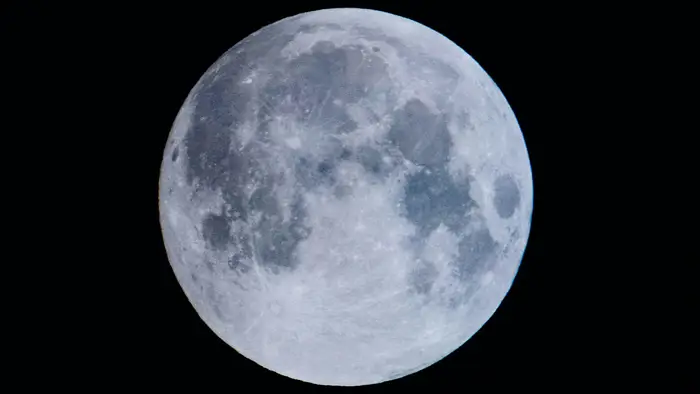
The Moon served as a calibration target, helping engineers perfect navigation by sight for the Jupiter tour. Image: Unsplash.
The quiet art of the gravity assist
There is something poetic about the maneuver Juice executed. The spacecraft needed to go outward, to Jupiter — so it fell inward, toward Earth, and let our planet throw it back out. It is the orbital equivalent of a judo throw: using the opponent’s mass and motion against them, or rather with them, borrowing what is lent freely and returning nothing but gratitude.
The technique is old — Voyager used it in the 1970s, Cassini refined it in the 1990s and 2000s — but Juice’s implementation is among the most intricate. Four assists across three bodies (counting the Moon), each dependent on the last, each requiring kilometer-level precision at interplanetary velocities. The September flyby’s success, with a single correction out of six opportunities, speaks to a navigation team operating at the very edge of the possible.
It also speaks to patience. Eight years from launch to arrival is a long time to wait for the science to begin. But the outer solar system does not yield to impatience; it yields to trajectories plotted years in advance and executed without error. Juice’s team has now executed three of four perfectly.
What comes next
With the Earth flyby behind it, Juice settles into another long cruise phase. The spacecraft will continue outward, its instruments largely quiet, its navigation team monitoring from Darmstadt as it coasts toward the 2029 encounter. That final Earth flyby — the fourth assist — will be the last borrowing before the long fall toward Jupiter.
When Juice arrives in July 2031, it will become the first spacecraft to orbit a moon other than our own, circling Ganymede in the mission’s climactic phase. By then, the photographs of September 2026 — Africa, Madagascar, the grey dot of the Moon — will be a decade old, relics of a cruise long completed. But the fuel saved that day, the navigation proven, and the trajectory bent by 20 degrees will still be working, carrying the mission through its explorations of the ocean worlds.
On September 28, Earth did what planets do best for the spacecraft that visit them: it gave Juice a push and sent it on its way. The spacecraft looked back once, took the picture, and kept going. Jupiter is waiting.

Skimming the edge: Juice’s closest approach came at 11:45 UTC over the Indian Ocean. Image: Unsplash.
A rehearsal watched by the world
The September flyby drew unusual public attention for a cruise-phase maneuver, and the reason was the imagery. Space agencies have learned that a beautiful photograph can do more for public engagement than a hundred technical papers, and Juice’s Earth portraits — released promptly by ESA — gave the mission a moment in the spotlight two-thirds of the way through its long journey.
But the deeper story, the one the engineers will remember, is the Moon-limb rehearsal. When Juice threads its way between Jupiter’s moons in the 2030s, flying past Europa at kilometers per second with no time for instructions from Earth, it will navigate by the same technique it practiced on September 28: sighting a horizon, solving the geometry, and trusting the math. The grey dot in the famous photograph was not just a photobomb. It was a teacher.
Five years from now, when Juice makes its final Earth flyby and departs for Jupiter for good, the team will run through the same rituals: the weeks of tracking, the correction opportunities mostly unused, the held breath at closest approach. If September 2026 is any guide, they will nail it. The long road to the ocean worlds is, so far, going exactly to plan.

The road ahead: one more Earth flyby in January 2029, then the long transfer to Jupiter. Image: Unsplash.