ESCAPADE Powered Earth Flyby November 2026: NASA's Twin Probes Slingshot to Mars
NASA has pulled off a maneuver no Mars-bound spacecraft had ever attempted before — and it did it twice in two days. On November 7 and again on November 9, 2026, the agency’s twin ESCAPADE spacecraft swung past Earth, fired their engines at the moment of closest approach, and used our own planet’s gravity to slingshot themselves onto a course for Mars. Both burns went exactly as planned. The pair are now on a ten-month cruise to the Red Planet, where they will become the first two-spacecraft formation ever to orbit another planet together.
The achievement matters for more than the two small probes themselves. ESCAPADE — short for Escape and Plasma Acceleration and Dynamics Explorers — launched a year ago, when Earth and Mars stood on opposite sides of the Sun and no direct flight to Mars was possible. Instead of waiting for the planets to align, the mission pioneered a new route: a year-long looping detour around a gravitational balancing point a million miles from Earth, followed by a powered dive past our own planet to steal the speed it needed. If the approach works as designed, it could free future Mars missions from the strict two-year launch windows that have governed interplanetary travel since the dawn of the Space Age.
“This is the first time NASA has used a powered Earth flyby to propel a spacecraft toward Mars, and we’ve now executed this maneuver twice, flawlessly, in just two days,” said Asal Naseri, acting associate flight director for the Heliophysics Division at NASA Headquarters in Washington.

Two Burns, Two Days, One First
The maneuver unfolded in two acts, one for each spacecraft. The first ESCAPADE probe, nicknamed Blue, completed its close approach to Earth and its roughly nine-minute trans-Mars injection burn at 5 a.m. EST on Saturday, November 7 — 5 p.m. WIB the same day — when it was about 1,000 miles above the planet’s surface. Two days later, its twin, Gold, followed suit, completing its own close approach and engine burn at about 6 a.m. EST on Monday, November 9, passing closer in at roughly 650 miles above the surface.
Each burn was a trans-Mars injection burn, the engine firing that commits a spacecraft to its path to Mars. Fired at closest approach, over southern Australia, each roughly nine-minute burn added more than 1,000 miles per hour to the spacecraft’s speed, lifting it from about 6.3 miles per second to about 6.7 miles per second — from roughly Mach 30 to Mach 31. At that final speed, NASA noted, a spacecraft could fly from Washington, D.C., to San Francisco in less than seven minutes.
The stakes were unusually sharp. Because the burns had to work the first time, there was no room for a second attempt. As principal investigator Rob Lillis of the University of California, Berkeley, had explained before the flybys, if the engines had failed to light, the spacecraft would have missed the interplanetary transfer window and had to wait two more years for another chance to get to Mars. Both lit. Both burns went as planned, NASA confirmed on November 9.
The two spacecraft are now on target to reach Mars in September 2027 — Blue on September 7, Gold on September 9. When they arrive, two days apart, each will fire its engine for about 11 minutes to slow down and enter orbit around the planet.
ESCAPADE at a Glance
| Fact | Detail |
|---|---|
| Full name | Escape and Plasma Acceleration and Dynamics Explorers |
| Spacecraft | Two identical probes, Blue and Gold, each about the size of a standard refrigerator |
| Launch | November 13, 2025, aboard Blue Origin’s New Glenn rocket from Launch Complex 36, Cape Canaveral Space Force Station, Florida |
| Powered Earth flybys | Blue: November 7, 2026, about 1,000 miles above Earth; Gold: November 9, 2026, about 650 miles above Earth |
| Engine burns | About 9 minutes each at closest approach, over southern Australia |
| Speed gain | More than 1,000 mph, from about 6.3 to about 6.7 miles per second |
| Mars arrival | September 7, 2027 (Blue) and September 9, 2027 (Gold) |
| Mars orbit insertion burns | About 11 minutes each |
| Science operations begin | June 2028 |
| Mission cost | Under $80 million for both spacecraft |
| Lead institution | University of California, Berkeley, Space Sciences Laboratory |
| Spacecraft builder | Rocket Lab |
| Program | NASA SIMPLEx (Small Innovative Missions for Planetary Exploration), funded by NASA’s Heliophysics Division |
Why ESCAPADE Could Not Fly Straight to Mars
To understand why NASA sent two spacecraft on a year-long detour before pointing them at Mars, it helps to picture where the planets were when ESCAPADE launched. On November 13, 2025, Earth and Mars stood on opposite sides of the Sun. A direct flight would have been enormously expensive in fuel, and in practical terms it was not on the table at all. Mars missions normally launch only when the two planets are aligned — an alignment that comes around once every 26 months — because that is when the trip is shortest and cheapest in propellant.
ESCAPADE refused to wait. Instead of heading straight for the Red Planet, both spacecraft entered what NASA calls a loiter orbit, or Earth-proximity orbit. They charted a first-of-its-kind, kidney-bean-shaped course around a place in space about a million miles from Earth called Lagrange point 2, a gravitational balancing point on the opposite side of Earth from the Sun. They spent roughly a year out there, then headed back toward Earth so they could use our planet’s gravity to propel themselves toward Mars once Earth and Mars were favorably aligned — which, by November 2026, they were.
“With this loiter orbit and Earth flyby, ESCAPADE is pioneering a new strategy for getting to Mars,” said Jeff Parker of Advanced Space, the mission’s lead designer. “This method provides the flexibility to launch almost anytime and then use Earth’s gravity to get a boost to Mars, rather than waiting every two years to launch there directly when the planets are aligned.”
That flexibility is the mission’s most consequential idea. If the strategy proves itself in flight, small, low-cost missions could launch whenever a rocket is ready and a budget is available, then wait in a parking orbit for the planets to line up. The 26-month launch window, one of the oldest constraints in interplanetary flight, would become a scheduling preference rather than a hard deadline. For a space agency trying to send more missions to Mars more often and more cheaply, that is a genuinely new tool.
The Oberth Maneuver, Explained
The flybys themselves were powered flybys — formally known as Oberth maneuvers, after the physicist Hermann Oberth, one of the founders of rocketry. The idea is almost a century old, but no Mars-bound spacecraft had ever successfully flown one around Earth before ESCAPADE.
An ordinary gravity assist works like this: a spacecraft flies close past a planet, and the planet’s gravity bends its path and changes its speed, all without burning any fuel. Spacecraft have used unpowered Earth flybys to redirect themselves toward other destinations for decades. A powered flyby adds a twist. The spacecraft fires its engine at the exact moment of closest approach, when it is moving fastest and deepest in the planet’s gravity well. Burning fuel there buys more extra speed than the same burn would anywhere else, because the energy of the exhaust adds to the energy the spacecraft is already gaining from falling toward the planet. It is the most efficient place in the whole trajectory to spend propellant.
ESCAPADE needed that efficiency. Each spacecraft is small — about the size of a standard refrigerator — and carries only a modest amount of fuel. The nine-minute burns were the mission’s single most critical events. The spacecraft had to arrive at exactly the right place, at exactly the right speed, at exactly the right second, and then fire an engine that had been sitting quiet for a year. NASA’s confirmation on November 9 that both burns went as planned was, in effect, confirmation that the entire mission architecture works.
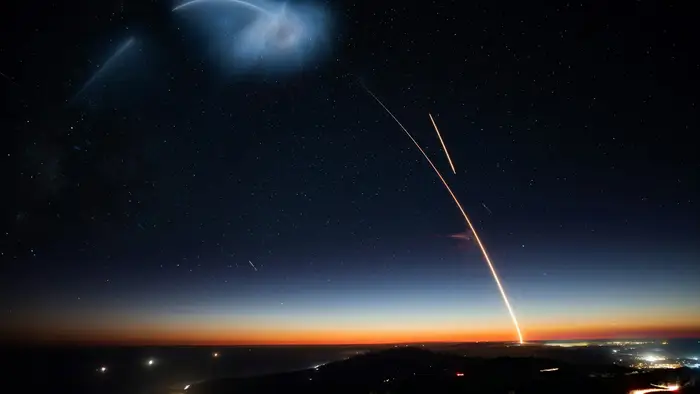
The geometry also made the flybys a brief public spectacle. In the hours before each burn, the spacecraft should have been visible from the ground in the western United States, appearing as faint points drifting slowly against the stars, bright enough to need a telescope to spot. Blue was likely brightest for the western United States between midnight and 1 a.m. PST in the early morning of November 7; Gold between 1 and 2 a.m. PST on November 9. At closest approach, each spacecraft passed between 600 and 1,100 miles above Earth’s surface — higher than most Earth-orbiting satellites — and fired its engine as it flew over southern Australia, where the burns began at 4:51 a.m. EST on November 7 and 5:51 a.m. EST on November 9.
What the Twin Probes Will Do at Mars
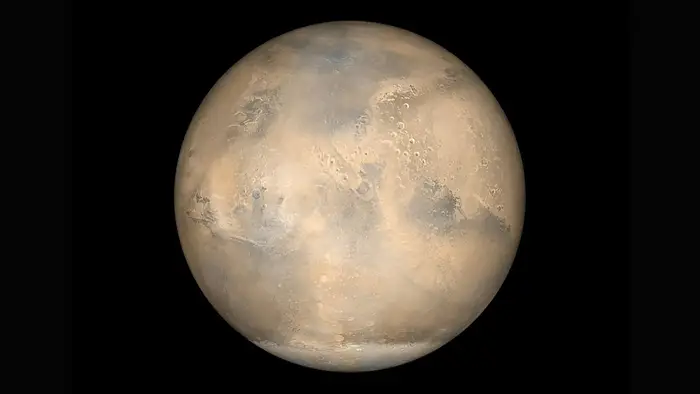
Getting to Mars is only half the mission. Once there, ESCAPADE will become the first multi-spacecraft mission to fly in formation around the planet, and the first science mission to choreograph two orbiters around Mars. That formation flying is the whole point of sending two spacecraft instead of one.
ESCAPADE’s science target is the solar wind — the million-mile-per-hour stream of charged particles flowing outward from the Sun — and what it does to Mars. Mars once had a thick atmosphere and liquid water on its surface. Today its air is thin, and one of the leading explanations is that the solar wind has been stripping it away for billions of years, because Mars lacks the strong global magnetic field that shields Earth. ESCAPADE will study how the solar wind interacts with the Martian environment and how that interaction drives atmospheric loss.
A single spacecraft can only measure the solar wind in one place at one time. Two spacecraft, flying in coordinated formation, can measure what is arriving from the Sun and what Mars is doing in response, simultaneously, from two different locations. That is the measurement no earlier Mars mission has been able to make. “This will be the first science mission to choreograph two orbiters around Mars, and the first time we will be able to make coordinated observations of the Martian environment from two different locations simultaneously,” said Lillis.
The science campaign will unfold in stages. After the September 2027 arrivals, the two spacecraft will take several months to maneuver into their first science formation, in which they will follow one another in the same orbit to study how the planet’s environment changes with time and location. Science operations are expected to begin in June 2028. About six months later, the pair will shift into different orbits: one will travel farther from Mars to observe the incoming solar wind, while the other stays closer to the planet to study how Mars responds to the solar wind in real time. That two-point campaign is scheduled to last five months.
“By better understanding how the solar wind affects the Martian environment, ESCAPADE’s findings could help us plan and prepare for future human exploration of the Red Planet,” said Michele Cash, ESCAPADE program scientist at NASA Headquarters. Mars has been a focus of intense activity in recent years, from Perseverance’s record-breaking 45-kilometer drive across Jezero Crater to the debate over the cancelled Mars Sample Return program and China’s rival plans — and understanding the radiation and atmospheric environment astronauts will face is a prerequisite for any crewed landing.
Timeline: ESCAPADE’s Long Road to Mars
- November 13, 2025 — ESCAPADE launches aboard Blue Origin’s New Glenn rocket from Launch Complex 36 at Cape Canaveral Space Force Station, Florida, with Earth and Mars on opposite sides of the Sun.
- November 2025 – November 2026 — The twin spacecraft fly a kidney-bean-shaped loiter orbit around the Earth-Sun Lagrange point 2, about a million miles from Earth, and make bonus science observations flying through Earth’s magnetotail.
- November 7, 2026, 5 a.m. EST — Blue completes its powered Earth flyby, firing its engine for about nine minutes at roughly 1,000 miles above Earth, and departs for Mars.
- November 9, 2026, 6 a.m. EST — Gold completes its powered Earth flyby, firing its engine for about nine minutes at roughly 650 miles above Earth, and departs for Mars.
- November 9, 2026 — NASA confirms both maneuvers succeeded, the first powered Earth flybys ever used to send spacecraft to Mars.
- November 2026 – September 2027 — Ten-month cruise to Mars, with a series of trajectory correction maneuvers to fine-tune the course.
- September 7, 2027 — Blue fires its engine for about 11 minutes to enter orbit around Mars.
- September 9, 2027 — Gold follows with its own roughly 11-minute Mars orbit insertion burn.
- Late 2027 – June 2028 — The spacecraft maneuver into their first science formation, following one another in the same orbit.
- June 2028 — Science operations begin.
- Late 2028 — The pair shift into different orbits for a five-month campaign measuring the solar wind and Mars’s response simultaneously from two locations.
Bonus Science on the Way Home
ESCAPADE’s long detour was not wasted time. During the loiter orbit, the spacecraft flew multiple times through Earth’s magnetotail — the part of our planet’s magnetic environment that gets stretched away from Earth, opposite the Sun, by the solar wind. No spacecraft had directly explored that distant region of the magnetotail before. Mission scientists report that ESCAPADE observed some interesting activity and structure there and are planning to share those findings soon.
The cruise to Mars will bring more. During the ten-month trip, the spacecraft will also be able to study the dynamics of the solar wind in the space between Earth and Mars — measurements that are useful in their own right, since the solar wind between the planets is the same stream that will buffet every future Mars-bound crew. The mission team will need several days after the flyby burns to assess exactly how well the spacecraft are aimed for Mars, and will use a series of trajectory correction maneuvers during the cruise to keep them on a precise course for the September 2027 rendezvous.
A Small Mission With an Outsized Idea
ESCAPADE is deliberately modest. The twin spacecraft have a total cost of under $80 million — a fraction of the billion-dollar flagship missions that usually dominate Mars exploration. It is funded by NASA’s Heliophysics Division and belongs to the agency’s SIMPLEx program, which supports missions that explore the solar system in innovative ways with smaller budgets. The University of California, Berkeley’s Space Sciences Laboratory leads the mission, with key partners Rocket Lab, which designed and built the spacecraft; NASA’s Goddard Space Flight Center in Greenbelt, Maryland; Embry-Riddle Aeronautical University; Advanced Space, which designed the trajectory; and Blue Origin, which launched the pair on the New Glenn rocket’s early flights.
That structure — a university-led mission, a commercially built spacecraft, a commercial launch vehicle, and a new trajectory that decouples the launch date from the planetary alignment — is itself a statement about where space exploration is heading. ESCAPADE was financed by NASA but executed almost entirely by the private sector and academic partners, at a price that would have been unthinkable for a two-spacecraft Mars mission a generation ago. If it succeeds at Mars, it will not only answer questions about the solar wind and atmospheric loss. It will also demonstrate that a small, cheap, flexibly launched mission can do first-class planetary science — and that the calendar of the planets no longer has to dictate the calendar of the missions we send to them.
The same appetite for ambitious small missions is visible elsewhere in Mars exploration, from Japan’s MMX mission, which aims to bring back the first samples from a Martian moon to the next generation of orbiters and landers now in development. ESCAPADE’s contribution is a navigational one: a proof that you can leave Earth whenever you are ready, wait patiently in the dark a million miles out, and then let Earth itself throw you toward Mars.
What Happens Next
For now, the two spacecraft are silent travelers, coasting toward a planet they will not reach for ten months. The mission team will spend the coming days confirming the precise aim of the trajectories the flybys set, then settle into the long routine of cruise operations: tracking, course corrections, instrument checkouts, and solar wind measurements along the way.
The next major milestone is not a maneuver but a date: September 7, 2027, when Blue must fire its engine for about 11 minutes to be captured into Mars orbit, followed by Gold on September 9. If those burns go as flawlessly as the Earth flybys did, the real science begins — two small spacecraft, flying in formation around another world, watching the solar wind arrive and watching Mars answer, at the same time, from two places at once.
A year ago, ESCAPADE left Earth at the worst possible moment, with Mars on the far side of the Sun. It waited a year in the dark, came home for a final push, and is now on its way. That is not just a clever trajectory. It is a reminder that in spaceflight, patience and physics can substitute for brute force — and that sometimes the best way to leave home is to come back first.

Sources
- NASA: NASA’s ESCAPADE Completes Powered Earth Flybys, Now En Route to Mars
- NASA: NASA’s Twin ESCAPADE Spacecraft to Slingshot Past Earth on Way to Mars
- EarthSky: ESCAPADE mission to fly past Earth twice in 2 days
- TechTimes: NASA’s Twin ESCAPADE Probes Complete First-Ever Powered Earth Flybys to Mars