ISS Seventh Solar Array Spacewalk October 29: Menon and Kutryk Deploy the Penultimate iROSA
High above Earth, with the planet rolling past in alternating bands of daylight and darkness, two astronauts finished a job more than five years in the making — almost. NASA astronaut Anil Menon and Canadian Space Agency astronaut Joshua Kutryk stepped back inside the International Space Station on Thursday, October 29, after installing and deploying the station’s seventh roll-out solar array, a 63-foot wing of photovoltaic power that unrolled itself in orbit like a carpet shaken out in slow motion. The spacewalk lasted 7 hours and 11 minutes, ended at 3:08 p.m. EDT, and left exactly one array still to fly: the eighth and final wing, scheduled for installation on November 5 by the same two astronauts. When that last wing deploys, the station’s long power upgrade will be complete, and the orbiting laboratory will carry the full electrical capacity it needs for its final years of science — and for its carefully planned farewell at the end of the decade.
It was, by NASA’s own accounting, a milestone outing in more than one sense. The October 29 excursion was designated U.S. spacewalk 100, the hundredth American spacewalk from the station without a space shuttle docked to the complex, and the 285th spacewalk overall in support of station assembly, maintenance, and upgrades. For Menon, it was his fourth spacewalk. For Kutryk, it was his first — and the beginning of a remarkable debut fortnight in orbit, with two spacewalks in eight days on his first spaceflight. By the time the pair repressurized the Quest airlock, Mission Control’s verdict was already in. “The spacewalk was essentially flawless,” NASA commentator Rob Navias said, a judgment that will sound almost understated to anyone who has watched an astronaut wrestle a 750-pound piece of hardware into place while wearing gloves thick enough to turn every bolt into a small negotiation.

Menon and Kutryk installed the seventh roll-out solar array on the station’s 2A power channel during the October 29 spacewalk. Image: Unsplash.
Seven hours, one wing, no wasted motion
The spacewalk began the way all of them do: with a switch from airlock power to the batteries in the astronauts’ suits. Menon, 50, and Kutryk, 44, switched their spacesuits to battery power at 7:57 a.m. EDT, the moment NASA counts as the official start of an extravehicular activity. From there, the timeline unfolded with the steady rhythm of a plan rehearsed for months in swimming pools and virtual mock-ups on the ground, then executed 250 miles up at five miles per second.
The first job was to free the array itself. The new wing had arrived at the station earlier in October tucked inside the unpressurized trunk of a SpaceX Dragon cargo capsule, on the company’s 35th resupply mission for NASA, and it had been parked on a temporary stowage platform ever since. Rolled up for launch, the assembly measured just 10 feet long, 2 feet wide, and 4 feet tall — a compact bundle that concealed a 63-foot wing. Menon and Kutryk worked together to unbolt it from the platform, a task that sounds simple and is anything but: every bolt must be captured, every tool tethered, because anything dropped in orbit does not fall to the ground but drifts away to become a hazard, or a lost piece of a puzzle that cannot be reordered from a warehouse.
Then came the journey to the worksite, and it showed off the station’s most famous piece of equipment. Menon secured himself to the end of the Canadarm2 robotic arm and rode it, carrying the 340-kilogram array, out to the station’s port side. Kutryk made his own way there along the station’s backbone truss, hand over hand along the structure that carries the station’s power, cooling, and communications. The two routes — one astronaut delivered by robot arm, the other climbing the truss — converged at the P4 truss worksite, where a mounting bracket installed by astronauts during a March spacewalk was waiting for the new wing. By about three hours and 13 minutes into the spacewalk, the pair had the array bolted into place on the station’s 2A electrical power channel.
The electrical connections demanded patience of a particular kind. Menon and Kutryk connected the array’s cables to tie it into the station’s power system during a night pass, when the station was in Earth’s shadow. The timing was deliberate: working in darkness reduces the risk associated with live electrical connections in sunlight, when the arrays are generating power. It is one of those details that captures what spacewalking actually is — not just daring, but choreography, with orbital mechanics setting the schedule and the astronauts working inside it.
And then, four hours and 23 minutes into the spacewalk, came the moment everyone had been waiting for. “And we see the iROSA deploying now,” Mission Control reported, as the rolled-up wing began to unroll. No motor drove the deployment. The potential energy stored in the assembly’s rolled-up carbon composite booms was enough, on its own, to unfurl the panel to its full 63-foot length. About twelve minutes later, the array had fully extended, draping itself over roughly half of the larger but less capable legacy panel beneath it on the P4 truss. Engineers and electrical officers in Mission Control, watching the telemetry, were pleased with what they saw. The new wing was in place, deployed, and feeding the station’s grid.
The pair finished the array work far enough ahead of NASA’s planned timeline that they could move on to what spacewalk planners call “get-ahead tasks” — preparatory work for the next outing. In this case, that meant getting a head start on the November 5 spacewalk, when Menon and Kutryk will go out again to install the eighth and final array. Finishing early is not a luxury on a spacewalk; it is the margin that turns a good day into a great one, and on October 29, the margin was real. At 3:08 p.m. EDT — 2:08 a.m. WIB on Friday, October 30 — the two astronauts began repressurizing the Quest airlock, ending an outing that had run 7 hours and 11 minutes without a serious hitch.
ISS Final Solar Array Spacewalk October 29: Menon and Kutryk to Finish the Station’s Power Upgrade
Why the seventh wing matters more than it looks
A single solar array, however elegant, might seem like a small addition to a station that already has eight original arrays and six roll-out wings. The reality is almost the opposite. The station’s eight original arrays are showing degraded power output, and they have exceeded their 15-year design life. They were built for a station expected to fly for a shorter time, and they have kept flying far beyond it — a triumph of engineering that nevertheless has a physical limit. Solar cells degrade under years of radiation, thermal cycling, and micrometeoroid wear, and the original wings no longer produce what they once did.
The roll-out arrays solve that problem without replacing anything. Each iROSA is mounted in front of, and partially covering, one of the legacy arrays, and the two work in tandem: sunlight that passes the new wing still reaches parts of the old one, and the combined output is greater than either could manage alone. Used together, the new arrays have increased the station’s power supply by 20 to 30 percent, according to NASA and independent reporting of the program. That extra power is not decorative. It runs the science racks, the life-support systems, the communications gear, and the commercial experiments that now share the station. And, crucially, it supports the station’s planned end: a safe and controlled deorbit currently scheduled for 2030, an operation that will demand reliable power and communications all the way down.
The numbers tell the story of the whole program. Before the upgrade, the station’s available power stood at about 160 kilowatts. Once all eight roll-out arrays are installed, NASA expects that figure to rise to approximately 215 kilowatts — an increase of up to 30 percent across the full system. That is a system-level projection for the completed augmentation, not a claim about any single wing. The seventh wing, installed on October 29, is the penultimate piece of that puzzle: after November 5, the augmentation will be complete, and the station will enter its final years with the power margin its planners intended.
There is also a quieter significance to finishing a job that began in 2021. The iROSA program has unfolded across multiple crews, multiple spacewalks, and multiple cargo deliveries, each one adding a wing to a structure that was never designed to be rebuilt in flight. Every installation has required astronauts to work on a truss built in the early 2000s, using brackets, bolts, and cables that had to be compatible with hardware designed decades earlier. Completing the seventh installation — and preparing the eighth — is proof that the station can still be upgraded in place, late in its life, by crews who were not yet astronauts when the first arrays were launched. For a program now planning its own retirement, that is a useful thing to demonstrate: the station is not merely being kept alive, it is still being improved.
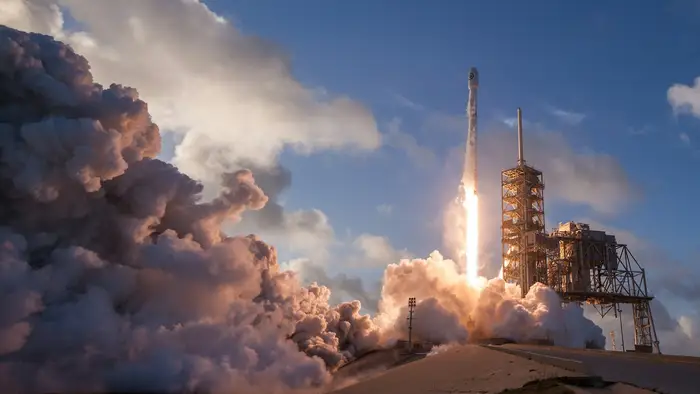
The new array arrived at the station inside a SpaceX Dragon cargo capsule on the company’s 35th resupply mission earlier in October. Image: Unsplash.
The 100th U.S. spacewalk, and the two men who made it
Milestone numbers can feel abstract until you attach them to people. The October 29 outing was the 100th U.S. spacewalk from the station without a space shuttle docked to the complex — a count that begins after the shuttle era, when station spacewalks became a purely station-based affair, launched from the Quest airlock rather than from a visiting orbiter. Counted more broadly, including spacewalks by all partner agencies in support of station assembly, maintenance, and upgrades, it was the 285th. And the successful outing brought NASA’s cumulative spacewalk time outside the station, since assembly began in 1998, to 75 days, 7 hours, and 14 minutes. It was also the eighth spacewalk of 2026, in a year that has already seen an unusually busy extravehicular schedule.
For Menon, the outing added to a spacewalking career that has accelerated quickly. It was his fourth spacewalk, bringing his total time outside to 26 hours and 31 minutes — all of it logged since he arrived at the station aboard a Russian Soyuz spacecraft in July. That pace is remarkable on its own: four spacewalks in a single expedition, each one building on the last, with the astronaut moving from preparing hardware to installing it. Menon had already worked on the station’s truss in earlier outings, and on October 29 he carried the array itself, riding the robotic arm like a crane operator who is also the load.
For Kutryk, the day was a debut in the fullest sense. It was his first spacewalk, and it made him the fifth Canadian astronaut to walk in space, following Chris Hadfield, Steve MacLean, Dave Williams, and David Saint-Jacques — and the first Canadian to do so since Saint-Jacques’s spacewalk in 2019. Kutryk arrived at the station on October 1 aboard a SpaceX Crew Dragon capsule, as part of the Crew-13 mission, and within a month he was outside, working on the station’s power system alongside a crewmate on his fourth outing. That pairing — a veteran and a rookie, sharing a worksite — is one of the oldest patterns in spacewalking, and one of the most effective: experience steadies the newcomer, and the newcomer brings the fresh eyes that catch what familiarity misses.
The two men are Expedition 75 crewmates, and their partnership will continue in less than a week. The November 5 outing, designated U.S. spacewalk 101, will send the same pair out again to install the eighth and final array. Two spacewalks in eight days, by the same two astronauts, to finish the same project, is an efficient way to close out a program — and a demanding one. The crew must recover, rest, reconfigure suits, and review a new set of procedures, all while the station continues its normal operations around them. That they finished the first outing ahead of schedule, with get-ahead tasks already complete, is the best possible preparation for the second.
How a roll-out array unfurls without a motor
The most counterintuitive part of the October 29 story is also the most elegant: the new wing deployed itself. There was no motor, no crank, no astronaut pulling a cord. The array’s carbon composite booms, rolled tightly for launch, stored enough potential energy in their coiled shape to unroll the panel once released — a bit like a window blind that opens itself, except that the blind is 63 feet long, weighs hundreds of pounds, and must deploy perfectly the first time, because there is no second chance to re-roll it in orbit.
That design is what makes the iROSA program possible at all. A rigid solar panel of the same size would never fit inside a Dragon’s trunk, and a folding panel of the traditional kind would need hinges, motors, and latches — each one a potential failure point. The roll-out design trades mechanisms for materials science: the booms are the structure, the spring, and the deployment system all at once. When Menon and Kutryk released the array, physics did the rest, and twelve minutes later a wing that had traveled to orbit as a bundle barely larger than a rolled carpet was spread across the station’s truss, catching sunlight.
The rest of the installation was deliberately old-fashioned by comparison: bolts, cables, and brackets. The array was mounted on a bracket installed during a March spacewalk, a reminder that space station construction is a relay race across expeditions. One crew installs the bracket; a later crew installs the array; a still later crew, or the same crew a week later, connects the final pieces. The electrical cables, connected during a night pass for safety, tied the new wing into the 2A channel’s power system, where it now works alongside the legacy array it partially covers. Nothing about the process was flashy. That was the point. The flashiest part of a spacewalk is usually the part that went wrong, and on October 29, nothing did.
It is worth pausing on the scale of the hardware, because numbers on a page rarely convey it. The rolled assembly weighed 750 pounds — more than three adult humans, carried by one astronaut riding a robotic arm while another climbed a truss to meet him. Unrolled, it stretched 63 feet, longer than a bowling lane, draped over about half of a legacy panel that is itself larger than the new wing. Working with objects of that size, in suits that pressurize like balloons and gloves that blunt the sense of touch, is the daily reality of station maintenance. That Menon and Kutryk did it ahead of schedule, and then started on next week’s work, is why Mission Control reached for the word “flawless.”

The array deployed without a motor, unrolling to its full 63-foot length on the stored energy of its carbon composite booms. Image: Unsplash.
One wing to go: what happens on November 5
The next chapter is already scheduled, and it is the one that completes the story. On Thursday, November 5, Menon and Kutryk will go out again to install the eighth and final roll-out solar array, this time on the station’s 3B power channel. NASA has said it will provide live coverage beginning at 6:45 a.m. Eastern time that morning, and the get-ahead tasks completed on October 29 were designed to make the second outing smoother than the first. The pattern will be familiar: unbolt a rolled wing from its stowage platform, carry it to the worksite, bolt it to its bracket, connect its cables, and watch it unroll. Familiar, however, does not mean routine — every spacewalk carries its own risks, and the final installation will be watched as closely as the seventh was.
When the eighth wing deploys, the roll-out arrays will be fully installed, and the station’s power system augmentation will be complete. The full system will then be rated at approximately 215 kilowatts of available power, up from about 160 kilowatts before the upgrade — the increase of up to 30 percent that NASA has projected for the completed program. That capacity will support the station’s remaining science, its commercial activities, and the complex choreography of its eventual deorbit, in which the station must remain powered and communicative while it is guided to a controlled reentry over an uninhabited stretch of ocean.
There is a broader lesson in the timing. The station is often described as aging, and it is — its oldest modules have been in orbit for more than a quarter century, and its original solar arrays have outlived their design life. But the October 29 spacewalk showed a station still being actively improved, not merely maintained. A power system upgraded in 2026, by a crew that includes an astronaut on his first spaceflight, for a station scheduled to retire in 2030, is an investment in the quality of the station’s final years. The science done in those years — in materials, medicine, Earth observation, and fundamental physics — will depend on the power installed this week and next.
The November 5 outing will also close a particular loop in Canadian space history. Kutryk’s first spacewalk on October 29 ended a seven-year gap since the last Canadian excursion, and his second, a week later, will make him one of the few astronauts of any nationality to log two spacewalks on a first flight. For the Canadian Space Agency, which built the robotic arm that carried Menon and his array to the worksite, the symmetry is neat: a Canadian astronaut, delivered in part by a Canadian robot, installing the penultimate piece of an American-led station’s power upgrade, with one more to go.
One More Step: Meir and Menon’s 6.5-Hour Spacewalk Completes the ISS Solar Upgrade Puzzle
The quiet work behind a flawless day
Spacewalks look like the work of two people. They are, in fact, the work of hundreds. Inside the station, crewmates operated the robotic arm and monitored the suits. In Houston, flight controllers tracked every bolt, cable, and timeline margin, and called out the deployment the moment it began. On the ground, engineers who designed the roll-out arrays years ago watched their hardware unfurl for the seventh time, each deployment a small vindication of a design that asks materials to do the work of machines. And in the months before the spacewalk, Menon and Kutryk rehearsed the outing in neutral-buoyancy pools, in virtual reality, and in the station’s own airlock, cleaning cooling loops, filling suit tanks, and preparing the garments that keep astronauts alive outside.
That preparation is why a 7-hour, 11-minute spacewalk can end ahead of schedule. The astronauts knew where every bolt was, where every cable ran, and what the next task would be before the current one was finished. They knew that the array’s cables would be connected in darkness, that the deployment would take about twelve minutes, and that the get-ahead tasks for November 5 were waiting if time allowed. When time did allow, they took them — the unglamorous, essential work of making the next hard day easier.
It is also why the phrase “essentially flawless” matters. Spaceflight has a habit of punishing complacency, and no one in Mission Control uses words like that lightly. A flawless spacewalk is not one in which nothing was difficult; it is one in which every difficulty was anticipated, trained for, and handled without drama. The October 29 outing had its difficulties — a 750-pound bundle, a robotic arm ride, a night-pass electrical connection, a self-deploying wing that had to work the first time — and it handled all of them. That is the standard the November 5 crew, who happen to be the same two people, will carry back outside with them.

After November 5, the station’s eight roll-out arrays will lift its available power from about 160 kilowatts to approximately 215 kilowatts. Image: Unsplash.
A station still building itself
When Menon and Kutryk repressurized the Quest airlock at 3:08 p.m. EDT on Thursday, they closed the hatch on more than a successful spacewalk. They closed it on the penultimate step of a power upgrade that began in 2021, that survived the station’s transition from construction to commercial era, and that will define what the station can do in its final years. One wing remains. One more spacewalk, one more unrolling, one more set of cables connected in the dark — and then the station will carry, for the first time, the full power system its planners designed for its old age.
There is something fitting about the way this upgrade ends: not with a launch, not with a docking, but with two astronauts outside, finishing a job by hand. The International Space Station was built that way, piece by piece, spacewalk by spacewalk, and it is being finished that way too. The seventh wing now catches sunlight over the P4 truss, draped across the legacy panel it was built to assist. The eighth is already at the station, waiting for November 5. And when it unrolls, the station that has spent more than 25 years teaching humanity how to live and work in orbit will have one more lesson to offer: that even in its final years, it is still, quite literally, building itself a brighter future.

The station’s upgraded power system will support its final years of science and its planned controlled deorbit in 2030. Image: Unsplash.