WISPIT 2c Second Planet Forming: Two Giant Worlds Growing Around a Young Sun
For the first time in the history of astronomy, scientists can watch two planets being born at the same time around the same star — and the view is changing how they think planetary systems are built. Around a star only about five million years old, a young twin of our own Sun, two gas giants are still gathering mass from the disc of gas and dust that surrounds them, each carving its own lane through the raw material of future worlds. The younger sibling, a world called WISPIT 2c, was confirmed by the European Southern Observatory’s telescopes in 2026, and its discovery turns a remarkable single find into something rarer still: a whole planetary system caught in the act of forming.
The announcement, issued by ESO in March 2026, described a system that looks like a snapshot of our own Solar System’s infancy. WISPIT 2 is ringed by a spectacular multi-ringed disc of dust and gas stretching roughly 380 times wider than the distance between Earth and the Sun. Inside that disc, the first newborn planet, WISPIT 2b, was found in August 2025, glowing in infrared light as it fed on hydrogen gas. Now a second planet has been confirmed closer to the star, about twice as massive as the first, and the pair together make WISPIT 2 only the second system ever found — after PDS 70 — in which two planets have been directly observed while still forming. “WISPIT 2 is the best look into our own past that we have to date,” said Chloe Lawlor, a PhD student at the University of Galway in Ireland and lead author of the study published in The Astrophysical Journal Letters.
That comparison to our own past is what makes the system so compelling. The Solar System is 4.5 billion years old, and the story of how its planets assembled has to be reconstructed from the finished product: the sizes and orbits of the planets we see today, the chemistry locked into meteorites, and the computer models that try to rewind the clock. WISPIT 2 offers something no model can — a live laboratory, five million years into its history, where the construction work is still under way and the builders are visible. “WISPIT 2 gives us a critical laboratory not just to observe the formation of a single planet but an entire planetary system,” said Christian Ginski, a co-author of the study and researcher at the University of Galway.
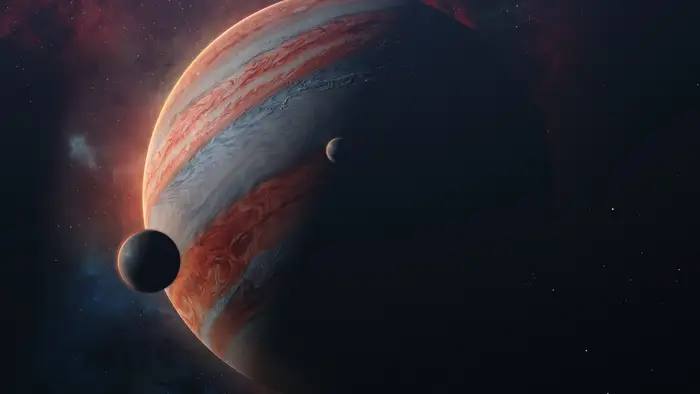
An artist’s impression of a gas-giant planet with moons. Image: Unsplash.
A Second World Emerges From the Glare
Finding WISPIT 2c was, by the discoverers’ own account, a problem of glare. The planet orbits only about 14 astronomical units from its star — roughly the distance of Saturn from the Sun, and four times closer in than its sibling — which puts it uncomfortably near the blazing light of the young star. The star outshines its planet by a factor of about a thousand, and at that separation the planet’s faint glow is easily swallowed entirely. It took the upgraded GRAVITY+ instrument on ESO’s Very Large Telescope Interferometer (VLTI) in Chile to pull the signal out of the starlight at all. “Critically our study made use of the recent upgrade to GRAVITY+ without which we would not have been able to get such a clear detection of the planet so close to its star,” said Guillaume Bourdarot, a study co-author and researcher at the Max Planck Institute for Extraterrestrial Physics (MPE) in Garching, Germany.
The hunt had begun with hints. After WISPIT 2b was discovered, follow-up observations led by the University of Galway picked up signs of an additional object near the star, first spotted with the University of Arizona’s MagAO-X instrument on the 6.5-metre Magellan Telescopes in Chile and the University of Virginia’s LMIRcam on the Large Binocular Telescope Interferometer in the United States. Those hints were not enough on their own: a smudge of light near a bright star can be many things, and a planet claim needs proof. The team turned to two of ESO’s most powerful tools. The SPHERE instrument on the Very Large Telescope captured an image of the object, and then GRAVITY+ on the VLTI confirmed that it was indeed a planet, measuring its light with the precision that only interferometry — combining the light of multiple telescopes into a single, far sharper view — can deliver.
The numbers that emerged describe a heavyweight. WISPIT 2c is about twice as massive as WISPIT 2b, putting it at roughly ten times the mass of Jupiter, and it orbits at about a quarter of its sibling’s distance from the star. That combination — more massive, yet closer in — is exactly what made it so hard to see: a bigger planet should be brighter, but proximity to the star more than cancels the advantage. “WISPIT 2 will become a unique laboratory for studying planetary formation,” Bourdarot said. “By combining interferometric precision with new adaptive optics, we were able to measure a signal that had previously been completely hidden in the starlight. This is a clear example of how the development of cutting-edge astronomical instruments leads to fundamental discoveries.”
WISPIT 2b: The First Baby Giant
The story of WISPIT 2 began a year earlier, in August 2025, when researchers from the University of Galway, Leiden Observatory and the University of Arizona announced the discovery of the first planet in the system. The host star sits at the centre of a dusty disc about 380 times wider than the distance between Earth and the Sun, and the team had gone looking for planets in such discs — but the disc they found was more spectacular than expected, patterned with distinct rings and gaps. Inside one of those gaps glowed WISPIT 2b, a gas giant about five times the mass of Jupiter, orbiting its star at about 57 astronomical units, or roughly ten times the distance between the Sun and Jupiter.
What made WISPIT 2b special was not just its existence but the evidence that it was still being built. The VLT’s SPHERE instrument revealed the young planet as a glowing dot in near-infrared light, still hot from its formation. Then the Magellan telescope in Chile detected hydrogen gas falling onto it — the unmistakable signature of a world still accreting, still pulling in the material that will become its atmosphere. It was the first unambiguous detection of a planet inside a multi-ringed disc, and only the second planet ever confirmed at such an early evolutionary stage around a Sun-like star. “This detection of a new world in formation really showed the amazing potential of our current instrumentation,” said Richelle van Capelleveen, a PhD student at Leiden Observatory in the Netherlands who led the earlier study.
The disc itself told the same story as the planet. Protoplanetary discs are the leftover clouds of gas and dust from a star’s birth, and theory has long held that the gaps in them are carved by newborn planets sweeping up material as they orbit. WISPIT 2b was caught doing exactly that, sitting in a gap of its own making, with the remaining dust piled into rings around it. The discovery helped confirm a long-standing prediction: that the dark lanes astronomers had been mapping in discs for years really are the footprints of unseen worlds. But one planet, however convincing, still leaves a question open — whether systems form their planets one at a time, or all at once. WISPIT 2c answered it.

A luminous nebula glowing among the stars. Image: Unsplash.
Two Planets, One Disc: The System in Numbers
The value of WISPIT 2 lies in the precision with which its parts can now be measured. Two planets, two gaps, one disc — and every figure comes from direct observation rather than inference. The table below gathers the key measurements reported by the discovery team and the observatories behind it.
| Feature | Measurement |
|---|---|
| Host star WISPIT 2 | About 5 million years old; a young version of our Sun |
| Protoplanetary disc | About 380 times the Earth–Sun distance across, with multiple rings and gaps |
| WISPIT 2b mass | About 5 times the mass of Jupiter |
| WISPIT 2b orbit | About 57 astronomical units from the star (10× the Sun–Jupiter distance) |
| WISPIT 2b discovered | August 2025 |
| WISPIT 2c mass | About 10 times the mass of Jupiter (twice WISPIT 2b) |
| WISPIT 2c orbit | About 14 astronomical units from the star (4× closer than WISPIT 2b) |
| WISPIT 2c confirmed | 2026, announced by ESO on 24 March 2026 |
| Star-to-planet brightness | Star about 1,000 times brighter than WISPIT 2c |
| Suspected third planet | Possibly about Saturn mass, in a smaller gap farther out |
| Systems with two forming planets seen directly | Two: PDS 70 and WISPIT 2 |
Those numbers sketch a system that is both familiar and strange. The masses are Jovian — both worlds are gas giants, like the outer planets of our own Solar System — but their arrangement is not. WISPIT 2b sits far beyond where Jupiter sits relative to the Sun, while WISPIT 2c occupies roughly Saturn’s distance and outweighs its sibling twofold. In our Solar System, Jupiter is the heavyweight and Saturn the lighter, more distant companion; in WISPIT 2 the order is reversed, with the heavier planet tucked closer in. That difference is part of the point. If planets can assemble in more than one configuration, then the Solar System’s layout is one outcome among many, and watching a different outcome take shape is the only way to learn which parts of the story are universal and which are accident.
The disc’s scale is equally striking. At roughly 380 astronomical units across, it is far more extended than the region of our Solar System that holds the planets, and its rings and gaps are laid out like a target. Each gap marks a place where a planet has cleared its orbit, sweeping dust and gas into its own growing bulk and leaving a dark lane behind. The two confirmed planets each sit in a clear gap of their own — the strongest possible evidence that the gaps are planetary work, not some trick of the disc’s own physics. And there is at least one more gap, smaller and farther out, that no known planet explains. “We suspect there may be a third planet carving out this gap,” Lawlor said, “potentially of Saturn mass owing to the gap’s being much narrower and shallower.” If that world exists, it would make WISPIT 2 a three-planet nursery — and a near-complete model of how a system like ours gets built.
A Timeline of Discovery
The WISPIT 2 story has unfolded quickly by astronomical standards, from a surprising disc to a confirmed two-planet system in under a year. The milestones below trace how the picture came together.
How WISPIT 2 Was Revealed
- August 2025 — Researchers from the University of Galway, Leiden Observatory and the University of Arizona discover WISPIT 2b, a gas giant about five times Jupiter’s mass, inside a gap in the system’s multi-ringed disc. Magellan observations detect hydrogen gas falling onto the planet, confirming it is still forming.
- Late 2025 — Follow-up observations led by the University of Galway pick up hints of an additional object near the star, spotted with MagAO-X on the Magellan Telescopes and LMIRcam on the Large Binocular Telescope Interferometer.
- 2026 — ESO’s SPHERE instrument images the new object, and the upgraded GRAVITY+ instrument on the VLTI confirms its planetary nature, measuring its faint light despite the star shining about a thousand times brighter.
- 24 March 2026 — ESO announces the discovery of WISPIT 2c in press release eso2604, and the study appears in The Astrophysical Journal Letters. WISPIT 2 becomes only the second system, after PDS 70, with two planets directly observed while forming.
- Coming years — Further study with ESO’s Very Large Telescope and GRAVITY+, and eventually the MICADO instrument on the Extremely Large Telescope, aims to confirm the suspected Saturn-mass third planet and watch the system evolve.
Why Two at Once Matters
Until WISPIT 2, PDS 70 stood alone. That system, around a young star in the constellation Centaurus, was the only one where astronomers had directly watched two planets forming at the same time, and a single example can always be a fluke. A second example changes the question. It suggests that multi-planet formation is not an oddity but something telescopes are now capable of catching whenever they look in the right place with the right instruments — and that the Solar System’s own history, in which several giant planets grew side by side, may be the normal way of things rather than the exception.
Frank Eisenhauer, Director of the Infrared Group at the Max Planck Institute for Extraterrestrial Physics and project leader of GRAVITY+, put it in terms that reach back to the beginning of our own system. “Finding two planets at such an early stage at the same time is almost like witnessing a rare twin birth,” he said. “This shows that planetary systems do not develop one after the other, but in parallel — much like our own Solar System once did.” The point is about timing. In the classic picture of planet formation, a disc cools and clumps, a core grows, gas falls in, and one planet emerges before the next begins. WISPIT 2 shows two giants growing in parallel, each in its own gap, at the same time, in the same disc. That parallelism matters because it changes how the planets interact: they compete for the same gas, they shape the same rings, and their gravity sculpts the disc together rather than in sequence. A system built in parallel may end up looking very different from one built in series, and only by catching systems mid-assembly can astronomers tell which path nature actually took.
The comparison with PDS 70 also sharpens what is new here. PDS 70’s disc is compact and its planets are the headline; WISPIT 2’s disc is far more extended, with distinctive gaps and rings spread across a much larger canvas, and it is that structure that hints at more worlds still to come. “These structures suggest that more planets are currently forming, which we will eventually detect,” Lawlor said. In other words, WISPIT 2 is not just a second PDS 70 — it is a bigger, richer laboratory, one whose disc still holds unanswered questions in the form of gaps with no known planet inside them.
That laboratory also speaks to a broader question that has driven exoplanet science for three decades: why do planetary systems look so different from one another? Surveys have found systems with hot Jupiters hugging their stars, systems with planets packed tighter than Mercury’s orbit, and systems that look, at a glance, like ours. SpaceNews has covered that diversity before, from the two distinct families of planetary systems that astronomers recently traced to the mass and chemistry of their host stars, to the dust-shrouded wreckage of colliding worlds in Beta Pictoris Cat’s Tail, where Hubble confirmed the aftermath of two dwarf planets smashing together. WISPIT 2 belongs to the earliest chapter of that story — the chapter before the planets have finished forming, before collisions and migrations have rearranged everything, when the raw architecture is still visible. It is the chapter that is hardest to observe and, for that reason, the one that has the most left to teach.
The Suspected Third Planet
The most tantalising detail in the WISPIT 2 system is the one that has not been confirmed at all. Beyond the gaps occupied by WISPIT 2b and WISPIT 2c, the disc carries at least one smaller gap, farther out, with no planet yet seen inside it. The gap is narrower and shallower than the other two, and that shape is itself a clue: a smaller, lighter planet would carve a narrower, shallower lane than a giant. Lawlor’s team suspects the culprit is a world of roughly Saturn’s mass, still hidden in the dust, waiting for a sharper eye.
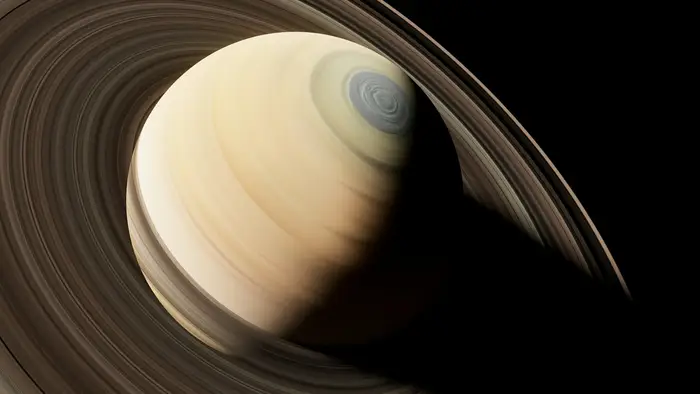
Saturn and its rings. Image: Unsplash.
If that third planet is real, the resemblance to our Solar System sharpens further: two gas giants already confirmed, a possible Saturn-mass world farther out, all of them forming in parallel inside a single disc around a Sun-like star. It would be the closest thing astronomers have ever seen to a Solar System under construction — not a finished system to be reverse-engineered, but a live one to be watched. And the team is candid that the gap might yet hold surprises. Gaps can be carved by more than one mechanism, and a Saturn-mass planet is a suspicion, not a detection. Confirming it will take the same combination of patience and technology that confirmed WISPIT 2c: more observations, sharper instruments, and a willingness to stare into the glare.
The hunt for that third world is also a test of the next generation of telescopes. Ginski noted that “with ESO’s upcoming Extremely Large Telescope, we may be able to directly image such a planet” — a reference to the 39-metre telescope now rising at Cerro Armazones in Chile, whose MICADO instrument is being developed at the Max Planck Institute for Extraterrestrial Physics. The ELT’s enormous mirror and advanced adaptive optics should be able to pick out fainter, closer-in planets than any telescope working today, and a Saturn-mass world in a narrow gap is exactly the kind of target it is being built for. Until then, the team plans to keep studying WISPIT 2 with the Very Large Telescope and GRAVITY+, building a longer baseline of observations that will pin down the two known planets more precisely and sharpen the case for a third.
How GRAVITY+ Did the Impossible
The discovery of WISPIT 2c is as much a story about instruments as it is about planets. GRAVITY is an instrument on the VLTI that combines the light of the four 8-metre telescopes at ESO’s Paranal Observatory in Chile into a single virtual telescope, achieving spatial resolution far beyond what any one of them could manage alone. The GRAVITY+ project, an international collaboration led by the Max Planck Institute for Extraterrestrial Physics, upgraded both the VLTI and the GRAVITY instrument itself, delivering new sensitivity and resolution along with upgraded adaptive optics that correct for the blurring of Earth’s atmosphere in real time.
That upgrade was decisive. WISPIT 2c sits so close to its star that its light is drowned a thousandfold, and no earlier instrument could separate the two cleanly enough to prove the planet was there. GRAVITY+ could. Its interferometric precision let the team measure a signal that had previously been completely hidden in the starlight, turning a hint from MagAO-X and LMIRcam into a confirmed world. The same upgrade is now paying off across the field: the GRAVITY collaboration has used the VLTI to track stars whipping around the supermassive black hole at the centre of our galaxy, and the instrument’s reach keeps growing as the upgrade beds in. In that sense WISPIT 2c is a demonstration as well as a discovery — proof that the tools astronomers have spent years building can now do the job they were designed for, opening a window onto planets that were invisible a decade ago.
The supporting cast of instruments tells the same story of teamwork. SPHERE, the exoplanet imager on the VLT, captured the image of WISPIT 2c by blocking the light of the central star and correcting for atmospheric turbulence, revealing the faint disc and its planets in fine detail. MagAO-X on the Magellan Telescopes and LMIRcam on the Large Binocular Telescope Interferometer supplied the first hints that something was there. No single telescope could have done it alone; the discovery is the product of observatories on two continents, in Chile and the United States, each contributing the piece the others could not see. It is a reminder that modern astronomy’s great discoveries are rarely the work of one instrument or one team, but of a network — and that the network is getting sharper every year.
What Comes Next
WISPIT 2 is now a fixture on the observing lists of the world’s largest telescopes, and the work ahead falls into three parts. The first is to watch the two known planets more closely, measuring their light and their positions over time so that their masses, orbits and growth rates can be pinned down with the precision the system deserves. The second is to settle the question of the third planet, testing whether the smaller outer gap really hides a Saturn-mass world and, if so, bringing it into the light. The third is to use the system as a test bed for the theories of planet formation themselves — comparing what is seen in the disc with what the models predict, and letting the discrepancies point to physics the models have missed.
Uranus, an ice giant. Image: Unsplash.
The long-term prize is bigger than one system. Every forming planet that astronomers manage to image directly adds a data point to a sample that is still vanishingly small: thousands of exoplanets are known, but only a handful have ever been caught in the act of forming, and only two systems have yielded two at once. Each new one tests whether the rules inferred from finished systems — from the hidden giant recovered from two-year-old Webb data to the magnetic field measured on a world 63 light-years away — hold up when the planets are still being built. If they do, the theories survive. If they do not, the theories change, and our picture of how the Solar System came to be changes with them.
For now, WISPIT 2 stands as the best look astronomers have into their own past: a young Sun, a vast ringed disc, two giant planets growing side by side, and perhaps a third world waiting in the dark. Five million years from now, that disc will be gone, its gas and dust either swallowed by the planets or blown away into space, and the system will look finished — settled, orderly, and silent about how it got that way. But today it is still under construction, and for the first time, humanity is watching a planetary system being born in stereo. The twin birth that Eisenhauer described is still in progress, and every observation brings the Solar System’s own origin story a little more sharply into focus.
The Milky Way arching across a dark night sky. Image: Unsplash.
Sources
- ESO: A Solar System in the making? Two planets spotted forming in disc around young star
- Max Planck Society: Rare discovery of two protoplanets
- EurekAlert: A Solar System in the making? Two planets spotted forming in disc around young star
- BBC Sky at Night Magazine: Astronomers are witnessing a Jupiter-like planet forming round a Sun-like star