Cleared for the Moon: Voyager's Griffin-1 Lander Passes Its Final Tests and Targets a Late-2026 Launch
A lander built to haul the building blocks of a lunar outpost has survived everything engineers could throw at it on Earth. On October 13, 2026, Voyager Technologies announced that its Griffin Mission One spacecraft, known as Griffin-1, had successfully completed acceptance testing, the final major ground milestone before a commercial lander can be shipped to its launch site. The spacecraft is now on track for a launch to the Moon in late 2026 aboard a SpaceX Falcon Heavy rocket, carrying ten science and technology payloads from six countries to Nobile Crater near the lunar south pole.
If it lands as planned, Griffin-1 will deliver the largest commercial payload ever sent to the lunar surface: more than 1,100 pounds, or 455 kilograms, of cargo. That single number is what separates this mission from the smaller robotic landers that have flown before it. Griffin-1 is not a scout. It is, in NASA’s own classification, an infrastructure-class lander — a machine designed to prove that commercial companies can deliver the heavy freight a sustained human presence on the Moon will require.
The announcement matters for another reason. Griffin-1 is the flagship mission of NASA’s effort to build a Moon Base, humanity’s first lunar outpost, under the agency’s Commercial Lunar Payload Services initiative, known as CLPS. Voyager told The Debrief that the mission “will now be part of Moon Base Phase I objectives,” and that each successful landing will contribute to that program’s goals. After years in which commercial lunar landings have produced as many failures as successes, Griffin-1 arrives as both a delivery truck and a test case: can a private company land half a ton of hardware, intact and upright, in one of the most punishing places in the solar system?
The machine
Griffin-1 began life at Astrobotic, the Pittsburgh-based lunar logistics company whose smaller Peregrine lander flew in January 2024 and never reached the Moon. Astrobotic is now part of Voyager Technologies, and Griffin is the company’s larger, more capable successor. Where Peregrine was designed to carry roughly 100 kilograms to the surface, Griffin is built for a far heavier job. During its recent test campaign the spacecraft weighed 2,789 pounds, or 1,265 kilograms, and NASA says it will deliver more than 455 kilograms of cargo to the surface.
That capacity changes what a single mission can do. Instead of one small instrument or a single rover, Griffin-1’s manifest reads like a small lunar program in itself: ten science and technology demonstrations from six countries, including payloads from NASA and the European Space Agency, plus commercial partners. The manifest is deliberately diverse. Some payloads will test mobility, some will test survival through the lunar night, and some will test the power systems that a future base will depend on. Every one of them is a rehearsal for something bigger.
“Griffin-1 marks a turning point for commercial lunar infrastructure,” said Dylan Taylor, Voyager’s chairman and chief executive, when the testing milestone was announced. “We are an enabler in building the transportation layer for the lunar economy: the logistics, access and systems that make sustained operations on the Moon possible. When Griffin touches down, it will be the largest commercial payload delivery in lunar history. The team has put years of work into this mission, and we are focused on getting Griffin to the Moon and putting that capability to work.”
The claim about scale is not marketing gloss. No commercial lander has ever delivered this much mass to the lunar surface, and no commercial lander has ever landed successfully at the lunar south pole at all. The south pole is where NASA wants to go, because it is where the water is — and water on the Moon means drinking water, breathable oxygen, and, split into hydrogen and oxygen, rocket propellant. But the south pole is also where the terrain is roughest, the light is lowest, and the temperatures are coldest. Landing there is the hardest version of an already hard problem.

The Moon’s cratered surface, the kind of rugged terrain Griffin-1 must navigate to reach Nobile Crater near the lunar south pole. Image: Unsplash.
Two weeks inside the torture chamber
Before any spacecraft earns a ride to the Moon, it must first survive a convincing imitation of the journey. Griffin-1’s imitation took place at NASA’s Jet Propulsion Laboratory in Southern California, in a facility with a history that stretches back to the dawn of planetary exploration.
The centerpiece was the 25-Foot Space Simulator, a thermal-vacuum chamber large enough to swallow a lander whole. Engineers and technicians moved Griffin-1 into the chamber — NASA published a photograph of the operation dated August 31 — and then spent about two weeks putting it through conditions designed to break it. The lander was baked at up to 75 degrees Celsius, or 167 degrees Fahrenheit, and frozen to minus 100 degrees Celsius, or minus 148 degrees Fahrenheit, alternating between extremes in the airless vacuum of the chamber. The swings replicate what a spacecraft endures in space and on the lunar surface, where there is no atmosphere to soften the Sun’s heat or hold warmth through the night.
Thermal-vacuum testing was only part of the campaign. Griffin-1 also endured vibration testing, which simulates the violent shaking of launch; acoustic testing, which reproduces the ear-splitting roar of a rocket; and electromagnetic checks, which verify that the spacecraft’s own electronics do not interfere with one another and can withstand the electromagnetic environment of flight. Acceptance testing, as Voyager described it, verified the performance of Griffin-1’s systems across the board and confirmed the spacecraft’s readiness for the next phase of launch preparation.
Passing these tests does not guarantee a successful landing. Engineers are careful about that distinction: a test records how a vehicle performed under specified ground conditions, not how it will behave in every phase of flight or on the surface. But failing them would have ended the mission before it began, and the test campaign’s history gives the result weight. JPL’s Environmental Test Laboratory has been putting robotic explorers through their paces since the Ranger program gave NASA its first close-up views of the Moon’s surface in the mid-1960s. The same facility and its successors tested the spacecraft that carried the Perseverance rover to Mars and the Europa Clipper toward Jupiter. Griffin-1 now joins that lineage.
“NASA JPL’s Environmental Test Laboratory has been putting robotic explorers to the test since the Ranger program gave us NASA’s first up-close views of the Moon’s surface in the mid-1960s,” said Charles Whetsel, manager of the Exploration Systems Development Office at JPL. “We’re proud to provide our expertise and facilities to support this new phase of commercial lunar exploration.”
With testing complete, Griffin-1 is returning to Voyager’s Lunar Systems headquarters in Pittsburgh, where the team will complete final preparations before shipping the spacecraft to Cape Canaveral in Florida for launch.

Griffin-1 is scheduled to launch aboard a SpaceX Falcon Heavy, the triple-core heavy-lift rocket that will carry it toward the Moon. Image: Unsplash.
The manifest: a rover, a survivor, and a power grid
The most important passenger aboard Griffin-1 is a rover. Astrolab’s FLIP, short for FLEX Lunar Innovation Platform, is the largest commercial payload ever delivered to the Moon, and it is the mission’s centerpiece for a simple reason: it is a dress rehearsal for the vehicle astronauts may one day drive.
FLIP is a precursor to Astrolab’s larger FLEX rover, a vehicle designed to support astronaut mobility across the lunar surface. Astrolab says FLIP will test full-sized versions of the batteries, tires, avionics systems, sensors, and software that will be used on FLEX. That matters because the lunar surface is brutally hard on wheels and electronics. The regolith — the pulverized rock dust that coats the Moon — is abrasive enough to chew through materials, and it clings to everything through static charge. Temperatures swing by hundreds of degrees between sunlight and shadow. A rover that can survive those conditions with full-sized hardware, rather than scaled-down models, de-risks the larger vehicle in a way that laboratory tests cannot.
The second headline payload is Voyager’s own. CubeRover is a small robotic rover designed to operate in the shadowed regions of the Moon’s surface, and its job is to test technologies that Voyager describes as critical to surviving the extreme conditions of the lunar night. That is a formidable assignment. A lunar night lasts about fourteen Earth days, and in the permanently shadowed craters near the south pole, temperatures can plunge below minus 200 degrees Celsius. Most lunar spacecraft are built to work through a single lunar day and then die when the night arrives; a rover that can endure the darkness, or at least operate in shadowed terrain, opens up the very places where water ice is thought to hide.
The third major demonstration looks beyond any single vehicle. LunaGrid is a power demonstration technology, and Voyager says Griffin’s lunar landers will lay the groundwork for a scalable lunar power network designed to support future missions and enable sustained operations on the Moon. The idea is straightforward and, if it works, transformative: a base cannot run on batteries alone, and it cannot depend on sunlight that disappears for two weeks at a time in the polar regions. A network that generates, stores, and distributes power across the surface is the difference between a campsite and a settlement. Griffin-1’s contribution is an early step — a demonstration that the pieces of such a network can survive delivery and operate on the surface — but every future lunar base plan assumes something like it will exist.
Beyond these three, the manifest includes seven more payloads from commercial and government partners, each with its own scientific objectives. Voyager has emphasized that every payload represents a customer and a capability. “Every payload on Griffin’s manifest represents a customer and a capability, and each contributes to the operational knowledge base we need to make the Moon a place where people can reliably live and work,” said John Thornton, Voyager’s executive vice president. “That’s the foundation we’re here to deliver.”
Why Nobile Crater
Griffin-1’s destination is Nobile Crater, a large impact crater near the lunar south pole. The choice is deliberate, and it reflects the central logic of NASA’s return to the Moon: go where the resources are.
The lunar south pole is a landscape of extremes. Because the Moon’s axis is tilted only slightly relative to the Sun, the floors of some polar craters never see sunlight at all. Those permanently shadowed regions are among the coldest places in the solar system, and they act as cold traps, preserving water ice delivered by comet impacts over billions of years. Orbital measurements have strongly indicated that water ice is present in these shadows. For a future base, that ice is the most valuable substance on the Moon. It can be drunk, breathed, and — with enough energy — split into hydrogen and oxygen for rocket fuel. A base that can make its own propellant is a base that can send crews home and dispatch missions deeper into the solar system without hauling every drop of fuel from Earth.
But the south pole is also treacherous. The same low Sun angles that create permanent shadows also mean that landing sites sit in long, deep shade, with ridges and crater rims casting shadows hundreds of meters long. Navigation and landing systems must cope with lighting conditions unlike anything at the equatorial sites where Apollo landed. Communication with Earth can be interrupted by terrain. And the cold is relentless: in shadow, temperatures fall far below anything a spacecraft experiences in low Earth orbit.
Precision landing is therefore not a luxury for Griffin-1; it is the mission. Voyager says the mission will begin by demonstrating the company’s in-house lunar mission and precision-landing capabilities. The lander must touch down in a specific area, upright, with its cargo intact, on terrain that has never been landed on by a commercial spacecraft. Every element of the test campaign at JPL — the thermal swings, the vibration, the vacuum — was preparation for that single moment.
A hard history to overcome
Griffin-1 does not fly in a vacuum of expectations. The commercial lunar landing record so far is a study in how difficult this business remains.
Astrobotic’s own Peregrine Mission One launched in January 2024 and suffered a propellant leak hours after launch. The spacecraft never reached the Moon and burned up in Earth’s atmosphere ten days later. Intuitive Machines’ Odysseus did reach the surface in February 2024 — the first commercial lunar landing in history — but it tipped onto its side during touchdown, limiting what it could do. The company’s second lander, Athena, tipped over in a crater in March 2025 and its mission ended early. Blue Origin, meanwhile, has its own south-pole landers in development but has not yet flown one to the surface.
None of this makes Griffin-1’s task impossible, but it does make the stakes plain. Each failure has taught the industry something: about propulsion reliability, about landing sensors, about the deceptive terrain of the lunar poles. Griffin-1 is bigger, heavier, and more complex than any of the landers that flew before it, which means it carries more risk as well as more capability. A successful landing would be the largest commercial delivery in lunar history and a powerful validation of NASA’s CLPS model, under which the agency buys delivery services from private companies rather than building and operating every lander itself. A failure would be a setback not just for Voyager but for the timeline of the Moon Base program.
That program is already looking past Griffin-1. Voyager told The Debrief that future Moon Base task order awards will fly two Peregrine lunar landers to the Moon by the end of 2028, building on whatever Griffin-1 demonstrates. The sequence is the point: Griffin-1 proves heavy delivery and precision landing; the missions that follow turn that capability into routine service. “Each successful landing will contribute to Moon Base objectives,” the company said.
The road to Cape Canaveral
What happens next is a sequence of unglamorous but essential steps. Griffin-1 is returning to Pittsburgh for final preparations. Then it will be shipped to Cape Canaveral, where it will be integrated with its Falcon Heavy launcher and put through the final checks that precede any launch: fueling rehearsals, communications tests, and the careful choreography of mating a lander to a rocket.
Voyager has not announced a specific launch day, saying only that the mission is on target for late 2026. With less than three months left in the year at the time of the announcement, that window is close — and, in spaceflight, close is when schedules are most fragile. A problem found during final preparations, a delay in the launch manifest, or a weather violation at the Cape can all push a date. The company has been careful to frame the schedule as a target rather than a promise.
Still, the shape of the mission is now fixed. A Falcon Heavy will lift Griffin-1 from Florida. The spacecraft will cruise to the Moon, enter lunar orbit, and attempt a powered descent to Nobile Crater. If it lands, FLIP will roll out and begin testing the hardware of a future astronaut rover. CubeRover will probe the shadowed places. LunaGrid’s demonstration will begin sketching the power network of a future base. And ten payloads from six countries will get to work on the surface of another world.
There is a line from Voyager’s announcement that captures why this mission is being watched so closely. “We are certainly proving out technologies for the future,” the company told The Debrief. It is a modest sentence for an ambitious claim, and it is accurate in a way that grander language would not be. Griffin-1 is not a base, and it is not a crew. It is the delivery truck, the test track, and the power line, all arriving together on a single lander. If the future of the Moon is a place where people can reliably live and work, it will be built by missions like this one — one heavy landing at a time.
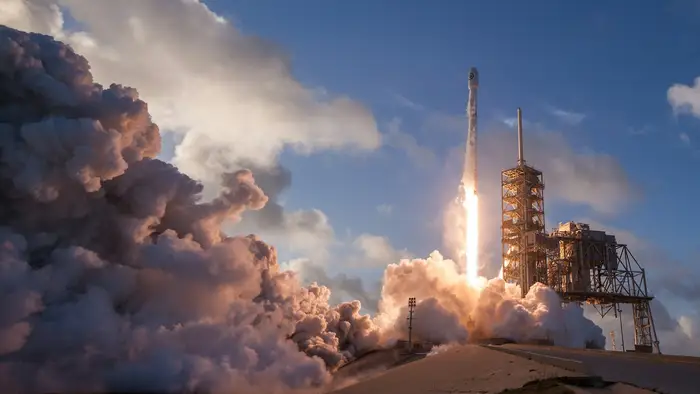
Every commercial lunar landing so far has been a lesson in difficulty; Griffin-1’s heavier, more complex design raises both the risk and the reward. Image: Unsplash.

Power is the difference between a lunar campsite and a settlement, and Griffin-1’s LunaGrid demonstration will test the first pieces of a scalable lunar power network. Image: Unsplash.

A lunar night lasts about fourteen Earth days, and the shadowed polar craters Griffin-1 will explore are among the coldest places in the solar system. Image: Unsplash.