SpaceX Set to Launch Bandwagon-5: 32 Payloads, a Pharma Factory, and a Second Starfall Capsule
Long before sunrise on Monday, a Falcon 9 rocket will roll through its final countdown at Cape Canaveral Space Force Station, its payload fairing packed tighter than a subway car at rush hour. Crammed inside are 32 separate payloads — radar satellites that can photograph the Earth through clouds and darkness, experimental navigation satellites meant to challenge GPS, a space tug designed to tow other spacecraft between orbits, and two very unusual passengers: a capsule built to manufacture cancer medicine in microgravity, and SpaceX’s own secretive reentry vehicle, Starfall, making only its second flight.
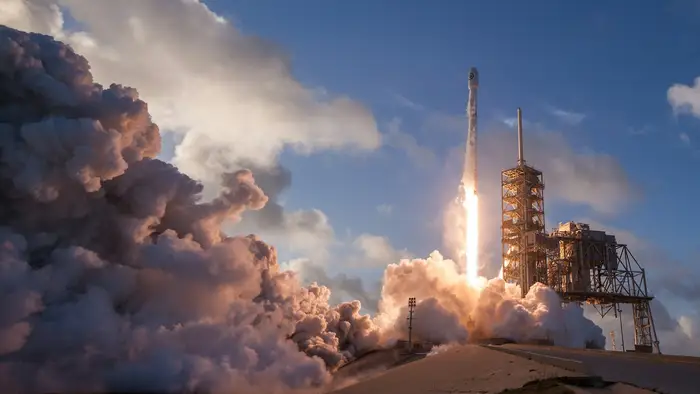
The mission is Bandwagon-5, the fifth flight in SpaceX’s dedicated mid-inclination rideshare program, and it is scheduled to lift off from Space Launch Complex 40 during a one-hour window that opens at 6:30 a.m. Eastern Daylight Time on Monday, October 19. It will be the 60th orbital rocket launch of 2026 from Cape Canaveral Space Force Station and the neighboring Kennedy Space Center — and one of the most diverse small-satellite manifests SpaceX has flown this year.
The mission: what is lifting off, and when
Bandwagon-5 will follow a southeasterly trajectory from Launch Complex 40, heading out over the Atlantic toward a low-Earth orbit at a mid-latitude inclination. That heading is the whole point of the Bandwagon line. SpaceX runs two families of rideshare missions. The Transporter missions fly from Vandenberg Space Force Base in California into near-polar, sun-synchronous orbits, circling the planet from pole to pole. The Bandwagon missions fly from Florida into mid-inclination orbits, where satellites spend far more of their time above the populated middle latitudes of the planet — exactly where most paying customers for imagery, communications, and navigation data actually live.
The flight is expected to carry 32 payloads in total, according to SpaceX’s mission timeline, a mix of cubesats, microsatellites, technology demonstrations, and larger hosted payloads. The one-hour launch window opens at 6:30 a.m. EDT (10:30 UTC), and SpaceX holds a backup opportunity in the same window on Tuesday morning if weather or hardware intervenes. The company’s live webcast will begin about 15 minutes before the scheduled liftoff and can be watched on SpaceX’s X account and its website.

About nine minutes after liftoff, the mission’s first stage — booster B1085 — will attempt to land on SpaceX’s autonomous droneship A Shortfall of Gravitas, stationed downrange in the Atlantic. If successful, it will be the booster’s 19th flight and recovery, extending the career of one of the most-traveled rockets in the world. B1085 previously flew NASA’s Crew-9 astronaut mission, the Firefly Blue Ghost Mission 1 lunar lander, the privately crewed Fram2 flight that circled the planet over the poles, the RRT-1 and MTG-S1 satellite missions, the SXM-10, SXM-11 and EchoStar XXV communications satellites, and ten batches of Starlink satellites. According to Spaceflight Now’s flight tracking, a successful touchdown would be the 167th landing on A Shortfall of Gravitas specifically and the 672nd Falcon booster landing to date — numbers that keep climbing at a pace the industry is still struggling to comprehend.
Because the booster is landing at sea rather than returning to the launch site, no sonic booms are expected over East Central Florida, Florida Today reported. Customer spacecraft will begin separating from the Falcon 9 upper stage about 57 minutes after liftoff, with deployments continuing for roughly the next quarter of an hour. The last item off the stack, mounted at the very top, will be SpaceX’s Starfall capsule, scheduled for deployment nearly three hours into the flight.
Starfall: SpaceX’s secretive microgravity capsule flies again
Perhaps the most intriguing passenger on Bandwagon-5 is one built by SpaceX itself. Riding at the top of the satellite stack is the second Starfall capsule — a disk-shaped reentry vehicle that SpaceX describes, in the understated language of its engineers, as a “microgravity lab researchers and entrepreneurs can leverage to develop their products and innovations.”
Starfall is one of the more secretive projects in an already secretive company. SpaceX did not announce the vehicle’s existence until its first flight. During the June 23, 2026, mission that carried Starfall Demo — the first capsule — the company waited until just before liftoff to reveal that its own spacecraft was aboard, sharing only a rendering and declining to say when it would be deployed or what it was carrying. That first capsule, NASASpaceflight reported, served as a technology demonstration for the concept.
The vehicle itself is a squat, saucer-like craft: about 3.1 meters (10.2 feet) in diameter and only 0.75 meters (2.5 feet) tall, with a mass of roughly 2,100 kilograms (4,600 pounds). According to an environmental assessment by the Federal Aviation Administration, a single Starfall capsule can support up to 1,000 kilograms (2,200 pounds) of payload mass — nearly half its own weight in cargo or experiments. It is designed to remain in space indefinitely and to reenter and be recovered by SpaceX at any time, effectively giving the company a reusable, on-orbit laboratory it can bring home whenever the work is done.
The capsule’s design reflects that dual mission. A top plate carries cold-gas nitrogen thrusters that orient the vehicle for reentry; a jettisonable heat shield absorbs the fury of atmospheric entry before being discarded; and a parachute-assisted splashdown brings the capsule gently down into the ocean. NASASpaceflight reports that these initial tests are planned to splash down in the Pacific Ocean roughly 1,300 kilometers off the coast of the United States or Mexico, where SpaceX recovery vessels will retrieve the vehicle and its contents.
SpaceX’s ambitions for Starfall go well beyond a single rideshare capsule. The company intends to use the vehicle for point-to-point cargo delivery — suborbital-style transport of goods between distant points on Earth — and as a carrier for products manufactured in microgravity. And although Starfall currently launches aboard Falcon 9, SpaceX plans to eventually fly the capsules aboard Starship, its super-heavy-lift vehicle, with multiple capsules likely riding on a single Starship launch. For now, though, the little disk on top of Bandwagon-5 is a test article: another data point in SpaceX’s quiet push into the orbital manufacturing economy that, as engineer Zachary Luppen put it during the June broadcast, offers “a huge opportunity to benefit life here on Earth through microgravity research and in-space manufacturing.”
W-7: a drug factory’s round trip
If Starfall is the quiet headline, the loudest mission objective on Bandwagon-5 belongs to a California company that treats orbit as a pharmaceutical factory. Varda Space Industries is flying its Winnebago-7 (W-7) capsule on this mission — an autonomous free-flying platform purpose-built to manufacture drugs in space and return them to Earth.
The logic is elegant. Many promising drug compounds crystallize poorly on Earth, limiting how effectively they dissolve — and therefore how well they work as medicines. In microgravity, molecules crystallize differently, sometimes forming structures that are impossible to produce in a laboratory on the ground. Varda’s bet is that space-grown crystals can unlock drugs that Earth-bound chemistry cannot.
W-7 will carry exactly such a candidate: a new cancer medicine called PROTAC, whose poor solubility has held it back. Varda will test whether crystallization in orbit can improve the drug’s properties — including its solubility — and then bring the results home. The round trip is the dramatic part. The capsule is designed to survive reentry at speeds reaching up to Mach 25, plunging through the atmosphere inside a protective heat shield before parachutes slow it for a gentle landing, where the space-manufactured medicine can be recovered and analyzed.
Varda’s approach has drawn attention because it treats the spacecraft as a factory rather than an experiment. The company has now flown multiple Winnebago capsules on SpaceX rideshare missions, and W-7 continues that campaign. For an industry built on satellites that never come back, a payload whose entire purpose is to return — with medicine grown in orbit — stands out on any manifest.
A navigation alternative to GPS
The Bandwagon-5 manifest also carries one of the most ambitious challenges to a piece of infrastructure nearly everyone on Earth relies on: the Global Positioning System. Four navigation satellites from California-based Xona Space Systems — Pulsar-01, Pulsar-02, Pulsar-03, and Pulsar-04 — will ride to orbit on this flight, forming the newest building blocks of a constellation the company expects to eventually number around 250 satellites.
Xona’s pitch is simple and audacious. GPS satellites orbit at medium-Earth altitude, about 20,000 kilometers up, in a system owned and operated by governments. Xona’s satellites will fly much closer to Earth, in low-Earth orbit, which the company says will allow it to broadcast a positioning, navigation, and timing (PNT) signal at least 100 times stronger than GPS. A stronger signal can punch through interference and jamming — a growing concern for military planners, aviation, and critical infrastructure — and can reach places where faint GPS signals struggle.
The mid-inclination orbit that Bandwagon-5 targets is particularly well suited to this constellation. As The Space Tap noted, Xona’s satellites in such orbits will pass over the mid-latitudes — home to the vast majority of the world’s population and economic activity — roughly eight times a day, offering frequent coverage where it matters most. Each new batch of Pulsar satellites inches the company closer to a commercial alternative to a government-owned utility.
Radar eyes: the SAR armada
A remarkable share of the Bandwagon-5 manifest is devoted to seeing through the night and the weather. Eight synthetic aperture radar (SAR) satellites from three different companies are booked on the flight, forming what amounts to a small armada of radar eyes.
Four SAR Earth-observation satellites come from ICEYE, the Finnish microsatellite company that has pioneered compact radar imaging spacecraft. Two high-resolution SAR satellites come from Capella Space, a San Francisco company known for some of the sharpest commercial radar imagery available. And two more commercial SAR payloads come from Umbra Space, another American radar-imaging firm. Together, they will add significant capacity to the commercial radar constellation — a class of satellite that uses radio waves rather than visible light to image the ground, producing detailed pictures in any weather and at any time of day or night.
SAR imagery has become one of the most strategically important products in the commercial space sector. Beyond military and intelligence applications, radar satellites monitor infrastructure, track flooding and natural disasters through cloud cover, measure ground subsidence in extreme detail, and watch shipping lanes and borders regardless of daylight. The concentration of eight SAR satellites on a single rideshare flight underscores how quickly this market is growing — and how rideshare launches have become its pipeline to orbit.
Joining them is another surveillance constellation: four radio-frequency monitoring satellites from HawkEye 360, the Virginia-based company that maps the planet’s radio emissions from space, detecting everything from ships running dark to interference with critical communications. According to Spaceflight Now’s manifest reporting, HawkEye 360’s four satellites were arranged through Exolaunch, the mission integrator that handled a large share of the flight’s smaller payloads.

Pelican-12, Starburst-1, and the space tug
The manifest’s heavy hitters continue with Planet Labs’ Pelican-12, a very-high-resolution optical imaging satellite set to join the company’s growing Pelican constellation. Planet has been steadily upgrading its fleet from the medium-resolution Dove satellites that made it famous to the sharper Pelican series, and each new Pelican sharpens the company’s ability to sell detailed imagery to governments and commercial customers.
Then there is Starburst-1, an ESPA-class spacecraft bus built by Portal Space Systems, a company founded by former SpaceX propulsion leadership. The satellite is designed for rapid retasking — the ability to change its mission on short notice — along with rendezvous and proximity operations (RPO) and significant orbital changes. Starburst shares core systems and manufacturing with Portal’s Supernova, a solar-thermal spacecraft engineered for exceptional maneuverability across orbits, from low-Earth orbit all the way to cislunar space. Spacecraft that can move, inspect, and reposition themselves are among the fastest-growing segments of the industry, driven by both commercial servicing and national-security demand.
Bandwagon-5 also carries Impulse Space’s LEO Express-4, an orbital transfer vehicle — essentially a space tug. The highly maneuverable spacecraft uses its Saiph thrusters to host and deploy other payloads into high-energy orbits that a rideshare rocket’s upper stage cannot economically reach. Beyond its delivery work, the vehicle can perform rendezvous and proximity operations and contribute to space domain awareness — the tracking and characterization of objects in orbit. Three previous LEO Express spacecraft flew aboard Falcon 9 Transporter missions in 2023 and 2025, making this the fourth flight of the design. Space tugs like these are becoming the connective tissue of the rideshare economy, ferrying small satellites from the drop-off orbit to their final destinations.
Exolaunch’s two-coast campaign
Behind much of this manifest sits a single Berlin-based company. Exolaunch, the launch-mission management firm headquartered in Germany’s capital, arranged 22 customer satellites on Bandwagon-5, according to NASASpaceflight’s mission reporting — and the flight is only half of its October campaign. Earlier in the month, the company deployed 45 satellites aboard SpaceX’s Transporter-18 mission from Vandenberg, meaning Exolaunch moved 67 customer satellites across two coasts and two orbital regimes within weeks of each other.
“As the global satellite market grows, access to launch remains a complex operational bottleneck,” Exolaunch said in a press release. “Securing capacity is only one part of the challenge: satellite operators must also navigate mission planning, technical interfaces, environmental testing, integration, international logistics, regulatory requirements and precise deployment.”
That mission-management work — the unglamorous logistics of getting dozens of satellites from factories around the world onto a single rocket, tested, integrated, licensed, and deployed in the right sequence — is what makes modern rideshare possible. Exolaunch’s customers on these two missions span 20 countries, including Argentina, Canada, Germany, Singapore, South Korea, Taiwan, Turkey, and the United Kingdom. The company has provided payloads for every SpaceX rideshare mission flown to date and says it has now manifested some 890 payloads across different launch vehicles, including Rocket Lab’s Electron and Arianespace’s Ariane 6.
The Transporter-18 flight also debuted Exolaunch’s newest hardware: Quadro Versa, a separation system for four-point-interface microsatellites weighing up to 1,000 kilograms (2,205 pounds). Separation systems are the mechanisms that hold satellites to the rocket and release them at precisely the right moment — and getting them right is the difference between a deployed constellation and a very expensive piece of orbital debris. “Introducing Quadro Versa marks an important milestone in our mission to provide world-class separation systems for virtually any satellite design,” said Connor Pollock, Exolaunch’s vice president of launch and engineering.
Why the mid-inclination rideshare matters
Bandwagon exists because not every satellite wants to fly over the poles. Sun-synchronous orbits, the destination of SpaceX’s Transporter missions, are ideal for Earth-observation satellites that want consistent lighting conditions on every pass. But communications, navigation, and many commercial imaging constellations serve customers concentrated in the temperate zones — and a mid-inclination orbit keeps satellites over those regions for a much larger fraction of each orbit.
The economics are equally important. A dedicated Falcon 9 launch costs on the order of $74 million at list price, putting it out of reach for most small-satellite operators. SpaceX’s rideshare program offers payloads of up to 50 kilograms a ride to orbit for $350,000, according to NASASpaceflight — roughly two hundred times cheaper than buying the whole rocket. For startups, universities, and even established constellation operators filling out their fleets, the shared ride is often the only affordable path to space. The most recent predecessor in the series, Bandwagon-4, flew on November 2, 2025, carrying 18 payloads — less than two-thirds of Monday’s manifest, a sign of how quickly demand for the mid-inclination option is growing.
A record pace on the Space Coast
Monday’s flight will mark the 60th orbital rocket launch of 2026 from Cape Canaveral Space Force Station and Kennedy Space Center, Florida Today reported. That puts the Space Coast well behind last year’s record of 109 orbital launches, but the pace remains extraordinary by any historical standard — 56 rockets had flown from the Cape through the end of September alone.
The Falcon 9 fleet driving that cadence has now logged 114 flights this year, according to the Space Nexus launch tracker, with more than 11,000 Starlink satellites in orbit as of mid-October. Booster reusability remains the engine of it all: Monday’s B1085 will be flying its 19th mission, and across the fleet, SpaceX is approaching 700 career booster landings.
The Cape’s most recent launch offers a preview of what Monday’s dawn could look like. On Tuesday, October 13, NASA’s SpaceX CRS-35 cargo mission lifted off at 6:33 a.m. carrying more than 6,300 pounds of supplies to the International Space Station — and painted the predawn sky with a luminous “space jellyfish,” the expanding plume of frozen exhaust crystals catching the first sunlight of the day. That launch flew a northeasterly trajectory and returned its booster to land, rattling windows across East Central Florida with sonic booms. Monday’s flight will head southeast and land at sea, so no booms are expected — but with sunrise at 7:25 a.m., less than an hour after the window opens, sky-watchers from Jacksonville Beach to West Palm Beach will want to look up. As of Friday, the Space Jellyfish Predictor website had yet to weigh in on whether Bandwagon-5’s plume would catch the light.

How to watch
SpaceX’s live webcast of the Bandwagon-5 launch will begin about 15 minutes before the window opens — roughly 6:15 a.m. EDT on Monday — and can be viewed on the company’s X profile and its website. If the flight slips, SpaceX holds a backup window at the same time on Tuesday morning.
Whenever it flies, Bandwagon-5 will be a fitting snapshot of the space industry in 2026: a single reused rocket carrying the wares of a dozen companies from 20 countries, a GPS challenger, a small fleet of radar eyes, a drug factory coming home, and a secretive SpaceX capsule testing the economics of manufacturing in orbit. The rideshare era was supposed to make space cheaper. Missions like this are making it stranger — and far more interesting — too.