NASA Swift Telescope Re-Entry November 2026: A 22-Year Gamma-Ray Hunter Burns Up Over Sumatra
For almost twenty-two years, it was the fastest responder in astronomy. When a gamma-ray burst flared somewhere in the distant universe, the Neil Gehrels Swift Observatory could swivel its telescopes onto the fading explosion in about ninety seconds, long before the light had a chance to vanish. It caught more than 2,000 of those cosmic blasts, helped solve the mystery of the briefest bursts, and alerted telescopes around the world to some of the most violent events ever recorded. On the morning of November 4, 2026, the mission ended the way its own targets begin: in a flash of light. Swift re-entered Earth’s atmosphere over northern Sumatra, Indonesia, and burned up, closing a career that lasted more than ten times longer than the two years it was designed for.
The United States Space Force confirmed the re-entry at 7:39 a.m. Eastern Standard Time, or 12:39 UTC, above the waters off the northern coast of Sumatra. Most of the 3,200-pound spacecraft was expected to disintegrate in the upper atmosphere, although NASA acknowledged that some of its most durable components could have survived the plunge to reach the surface. The agency estimated an approximately one-in-2,100 chance that falling debris would harm anyone on the ground, and the re-entry corridor stretched across a broad band of ocean and islands near the equator, where the observatory’s low-inclination orbit confined any surviving fragments to latitudes between 20.6 degrees south and 20.6 degrees north.
Swift’s final descent was not a surprise. The spacecraft had been losing altitude for more than a year, dragged down by an atmosphere swollen by increased solar activity, and NASA formally ended science operations in late October, once the observatory had sunk too low to keep its telescopes pointed steadily at the sky. Its last observation came on October 20, at an altitude of about 275 kilometres. Two weeks later, the sky’s most faithful sentry was gone.
A dense field of stars across the night sky. Image: Unsplash.
A Fireball Over Sumatra
The end came quickly, as re-entries do, but the forecast had been narrowing for days. NASA published a Space Force estimate on November 2 that placed the re-entry at approximately 3:30 a.m. Eastern, with an uncertainty of eleven hours either way, and tracking teams continued to refine the prediction as Swift spiralled downward. The confirmed time, 7:39 a.m. Eastern, fell inside that window, and tracking put the break-up at roughly 3.4 degrees north latitude and 98.6 degrees east longitude, just off the coast of northern Sumatra.
Because Swift’s orbit hugged the equator, the debris footprint was always going to lie in the tropics. NASA’s re-entry assessment described a broad swath stretching nearly 1,500 miles in latitude above and below the equator, a corridor that covers far more ocean than land. The spacecraft weighed about 1,450 kilograms, and while the great majority of it would have vaporised in the friction of the upper atmosphere, heavier pieces, such as parts of its structure and its mirrors, stood a chance of surviving to the surface. No reports of debris reaching the ground, or of any injuries, had surfaced in the days after the event, and the one-in-2,100 risk figure NASA quoted in advance reflected how unlikely harm was even in the worst case.
The re-entry closed a mission that had already been formally wound down. Swift’s science operations ended after the spacecraft descended to a height where atmospheric drag made it impossible to keep its telescopes steadily pointed at astronomical targets, and NASA terminated operations on October 23, 2026, a few days ahead of the destructive re-entry. The final weeks were quiet. The last gamma-ray burst Swift ever recorded, designated GRB 261017A, had been caught on October 17 in the constellation Leo, at 16:05:05 UTC, and after that the observatory simply ran out of sky to hold.
The Telescope That Could Turn in Ninety Seconds
Swift launched into orbit on November 20, 2004, aboard a Delta II rocket from Cape Canaveral in Florida, as NASA’s Swift Gamma-ray Observatory. In 2018, NASA renamed the spacecraft in honour of Neil Gehrels, the astronomer who helped develop the mission and served as its first principal investigator until his death in February 2017. At launch it was a first-of-its-kind observatory: a multiwavelength telescope built around a single, audacious idea, that a satellite could detect a gamma-ray burst on its own, work out where it was, and swing its other telescopes onto the spot before the afterglow faded.
Gamma-ray bursts are the most powerful explosions in the universe. They are triggered by the catastrophic deaths of massive stars, and by the mergers of systems containing orbiting neutron stars or black holes, and for a few seconds they can outshine everything else in the gamma-ray sky. The trouble, for astronomers, is that they are gone almost as soon as they appear. A conventional telescope needs a human to point it, and by the time the paperwork is done the afterglow is usually history. Swift was built to remove the human from the loop.
The spacecraft carried three instruments that worked as a team. The Burst Alert Telescope, a wide-field gamma-ray detector, watched roughly half the sky at any moment for a sudden flash. When it caught one, it computed the burst’s position to within about three arcminutes and relayed that position to the ground within twenty seconds. The spacecraft then autonomously slewed, typically within ninety seconds, to bring its two other instruments to bear: the X-ray Telescope and the Ultraviolet/Optical Telescope, which recorded the fading afterglow in finer detail. That speed was the mission’s signature. It turned Swift into a first responder, and its alerts fed a global network of ground-based telescopes and other space observatories, including Hubble and the James Webb Space Telescope, which followed up the most interesting events with deeper observations.
Swift was a NASA Medium-class Explorer mission, operated by Pennsylvania State University and developed in partnership between NASA’s Goddard Space Flight Center and an international consortium from the United States, the United Kingdom, and Italy. Its nominal on-orbit lifetime was two years. It lasted twenty-one years, ten months, and fourteen days.
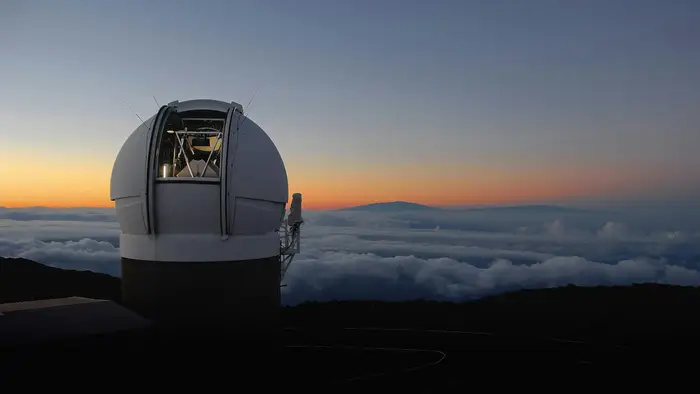
An observatory dome above the clouds at sunset. Image: Unsplash.
Twenty-Two Years of Firsts
Swift did not take long to prove itself. Less than four weeks after launch, while the spacecraft was still being commissioned, its Burst Alert Telescope triggered on an apparent gamma-ray burst on December 17, 2004. The first fully operational burst, with the autonomous slewing system enabled, followed on January 17, 2005. Then, on May 9, 2005, Swift detected GRB 050509B, a burst that lasted just one-twentieth of a second. The flash itself was over in a blink, yet Swift turned quickly enough to catch eleven X-ray photons from the fading event, the first time astronomers had ever detected an afterglow from such a short-duration burst.
That single observation helped answer a question that had divided astronomers for years. Long bursts, which can last for minutes, were already linked to the collapse of massive stars. Short bursts were a different beast, and Swift’s rapid afterglow showed they came from somewhere else entirely: the merger of compact objects, the same kind of collision that produces gravitational waves. It was a connection that would be confirmed spectacularly a dozen years later, when Swift helped observe the aftermath of a neutron star merger detected by gravitational-wave observatories in 2017, an event that also allowed astronomers to trace a ghostly, high-energy neutrino particle back to its origin in a distant blazar.
The milestones kept coming. On October 27, 2015, Swift detected its one-thousandth gamma-ray burst, GRB 151027B in the constellation Eridanus. On January 14, 2019, it caught GRB 190114C, a burst so energetic that its light reached teraelectronvolt energies, a regime once thought out of reach for such events. And on October 9, 2022, Swift and the Fermi observatory simultaneously detected GRB 221009A, the brightest gamma-ray burst ever recorded, an explosion so intense that astronomers quickly nicknamed it the Brightest Of All Time. It was one of the closest bursts ever detected, and Swift’s rapid alert let telescopes worldwide study it in unprecedented detail.
But Swift was never only a burst hunter. Over its long life it became a general-purpose observatory for the transient sky, the place astronomers turned when anything in the universe changed quickly. It studied more than 1,400 supernovae, watched a supernova begin in real time, and followed stars being shredded by black holes, comets and asteroids passing near Earth, and the flickering of supermassive black holes in the hearts of distant galaxies. The data it gathered was made quickly and publicly available, and by the end of its career it had contributed to roughly 7,000 scientific papers, a twelve-terabyte public archive that will keep researchers busy for years. By its twentieth anniversary in orbit, the mission had already logged about 1,800 bursts, 1,400 supernovae, and more than 6,600 scientific publications. Its final tally passed 2,000 bursts, with the last one recorded just seventeen days before the spacecraft’s last observation.
The mission’s reach extended well beyond gamma-ray bursts. In 2017, Swift’s rapid response helped pin down the light from a neutron star merger, the first event ever seen in both gravitational waves and ordinary light, and the same year it contributed to tracing a high-energy neutrino to the blazar TXS 0506+056, a breakthrough in the young field of multi-messenger astronomy. Those were the kinds of discoveries that had not even been imagined when the spacecraft was designed in the late 1990s, and they were possible only because Swift could react faster than any telescope that had flown before it.
Swift’s appetite for exploding stars also connects it to the supernova science that continues today. Astronomers still chase the early light of stellar explosions to learn how they work, and the recent discovery of SN 2026ahvy Supernova NGC 1433: A Once-in-a-Decade Type Ia Blast shows the same hunger for catching cosmic blasts young. Swift’s own supernova haul, more than 1,400 events, helped turn that kind of rapid follow-up into a routine part of astronomy. Its X-ray vision also reached into the extreme environments around black holes, a field that the James Webb Space Telescope has since carried forward, as in the recent observations of Holmberg II X-1 JWST Black Hole Lights Up a Nebula in a Metal-Poor Galaxy and the runaway black hole documented in RBH-1 Runaway Black Hole at 954 km/s: Webb Confirms a Monster Fleeing Its Galaxy. Swift did the fast work; the great observatories did the deep work, and together they mapped a universe that is far more violent, and far more interesting, than anyone expected.
Earth seen in full from space. Image: Unsplash.
By the Numbers: The Swift Observatory at a Glance
| Figure | Value |
|---|---|
| Launch date | 20 November 2004, 17:16:01 UTC |
| Launch vehicle | Delta II 7320-10C |
| Launch site | Cape Canaveral, SLC-17A, Florida |
| Spacecraft mass | About 3,200 pounds (1,450 kg) |
| Initial orbit | 585 by 604 km, inclination 20.6 degrees |
| Design lifetime | 2 years |
| Actual mission duration | 21 years, 10 months, 14 days |
| Instruments | Burst Alert Telescope, X-ray Telescope, Ultraviolet/Optical Telescope |
| Burst localisation | Within 3 arcminutes |
| Position relay to ground | Within 20 seconds |
| Typical slew to a burst | About 90 seconds |
| Gamma-ray bursts detected | More than 2,000 (2,046 on the final tally) |
| Supernovae studied | More than 1,400 |
| Scientific papers supported | About 7,000 |
| Public data archive | About 12 terabytes |
| Final science observation | 20 October 2026 |
| Operations terminated | 23 October 2026 |
| Re-entry | 4 November 2026, 7:39 a.m. EST (12:39 UTC), over North Sumatra, Indonesia |
| Estimated risk of debris harming anyone | About 1 in 2,100 |
The table tells the story in miniature: a spacecraft built for two years and a few hundred bursts ended up running for nearly twenty-two, catching ten times the explosions it was designed for and supporting thousands of papers. Its detection rate averaged about a hundred bursts a year, with a sensitivity roughly three times greater than the BATSE detector aboard the Compton Gamma Ray Observatory that had preceded it, and its rapid alerts became the backbone of time-domain astronomy, the study of a sky that changes on timescales of seconds rather than centuries.
Mission Timeline
20 November 2004 — Swift launches aboard a Delta II rocket from Cape Canaveral, Florida, into a near-perfect orbit of 585 by 604 kilometres, beginning a planned two-year mission to study gamma-ray bursts.
17 December 2004 — Less than four weeks after launch, the Burst Alert Telescope triggers on an apparent gamma-ray burst while the spacecraft is still being commissioned.
17 January 2005 — Swift catches its first gamma-ray burst with the autonomous slewing system fully enabled, proving the rapid-response design works in orbit.
9 May 2005 — Swift detects GRB 050509B, a burst lasting just 0.03 seconds, and records the first-ever afterglow from a short-duration burst, pointing astronomers toward neutron star mergers as the origin of short bursts.
27 October 2015 — Swift detects its 1,000th gamma-ray burst, GRB 151027B in the constellation Eridanus, a decade into a mission that was supposed to last two years.
2017 — Swift helps observe the light from a neutron star merger detected in gravitational waves, and contributes to tracing a high-energy neutrino to the blazar TXS 0506+056.
February 2018 — NASA renames the mission the Neil Gehrels Swift Observatory, honouring the astronomer who helped develop it and served as its first principal investigator.
14 January 2019 — Swift detects GRB 190114C, a burst reaching teraelectronvolt energies, among the most powerful ever observed.
9 October 2022 — Swift and Fermi simultaneously detect GRB 221009A, the brightest gamma-ray burst ever recorded.
September 2025 — NASA awards a $30 million contract to Katalyst Space for a commercial rendezvous-and-reboost mission to raise Swift’s decaying orbit.
July 2026 — The rescue spacecraft suffers malfunctions, and NASA calls off the reboost attempt in August, leaving Swift to its fate.
17 October 2026 — Swift records its last gamma-ray burst, GRB 261017A, in the constellation Leo.
20 October 2026 — Swift makes its final science observation, at an altitude of about 275 kilometres, as atmospheric drag makes steady pointing impossible.
23 October 2026 — NASA formally terminates Swift operations, a few days ahead of re-entry.
4 November 2026 — Swift re-enters Earth’s atmosphere at 7:39 a.m. EST over North Sumatra, Indonesia, ending a mission of almost twenty-two years.
The Rescue That Did Not Happen
Swift’s end was not inevitable until quite late. By 2025, the spacecraft’s orbit had been falling for more than a year, mostly in the previous two years, because an increase in solar activity had expanded Earth’s upper atmosphere enough to slow the satellite through drag. The spacecraft itself was still healthy and scientifically productive, and NASA saw a chance to save it. In September 2025, the agency awarded a $30 million contract to the commercial company Katalyst Space for a rendezvous-and-reboost mission: a servicing spacecraft called LINK would fly to Swift, dock with it, and raise its orbit, buying the observatory years of additional life.
It was an ambitious idea, and it was not the first time a rescue had been imagined for an ageing observatory. But the attempt faltered. The LINK servicer suffered several malfunctions in July 2026, including attitude-control problems, and NASA called off the boost in August. Swift returned to science after the failed attempt, which increased drag again as the servicer’s manoeuvres disturbed the orbit, and from that point the descent was a matter of time. The observatory spent its final months doing what it had always done, watching the sky, until the atmosphere itself made that impossible.
The failed rescue says something about where spaceflight stands in the 2020s. Commercial servicing of satellites is still a young discipline, and the first attempt to save a flagship science observatory ended in disappointment. But the fact that NASA tried at all, and paid $30 million for the attempt, is a measure of how much the agency valued Swift. Few missions get a rescue mission. Swift was one of them, and the attempt’s failure makes its loss feel sharper: this was not a spacecraft that wore out, but one that was still working when the sky came up to meet it.
What Swift Leaves Behind
Swift leaves behind no single successor. NASA has not named a replacement, and no other spacecraft does exactly what Swift did: watch half the sky for gamma-ray flashes, locate them in seconds, and swing a suite of telescopes onto the fading light within a minute and a half. Other observatories will carry parts of the job. Fermi continues to watch the gamma-ray sky, ground-based telescopes have grown faster at responding to alerts, and the next generation of transient-hunting missions is still on the drawing board. But the particular combination of speed, sensitivity, and twenty-two years of institutional memory is gone, and the astronomy community will feel the gap the next time a bright burst goes off and there is no Swift to chase it.
What remains is the archive, and the science it enabled. About twelve terabytes of public data, roughly 7,000 papers, and a generation of astronomers who learned their trade on Swift alerts. The mission rewrote the textbook on gamma-ray bursts, proved that short bursts come from merging neutron stars, caught the brightest explosion ever seen, and helped open the era of multi-messenger astronomy, in which a single event can be studied in gravitational waves, neutrinos, and light all at once. It also set a standard for how science missions should behave: open data, fast alerts, and a willingness to let the whole world use the telescope.
There is a certain symmetry to the ending. Swift spent its life studying the most violent explosions in the universe, flashes of energy so intense that a single burst can briefly outshine an entire galaxy. In the end, it made one of its own: a streak of fire across the tropical sky above Sumatra, visible for a few seconds to anyone who happened to be looking up, and then gone. The telescope that taught astronomers to look fast had one last lesson to offer, which is that even the longest missions end, and that the measure of a spacecraft is not how long it was supposed to last, but how much it did with the time it was given. Swift was given two years. It took twenty-two, and it used every one of them.
The Milky Way core glowing through clouds of gas and dust. Image: Unsplash.

A star-filled night sky stretching to the horizon. Image: Unsplash.