Google Project Suncatcher First AI Response 2026: A Haiku Beamed Down From an Orbiting TPU
The first artificial intelligence answer ever generated by a data-centre-class chip in orbit was not a weather forecast, a satellite health report, or a line of code. It was a haiku. Three short lines, beamed down to a ground station in the Arctic as the satellite passed over Svalbard, Norway, and then relayed to Earth with the quiet understatement that has come to define this particular experiment: it worked.
On 30 October 2026, Google announced that its Project Suncatcher prototype satellite had returned its first complete AI response from space. Engineers had sent a prompt up to the spacecraft during a ground-station pass, booted up its Tensor Processing Unit, or TPU, run Google’s Gemma 4 open model on board, and received the answer back on Earth. Google chief executive Sundar Pichai called it a “‘hello world’ milestone for Project Suncatcher”. The model, asked to write a haiku about being in space, replied:
“Blue marble below / Data streams in silent grace / Starlight feeds my core.”
It is, by any honest measure, a tiny result. The poem is seventeen syllables long, the model is small by modern standards, and Google has published no speed, accuracy, or efficiency figures from the test. But the haiku matters precisely because of what it proves and what it previews. A chip designed for the humming, air-conditioned halls of a terrestrial data centre has now survived a rocket launch, powered up in low Earth orbit, run a real model, and talked to the ground. That is the first rung of a ladder Google hopes will eventually lead to something far more ambitious: constellations of solar-powered satellites that do heavy AI computing in space, bathed in near-continuous sunlight, connected to one another by laser links, and freed from the land, water, and grid constraints that now shape every large data centre on Earth.
Whether that vision is a plausible next chapter for computing or an expensive curiosity will not be settled by a poem. It will be settled by the unglamorous tests that come next: how the chips handle heat and radiation, how long they last, how much power they can really draw, and whether launching them can ever become cheap enough. The haiku is the starting gun, not the finish line. What follows is the story of the satellite that wrote it, the idea behind it, and the hard questions it now has to answer.
What actually happened in orbit
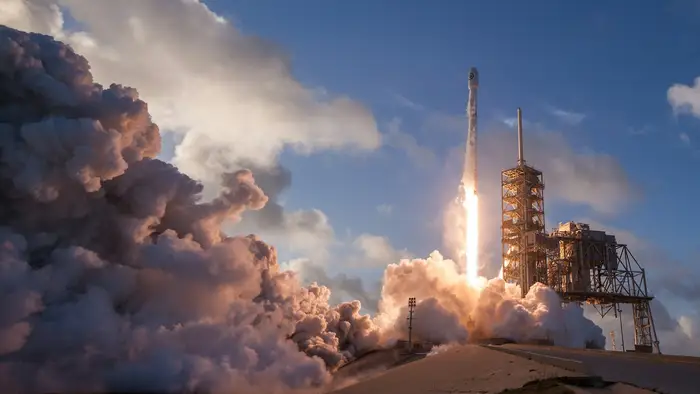
Project Suncatcher’s prototype satellite was launched on 1 October 2026 aboard SpaceX’s Transporter-18 rideshare mission, a Falcon 9 flight that carried more than 100 spacecraft into orbit. The satellite itself was built in partnership with Planet, the Earth-imaging company, which supplied the spacecraft bus that hosts Google’s payload. For roughly four weeks after launch, the team worked through commissioning: powering up the host spacecraft, checking the TPU trays, and running machine-learning tests to make sure the hardware was healthy before anyone asked it to do anything interesting.
Then, in the week of the announcement, came the test itself. During a ground-station pass, Google uplinked its first prompt to the Gemma 4 model running on board. Sources differ slightly on the exact wording of the prompt. Some reports describe a simple request for a haiku about being in space; The Register quotes a longer version, asking for a haiku from the perspective of a TPU orbiting Earth, with the world spinning beneath it. Either way, the answer that came down over Svalbard was the same three lines, and Google’s account of the moment, written by Travis Beals, senior director of Paradigms of Intelligence at Google, is deliberately plain: the team sent a command up, booted the TPU, ran the prompt, and received the first complete response back on Earth.
After the haiku, the team kept going. Google says it also tested space-themed limericks and prompts asking the model to report the technical status of the payload systems — a more practical exercise, since a satellite that can summarise its own telemetry in plain language is a satellite that is easier for a small operations team to look after. A Google spokesperson told TechCrunch the satellite was operating nominally, which, in the understated language of space operations, is high praise for a first-of-its-kind payload.
It is worth being precise about what this milestone is, and what it is not. Google describes it as the first-ever AI response from a data-centre-class TPU in orbit. That qualifier matters. Small AI accelerators and machine-learning models have flown in space before, on Earth-observation satellites that process images on board rather than downlinking every raw pixel, and on research payloads of various kinds. What is new here is the class of chip: a TPU of the kind that powers Google’s cloud data centres, running a general-purpose open model, taking a prompt from the ground and returning a generated answer. It is a data-centre workload, transplanted into orbit, at however small a scale.
It is also worth being precise about scale. The prototype carries four TPUs, but power constraints mean only one can run at a time, and it can run for only about 20 minutes at a time, according to TechCrunch’s reporting. The satellite generates up to about 1 kilowatt of electricity — roughly what a hair dryer or a small microwave oven draws, and a tiny fraction of the megawatts a terrestrial data centre consumes. Nobody at Google is pretending otherwise. The prototype is a laboratory, not a server farm, and its job is to answer questions about survival, not to serve users.
Why Google wants to put data centres in space at all
Project Suncatcher was unveiled publicly in November 2025 as a research “moonshot”, and its logic starts on the ground. Artificial intelligence workloads are growing fast, and the data centres that run them are running into three constraints at once: energy, cooling, and land. A modern AI data centre can consume as much electricity as a small city, it needs enormous cooling systems to carry away the heat its chips produce, and it needs a site with grid capacity, water, planning permission, and neighbours willing to live next to it. In many of the places where cloud companies would most like to build, one or more of those things is now scarce or contested.
Space, in Google’s argument, flips the energy problem on its head. In the right orbit — a dawn-to-dusk, sun-synchronous orbit, in which a satellite rides the terminator between day and night — a solar panel can sit in near-continuous sunlight, with no clouds, no night, and no atmosphere dimming the light. Google’s research paper puts the advantage starkly: solar panels in such an orbit can produce up to eight times as much energy per unit area as equivalent panels on the ground at mid-latitudes. That does not mean eight times as much useful computing, because everything else about space is harder, but it does mean the raw energy resource is abundant, free, and uninterrupted in a way that no terrestrial site can match. It also means smaller batteries, since a satellite that rarely enters shadow does not need to store much power for the dark.
The second part of the argument is about heat. A data centre on Earth spends a great deal of its energy budget getting rid of heat, often with water. In space there is no air and no water cooling, and heat can only leave by radiation, which is slow and requires large radiators. That is a serious engineering problem, and Google does not hide it. But the company also notes that the cold sink of space is, in principle, always available, and that a satellite designed from the start around radiative cooling does not compete with anyone for a river or a reservoir.
The third part is scale. Google’s long-term vision is not one satellite with four TPUs. It is compact constellations of small satellites, flying close together — kilometres apart or less — carrying TPUs and linked by free-space optical links, essentially lasers, so that they can share data at the rates a distributed machine-learning workload demands. The company’s published concept describes roughly 80 satellites in low Earth orbit, about 640 kilometres up, working as a single system. The point of flying them close together is that laser links over short distances can carry far more data than links spanning continents or reaching down to the ground, and Google has already demonstrated a bench-scale link achieving 800 gigabits per second each way, or 1.6 terabits per second in total, with a single transceiver pair.
That is the dream, at least. The prototype that wrote the haiku is the first, smallest step towards testing whether any of it survives contact with reality.
The two tests that matter next: heat and radiation
Google has been clear about what comes next, and the order is telling. Before any talk of bigger constellations, the prototype must survive thermal stress and radiation testing in orbit. Those are the two forces most likely to kill a data-centre chip in space, and they are the reason the haiku, charming as it is, proves so little on its own.
Radiation is the subtler enemy. Space is full of charged particles, and when one strikes a chip it can flip a stored bit from one to zero or back again, corrupting data without necessarily triggering any alarm. Engineers call this silent data corruption, and it is the nightmare scenario for a computing system that is supposed to be trusted: the machine does not crash, it just quietly gets an answer wrong. Google has already done laboratory work on this problem. Its researchers tested Trillium-generation TPUs in a 67 mega-electron-volt proton beam, simulating the low Earth orbit radiation environment, and found that high-bandwidth memory was the most sensitive component, showing irregularities at a cumulative dose of about 2 kilorads (silicon), roughly three times Google’s estimated minimum requirement of 750 rads (silicon) for a five-year mission. Crucially, no hard failures were observed up to 15 kilorads (silicon). Translating those laboratory numbers into an operational estimate, the researchers calculated that for typical transformer workloads, the silent data corruption rate worked out to roughly one event per 17 rads, which at an estimated orbital dose of 150 rads (silicon) per year gives a failure probability on the order of one per three million inferences, assuming one inference per second. Google’s researchers described that as likely acceptable for inference work, where a single wrong answer among millions is tolerable in a way it would not be for, say, a financial transaction or a flight-control calculation.
Those numbers are encouraging, but they are laboratory numbers, and orbit has a way of humbling laboratory numbers. Real radiation comes in bursts, varies with solar activity and with the satellite’s position in its orbit — the South Atlantic Anomaly, a dip in Earth’s magnetic field over the South Atlantic, is a notorious hotspot — and interacts with a real spacecraft’s shielding, layout, and operating temperature in ways a beam test can only approximate. The in-orbit tests now under way are designed to find out whether the chips degrade, glitch, or fail in patterns the laboratory did not predict, and whether error correction and redundancy can keep the system trustworthy over months and years rather than minutes.
Heat is the more immediate, practical problem. A TPU running at full tilt generates a great deal of heat in a small package, and on Earth that heat is carried away by fans, liquid cooling, and air conditioning. In vacuum, there is no air to carry it anywhere. The prototype’s 20-minute operating limit is, in part, a thermal story: run the chip, watch the temperature climb, stop before it climbs too far, radiate the heat away, and go again. A future orbital data centre would need radiators sized for continuous operation, and radiators are large, heavy, and expensive to launch. Every kilogram of radiator is a kilogram that is not a chip or a solar panel, and the trade-off between computing power, power generation, and heat rejection will define what an orbital data centre can actually do.
There is also the question of what happens when something goes wrong and nobody can touch the hardware. A terrestrial data centre has technicians who can swap a failed drive or reseat a card. An orbital data centre has none. Reliability must be designed in, with redundancy, graceful degradation, and the ability to route around dead components. That is a solved problem for communications satellites, which routinely operate for fifteen years without servicing, but it is a newer problem for the dense, hot, power-hungry world of AI accelerators, where failure modes are less well understood.

The economics: a very expensive haiku, for now
If the engineering tests are the first hurdle, cost is the second, and it is the one that has drawn the most sceptical commentary. The Register, reporting the haiku, did the arithmetic with a straight face: the roughly 20 tokens of the poem would cost about $0.000012 if generated through Google’s cloud API, based on Gemma 4 pricing, while the satellite that generated them weighs perhaps 500 kilograms and a retail launch price of around $7,000 per kilogram would put the launch alone in the millions. It is, the piece concluded, a very expensive haiku. The joke lands because it is true, and Google would not dispute it. Nobody builds a prototype to save money on poetry.
The serious version of the cost question is about the trajectory, not the starting point. Google’s analysis, published with the original Suncatcher research in 2025, argues that if launch prices fall below $200 per kilogram by the mid-2030s — driven by reusable rockets, above all SpaceX’s Starship — then the cost of launching and operating a space-based data centre could become roughly comparable to the energy costs of an equivalent terrestrial data centre, measured per kilowatt per year. That is a big “if” resting on a big “if”: launch prices must fall by more than an order of magnitude from today’s rideshare rates, and the satellites themselves must become cheap, reliable, and mass-producible. SpaceX’s Starship programme, which is itself still in flight testing, is the main reason anyone takes the $200 figure seriously at all, and even its most enthusiastic supporters would concede that the timeline is uncertain.
There is also a cost that does not appear in Google’s per-kilowatt arithmetic: the environmental cost of getting there. A single rocket launch emits hundreds of tonnes of carbon dioxide, along with other exhaust products whose high-altitude effects are still being studied, and that upfront cost must be amortised over the satellite’s operating life. If an orbital data centre runs for five years on clean solar power, the lifetime carbon balance may still favour space. If it fails after five months, it will not. Independent lifecycle accounting, not corporate projections, will eventually have to settle that question, and it has barely begun.
None of this means the idea is foolish. The history of computing is full of prototypes that looked absurdly expensive at birth and became cheap through scale: the first transistors, the first hard drives, the first commercial satellites. But it does mean the burden of proof is on Suncatcher, and the haiku, for all its charm, does not carry it. What would carry it is a demonstration that TPUs can run for months in orbit without unacceptable error rates, that thermal management can support longer and longer duty cycles, and that the next generation of satellites can do something useful — process Earth-observation imagery on board, for instance, where the alternative is downlinking terabytes of raw data — at a cost that is merely high rather than astronomical.
Suncatcher is not alone in orbit
Google is not the only company that has decided the data centre’s next address might be above the atmosphere, and the race taking shape around it gives Suncatcher useful context — and useful competition. The orbital AI field has moved quickly in the past year, and the new article’s closest cousins are already flying.
One is Starcloud, a startup that has raised $450 million in total, including a $250 million Series A extension at a $2.3 billion valuation backed by Nvidia, to turn a single graphics processor flown in orbit into a factory-built fleet of AI data-centre satellites, as described in Nvidia Bets on the Sky: Starcloud’s $250 Million Extension Takes Orbital AI Data Centers From Demo to Factory Floor. Where Google is a research moonshot inside a company that already owns some of the world’s largest data centres, Starcloud is a pure-play bet: that orbital compute is a market in its own right, and that the company that industrialises it first will own it.
The other is China’s Three-Body Computing Constellation, which in October 2026 doubled to 20 satellites when LandSpace’s Zhuque-2E rocket lofted eight AI computing satellites and two laser-communication testers into orbit, making it the world’s first working orbital data-centre fleet, as described in The Data Center Leaves Earth: China’s Orbital AI Constellation Doubles With a Methane-Fueled Launch. The Chinese constellation is further along in raw satellite count than Suncatcher, though its computing payloads and inter-satellite links are a different design answering a different set of questions, and direct comparisons of capability are difficult from public information alone.
The contrast between the three efforts is instructive. Three-Body is building a fleet and learning by operating it. Starcloud is raising capital to build a factory for fleets. Google is running a careful, instrumented experiment to learn whether its own chips can survive the environment at all, before committing to a fleet. All three cannot be wrong about the direction of travel, but they can certainly be wrong about the timing, and the company that learns fastest about radiation, heat, and operations — rather than the company that launches the most hardware soonest — may end up with the advantage that matters.
There is also interest from the launch providers themselves. Elon Musk has said SpaceX will pursue orbital data centres, and Jeff Bezos has spoken about the idea in the context of Amazon’s space ambitions. Their interest is not altruistic: if orbital data centres become a real market, they become a real launch market, and the company that can launch cheapest will capture much of the value. Google’s $200-per-kilogram projection depends, in large part, on those companies succeeding. Suncatcher is, in that sense, a bet on someone else’s rocket as much as on its own chips.
What to watch next
Google’s own roadmap gives the next milestones clearly enough. After thermal and radiation testing on the current prototype, the plan is to launch twin interconnected satellites in 2027 — a step up from the single prototype that flew in October 2026, and a step that tests the part of the vision the haiku could not touch at all: the laser links between satellites that would let a constellation act as one computer rather than a collection of isolated ones. The original 2025 announcement described two prototype satellites by early 2027, in partnership with Planet; the October 2026 update describes “twin interconnected satellites in 2027” without a month, a small softening of the schedule that is worth noting without over-reading. Schedules in space slip. What matters is whether the twins fly, and whether they talk to each other at the rates Google’s bench tests promise.
Beyond that, the questions to watch are concrete and answerable. First, the radiation results: does the silent data corruption rate in orbit match the laboratory estimate of roughly one failure per three million inferences, or does the real environment produce surprises? Second, the thermal results: can the duty cycle stretch from 20 minutes towards continuous operation, and at what cost in radiator mass? Third, the power story: can a future satellite generate substantially more than 1 kilowatt without becoming too large or too expensive to launch in numbers? Fourth, the links: can inter-satellite lasers deliver data-centre-scale bandwidth — tens of terabits per second across a constellation — outside the laboratory? And fifth, the use case: will the first real workload for an orbital data centre be something that genuinely benefits from being in space, such as processing Earth-observation data where it is collected, rather than a terrestrial workload transplanted upwards for the novelty of it?
There are also questions Google’s announcements do not address, and which will only grow louder if the project scales. Orbital debris is the most obvious. A constellation of data-centre satellites, each larger and more massive than a typical communications satellite, adds to the population of objects in low Earth orbit, and to the risk of collisions that could cascade. Google will need a credible debris-mitigation and deorbit plan, and regulators will need to decide how to license a new class of spacecraft that is, in effect, a flying server room. Spectrum and laser-link safety, data sovereignty — whose laws govern a computer that is, literally, above every jurisdiction? — and the security of a data centre that any capable actor could, in principle, approach in orbit, are all questions that have barely been asked, let alone answered.
For now, though, the appropriate response to the haiku is neither breathless hype nor dismissive laughter. It is the response that good science deserves: noted, verified, and filed under “interesting, now show me more”. A chip survived launch, booted up, ran a model, and answered a question from space. That is a genuine first, and firsts have a way of compounding. The first transistor did not replace the vacuum tube overnight. The first satellite did not create the space economy overnight. The first AI answer from orbit will not move a single workload off Earth tomorrow. But it does mean that, from now on, when someone asks whether a data centre could run in space, the answer is no longer purely theoretical. Someone has tried it, at a small scale, and the machine answered back — in verse, from above the blue marble, with starlight feeding its core.