Nvidia Bets on the Sky: Starcloud's $250 Million Extension Takes Orbital AI Data Centers From Demo to Factory Floor
In November 2025, a satellite weighing about as much as a large adult flew into low Earth orbit carrying something no one had ever flown before: an ordinary, terrestrial-grade Nvidia H100 graphics processor, the kind of chip that powers artificial intelligence in warehouses full of servers on the ground. The satellite was Starcloud-1, built by a startup that was barely two years old. Within months, that chip had trained a small language model and run another one in orbit, and the company behind it had become, in the space of seventeen months, the fastest unicorn in the history of the Y Combinator startup accelerator.
Now the bet has grown much larger. In August 2026, Starcloud announced a $250 million extension to its Series A funding round, valuing the Redmond, Washington company at $2.3 billion and bringing its total raised since its founding in January 2024 to $450 million. The extension was led by Manhattan West and, crucially, included Nvidia itself as an investor, alongside Cisco Investments and a roster of returning backers including Benchmark, EQT, Soma Capital, NFX, and SevenSevenSix. When the company whose chips define the artificial intelligence era puts its own money into putting those chips in orbit, the idea of the orbital data center stops being a curiosity and starts being a line item in somebody’s industrial plan.
That is the story of this article: not whether data centers belong in space — a question on which reasonable engineers still disagree sharply — but how a single demonstration satellite became, in less than a year, a funded factory program with a chip roadmap, a constellation filing, and a launch problem that its own chief executive now calls one of his biggest costs.

A Startup Built Around a Single Insight
Starcloud was founded in January 2024 under the name Lumen Orbit, and it entered Y Combinator’s summer 2024 batch with a thesis that sounds simple until you try to build it. Artificial intelligence needs electricity on a scale that is straining power grids, land availability, water supplies, and local politics all at once. In space, the company argues, sunlight is nearly uninterrupted, there is no neighbor to object to a new facility, and heat can be rejected directly into the cold of the cosmos without evaporating millions of tonnes of water. If launch costs keep falling, the pitch goes, the cheapest place to run a power-hungry computer may eventually be the place with the most power and the fewest permits: above the atmosphere.
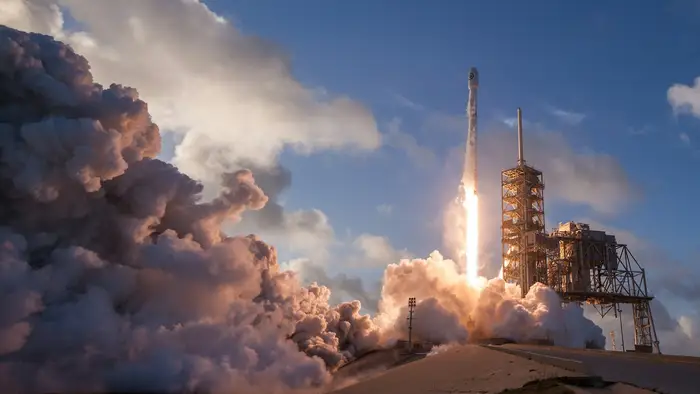
The company’s first move was deliberately small. Starcloud-1, a spacecraft of about 60 kilograms, rode to orbit on a Falcon 9 rideshare in November 2025 carrying a standard Nvidia H100 data-center graphics processor. The point was not the size of the computer but its ordinariness. Almost every chip previously flown in space was a radiation-hardened, slower, specialized part designed for imaging satellites or spacecraft avionics. Starcloud flew the same kind of silicon that data centers buy by the rack, and then set out to prove it could do useful work up there.
By the company’s account, it did. Starcloud-1 trained NanoGPT, a minimalist educational language model created by OpenAI founding member Andrej Karpathy, feeding it the complete works of Shakespeare and asking it to produce Shakespearean English. It then ran Google’s Gemma, a lightweight open language model. The demonstrations were modest in scale — nobody mistook NanoGPT for a frontier model — but the sequence mattered: a commercial chip survived launch, survived the thermal and radiation environment of low Earth orbit long enough to complete training runs, and returned results. Starcloud’s co-founder and chief executive, Philip Johnston, summed up the milestone in the company’s announcement of its new funding round: “Last November we put the first NVIDIA H100 in orbit. Today, this fresh capital empowers us to build the infrastructure to launch many more of Nvidia’s most advanced GPUs into space.”
That sentence contains the whole strategy. Starcloud is not selling a single satellite. It is selling a pipeline: prove the chip works, prove the factory can build the spacecraft, prove the launches can be booked, and then scale.
Two Rounds, Five Months, Four Times the Valuation
The money arrived fast. On March 30, 2026, Starcloud closed a $170 million Series A round at a $1.1 billion post-money valuation, led by Benchmark with participation from firms including EQT and In-Q-Tel, the venture arm associated with the United States intelligence community. Seventeen months after its Y Combinator demo day, the company was a unicorn, reportedly the fastest in the accelerator’s history.
Five months later came the extension: $250 million more, at $2.3 billion, led by Manhattan West, an investor with prior stakes in SpaceX, Relativity Space, and Axiom Space. The new money more than doubled the valuation and brought the total raised to $450 million. The composition of the round is as interesting as its size. Nvidia’s participation, alongside Cisco Investments, ties the orbital-compute bet directly to the terrestrial infrastructure giants whose hardware and networking it would extend. Returning investors Benchmark, EQT, Soma, NFX, and SevenSevenSix were joined by new backers including Cedar Capital, Goanna Capital, and Standard Capital.
The timing of the extension also landed in a particular political moment on the ground. Public resistance to new terrestrial data centers has been rising, with polling reported alongside the funding announcement finding that roughly 71 percent of Americans surveyed by Gallup in the spring of 2026 said they opposed a data center being built near them. Starcloud’s pitch — no neighbors, no local grid queue, no water consumption — is aimed squarely at that friction. Whether orbit actually escapes those constraints, or merely trades them for harder ones, is the open question at the heart of the company’s valuation.
What the Money Buys: A Factory, a Chip, and a Launch Manifest
Starcloud has been unusually specific about where the capital goes, and the specifics are what separate this round from a generic funding headline. Three items dominate the plan.
First, the factory. Starcloud is fitting out a 100,000-square-foot production facility in Woodinville, Washington, near its Redmond headquarters, where it is developing production lines for its next spacecraft, Starcloud-3. The company today employs only about 25 people, a figure its own supporters acknowledge makes the factory the near-term operational risk: the organization must grow from a team that built one small demonstrator into a manufacturer. The factory is the bet that orbital data centers become a product line rather than a series of one-off spacecraft.
Second, the chip roadmap. In March 2026, Starcloud and Nvidia agreed to develop the Space-1 Vera Rubin module, a space-adapted version of Nvidia’s Vera Rubin architecture, for deployment in late 2028. The distinction matters. Starcloud-1 flew an off-the-shelf H100; the Vera Rubin module is meant to be hardware designed from the start for the orbital environment, informed by what Starcloud learned operating the H100 in space. Nvidia’s chief executive, Jensen Huang, framed the broader ambition in terms that go beyond any single company: “Space computing, the final frontier, has arrived. As we deploy satellite constellations and explore deeper into space, intelligence must live wherever data is generated.” Nvidia is spreading its orbital bets — it is also working with companies including Axiom Space, Planet Labs, and Kepler Communications on space-hardened hardware — but Starcloud is the partner that has already flown its flagship data-center silicon.
Third, the spacecraft sequence. Starcloud-2, planned for early 2027, is described as a 450-kilogram platform generating about 8 kilowatts, a step up from the 60-kilogram demonstrator toward a genuine commercial GPU cluster satellite in a sun-synchronous orbit that keeps it in consistent sunlight. Starcloud-3 is the industrial-scale vehicle: roughly three tonnes and about 200 kilowatts, sized to fit Starship’s payload dispenser. The progression — 60 kilograms, then 450, then 3,000 — is the company’s answer to the skeptic’s question of whether one GPU in orbit can become a business. Each step is roughly an order of magnitude larger than the last, and each depends on the previous one working.
The 88,000-Satellite Filing
Beyond the spacecraft, Starcloud has filed the most audacious paperwork in the orbital-compute race. In February 2026, the company submitted a proposal to the United States Federal Communications Commission for a constellation of up to 88,000 satellites delivering approximately 20 gigawatts of computing capacity. For perspective, a single large terrestrial data center typically consumes on the order of 100 to 300 megawatts; 20 gigawatts is the output of roughly twenty large power stations, distributed across tens of thousands of spacecraft.
The filing should be read for what it is: an application for permission and spectrum, not a construction plan. No company has ever built 88,000 of anything for orbit, and Starcloud’s current headcount of 25 people against that number is, as even sympathetic coverage has noted, a very long ladder to climb. But the filing serves two purposes. It stakes a regulatory claim in a domain where spectrum and orbital slots are first-come, first-served resources, and it signals to investors and launch providers the scale at which the company intends to operate if the economics work. The extension round’s emphasis on launch procurement suggests the company is taking the second purpose seriously: before you can fly 88,000 satellites, you need to be able to book rockets at all.
The economics claim that underpins all of this is bold. Starcloud has said its approach could reduce energy costs by up to 90 percent compared with ground-based facilities, a tenfold reduction that its chief executive has repeated publicly. A company white paper cited in recent coverage compares running a 40-megawatt computing cluster for ten years on Earth — $140 million of electricity, $20 million of backup power, $7 million of cooling, and 1.7 million tonnes of water — with running the same cluster in orbit, at $2 million for the solar array, $5 million for one launch, and $1.2 million for radiation shielding, for a total of $167 million against $8.2 million. Those are the company’s own figures, not independently verified costs, and they assume away much of what makes space hard. They are best understood as the thesis the $450 million is funding someone to test, not as a result that has been demonstrated.
Why Skeptics Are Not Convinced
The skepticism is substantial, specific, and worth taking seriously, because it identifies exactly where the thesis could break. The first problem is heat. A vacuum is a terrible conductor, so a data center in orbit cannot shed heat into air or water; it can only radiate it away, which requires enormous radiator panels to dump the waste heat from a dense GPU cluster. One analysis of Starcloud’s long-term plans noted proposals involving radiators spanning many square kilometers for gigawatt-scale facilities. The deployable radiators and liquid-cooling loops now appearing on rival orbital-compute satellites are direct responses to this problem, but they add mass, complexity, and failure modes.
The second problem is radiation. Ionizing particles in orbit can flip bits in memory, corrupt calculations, and degrade electronics over time. Space-rated chips are slower than commercial hardware precisely because of the hardening required to resist this, and critics note that the H100’s survival on a single demonstrator for a limited period is not the same as years of reliable operation at scale. Hewlett Packard’s experience with edge computers aboard the International Space Station is often cited in this context: identical calculations were run on three separate nodes and compared, to weed out corrupted results, tripling the power and mass required. Starcloud’s white paper argues that its larger server volumes need comparatively less shielding per unit of compute, but that argument remains unproven at the scale of a real data center.
The third problem is launch. Even at Falcon 9 prices of roughly $2,700 per kilogram to orbit, critics calculate that orbital data centers only make financial sense if launch costs fall toward $200 per kilogram, a drop that would require a fully reusable heavy-lift vehicle flying routinely. Johnston himself has been candid that launch capacity is now one of his biggest costs and that it is getting scarce. SpaceX plans to phase out Falcon 9 around 2028 in favor of Starship, and until Starship flies payloads reliably at high cadence, every company building large things for orbit is competing for the same rides. Johnston put the risk plainly: “Obviously if we can’t book any SpaceX launch capacity in 2029, that will be challenging for us.” A company whose factory output depends on someone else’s rocket schedule has a dependency no terrestrial data-center builder faces.
The fourth problem is maintenance. On the ground, a failed server is swapped in minutes by a technician. In orbit, there is no technician, and hardware cannot be upgraded when a new generation of chips arrives eighteen months later. A satellite launched in 2027 will still be flying the chips of 2027 in 2030, while its terrestrial competitors have moved on twice. Starcloud’s answer is implied by its architecture: build satellites cheaply enough, and launch often enough, that replacement beats repair. That answer only works if launch really does become cheap and routine.
A Race, Not a Solo Flight
Starcloud is not alone, and the shape of the competition clarifies what is genuinely new about its approach. In China, the Three-Body Computing Constellation operated by ADA Space and Zhejiang Lab already numbers 20 satellites after an October 2026 launch, processing artificial intelligence workloads in orbit and linked by laser crosslinks — the world’s first working orbital data-center fleet, ahead of any American company on deployed hardware. In the United States, Kepler Communications plans to add Nvidia hardware to data-relay satellites for on-orbit computing, and established players from Axiom Space to Planet Labs are exploring space-hardened Nvidia silicon. Lonestar has taken a different path entirely, landing data storage on the Moon. The European Space Agency, through studies such as the ASCEND project led by Thales Alenia Space, is examining whether orbital data centers could strengthen European digital sovereignty.
What distinguishes Starcloud within this field is the closed loop it has already demonstrated: commercial silicon flown, a model trained, a result returned, a chip partnership signed, and a factory being built. Most competitors still rest on roadmaps, edge-AI chips designed for imaging satellites, or single demonstrations. Starcloud’s sequence — H100 flown, NanoGPT and Gemma run, Vera Rubin module co-developed with Nvidia, production lines under construction — is the only one so far that connects a data-center chip to a trained model and back to a manufacturing plan. That is what the $2.3 billion valuation is paying for: not a satellite, but a loop that can be repeated at increasing scale.
It is also what makes the next two milestones decisive. Starcloud-2, due in early 2027, is the first real proof point: an 8-kilowatt commercial platform doing useful compute at a cost anyone can audit. If it flies and performs, the story graduates from demonstration to product. If it slips — on launch, on thermals, on economics — the valuation will look like it priced the press release rather than the product. The Vera Rubin Space-1 module in late 2028 is the second: the moment Nvidia’s involvement stops being an investment and becomes a product line of chips built specifically to run in orbit. Whether it ships on time will tell observers how serious the biggest name in AI hardware really is about this frontier.
The Kicker: The Factory Is the Story
There is a temptation to treat Starcloud as a science-fiction story: computers in space, sunlight instead of power stations, radiators the size of cities. The more useful way to read the August extension is as an industrial story. A company with 25 employees and one flown GPU has convinced Nvidia, Manhattan West, Benchmark, and Cisco to fund a 100,000-square-foot factory, a chip co-development program, and a launch-buying campaign, on the strength of a single demonstration that a commercial chip can think in orbit.
That is either the beginning of a new infrastructure layer or an expensive lesson in the difference between a demo and a data center. The physics has not changed: heat still needs radiating, bits still flip under cosmic rays, rockets still cost money and still slip schedules. What has changed is that the people who build the world’s AI hardware are now paying to find out whether those problems are engineering challenges or deal-breakers — and they are paying at a scale that guarantees the answer will arrive, one way or the other, within the next few years.
When Starcloud-2 lifts off, it will carry more than a cluster of graphics processors. It will carry the question at the center of a $450 million bet: whether the hardest part of artificial intelligence’s energy problem was ever really about energy at all, or whether it was always about finding somewhere to put the machines where nobody would mind the heat. Space, for the first time, has a funded answer in production. The factory in Woodinville will tell us whether that answer scales — or whether the sky, like every frontier before it, turns out to be more expensive than the brochure promised.