Webb Maps the True Shape of a Distant World for the First Time — and It Is Egg-Shaped
For centuries, every planet astronomers studied was a sphere by assumption. Circles are easy math: a disk of starlight dims by a tidy amount when a round planet crosses it, and models fit the numbers beautifully. But circles are also a convenience, and this week an international team of researchers has finally replaced the convenience with reality. Using the James Webb Space Telescope, scientists have mapped the true, three-dimensional shape of a planet orbiting a star some 1,300 light-years from Earth — and the world is not a sphere. It is, roughly, an egg.
The planet is WASP-17b, a bloated hot Jupiter racing around its star once every three and a half days. In a paper published in Nature Astronomy this week, a Cornell-led team unveiled a reconstruction of the planet’s silhouette that shows an ovoid, slightly lopsided form — elongated on one side, pinched by the physics of a world roasted by its sun. The result, the team says, matches decades of theoretical predictions about how extreme heat and howling winds should deform a planet, and it demonstrates a technique that could one day let astronomers read weather and atmospheric circulation on worlds far beyond our own.
“This is proof of concept that planets are in fact 3D objects,” said first author Lili Alderson, a Klarman Postdoctoral Fellow at Cornell University. Until now, she noted, the idea that hot gas giants should be deformed was a computational exercise. “To move beyond computational exercises and see it for real is a different matter.”
The Egg in Scorpius
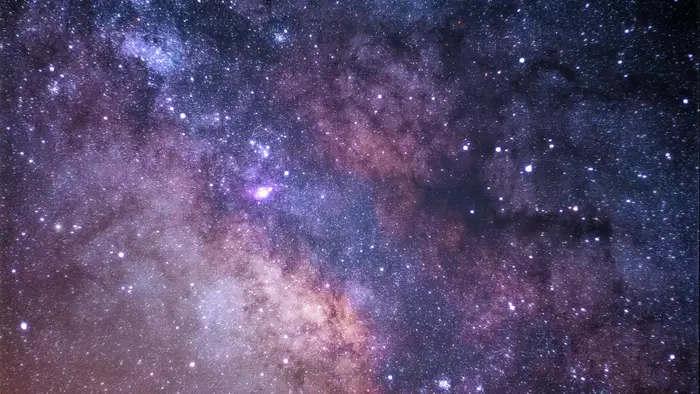
WASP-17b is no stranger to the headlines. It was discovered in 2009 by the SuperWASP ground-based survey, one of the first generation of planets found by the transit method — the dip in a star’s brightness as a planet crosses its face. From that dip, astronomers could work out its size and orbit: a giant roughly twice the width of Jupiter, circling an F-type star in the constellation Scorpius at a distance of just 0.0515 astronomical units, completing a year in about 3.7 days.
That combination — huge and extremely close to its star — makes WASP-17b what astronomers call a hot Jupiter, and one of the puffiest known. Though it spans nearly twice Jupiter’s diameter, it weighs only about half as much as the solar system’s largest planet. Such inflated worlds have puzzled theorists for years: something is pumping extra energy into their interiors, and something else — the ferocious radiation from their stars — is reshaping their atmospheres from the outside.
Because it orbits so close to its star, WASP-17b is almost certainly tidally locked, meaning the same hemisphere faces its sun at all times, just as the Moon always shows the same face to Earth. On the permanent dayside, temperatures soar high enough to vaporize rock; on the permanent nightside, it is far cooler. Between them, models predict, violent winds must redistribute the heat, with a broad equatorial jet stream shuttling hot gas around the planet’s middle.
The planet has already been one of the James Webb Space Telescope’s favorite laboratories. In 2023, Webb’s Mid-Infrared Instrument stared at the WASP-17 system for nearly ten hours, collecting more than 1,275 brightness measurements across the transit. The resulting transmission spectrum contained a surprise: a bump at a wavelength of 8.6 microns that revealed the first detection of quartz — tiny crystals of silicon dioxide — in the clouds of an exoplanet. That finding, published in 2023, told astronomers that solid crystals can form directly from hot gas in the planet’s upper atmosphere, without ever passing through a liquid phase, and it gave them an inventory of the minerals swirling in the alien skies.
But even as Webb was reading the chemistry of WASP-17b’s clouds, nobody knew the planet’s actual shape. The new study changed that.
From Circles to Contours
The trick to seeing a shape 1,300 light-years away lies in the transit itself. When WASP-17b crosses in front of its star, starlight filters through the thin ring of the planet’s atmosphere at its limb — the visible edge. By measuring how that filtered light changes at different points along the edge, rather than averaging the whole disk together, researchers can reconstruct what the edge actually looks like. The new method, called transit mapping or the transmission strings technique, treats the planet’s limb as a series of segments and solves for each one’s distance from the planet’s center.
“Rather than assuming your planet is a circle with the same radius all the way around, our technique allows you to pull out different distances from the center to the edge of the planet,” Alderson explained. “We’ve gone from a ring to understanding where on the ring the gemstones are, so to speak.”
The approach builds on an older technique called eclipse mapping, which uses the way light changes as a planet slips behind its star to infer properties of its surface and atmosphere. Transit mapping inverts the geometry: instead of the planet disappearing, it is the star’s light passing through the planet’s atmospheric fringe that carries the information. Because the planet’s atmosphere has different depths at different points around its limb — deeper where the atmosphere is hotter and more extended, shallower where it is cooler and more compact — the transmitted starlight encodes a silhouette.
Pulling that signal out requires extraordinary data quality. Webb’s stability and sensitivity make it possible to measure the tiny differences in transit depth between one part of the planet’s edge and another — differences far too small for earlier observatories to separate from noise. The team validated the method carefully before applying it to the real data, and when the numbers converged, they showed a consistent, structured picture.
What Webb Saw
The reconstructed silhouette of WASP-17b is, in the researchers’ description, ovoid — egg-like, with one side more elongated than the other. The deformation is not enormous: the traditional circular model was not, in the team’s words, entirely off the mark. But it is real, and it is asymmetric, which is precisely what the physics predicts.
The pattern fits the signature of a planet whose atmosphere is being sculpted by two forces at once. The first is the star’s gravity and radiation, which heats the dayside atmosphere so intensely that it puffs outward, extending further into space than the cooler nightside gas. The second is atmospheric circulation: the broad equatorial jet that models say must ferry heat from the permanent day side to the permanent night side. Where the jet is strongest, it inflates the atmosphere outward, producing the equatorial bulge the reconstruction reveals.
The asymmetry — the lopsidedness of the egg — is the clincher. A perfectly symmetric planet would show a symmetric bulge; the real world does not. Instead, the shape encodes the direction of the winds and the temperature contrast between the day and night hemispheres, frozen into the outline of the atmosphere itself.
Second author Hannah Wakeford of the University of Bristol emphasized that the coherence of the result is what makes it exciting. The numbers from different parts of the planet’s edge came together to show a structured, dynamical picture of a giant world more than a thousand light-years away — not a random scatter of noise, but the fingerprint of a circulation pattern astronomers have modeled for years but never directly seen.

Why a Bulge Matters
At first glance, confirming that a hot Jupiter is slightly egg-shaped might sound like a footnote. But the shape of an atmosphere is a direct readout of the forces acting inside it, and for the first time astronomers have that readout for a world beyond the solar system.
Consider how much of planetary science on Earth depends on shape. The Earth itself is an oblate spheroid, flattened at the poles by its rotation — a deformation that tells geophysicists about the planet’s spin and interior. Jupiter and Saturn bulge at their equators for the same reason, and the precise degree of the bulge constrains what lies inside them. For exoplanets, theorists have long predicted that tidal forces from a nearby star and fierce day-night temperature contrasts should produce their own characteristic deformations, but predictions without measurements are just stories.
Now there is a measurement. The transit mapping technique does more than confirm one prediction: it hands astronomers a new instrument. Because the method resolves the limb in segments, it can in principle map not just shape but the spatial variation of atmospheric properties around the planet’s edge — the seeds of weather maps for alien worlds. Different molecules absorb starlight at different wavelengths, and by applying the segmented analysis across Webb’s spectroscopic channels, researchers could eventually trace where clouds, hazes, and temperature gradients sit around a planet’s terminator.
That is the long game, and the team is explicit about it. The same technique that revealed WASP-17b’s egg-like form can be turned on other transiting exoplanets, including smaller and cooler worlds, where the signals will be fainter but the scientific payoff potentially larger. Mapping shapes and circulation on a statistical sample of hot Jupiters would let astronomers test which atmospheric processes are universal and which depend on a planet’s particular history — a comparative planetology program that until now was confined to the eight worlds of our own solar system.

A Familiar Physics, at an Unfamiliar Scale
To appreciate what is happening on WASP-17b, it helps to think about the extremes involved. The planet’s orbit is so tight that its year lasts less than four Earth days. At a separation of 0.0515 astronomical units — roughly one-twentieth the distance between the Earth and the Sun — the stellar irradiation baking the dayside is thousands of times stronger than sunlight at Earth. The upper atmosphere simmers at temperatures around 1,500 degrees Celsius, hot enough that minerals like quartz crystallize directly from vapor in the thin air, as the 2023 Webb observations showed.
In such an environment, the atmosphere is not a calm envelope. The temperature contrast between the blistering dayside and the cooler nightside drives supersonic winds, and the equatorial jet — a river of hot gas circling the planet’s middle — redistributes energy on a planetary scale. It is this jet, the team concludes, that puffs the equator outward and stretches one side of the silhouette more than the other, like a balloon squeezed unevenly in a fist.
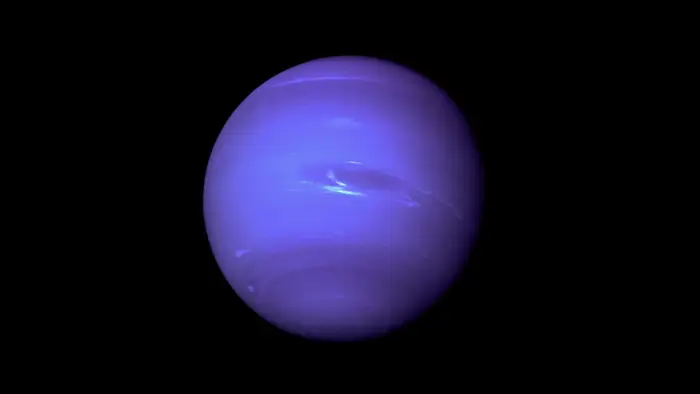
There are precedents in our own solar system for winds that reshape a world. On Jupiter, alternating jet streams carve the banded clouds into chevrons and ovals, and the Great Red Spot — a storm wider than the Earth — is itself a deformation driven by circulation. On Neptune, the fastest winds in the solar system, screaming past 2,000 kilometers per hour, sculpt a deep blue atmosphere into streaks and dark spots. What Webb has done is extend that kind of dynamical reasoning to a world no human instrument will ever visit, and shown that the same equations hold.
Tidal Locking: One Face to the Fire
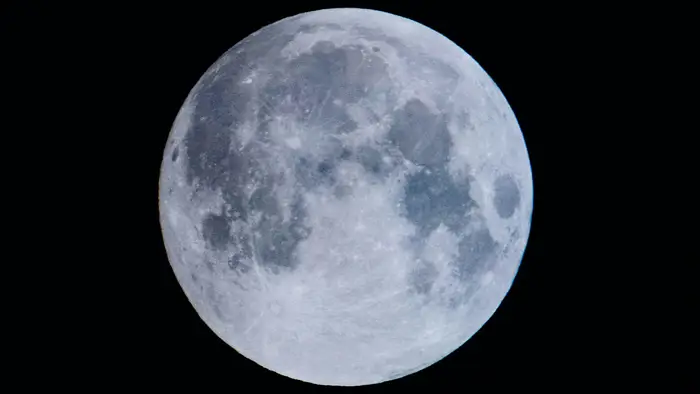
The geometry that makes WASP-17b’s shape possible also makes it inevitable. A planet this close to its star cannot escape tidal locking: the gravitational grip of the star has long since slowed the planet’s rotation until it turns exactly once per orbit, presenting the same face to the star forever. Our own Moon is tidally locked to the Earth in precisely the same way, which is why the far side of the Moon was unseen until the space age.
On a tidally locked hot Jupiter, the consequences are far more dramatic than lunar phases. The permanent dayside receives a constant, unrelenting flood of radiation; the permanent nightside radiates its heat into the dark and receives almost none. Without atmospheric circulation, the dayside would be incandescent and the nightside frozen. The planet survives the imbalance by moving heat — and the motion of that heat is exactly what deforms it.
This is why the team attributes the egg-like silhouette to the combined effects of stellar irradiation and the equatorial jet. The dayside atmosphere, heated from above, expands; the jet carries that expanded gas around to the nightside, stretching the silhouette; and the uneven strength of the winds on different sides of the planet produces the observed asymmetry. Every bump and stretch in the reconstructed outline is, in effect, a weather report written in geometry.
Webb’s Growing Playbook
The WASP-17b result arrives in the middle of a remarkable run for exoplanet science with Webb. The telescope, launched in 2021, has moved the field from detection to characterization at a pace that would have seemed implausible a decade ago. Transmission spectroscopy — reading the composition of an exoplanet’s atmosphere from the starlight filtered through it — has matured into a routine tool. Emission spectroscopy, eclipse mapping, and phase-curve analysis have followed. Transit mapping is now the newest entry in that playbook, and arguably the most geometric: it does not just ask what the atmosphere is made of, but what the planet looks like.
The method’s promise extends well beyond hot Jupiters. The same segmented-limb analysis could be applied to the growing catalog of transiting sub-Neptunes and super-Earths, where atmospheric escape, cloud formation, and composition gradients may leave their own signatures in the shape of the limb. For the most tantalizing targets — potentially rocky planets in the habitable zones of their stars — any asymmetry in the limb could hint at patchy clouds, terminator hazes, or day-night contrasts that bear on habitability itself. Those measurements will demand far more observing time and even greater precision than WASP-17b required, but the proof of concept is now in hand.
There is also a pleasing symmetry in the story of this particular planet. WASP-17b has been, since its discovery in 2009, a kind of Rosetta Stone for hot Jupiter science: one of the first transiting planets found from the ground, one of the first shown to have quartz clouds from space, and now the first whose true shape has been measured. Each generation of instruments has peeled back another layer — first the existence of the world, then the chemistry of its skies, now its very form.
The Kicker: Seeing Is Believing
Astronomy is often described as the science of the unseeable: black holes inferred from orbits, dark matter from gravity, exoplanets from wobbles and dips in starlight. The WASP-17b study fits squarely in that tradition, yet it also pushes against it. Nobody will ever photograph this egg-shaped world directly — it is a pinprick of light drowned in stellar glare, 1,300 light-years away. But the team did something almost as good: they measured the shadow it casts, edge by edge, and let the shadow draw the planet.
It is worth pausing on what that means. Every artist’s impression of an exoplanet you have ever seen — the swirling gas giant, the lava world, the blue marble around another sun — has been exactly that: an impression, painted from spectra and models. The silhouette of WASP-17b is different. It is not painted. It is derived, limb segment by limb segment, from the way real starlight bent through a real atmosphere. The egg is the first exoplanet portrait that is also a measurement.
And it will not be the last. As Webb continues its mission and as new observatories join the hunt, the technique demonstrated this week can be refined, automated, and aimed at fainter targets. Planets, it turns out, really are three-dimensional objects — and astronomers have finally learned how to see them that way.
Sources: The Debrief (October 15, 2026) reporting on the Nature Astronomy paper by Lili Alderson et al.; NASA Science exoplanet catalog entry for WASP-17 b; NASA/STScI description of Webb’s 2023 quartz-cloud observations of WASP-17 b.