Terran R Structural Qualification November 2026: Relativity's Giant Reusable Rocket Clears Its Final Ground Tests
Relativity Space’s Terran R has spent years as a set of promises on a web page: a 3D-printed, reusable, medium-to-heavy lift rocket that would carry 23.5 metric tons to orbit and give the United States a new workhorse just as its existing fleet shows signs of strain. This week, the promises started turning into hardware. The company’s second stage has now fired for the full length of a mission burn, every primary structure of the first flight vehicle has passed structural qualification, and the launch pad in Florida is nearly ready to receive the rocket.
The progress report, published by NASASpaceflight on November 19 and drawn from Relativity’s own October 2026 company update, describes a program moving on three fronts at once: testing in Mississippi, assembly in California, and pad construction in Florida. None of it is a launch date. Relativity has not named one, and the first flight remains targeted for late 2026 on the company’s public schedule. But the milestones reported this week are the ones that have to happen before any date can be believed: the engines have fired, the structures have been crushed and shaken to beyond flight loads, and the ground systems are being proven out one subsystem at a time.
For an industry watching the American launch market tighten — with ULA’s Vulcan grounded after its November 15 failure and SpaceX’s Falcon 9 carrying a load no single rocket was meant to bear alone — the timing matters. Terran R is not yet a rocket that has flown. After this week, it is a rocket that has been tested like one that is about to.

A second stage that fired for the full mission
The headline test took place at NASA’s Stennis Space Center in Mississippi, on the historic A2 test stand. In October, Terran R’s flight-one second stage completed a 10-second hot fire there — the first stage-level test on A2 since 1970. The stand was built in the 1960s to test the S-II second stage of the Saturn V for the Apollo program, and was later reconfigured to test individual Space Shuttle main engines. After more than half a century, it is firing rocket stages again.
According to Relativity, the test day went cleanly: teams loaded propellant and helium and “moved into terminal count without a hold” before firing the single Aeon V vacuum engine for the planned 10 seconds. That short firing was only the opening act. Engineers then reconfigured the stage into a flight-representative setup for longer-duration testing, culminating in a mission duty cycle hot fire lasting more than 400 seconds — the full burn duration the upper stage will need during a flight in the vacuum of space — completed successfully on the first attempt.
A 10-second firing proves an engine lights and a stage holds together. A 400-second firing proves the stage can do its actual job: push a payload all the way to orbit, with propellant sloshing, temperatures shifting, and turbomachinery running for minutes rather than seconds. Passing the mission duty cycle on the first attempt is the kind of result test engineers dream about and rarely get, and it removes one of the largest remaining technical risks from the program. Elsewhere at Stennis, acceptance testing continues on the R stand for the Aeon R engines that will power flight two.
The choice of test site is itself part of the story. Relativity did not build a new stand for this campaign; it returned a piece of Apollo-era infrastructure to service. The A2 stand last supported stage testing during the Apollo program, and its revival for Terran R connects the newest American rocket program to the oldest test infrastructure in the country’s spaceport system. For a company whose entire pitch is doing more with less — printing rocket parts instead of machining them, iterating fast instead of perfecting slowly — borrowing a proven stand rather than building a new one fits the pattern.
The first stage takes shape in Long Beach
While the second stage was firing in Mississippi, the first stage was coming together at Relativity’s headquarters and factory in Long Beach, California. The stage is nearing structural completion, and the milestone that dominated October was the breakover of its thrust structure: engineers rotated the assembly from vertical to horizontal for the first time, with all 13 Aeon R engines, their fluid lines, and the avionics that control the vehicle installed in one compact structure.
Breakover sounds like a simple rotation. In practice it is one of the most delicate operations in rocket assembly: a fully engined thrust structure is heavy, unwieldy, and full of precisely routed plumbing, and turning it on its side is the moment when every bracket, line, and connector proves it was installed correctly. Completing breakover kicked off mating operations with the first stage’s tankage, and Relativity’s in-house paint team has begun applying the stage’s livery — a small, visible sign that a piece of hardware is transitioning from assembly to flight article.
The interstage — the structure that connects the two stages and shields the upper-stage engine — has been through its own trial. At the factory test yard in Long Beach, it completed protoflight testing on Relativity’s structural test stand, nicknamed the “Tender Loving Crusher.” The campaign applied millions of pounds of compressive load, along with punch loads on the grid fins, loads across the raceway fluids, the liquid oxygen vent, and nearby composite overwrapped pressure vessels, plus preloads on each of the stage separation latches. Both the punch loads and the latch preloads exceeded expected flight levels. The results confirmed the interstage is ready for the structural demands of launch, and — critically — the campaign closed out the structural qualification of all primary structures for Terran R’s first flight.
That sentence is the one that matters most in the whole update. Structural qualification is the gate that says a rocket’s bones can take the loads of flight. With the interstage cleared, every primary structure on flight one has now passed. What remains is integration and testing of the assembled vehicle, not proof that its parts can survive.
Work continues in parallel on the parts of the first stage that will bring it home. Technicians are bonding the thermal protection system to the interstage, and welding is under way on the lattice-shaped grid fins — the control surfaces that steer the first stage during re-entry. Terran R’s first stage was designed for reuse from the start, and the grid fins are a key part of that architecture, guiding the booster back toward a propulsive landing on a downrange droneship. Production for future vehicles is already moving: all flight-two engine builds are complete, and circumferential friction stir welds on the flight-two barrels continue to progress.
Terran R by the numbers
Terran R is a substantial machine — far larger than the Terran 1 that preceded it, and closer in scale to a Falcon Heavy core or Blue Origin’s New Glenn than to the small launchers that defined Relativity’s early years. The figures below come from Relativity’s published vehicle specifications.
| Specification | Terran R |
|---|---|
| Height | 86.6 m (284 ft) |
| Diameter / payload fairing | 5.4 m (17.7 ft) |
| Stages | 2 |
| First-stage engines | 13 × Aeon R (LOX / methane) |
| Second-stage engine | 1 × Aeon V vacuum engine |
| Total liftoff thrust | 3,497,000 lbf (15,555 kN) |
| Single Aeon R sea-level thrust | 269,000 lbf |
| Aeon V vacuum thrust | 323,000 lbf |
| Payload to LEO, downrange landing | 23,500 kg |
| Payload to LEO, expendable | 33,500 kg |
| Payload to GTO, downrange landing | 5,500 kg |
| Launch site | Launch Complex 16, Cape Canaveral Space Force Station |
| First flight | Targeted for 2026 |
The payload figures carry an important distinction. With the first stage recovered on a droneship downrange, Terran R is rated for 23,500 kilograms to low Earth orbit. Flown expendable — the booster sacrificed — that rises to 33,500 kilograms. The 10,000-kilogram gap is the price of reusability: the propellant reserved for the boost-back, re-entry, and landing burns. It is also the reason the reusable figure, not the expendable one, is the number that matters for the rocket’s economics. Relativity’s business case depends on flying the same first stage repeatedly, and the 23,500-kilogram figure is the one its customers will actually buy.
The engines tell a similar story of scale. Each Aeon R produces 269,000 pounds of sea-level thrust, and 13 of them together deliver 3,497,000 pounds at liftoff — roughly five times the thrust of the Aeon 1 engines that powered Terran 1. The Aeon R went from design to qualification in 14 months, according to Relativity, and the engines burn liquid oxygen and liquid methane in a gas-generator cycle. Methane matters for reuse: it burns cleaner than kerosene, leaving less soot and coking inside an engine that is supposed to fly again, and it can be produced on Mars — a fact that matters to a company whose founding mission is building humanity’s multiplanetary future.
At 86.6 metres tall, Terran R is more than twice the height of Terran 1, which stood about 33 metres. It is taller than a 25-storey building, with a 5.4-metre diameter that matches the width of its payload fairing. The size is deliberate: Relativity is not building a bigger small rocket. It is building a medium-to-heavy lift vehicle aimed squarely at the market now served almost entirely by Falcon 9 — satellite constellations, government missions, and lunar cargo.
Launch Complex 16: the pad catches up
A rocket is only half a launch system. The other half is the pad, and at Launch Complex 16 at Cape Canaveral Space Force Station, Relativity’s renovations are nearing completion. The site is the same pad Terran 1 flew from, rebuilt for a rocket more than twice as tall.
On the launch mount, steel framing is complete on the launch table. The down conductor towers for the lightning protection system have reached their full height — 161-metre towers that will soon be strung with overhead catenary wires to form a protective canopy over the pad. Once those cables are tensioned and topped with air terminals, engineers will tie the surrounding pad structures into the main grounding grid, run electrical resistance tests to verify that lightning strikes dissipate safely into the 30-metre foundations, and secure final range safety sign-off ahead of launch operations.
The transporter erector — the machine that will carry Terran R from the horizontal integration facility to the pad and raise it upright on the launch mount — is also taking shape. The second stage’s fluid systems have been installed in the upper strongback, and the second of a pair of massive hydraulic lift cylinders has arrived on site. Those cylinders provide the force that brings the vehicle from horizontal to vertical. At the propellant farms, teams have cryo-shocked the liquid oxygen tanks, filling them with cryogenic fluid to verify they can withstand the extreme cold before being commissioned. The horizontal integration facility itself is now wearing Relativity’s name, with a freshly painted logo on the building.
Because Terran R is horizontally integrated, the flow at LC-16 will look different from the vertical assembly familiar at most Cape pads. The rocket will be put together lying down, rolled to the pad on the transporter erector, and raised onto the launch table — a process closer to how SpaceX handles Falcon 9 than to the towering vertical integration of Vulcan or SLS. It is a quieter kind of pad, built for cadence rather than ceremony.
A manifest takes shape
Hardware milestones are only half the story of a new rocket. The other half is whether anyone wants to fly on it — and here, too, November brought news. On November 7, NASA awarded Impulse Space a firm-fixed-price task order under its Venture-Class Acquisition of Dedicated and Rideshare (VADR) contract, calling for Impulse’s Helios kick stage and a lunar lander to fly aboard Terran R beginning in 2028. Impulse will serve as the prime contractor supporting NASA’s Moon Base program, using Terran R to launch the vehicles into orbit, then deploying the payloads into target cislunar orbits and testing cargo delivery near the lunar south pole.
The award was one of six task orders worth a combined roughly 1.3 billion dollars under VADR, announced by NASA during its MAX POWER event at Cape Canaveral. The full slate shows how NASA is spreading its lunar logistics across the emerging launch market: SpaceX’s Falcon 9 will fly two missions, Blue Origin will fly three New Glenn missions, and the Impulse–Relativity pairing will fly the Terran R missions. The VADR awards represent an evolution in how NASA buys missions — a buy-now, payload-later approach that lets the agency reshuffle cargo as hardware matures, rather than locking a payload to a rocket years in advance. “When you’re trying to scale up to what we’re talking about today, you want to have the flexibility to move pieces around,” NASA Administrator Jared Isaacman said during the briefing.
The same event unveiled the next phase of the Commercial Lunar Payload Services program: CLPS 2, a 10-year contract worth up to 10 billion dollars combined, built for a new generation of landers carrying two to six metric tons. Eight companies made the cut to compete for lunar deliveries, including Blue Origin, Firefly Aerospace, Intuitive Machines, Lockheed Martin, Northrop Grumman, SpaceX, and the newcomers Northrop Grumman and ispace-U.S. alongside Voyager Technologies. The Terran R–Helios missions sit squarely in this ecosystem: a heavy-lift rocket feeding a kick stage feeding a lander, each piece built by a different company, all of it aimed at the same lunar south pole.
That ecosystem is the context in which Terran R’s debut matters. The rocket’s first flight will carry no NASA lunar cargo — flight one is a test, and test flights carry test payloads. But the manifest behind it is no longer hypothetical. A lunar assignment beginning in 2028 gives Relativity a deadline that is also a destination: the rocket has to be flying, and flying reliably, within about two years of its debut.
Timeline: from a 3D-printed first flight to a heavy-lift debut
Terran R’s story begins with a smaller rocket that never reached orbit — and that is exactly the point. Relativity’s path to a heavy-lift vehicle runs through the lessons of Terran 1.
| Date | Milestone |
|---|---|
| February 2021 | Relativity announces Terran R, a larger reusable rocket to follow Terran 1 |
| July 2022 | Relativity and Impulse Space announce a Mars-bound payload for Terran R’s first flight |
| March 22, 2023 | Terran 1 flies its only mission, “Good Luck, Have Fun,” from LC-16; it survives Max-Q and stage separation but a second-stage anomaly prevents orbit |
| April 12, 2023 | Relativity retires Terran 1 and shifts all focus to Terran R |
| September 2024 | Terran R’s diameter is refined from 5.5 m to 5.4 m in the final configuration |
| October 2026 | Terran R’s flight-one second stage completes a 10-second hot fire on Stennis’s A2 stand, its first stage-level test since 1970 |
| November 7, 2026 | NASA awards Impulse Space a VADR task order to fly Helios and a lunar lander on Terran R beginning in 2028 |
| November 16, 2026 | Relativity publishes its October company update, reporting breakover and interstage qualification complete |
| November 19, 2026 | NASASpaceflight reports the second stage’s mission duty cycle hot fire — more than 400 seconds, first attempt — and the close of structural qualification for all primary flight-one structures |
| 2028 | Impulse lunar missions on Terran R scheduled to begin |
The Terran 1 flight deserves a closer look, because it explains both the rocket that followed and the company that built it. On March 22, 2023, the 33-metre Terran 1 lifted off from Launch Complex 16 on its inaugural test flight, carrying no satellites — only a 3D-printed ring as a memento. The rocket was about 85 percent 3D-printed by mass, the first orbital-class launcher primarily manufactured with additive manufacturing, and the first American launch vehicle of its size to burn methane. It survived Max-Q, the phase of flight where aerodynamic loads peak, and its stages separated cleanly. Then, about three minutes in, the second stage’s Aeon engine sputtered and failed to reach full thrust. The rocket reached a top speed of about 4,600 miles per hour — far short of the roughly 17,000 needed for orbit — and its remains fell into the Atlantic about 400 miles east of Canaveral.
Relativity called the flight a success anyway, and in the narrow sense it was: the stated objective was to gather data at Max-Q and achieve stage separation, and both happened. Three weeks later, the company retired Terran 1 outright. The decision was blunt and, in retrospect, correct. A 1,250-kilogram payload capacity, sold at 12 million dollars a launch, could not compete in a market where Falcon 9 was flying reused boosters for less per kilogram. Terran R — bigger, reusable, aimed at the medium-heavy market — was the rocket the market actually wanted. Everything since has been the long work of building it.
Why the timing matters
Terran R is arriving at a moment when the American launch market has rarely been tighter. ULA’s Vulcan Centaur has been grounded since its November 15 failure, which destroyed 40 Amazon Leo satellites minutes after liftoff, and the investigation into that failure is still under way. SpaceX’s Falcon 9 has absorbed much of the slack — the Space Force moved six launches to SpaceX as Vulcan stayed grounded — but analysts have warned that the strategy of shifting missions to SpaceX is near its limit, with Falcon 9 approaching its flight-rate ceiling and no certified successor yet available. The Pentagon has begun hedging, with loans to Rocket Lab and Stoke Space aimed at building alternative capacity.
That context is the opening Terran R was designed for. It is also the reason the rocket’s debut carries more weight than a typical first flight. A successful Terran R does not just add a rocket to the market; it adds a second American medium-heavy lift option at the exact moment the market has effectively one. Its competitors are not standing still — Rocket Lab’s Neutron, the most direct rival in the medium-lift class, has slipped to 2027 after tank troubles, and Blue Origin’s New Glenn is still working through its own certification path — but Terran R’s progress this week puts it visibly ahead of the pack of would-be Falcon 9 rivals. The second stage has fired for a full mission. The structures are qualified. The pad is nearly ready.
None of that guarantees a launch this year. First flights of large new rockets rarely hold their dates, and Relativity has not announced a firm one. What the November updates guarantee is narrower and more important: the hardware has passed the tests that cannot be faked. A rocket that has survived millions of pounds of compressive load and a 400-second burn is a rocket that exists. The remaining question is whether the assembled vehicle, the pad, and the range can come together on schedule — and that is a question of integration, not of invention.

What still stands between Terran R and liftoff
The work ahead is substantial, and Relativity’s own updates describe it plainly. The first stage’s thrust structure must finish mating to its tankage, and the fully assembled first stage must then go through its own hot-fire campaign — the test that has not happened yet and that will be the next major milestone to watch. The second stage, having passed its mission duty cycle firing, needs its flight configuration finalised. At the Cape, the lightning protection system needs its catenary wires strung and its grounding grid proven, and the range must give its final safety sign-off before any launch can proceed.
There is also the question of the first flight’s payload. The July 2022 plan to fly an Impulse Mars-bound payload on the debut mission has long since evolved, and neither Relativity nor Impulse has publicly confirmed what flight one will carry. Test flights of new rockets typically fly mass simulators or low-risk payloads, and Terran R’s first launch will be judged not by what it carries but by whether the vehicle reaches orbit and the first stage comes back. The 23,500-kilogram reusable payload figure, the 33,500-kilogram expendable figure, and the 3,497,000 pounds of thrust are all paper numbers until the rocket flies with them.
The honest way to read this week’s news, then, is as a progress report rather than a countdown. Relativity has cleared the ground-test gates that stood between design and flight. The structures are qualified, the second stage has burned for a full mission, and the pad is nearly complete. What remains is the assembly of the whole — stage one mated, stages stacked, vehicle rolled out, and a static fire of the full first stage — followed by the launch itself. Each of those steps is routine for an established rocket and novel for a new one, and each will be watched closely by an industry that needs this rocket to work.
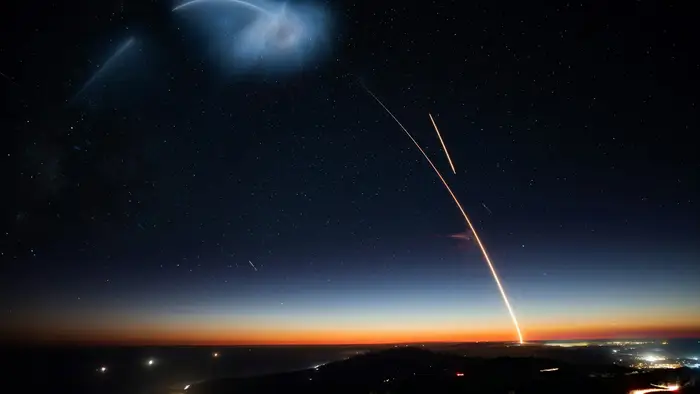
For now, the story of Terran R is the story of a company that bet everything on a bigger rocket after its first one fell short — and is now, three and a half years later, close enough to the pad to see it. The arc of a rocket’s exhaust across a dusk sky is easy to photograph. Getting a new one to draw that arc for the first time is the hard part. This week, Relativity got measurably closer.

The satellites Terran R is built to carry — constellations, government payloads, and lunar cargo — are the reason the rocket’s debut matters beyond Relativity itself. Every month of delay is a month the market waits for a second heavy-lift option.