Perseverance Finds Corundum on Mars: Rubies Hiding in Jezero Crater
NASA’s Perseverance rover has found something no one expected to find on Mars: the mineral that makes rubies. Firing its SuperCam laser at three small, pale rocks on the rim of Jezero Crater, the rover caught a faint red glow that could only come from chromium trapped inside corundum — the same mineral that, on Earth, becomes a ruby when chromium colours it red and a sapphire when iron and titanium turn it blue. No gemstone has turned up, and none is likely to. The crystals are microscopic, smaller than four tenths of a millimetre across, far too small for the rover’s cameras to pick out. But their presence, confirmed in a peer-reviewed paper and described by NASA in a blog post this month, tells a story about ancient Mars that no one had expected to hear: somewhere in the planet’s deep past, rocks were heated to hundreds of degrees and squeezed hard enough to grow a mineral that Mars, a world without plate tectonics, was not supposed to make.
The discovery is the kind of result that rewards patience. The first hint arrived two years ago, when the SuperCam team shot a light-coloured rock with the rover’s laser and watched an unfamiliar signal come back. It took a careful programme of night-time measurements, laboratory comparisons with real rubies, and a paper led by Ann Ollila of Los Alamos National Laboratory, published in Geophysical Research Letters on August 11, 2026, before the team was confident enough to name the mineral. NASA’s SuperCam principal investigator, Roger Wiens of Purdue University, described the find in a NASA blog post titled “Rubies on Mars?” dated November 4, 2026. “While we haven’t found collectable rubies on Mars yet,” he wrote, “the little corundum crystals are helping us learn more about Mars’ past.”
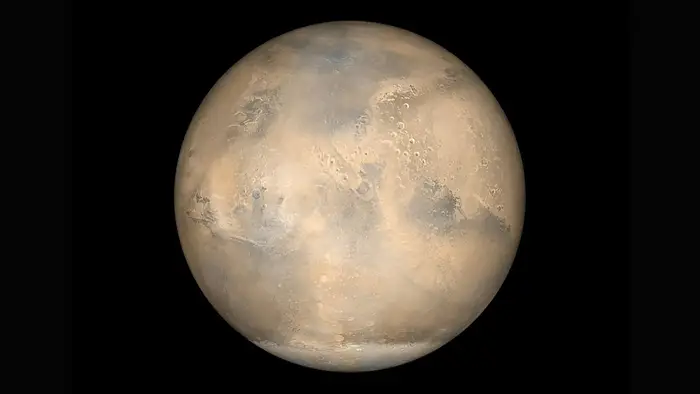
Mars, the red planet, where Perseverance found corundum in rocks on the rim of Jezero Crater. Image: Unsplash.
A red glow in the dark
Corundum in its pure form is colourless. It is aluminium oxide, a hard, transparent mineral, and it only becomes a gemstone when trace elements slip into its crystal structure. Chromium makes it red — ruby. Iron and titanium make it blue — sapphire. Chromium does something else that matters enormously to a rover working 200 million kilometres from home: when laser light strikes it inside corundum, it glows.
That glow is the whole detection. SuperCam, the laser instrument on Perseverance’s mast, can do more than zap rocks to read their chemistry. As a side benefit of the way it performs Raman spectroscopy, it can also study time-resolved luminescence — the light a material gives off after a laser pulse, and how long that light lasts. Most luminescence is broad and smeared across many wavelengths. What the team saw in three Martian rocks was the opposite: strong, narrow peaks at two precise wavelengths, 692.7 and 694.1 nanometres, deep in the red, near the 700-nanometre edge of what the human eye can see.
The measurements were made at night. SuperCam fires a pulsed laser with a wavelength of 532 nanometres at the target rock, then records the light the rock gives off in response and how quickly that light fades. In all three rocks, the response carried the two strong red peaks, and where those peaks were strong, weaker corundum lines appeared too, at about 699.4, 701.5, 704.7 and 707.3 nanometres. The pattern is the fingerprint of chromium sitting inside corundum, and the team argues it is distinctive enough to identify the mineral on its own.
The timing sealed the case. After the laser fired, the glow from one of the rocks, Smiths Harbor, faded with a lifetime of about 3 milliseconds — three thousandths of a second. That value falls between the lifetimes measured from two ruby samples on Earth, and the team calls it the final piece of evidence for corundum. Before SuperCam was installed on Perseverance, the team placed a ruby in the laser beam and watched the entire room pulse a brilliant red as the beam hit the gemstone. Wiens recalls that it was extremely bright. On Mars, the same physics played out at a whisper, in grains too small to see.
There is one honest caveat, and the team states it plainly. The glow needs only a trace of chromium, and sapphire measured in the laboratory gives a matching signal, so the result does not tell the team what colour the Martian grains are. They may be red, they may be blue, they may be colourless. Nobody will know until a sample comes home — and that, as it happens, is exactly the question the corundum rocks now pose to the future of Mars exploration.
Three rocks on the crater rim
The corundum turned up in three centimetre-sized rocks named Hampden River, Coffee Cove and Smiths Harbor. They are light-toned float rocks — a geologist’s term for loose pieces that are no longer attached to bedrock — found on the rim of Jezero Crater, the 45-kilometre-wide impact crater where Perseverance landed in February 2021. Two of the rocks lay a few metres apart. The third was about 100 metres, roughly 330 feet, to the south.
SuperCam studied them in March, April and July 2025. The paper covers rocks analysed through early July 2025, so anything the rover has measured since then is not in it. That matters, because the team has changed its habits since the discovery. Earlier in the mission, the team tried the time-resolved luminescence technique only rarely. Lately, Wiens writes, they have carried out the observations frequently on light-toned rocks, looking for more evidence of what impacts did to this ancient terrain.
The most recent example sits in the rover’s latest images. A heavily pitted, light-toned loose rock nicknamed Nhlanguleni, photographed by Perseverance’s WATSON camera on October 29, 2026, at a spot called Kapama Karula, is exactly the kind of target the team now tests with the laser technique that found corundum. Nhlanguleni is not one of the three rocks where corundum was found. But it shows how the discovery has rewired the rover’s daily science: pale rocks that once would have been passed by are now prime suspects.
The three corundum-bearing rocks are small, but their setting is large. They lie near rocks the team interprets as impact breccias — rocks made of broken fragments welded together by the violence of an impact — on the rim of Jezero itself, a crater gouged out by an ancient asteroid strike. That setting is the first clue to how the corundum got there, and it points to the most dramatic process in Martian geology: the impact itself.
The night sky over Jezero Crater is dark enough for SuperCam’s laser to catch the faint red glow of chromium in corundum. Image: Unsplash.
A mineral that should not be there
Corundum is a demanding mineral. It forms where rock is rich in aluminium and poor in silicon, and it needs temperatures above about 350 to 400 degrees Celsius — roughly 660 to 750 degrees Fahrenheit. That kind of heat and pressure is found in deep magma, or in shallower rock heated by tectonic processes or by meteorite impacts. On Earth, one of the main ways corundum forms is where one tectonic plate sinks beneath another, carrying rock down into the planet’s hot interior. Mars has no such machinery. As Wiens puts it, corundum is a mineral the team would not expect to find on Mars, a planet that lacks plate tectonics. The paper states the Mars side more carefully: there is no conclusive evidence that plate tectonics ever occurred there.
So how did it form? The team’s favoured explanation is metamorphism — the changing of rock by heat and pressure — caused by a large impact, likely with fluids at some stage. A big impact does more than dig a crater. It fractures the crust for kilometres around, it heats rock, and the heat can linger for a long time, driving hot water through the broken stone and rearranging its minerals. Because Perseverance is working in very ancient terrain near the rim of Jezero, Wiens writes, the team can expect some evidence of localised metamorphism. As the first mission in such terrain, he adds, “we are learning new things.”
The authors are careful not to overclaim. They call impact metamorphism the most plausible scenario, but they describe the evidence as sparse and the case for an impact as circumstantial, and they do not exclude other origins. Corundum can also form in magma, or where fluids move elements between two different kinds of rock. The identification itself, however, rests on firmer ground. SuperCam’s chemistry and Raman measurements of the same rocks showed no sign of corundum, which the team takes to mean the grains are small, rare, or both — consistent with the size limit of less than about 200 to 375 microns. The two peaks and their lifetime, the authors argue, are distinctive enough to identify the mineral on their own.
That restraint is part of why the result is convincing. The paper lists 44 authors. The claim is narrow — three rocks, one technique, one mineral — and the interpretation is flagged as provisional. What is not provisional is the surprise: a mineral that needs the kind of heat Mars was not supposed to deliver, sitting in loose stones on the rim of a crater the rover has been climbing for years.
The numbers behind the glow
Every figure in the detection comes from the SuperCam team’s own measurements, published in Geophysical Research Letters and summarised by NASA. Put together, they show how much information a rover can extract from a flash of light three thousandths of a second long.
| Measurement | Value | What it means |
|---|---|---|
| Rocks containing corundum | 3 — Hampden River, Coffee Cove, Smiths Harbor | First corundum ever identified on Mars |
| SuperCam laser wavelength | 532 nanometres | Green pulsed laser fired at night |
| Strong luminescence peaks | 692.7 and 694.1 nanometres | Red light from chromium in corundum |
| Weaker corundum lines | 699.4, 701.5, 704.7, 707.3 nm | Supporting fingerprint of the mineral |
| Glow lifetime (Smiths Harbor) | About 3 milliseconds | Falls between two Earth ruby samples |
| Upper limit on grain size | Under 200–375 microns | Less than 0.4 mm; too small for the camera to resolve from 2.4–5 m |
| Temperature corundum needs | Above 350–400 °C (660–750 °F) | Heat of deep magma or impact metamorphism |
| Width of Jezero Crater | 45 kilometres (28 miles) | Ancient impact crater; Perseverance’s landing site |
| Rocks analysed in the paper | Through early July 2025 | Measurements from March, April and July 2025 |
| Authors on the paper | 44 | Led by Ann Ollila, Los Alamos National Laboratory |
The size limit deserves a closer look, because it explains why no one has seen this mineral on Mars before. SuperCam’s camera can resolve details down to about 200 to 375 microns from 2.4 to 5 metres away, and the grains are smaller than that. From the rover’s mast, the corundum is invisible. Only the laser’s red glow betrays it — and only at night, when the Sun is not flooding the rock with light. It is a reminder that the most interesting things a rover finds are not always the things it can photograph. Sometimes the instrument that matters is the one that listens for light the eye cannot separate from the dark.
Timeline: from laser flash to public announcement
The corundum story unfolded slowly, which is normal for a result that had to survive laboratory comparison and peer review before anyone would believe it.
| Date | Milestone |
|---|---|
| February 2021 | Perseverance lands in Jezero Crater to study the rock record of ancient Mars |
| About two years before publication | SuperCam team is startled by strong, narrow luminescence peaks at 692.7 and 694.1 nm from a light-coloured rock |
| March–July 2025 | SuperCam studies Hampden River, Coffee Cove and Smiths Harbor with time-resolved luminescence |
| Early July 2025 | Cut-off for rocks analysed in the published paper |
| August 11, 2026 | Ollila et al. paper published in Geophysical Research Letters (DOI: 10.1029/2026GL122537) |
| August 13, 2026 | ScienceAlert reports the find, calling it “very unexpected” |
| October 29, 2026 | WATSON camera photographs Nhlanguleni, a light-toned rock now routinely tested with the same laser technique |
| November 4, 2026 | NASA publishes Roger Wiens’ blog post “Rubies on Mars?” |
| November 9, 2026 | NASA publishes a mission update: Perseverance’s newest sample, “Singita”, may be among the oldest rocks in its collection |
The gap between the first flash and the announcement is not a delay; it is the work. A single strange signal is a curiosity. The same signal in three rocks, with a lifetime that matches Earth rubies and weaker lines in the right places, is a discovery. And a discovery published in a peer-reviewed journal, with the instrument’s principal investigator explaining it in public, is a result the field can build on.
Why three tiny crystals matter
It is fair to ask why anyone should care about mineral grains smaller than a grain of sand on a planet no human has visited. The answer has three parts, and each one reaches beyond the three rocks.
First, the corundum rewrites a small piece of Martian history. Jezero Crater is one of the most studied places on Mars: an ancient lake bed, a river delta, a landing site chosen because it once held water and might once have held life. The crater rim, where Perseverance now climbs, is older and rougher ground, shaped by the impact that made the crater and by whatever came after. Finding corundum there means that at least one corner of that terrain was heated past 350 degrees Celsius and held there long enough for a demanding mineral to grow. That is a fact about the planet’s thermal past that no orbiter could have delivered, because no orbiter can see grains this small, and no meteorite from Mars had ever shown corundum either. Until now, the mineral had not been identified on Mars from orbit, by a rover or lander on the ground, or in a meteorite from Mars. Perseverance’s laser changed that in a single night’s work, repeated three times.
Second, the detection proves a technique. Time-resolved luminescence was a side benefit of SuperCam’s design, not its headline job. The instrument’s main work is vaporising pinpricks of rock with its laser and reading the flash to measure chemistry, and using Raman spectroscopy to identify minerals. Luminescence was a bonus capability the team tried only rarely early in the mission. Now it is a tool with a proven result, and the team uses it frequently on light-toned rocks. Every future rover that carries a laser spectrometer inherits this lesson: the glow a rock gives off after the laser fires can reveal minerals that chemistry and Raman miss, because the grains are too small, too rare, or too scattered for the other methods to catch. The paper’s authors note that the same rocks showed no sign of corundum in SuperCam’s chemistry and Raman data. Without luminescence, the mineral would still be invisible.
Third, the find sharpens the case for bringing Mars rocks home. The authors write that a core sample from a corundum-bearing outcrop, returned to Earth, could settle how the mineral formed. On Earth, a laboratory could measure the grains’ chemistry, their isotopes, and the minerals around them with instruments no rover can carry, and distinguish impact heating from magma from fluid alteration. That is precisely the kind of question a sample-return mission exists to answer — and it arrives at a moment when NASA is rethinking how to get Perseverance’s samples back at all.
The sample-return connection
Perseverance has been collecting and sealing rock cores since it landed, leaving some in a depot on the Martian surface and storing others aboard the rover. The original plan to fetch them grew to a cost near 11 billion dollars, with Earth return not happening until 2040, and NASA cancelled it in 2024 as too expensive and too slow. This month, the agency began a fresh planning effort called the Perseverance Sample Retrieval Architecture, or PSRA, disclosed by Tiffany Morgan, director of NASA’s Mars Exploration Program, during a virtual meeting of the Mars Exploration Program Analysis Group on November 9, 2026. A PSRA strategy team will formally begin its work in January 2027, with a final report expected by the winter of 2027–2028.
The corundum rocks are not among the samples Perseverance has sealed — the three rocks are loose float, not bedrock, and the paper covers only measurements, not a cored sample. But the logic connects directly. A corundum-bearing outcrop is exactly the sort of target a future retrieval mission would want to sample, because only a returned core can answer the question the rover cannot: how did this mineral form? The same reasoning applies to the rover’s newest sample, “Singita”, collected after the rover’s 66th successful abrasion, “Pumbe”. Singita is the rover’s first sample in more than a year, and NASA’s November 9 mission update says it may be among the oldest rocks in Perseverance’s collection. Textures in the rock suggest it formed deep in the crust and was modified and excavated by at least one, and possibly multiple, large impact events — the same violent history the corundum points to.
There is a quiet symmetry here. The rover’s newest sample and its most surprising mineral both point to the same story: the oldest ground Perseverance has reached was forged and reworked by impacts, deep in the crust, long before Jezero held a lake. The rover climbed to the crater rim looking for the planet’s earliest chapters, and the rim is answering with rocks that record heat, pressure and violence on a scale the lake-bed sediments never saw. The struggle to bring those rocks home is now the bottleneck between a tantalising laser flash and a definitive answer, and the PSRA review is NASA’s attempt to break it — with China’s own Tianwen-3 sample-return mission adding pressure from the other side of the race.
Desert terrain under the Milky Way — the closest Earth analogue to the ancient, crater-rim ground Perseverance is now exploring. Image: Unsplash.
A rover still climbing
The corundum find arrives alongside evidence that Perseverance, nearly six years into its mission, is as capable as ever. The latest mission status report opens with the words “Perseverance remains healthy and stable on Mars” and lists spacecraft status as nominal. The rover has now completed its 66th successful abrasion, grinding a patch of rock flat so its instruments can read the fresh surface, and collected an intriguing new sample alongside it.
Getting that sample took the quality the rover is named for. An earlier abrasion, “Badger Peak”, resembled the new target “Pumbe” but had proved too hard to core. The team felt strongly that a gabbro — an igneous rock made mostly of calcium-rich plagioclase feldspar and pyroxene crystals — belonged in the collection, so Perseverance travelled about 100 metres to a different patch of light-toned rocks, where visual and chemical data showed a composition similar to Badger Peak. To improve the odds, the team chose a neighbouring rock with a flatter surface, better oriented for the drill stabilisers to press against, and used a coring bit with less wear. At last the drill made it about 3.1 centimetres — 1.2 inches — into the rock, and sample acquisition followed. That is the kind of patient, unglamorous problem-solving that keeps a rover productive years after landing, and it is the same patience that turned a strange laser signal into a published mineral discovery.
The driving behind all of this is worth remembering too. Perseverance has covered more ground than any rover before it, and its 45-kilometre driving record is the reason it could reach the crater rim at all. The corundum rocks, the gabbro sample, the light-toned patches — none of them would have been found if the rover had stayed on the crater floor. Mobility is what turned a lake-bed mission into a rim mission, and the rim is where the oldest rocks live.
Nor is the science standing still in other directions. A separate study published in the Proceedings of the National Academy of Sciences in late October 2026, led by Scott VanBommel of Washington University in St. Louis, examined dust collected on small swatches of spacesuit material Perseverance carries on its robotic arm. After 1,645 Martian days, the swatches showed little visible wear — Martian dust, the study suggests, may be less abrasive than lunar dust — but the rover also detected ultrafine particles around 100 to 300 nanometres across, roughly 700 times thinner than a human hair, that can remain attached to suit materials for years. It is a different kind of finding from corundum, and a practical one: the dust future astronauts breathe and carry into their habitats matters as much as the rocks they collect. Together, the two studies show a rover doing double duty as a field geologist and a pathfinder for the humans who may one day follow it.
What comes next
The immediate next step is more of the same patient work. The SuperCam team will keep turning its laser on light-toned rocks, looking for more corundum and more evidence of what impacts did to this ancient terrain. Each new detection, if it comes, will tighten the map of where metamorphism happened and how widespread it was. A single cluster of three rocks proves the mineral exists on Mars. A pattern of detections would start to prove how it formed.
The longer-term step belongs to the sample-return effort. A core from a corundum-bearing outcrop, analysed in a laboratory on Earth, could settle the formation question that the rover’s laser cannot. That is the promise the PSRA review now carries: find a workable way to fetch the samples Perseverance has already sealed, and the rocks the rover is still finding, before the trail goes cold. Until then, the corundum stays where it is — microscopic crystals in three small stones on a crater rim, glowing red for three thousandths of a second whenever a laser asks them to, waiting for someone to come and read the rest of the story.
And there is a wider lesson, one that applies well beyond Mars. The most powerful telescope in history, the James Webb Space Telescope, recently needed a new image-processing technique to pull a known exoplanet, 51 Eridani b, out of two-year-old data where standard methods saw only glare. Perseverance needed a side-benefit capability of its laser to pull a mineral out of rocks its other instruments could not read. In both cases the data was already there. What changed was the method. The sky, and the ground, keep more secrets than our first look reveals — and the patient re-examination of what we already have is, for now, the cheapest discovery programme in space science.
The reddish glow of a full moon — the same deep red, near 693 nanometres, that betrayed corundum on Mars. Image: Unsplash.
The red planet keeps its secrets — until it doesn’t
Mars has a habit of answering questions nobody asked. Perseverance went to Jezero Crater to read the record of an ancient lake, to look for signs of past life in river-delta mud. It found those sediments, and it is still finding them. But the mission’s most unexpected result so far came from the rim, from three loose stones that look like nothing special, in a place the rover reached only because it kept driving long after its primary mission was done. A mineral that needs the heat of deep magma or a giant impact, on a planet without plate tectonics, in grains too small to see, found by a laser’s afterglow in the dark.
That is the shape of exploration at its best: a tool used in a way its designers half-intended, a signal that looks like noise until it repeats, a team willing to spend two years checking before it speaks, and a result that opens a new question instead of closing one. The corundum does not rewrite Mars. It adds a paragraph to a history that is still being written, one laser pulse at a time — and it reminds us that the most interesting rocks on Mars may be the pale, unremarkable ones, lying a few metres apart on a crater rim, waiting for someone to shine a light on them after dark.
No one has found a gemstone on Mars. What Perseverance found is better: a clue. And clues, on a planet 200 million kilometres away, are the most valuable things a rover can bring home — even when home is still years away.

A blood moon, deep red against the dark — the colour of chromium glowing inside corundum, 200 million kilometres away. Image: Unsplash.
Sources
- NASA: “Rubies on Mars?” — Roger C. Wiens, SuperCam principal investigator
- NASA: “Newest Sample, Oldest Rock?” — Perseverance mission update, November 9, 2026
- CycleCalcs: “Perseverance finds corundum, the mineral of rubies, on Mars”
- Everything Space: “NASA launches new strategy review to rescue Mars Sample Return program”