Kuiper Belt Primordial Heavy Water November 2026: Twelve Dust Grains Point to an Ancient Ocean Beyond Neptune
Somewhere high above Earth, in the thin air of the stratosphere, NASA aircraft fly through a rain so fine that no one can see it. Every year, tens of thousands of tonnes of dust from space drift down through the atmosphere, and a small fraction of it is caught on collectors mounted under the wings of high-altitude planes. Most of those grains are anonymous — chips of asteroid, flakes of comet, fragments ground down by billions of years of collisions. But twelve of them, each smaller than the width of a human hair, have just told scientists something no telescope and no spacecraft has been able to confirm: far beyond Neptune, in the cold ring of icy worlds called the Kuiper Belt, there is water unlike any water in the inner Solar System — water heavy with oxygen isotopes that formed before the planets did, and which has stayed sealed away from the rest of the Solar System ever since.
The finding, published in the journal Science Advances on November 11, 2026, comes from a team led by planetary scientist Lindsay P. Keller of NASA’s Johnson Space Center, working with colleagues at the University of California, Los Angeles. It is a small study built on a small sample — twelve grains, each between 10 and 30 micrometres across — and the authors are careful about what it can and cannot prove. But the chemical signature inside those grains is so distinctive, and so different from anything found in meteorites that fell closer to the Sun, that the team calls it compelling evidence for a major reservoir of primordial heavy water beyond the orbits of the giant planets, a reservoir that was largely isolated from inner Solar System materials for the entire history of the Solar System.
It is a detective story told in dust, and it matters because of the oldest question in planetary science: where did Earth’s water come from? The oceans that cover most of our planet, the water in our bodies, the water that made life possible — none of it was here when Earth formed. The young Earth was too hot, and too close to the Sun, to hold on to much water at all. So the water must have arrived later, delivered by asteroids and comets that formed farther out, where ice could survive. But which ones? And from how far away? The twelve grains suggest that the outer Solar System kept its own, separate supply — and that the boundary between the two water worlds was drawn early, and held, by the giant planets themselves.
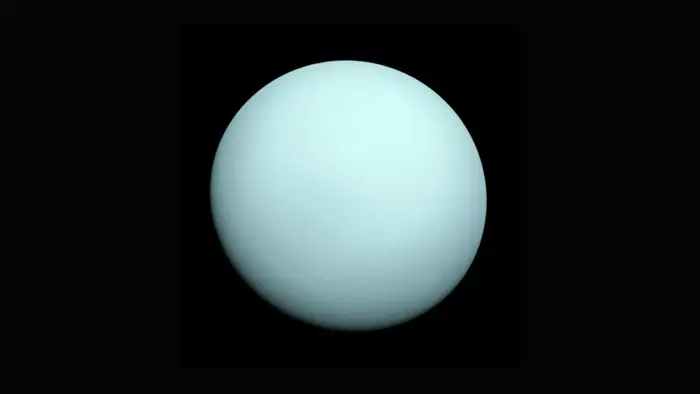
A belt of ice beyond Neptune
To understand why twelve grains of dust can say anything at all about the edge of the Solar System, it helps to picture what the Kuiper Belt actually is. Beyond Neptune, roughly 30 times farther from the Sun than Earth, lies a vast ring of icy bodies — dwarf planets like Pluto, Eris, Haumea and Makemake, and countless smaller worlds made mostly of frozen water, methane and ammonia, mixed with rock and dust. These are the leftovers of planet formation, bodies that never grew large enough to become planets and that have spent most of the Solar System’s history in a deep freeze, far from the Sun’s heat.
That cold is the whole point. Close to the young Sun, temperatures were too high for water ice to survive, and the rocky planets that formed there — Mercury, Venus, Earth and Mars — started out dry. Farther out, beyond a boundary astronomers call the snow line, water could freeze, and the building blocks of planets were rich in ice. The Kuiper Belt is the most distant, least processed storehouse of that original icy material. Unlike asteroids, which have been baked, battered and chemically reworked, Kuiper Belt objects are thought to preserve the chemistry of the Solar System’s earliest days almost unchanged.
The problem has always been getting a sample. No spacecraft has ever landed on a Kuiper Belt object, and only one — NASA’s New Horizons, which flew past Pluto in 2015 and the small world Arrokoth in 2019 — has ever visited the region at all. Bringing a piece of it back to Earth would take decades and billions of dollars. So Keller’s team took a different route: they waited for the Kuiper Belt to come to them.
Every day, dust from across the Solar System spirals slowly inward under the gentle pressure of sunlight, a process that can take millions of years to carry a grain from the Kuiper Belt to Earth. Some of that dust burns up as meteors. Some of it survives the fall and settles in the stratosphere, where NASA aircraft have been collecting it for decades. The team’s idea was to sift through that collection for grains that could be traced, by their scars, to the far outer Solar System — and then read the chemistry locked inside them.
How to read a grain of dust
The twelve grains at the heart of the study are hydrated interplanetary dust particles, each 10 to 30 micrometres across — about a third of the width of a human hair at the largest. They were drawn from NASA’s cosmic dust collection, gathered by high-altitude aircraft flying through the stratosphere, and they were chosen because of something written on their surfaces: an unusually dense pattern of radiation tracks.
When a dust grain spends millions of years drifting through space, energetic particles from the Sun slam into it and leave microscopic scars — narrow damage trails in its crystal structure, visible only under an electron microscope. The longer a grain has been exposed to space, and the farther it has travelled, the more of these tracks it collects. Earlier research had already linked unusually dense track patterns to a Kuiper Belt origin. Keller’s team measured the grains and found track densities around 100 times greater than expected for dust from the asteroid belt or from Jupiter-family comets — the two nearer sources that supply most of the dust reaching Earth. One grain examined in the study carried a track density of about five times ten to the tenth power per square centimetre, a battering no short journey could explain. The grains, in other words, had been travelling for a very long time, from very far away.
That alone would be interesting. What made the study remarkable was what the team found inside the grains. Using electron microscopy, chemical analysis and oxygen isotope measurements — the isotope work done with an ion microprobe at UCLA — the researchers discovered that the grains were made mostly of hydrated minerals: clays, including a water-bearing clay called saponite, along with magnesium- and iron-rich carbonates. Those minerals could only have formed one way: liquid water, or at least water-rich fluid, reacting with rock inside the grains’ parent bodies at low temperatures, long ago, before the grains were knocked loose and began their long drift sunward.
The water itself is long gone — boiled away or lost during the grains’ journey. But the oxygen that was once part of its molecules stayed behind, locked into the clay minerals. And oxygen, it turns out, keeps a record.
The oxygen fingerprint
Oxygen comes in three stable forms, called isotopes, which differ in the number of neutrons in their atomic nuclei. The commonest, oxygen-16, has eight protons and eight neutrons. The two heavier varieties, oxygen-17 and oxygen-18, carry one and two extra neutrons respectively. Water made with the heavier isotopes is a kind of heavy water — not the deuterium-rich heavy water of nuclear reactors, but water whose oxygen atoms are heavier than usual. And the proportions of these isotopes are not the same everywhere in the Solar System.
The reason goes back to the Solar System’s birth. In the cold outer reaches of the cloud that collapsed to form the Sun and planets, ultraviolet light broke apart carbon monoxide gas, freeing heavy oxygen to end up in water ice. Ice that formed far from the young Sun should therefore be enriched in oxygen-17 and oxygen-18, while material closer in should be lighter. In 2011, NASA’s Genesis mission, which collected particles of the solar wind and returned them to Earth, showed that the Sun itself contains proportionally more light oxygen than Earth and most meteorites — a result that, together with meteorite analyses, led scientists to predict that ice in the outer Solar System would be proportionally richer in heavy oxygen. The prediction was clear. The evidence was missing.
Hints existed. Evidence of this heavy form of water had been found in minerals from one primitive meteorite and in the comet 67P, the rubber-duck-shaped world visited by the European Space Agency’s Rosetta mission. But a single meteorite and a single comet could not settle the question of whether heavy water was common in the outer Solar System or whether something else explained those findings. Testable samples from the region were vanishingly rare — until twelve grains of dust changed that.
When Keller and his colleagues measured the oxygen isotopes in their grains, the numbers stood out sharply. They calculated a quantity called delta-17-O, written Δ17O, which measures the excess of oxygen-17 relative to a standard. In the grains, Δ17O averaged about plus 62 parts per thousand. Water inferred from carbonaceous chondrite meteorites — the most primitive meteorites in the collections, and the best available record of inner Solar System water — sits at roughly plus 3 to plus 7. The gap is enormous: the outer Solar System water implied by the grains is far richer in heavy oxygen than anything the inner Solar System can offer.
Working backwards through the chemical reactions that built the clays, the team estimated what the original water must have looked like. Their calculations indicated that the water’s oxygen-18 to oxygen-16 ratio would have been roughly 15 percent higher than the standard set by Earth’s oceans. That figure comes with an important qualification: the researchers describe it as a model-based upper limit, not a direct measurement. No one has ever held a sample of this water. The estimate rests on a mass balance that assumes a single main reaction built the clays — and in that reaction, only one oxygen atom in eight comes from water, which dilutes the signal — and it leaves out water held between the clay layers. The authors are explicit about these limits. But even as an upper limit, the number points in one direction: the outer Solar System’s water was different, and it stayed different.
The numbers that make the case
The study’s argument rests on a handful of measurements, each of them small in scale and large in implication. Set side by side, they show why twelve microscopic grains can carry so much weight.
| Measurement | Value | What it means |
|---|---|---|
| Grains examined | 12 hydrated interplanetary dust particles | The entire sample behind the finding |
| Grain size | 10 to 30 micrometres each | Smaller than a human hair; collected from Earth’s stratosphere by NASA aircraft |
| Radiation track density | About 100 times higher than dust from the asteroid belt or Jupiter-family comets | Consistent with a long journey from the Kuiper Belt |
| Carbon content | About 4 times the level in CI chondrites, the most primitive meteorites | Formed under different conditions, far from the Sun |
| Oxygen-17 excess (Δ17O) | About +62 parts per thousand, on average | Far above the +3 to +7 of water in carbonaceous chondrite meteorites |
| Oxygen-18 enrichment | Roughly 15 percent higher than Earth’s ocean-water standard | A model-based upper-limit estimate of the original water |
| Share of inner Solar System dust from the Kuiper Belt | Up to a quarter, by some estimates | The reservoir the grains sample may be a major contributor |
The carbon figure deserves a note of its own. The grains were extraordinarily rich in carbon, containing around four times as much as certain carbonaceous meteorites — another sign that they formed under different conditions, far from the Sun, in a region where carbon-rich ices and organic material were abundant. And the authors cite estimates that up to a quarter of the interplanetary dust reaching the inner Solar System may come from the Kuiper Belt, which means this is not a rare curiosity: the reservoir these grains sample could be a significant part of the dust that rains down on Earth every day.
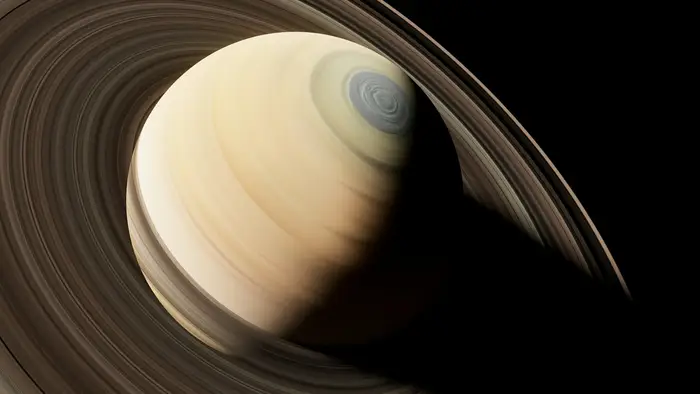
Why Saturn drew the line
Perhaps the most striking claim in the paper is not that the heavy water exists, but that it stayed put. The researchers say this distant reservoir likely never mixed much with material closer to the Sun — and the evidence for that is in the differences between the chemical compositions of particles from the inner and outer Solar System. If the two regions had mixed freely over 4.6 billion years, the sharp isotopic contrast the team measured should have been smeared away. It was not.
The team proposes a gatekeeper: Saturn, possibly acting together with Uranus and Neptune, kept the regions separate. The paper argues that hydrodynamic simulations predict a pressure bump exterior to Saturn’s orbit within the first few million years of the Solar System — a kind of traffic jam in the swirling disk of gas and dust around the young Sun that would have slowed or stopped the inward drift of outer Solar System particles. Beyond that bump, the heavy water stayed where it was. Inside it, the inner Solar System developed its own, lighter water. The two reservoirs evolved in parallel, largely unaware of each other, for billions of years.
That isolation is what makes the finding useful. If outer Solar System water had mixed freely with inner Solar System water, its fingerprint would be unreadable today. Because it did not, the twelve grains preserve a chemical memory of the Solar System’s earliest geography — a map of where things formed, written in oxygen.
It also reframes the question of where Earth’s water came from. Earth sits well inside Saturn’s orbit, in the region whose water the study characterises as light. That fits with the idea that Earth’s oceans were delivered mainly by asteroids and other inner Solar System bodies, rather than by comets from the Kuiper Belt — though the study does not settle that debate, and the authors do not claim that it does. What it does show is that the outer reservoir existed, that it was chemically distinct, and that it did not pour its contents sunward in any large quantity. For planetary scientists trying to trace the delivery routes of water to the young Earth, that is a boundary condition worth having: a line on the map, drawn by Saturn, that the water did not cross.
A second ice story, the same week
The Kuiper Belt result did not arrive alone. In the same week, a separate team reported a related discovery about ice in another planetary system — and the two findings, taken together, sketch a picture of how common and how ancient frozen water may be.
On November 12, 2026, the journal Science published a study led by Sarah Betti of the Space Telescope Science Institute, reporting the first direct detection of water ice and carbon dioxide ice in the debris disk around Beta Pictoris, a star about 64 light-years away and only about 20 million years old — a baby beside our 4.6-billion-year-old Sun. Using the James Webb Space Telescope’s Near-Infrared Spectrograph, the team observed the star’s disk on December 7, 2023, recording spectra from 0.6 to 5.2 micrometres, and found water ice spread across the disk in a strikingly uniform pattern.
The surprise was the form the ice takes. It is overwhelmingly amorphous — glassy, its molecules lacking any orderly crystal structure — with less than 7 percent of the ice volume in crystalline form. And it is mixed with carbon dioxide, at roughly one carbon dioxide molecule for every 10 water molecules, in about the same recipe as the comets of our own Solar System. The carbon dioxide was found in two spots on opposite sides of the star, each about 100 times Earth’s distance from the Sun, including a rarer version made with heavier carbon-13. The team concluded that the ices most likely froze in the cold interstellar cloud from which the star was born — before Beta Pictoris and its planets existed — and that frequent collisions between comets and small icy-rocky bodies called planetesimals are needed to keep the disk’s dust topped up, since dust on its own does not last long.
The two studies look at different systems with different tools — dust grains caught above Earth, and starlight reflected from a disk 64 light-years away — but they point the same way. Water ice is not a late addition to planetary systems. It is there from the beginning, frozen into the raw material before stars ignite, and its chemistry carries the signature of where it formed. The Beta Pictoris result shows that the recipe found in our Solar System’s comets — glassy water ice mixed with carbon dioxide in roughly a one-to-ten ratio — appears in other young systems too. The Kuiper Belt result shows that, within our own system, that primordial ice was kept in a separate reservoir, preserved by distance and by Saturn’s gravity, for the whole history of the Solar System.
Two waters, one Solar System
The contrast the study draws — inner water versus outer water — is worth spelling out, because it is the heart of the paper’s argument.
| Inner Solar System water | Outer Solar System water | |
|---|---|---|
| Best record | Carbonaceous chondrite meteorites | 12 hydrated dust grains from the stratosphere |
| Oxygen-17 excess (Δ17O) | About +3 to +7 parts per thousand | About +62 parts per thousand |
| Oxygen-18 vs Earth’s oceans | Close to the terrestrial standard | Roughly 15 percent higher (upper-limit estimate) |
| Carbon content | Baseline of CI chondrites | About 4 times the CI chondrite level |
| Likely origin | Processed near the young Sun | Frozen far from the Sun, possibly in the interstellar cloud |
| Mixing with the other reservoir | Limited | Limited — separated, most likely by Saturn |
| Evidence of water-rock reaction | Familiar hydrated meteorites | Saponite clays and carbonates in the grains |
The table makes the separation visible at a glance. These are not two samples of the same water with slightly different measurements. They are two different waters, formed in different places, under different conditions, and kept apart for the age of the Solar System. That is why the authors write of a “major heavy water reservoir” rather than a local anomaly: the chemistry implies a region-wide supply, not a quirk of twelve unusual grains.
It is also why the study’s caveats matter, and why the authors state them plainly. Twelve grains is a small number from which to describe a reservoir spanning billions of kilometres. The water values come from a mass balance that assumes a single main reaction and leaves out water held between the clay layers, so the authors treat them as upper limits. And the case for a Kuiper Belt origin rests on radiation track counts rather than on any orbit traced back to a source — a limitation the full paper states openly. Only material collected at the source could test the idea directly, and no mission is currently planned to do that.
Those limits do not weaken the result so much as define it. Science at the edge of the Solar System is often like this: a small, hard-won sample, a careful chain of inference, and a conclusion stated with the uncertainty left in. The alternative — waiting decades for a sample-return mission to the Kuiper Belt — would mean leaving the question unasked. Instead, the team asked it of the dust that was already falling, and the dust answered.
How the story unfolded
The finding has a long backstory, and its timeline shows how slowly — and then how quickly — a decades-old prediction can turn into evidence.
- About 4.6 billion years ago, the Solar System forms from a collapsing cloud of gas and dust. In the cold outer regions, water freezes into ice enriched in heavy oxygen; closer to the young Sun, it does not.
- 2011, NASA’s Genesis mission returns samples of the solar wind showing that the Sun contains proportionally more light oxygen than Earth and most meteorites, supporting the theory that outer Solar System ice should be heavy.
- 2014–2016, the European Space Agency’s Rosetta mission studies comet 67P, and evidence of heavy water is found in the comet and in minerals from a primitive meteorite — the first hints, but not proof, of a wider reservoir.
- December 7, 2023, the James Webb Space Telescope observes Beta Pictoris with its NIRSpec instrument, recording the spectra that will reveal amorphous water ice and carbon dioxide ice in another system’s debris disk.
- November 11, 2026, Keller and colleagues publish “A primordial heavy water reservoir in the outer solar system” in Science Advances, reporting the twelve grains, the Δ17O value of about +62 parts per thousand, and the case for a reservoir isolated by Saturn.
- November 12, 2026, the Beta Pictoris ice study is published in Science, showing that the glassy, carbon-dioxide-mixed ice found around a young star matches the recipe of our own Solar System’s comets.
Each step in that chain depended on the one before it: a prediction from Genesis, a hint from Rosetta, a technique for reading radiation tracks in dust, and finally a dozen grains small enough to sit on the head of a pin. The result is not a photograph of a distant ocean. It is something stranger and, in its way, more impressive: a chemical measurement made on Earth that reaches 30 astronomical units out into the dark and reports back that the water there is different from ours, and always was.
Why twelve grains are enough — and why they are not
It is fair to ask whether twelve grains can really support a claim about a reservoir spanning the outer Solar System. The honest answer is that they can support the claim the authors actually make, and no more — and the authors say so themselves. The paper’s conclusion is that the evidence is “compelling”, not conclusive. It is a word chosen with care, and it is the right word.
What makes twelve grains enough is convergence. The radiation tracks point one way: far away, long exposure. The carbon content points the same way: formed under conditions unlike those of the inner Solar System. The oxygen isotopes point the same way again, and by a large margin: a Δ17O of about +62 parts per thousand against +3 to +7 for inner Solar System water is not a borderline result. Three independent lines of evidence, measured with different instruments, all land on the same answer. That is how a small sample earns a big conclusion.
What makes twelve grains not enough is everything the study cannot do. It cannot trace any single grain back to a specific parent body. It cannot measure the water directly — the water is gone, and only its oxygen remains. It cannot say how large the reservoir is, how much water it holds, or exactly where its boundary lies. Those questions will need more grains, better models, and eventually a spacecraft that goes to the Kuiper Belt and brings a piece of it home.
There is also a wider lesson in the method itself. The stratospheric dust collection that made this study possible is one of the cheapest sample-return programmes in the history of space science: no launch vehicle, no landing, no return capsule — just aircraft flying through dust that falls from the sky for free. The same collection has been running for decades, and it still holds grains no one has examined. The twelve that Keller’s team studied were chosen because their radiation tracks marked them out. There may be more like them already sitting in the archive, waiting for someone to ask the right question.
For now, the picture the study paints is clear enough to change how planetary scientists think about the outer Solar System. Beyond Neptune, there is water that remembers the Solar System’s birth — water enriched in heavy oxygen, locked into clay minerals inside dust grains, preserved by cold and by distance and by the gravity of Saturn. It never reached Earth in any quantity. It never mixed with the water that became our oceans. It simply waited, for 4.6 billion years, until a few specks of it drifted sunward, fell through the stratosphere, and landed in a collector under the wing of an aircraft — carrying, in their microscopic scars and their heavy oxygen, the news that the edge of the Solar System has been keeping its own water all along.
That is a small discovery, measured in micrometres. It is also a reminder of how much of the Solar System is still unknown, and how close some of that unknown already is — falling, grain by grain, out of the sky above us. The next time a team goes looking through the dust collection, they will be looking for more than twelve grains. They will be looking for the rest of the reservoir.
For a closer look at the icy wanderers that carry this primordial material sunward, see Euclid First Comet C/2026 S1 November 2026: The Galaxy Telescope That Found a Comet by Accident, and for another small body whose buried ice may be quietly pushing it off course, see 1998 KY26 Asteroid Acceleration Mystery: The Tiny Rock That Moves Like It Has an Engine. The infrared sky survey now mapping frozen water across the Milky Way is covered in SPHEREx Data Release 1 All-Sky Spectral Cube: NASA Maps the Infrared Universe.
Sources
- Phys.org: Space dust particles point to ancient heavy-oxygen water reservoir in the Kuiper belt
- ScienceAlert: Scientists Find Evidence of Primordial Water Hidden at The Edge of The Solar System
- Astro Bulletin: Kuiper Belt Dust Reveals Primordial Water
- Phys.org: Dirty ice around young star Beta Pictoris suggests frequent collisions