IC 342 Intermediate-Mass Black Hole: Keck Weighs a 195,000-Sun Monster in the Hidden Galaxy
A Middleweight Black Hole Steps Out of Hiding
For decades, astronomers have hunted for a missing link in the black hole family tree. Stellar-mass black holes, the collapsed cores of dead massive stars, weigh a few dozen Suns at most. Supermassive black holes, the monsters anchoring the centres of galaxies, weigh millions or billions of Suns. In between, theory insists, there should be a middleweight population — intermediate-mass black holes, or IMBHs — the seeds from which the giants grew. Finding them, and weighing them, has proved extraordinarily difficult.
This week, that hunt scored one of its cleanest victories. A team led by Tuan N. Le has measured the mass of a black hole at the centre of IC 342, a spiral galaxy long nicknamed the Hidden Galaxy because it sits behind the dust and stars of our own Milky Way. Using the W. M. Keck Observatory in Hawaii, the team weighed the hidden object at about 195,000 times the mass of the Sun — squarely in the intermediate-mass range — and did it by tracking the motions of stars whipping around it, the most direct weighing method astronomy has.
The result, posted to arXiv on 18 November 2026, is the first direct stellar-dynamical measurement of an intermediate-mass black hole in IC 342. It places the galaxy among a rare handful of bulgeless spirals where a central black hole has been weighed directly, and it gives theorists a new anchor point for understanding how black holes and the dense star clusters around them grow up together.

The Milky Way’s own stars and dust veil the Hidden Galaxy IC 342 from view. Image: Unsplash.
The Galaxy Behind the Curtain
IC 342, also catalogued as Caldwell 5, is one of the brightest galaxies in the IC 342/Maffei group, a small gathering of galaxies lying close to our own Local Group. NASA’s Astronomy Picture of the Day featured it on 4 November 2026, describing how the image peers “through the plane of the Milky Way, through all its gas, dust and stars,” to unveil the spiral beyond. The galaxy sits roughly 10 million light-years away — close by cosmic standards — yet for much of astronomical history it was barely studied at all, because the crowded foreground of our own galaxy swamps its light.
That foreground has caused real confusion. Inaccurate accounting for the Milky Way’s dust once fed a theory that IC 342 had been ejected from the Local Group. Better measurements corrected that misunderstanding, and the galaxy is now recognised as a near neighbour, a nearly face-on spiral tilted only about 31 degrees to our line of sight. Its own dust intermittently blocks the glow of hydrogen gas inside it, a sign of bright, young stars, and magnetic field maps suggest those fields may help shape its spiral arms — one of the longest-running puzzles in galactic astronomy.
But the same dust that makes IC 342 hard to see in visible light makes its core nearly impossible to study with ordinary telescopes. The paper’s authors put the foreground extinction at about 0.74 magnitudes in the near-infrared F814W band — enough to render the nucleus, in their words, inaccessible to optical spectroscopy. To weigh whatever lurks at the galaxy’s heart, they had to look in the infrared, where dust is more transparent, and they had to look sharply.
Weighing Darkness by Starlight
The team turned to OSIRIS, an integral-field spectrograph on the Keck II telescope, working with laser guide star adaptive optics. Adaptive optics corrects, hundreds of times a second, for the blurring of Earth’s atmosphere, letting a ground-based telescope approach the sharpness of a space telescope. OSIRIS slices the light from a small patch of sky into a grid and takes a spectrum at every point, building a two-dimensional map of how fast stars are moving at each spot.
The observations were made in the K band, at a wavelength of about 2.3 microns — deep in the near-infrared, where the dust in front of IC 342 thins enough to let the galaxy’s nuclear light through. The team extracted the motions of stars from the CO bandheads, distinctive dips in the spectra of cool giant stars, using a fitting technique known as pPXF. The resulting velocity map reached a resolution of 0.062 arcseconds, fine enough to resolve structures a few light-years across at IC 342’s distance.
What the map showed was a telltale spike. Away from the centre, the stars in IC 342’s nucleus drift with a velocity dispersion — the spread of their random speeds — of about 42 kilometres per second. But within about 0.2 arcseconds of the centre, that spread climbs to a peak of roughly 49 kilometres per second. Stars do not speed up for nothing. Something massive and dark sits at the centre, tugging them into faster, tighter orbits.
That “something” sits inside a nuclear star cluster, a dense ball of stars at the galaxy’s heart weighing about 11.7 million Suns. The cluster alone cannot explain the speedup. The team modelled the stellar motions with an ensemble of four dynamical models, spanning different assumptions about how the stars’ orbits are aligned and how the telescope’s blurring is represented, and combined them with a mass model built from archival Hubble Space Telescope imaging in the F814W band. The models decompose the galaxy’s light into three Sérsic components plus an exponential disk, tracing how starlight — and therefore stellar mass — is distributed.
The answer came out at 195,000 solar masses, with an uncertainty of about 61,000 Suns either way. Formally, the paper reports the black hole mass as (1.95 ± 0.61) × 10^5 solar masses.
The Detail That Made the Difference
The measurement hinged on a subtlety that earlier approaches had missed: the stars at the centre of IC 342 are not all the same age. The nuclear star cluster hosts a young population of stars, and young stars are brighter per unit of mass than old ones. That means the ratio of stellar mass to light — the conversion factor astronomers use to turn a picture of starlight into a map of mass — changes with distance from the centre.
The team built that physically motivated mass-to-light gradient into their models. It proved essential. Standard models that assume a constant mass-to-light ratio systematically overestimate the mass of the stars at the centre, and that extra phantom stellar mass swallows the black hole’s signature entirely, leaving only an upper limit. Only by accounting for the young central population did the black hole emerge from the data.
It is a cautionary tale for the whole field. Several candidate intermediate-mass black holes may have been missed, or mismeasured, because the stellar populations around them were treated as uniform. The IC 342 result shows that getting the stars right is a precondition for getting the black hole right — and it hands other teams a recipe for revisiting galaxies where earlier searches came up empty.
The models also found that the stars around the black hole move on near-isotropic orbits, with an anisotropy parameter close to zero, a pattern typical of fast-rotating late-type spiral galaxies. That consistency is reassuring: nothing about the stellar motions looks exotic or contrived. The system behaves the way a normal spiral nucleus should, except for the 195,000-Sun weight sitting at its centre.
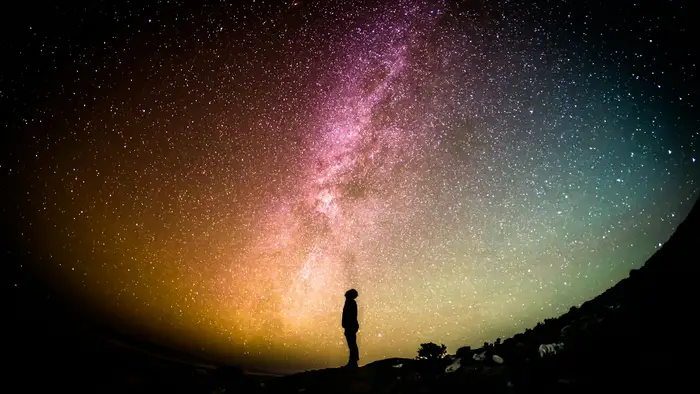
Deep space filled with distant galaxies. Image: Unsplash.
Why Middleweights Matter
Black holes come in two well-established sizes, and the gap between them has troubled theorists for decades. Stellar-mass black holes, born when massive stars collapse, weigh between about five and a few dozen Suns. Supermassive black holes, found at the centres of most large galaxies, weigh millions to billions of Suns. The question is how the small ones ever became the big ones within the age of the universe — and the leading answer is that they grew from intermediate seeds.
An intermediate-mass black hole of 195,000 Suns is exactly the kind of seed the models need. It is far too heavy to have formed from a single collapsing star, yet far too light to be a fully grown galactic nucleus. Objects like it are the missing link: if they exist in the numbers theory predicts, they can merge and feed their way up to supermassive scale over cosmic time. If they do not exist, the growth story needs a rewrite.
That is why each confirmed IMBH matters beyond its own galaxy. The IC 342 measurement joins a small but growing census. In 2017, astronomers reported evidence for a black hole of about 2,200 Suns at the centre of the globular cluster 47 Tucanae, found by studying the collective motions of its stars rather than the X-ray glow of infalling gas. In July 2024, a team led by researchers from the University of Utah and the Max Planck Institute for Astronomy confirmed a central black hole in Omega Centauri, the Milky Way’s most massive globular cluster, after cataloguing the motions of 1.4 million stars across more than 500 Hubble images and finding seven fast-moving stars clustered at the centre. At about 18,000 light-years away, Omega Centauri’s black hole is the closest known example of a massive black hole beyond the Milky Way’s own central giant.
Other candidates have turned up by other means. A black hole of about 55,000 solar masses, described by its discoverers as a “Goldilocks” black hole, was identified through a gravitationally lensed gamma-ray burst — the same half-second flash of light seen twice, its path bent by the intervening mass. The researchers behind that find estimated that some 46,000 intermediate-mass black holes may lurk in the vicinity of the Milky Way alone. And in the starburst galaxy M82, X-ray observations from ASCA and Chandra revealed an intermediate-mass black hole apparently sitting inside a young, compact star cluster — a finding that inspired a “runaway” formation scenario, in which massive stars in a dense cluster merge repeatedly, building a middleweight black hole that later sinks to the galactic centre through dynamical friction.
IC 342’s black hole adds a different kind of data point to this census. Unlike the cluster black holes, it sits at the centre of a spiral galaxy — but a bulgeless one. Most well-weighed supermassive black holes live in galaxies with prominent central bulges, and the tight correlations between black hole mass and bulge properties have shaped decades of theory. Bulgeless galaxies break that pattern. Measuring a black hole in one, with both the black hole and its surrounding nuclear star cluster directly characterised, gives theorists a rare clean test of how black holes and their host structures co-evolve when there is no bulge to do the correlating.
IC 342 at a Glance
| Property | Value |
|---|---|
| Galaxy | IC 342 (Caldwell 5), the Hidden Galaxy |
| Type | Nearly face-on bulgeless spiral (inclination ≈ 31°) |
| Distance | 3.45 ± 0.13 Mpc (about 11 million light-years) |
| Black hole mass | (1.95 ± 0.61) × 10^5 solar masses |
| Nuclear star cluster mass | ≈ 1.17 × 10^7 solar masses |
| Central velocity dispersion | Rises from ≈ 42 km/s to a peak of ≈ 49 km/s |
| Instrument | Keck/OSIRIS integral-field spectroscopy, laser guide star adaptive optics |
| Observing band | K band, ≈ 2.3 microns |
| Spatial resolution | 0.062 arcseconds |
| Foreground extinction | A(F814W) ≈ 0.74 mag |
| Paper | Le et al., arXiv:2611.24608, submitted 18 Nov 2026 |
A Crowded Field, A Careful Weighing
The team is careful about what the measurement is — and what it is not. This is a preprint, posted to arXiv on 18 November 2026 and not yet peer-reviewed. Its authors number fifteen, spanning institutions in Vietnam, Australia, the United States and Europe, and the analysis leans on archival Hubble imaging as well as the new Keck spectra. The headline number, 195,000 Suns, carries a roughly 30 percent uncertainty, and it rests on dynamical modelling — inferring mass from motion — rather than on a direct image or a glowing accretion disk.
That caution is warranted, because the field has seen candidates come and go. Intermediate-mass black holes are notoriously hard to confirm: they are usually quiet, accreting little gas and emitting few X-rays, so the classic signature of a feeding black hole is often absent. The 47 Tucanae candidate, for example, was inferred from the collective stirring of stars, not from any light the black hole itself produces. Omega Centauri’s case took a decade of argument and a catalogue of over a million stellar velocities to settle. IC 342’s measurement follows the same demanding playbook — no flash of light, just the patient mapping of how stars move under an unseen weight — and its authors present it with the modelling laid bare, including the four-model ensemble and the mass-to-light gradient that made the detection possible.
What strengthens the result is the way the pieces fit. The velocity spike is localised to the innermost fraction of an arcsecond. The nuclear star cluster is independently measured. The stellar orbits come out near-isotropic, as expected for a galaxy of this type. And the mass that emerges — 195,000 Suns — lands in a range where an intermediate-mass black hole is the natural explanation, far above anything a cluster of stellar remnants could plausibly mimic.

A dense field of stars, like the crowded nucleus where IC 342’s black hole hides. Image: Unsplash.
The Seeds of Giants
The IC 342 result also lands in the middle of a wider debate about where supermassive black holes come from. The James Webb Space Telescope has found surprisingly massive black holes surprisingly early in the universe’s history — objects that seem too big, too soon, for slow growth from stellar-mass seeds. That tension has pushed theorists toward heavier starting points: black holes born big, either from the direct collapse of giant gas clouds or from runaway collisions in dense young star clusters.
Recent modelling supports the collision route. A study published in October 2026 found that repeated stellar collisions in dense, early-universe clusters can build stars exceeding 100,000 times the Sun’s mass — stars that would collapse into intermediate-mass or even supermassive black holes, and leave behind systems resembling the Galactic Centre: a black hole wrapped in a dense star cluster. The IC 342 system looks, in miniature, like the end state of that process: a middleweight black hole nested inside a nuclear star cluster, in a galaxy with no bulge to confuse the story.
That resemblance is not proof of a shared origin. IC 342 is a nearby, present-day galaxy, not an infant galaxy from the early universe, and its black hole could have grown by quieter means — slow accretion, minor mergers, or the gradual sinking of cluster black holes to the centre. But it gives observers a nearby laboratory for the physics that the early-universe models invoke. If the same co-evolution of black hole and nuclear star cluster operates in a humble bulgeless spiral today, it is easier to believe it operated in the crowded nurseries of the first galaxies.
The result also connects to other threads on this site. The Holmberg II X-1 JWST Black Hole Lights Up a Nebula in a Metal-Poor Galaxy story covered another intermediate-mass candidate, this one betrayed by the glowing nebula its radiation lights up. The JWST Little Red Dots November 2026: The First Supermassive Black Holes Explained article examined the compact red objects Webb found in the early universe, one proposed explanation for which is rapidly growing black hole seeds. And the 10 Solar Mass Black Holes Failed Supernovae: The Stars That Died Without Exploding piece looked at the other end of the mass scale, where stars collapse straight into black holes without the fireworks of a supernova. IC 342’s 195,000-Sun object sits between those stories, and helps join them into a single narrative of how black holes are born, grow, and shape the galaxies around them.
The Hidden Galaxy’s Next Chapter
What comes next for IC 342 is more observation. A dynamical mass from one instrument and one modelling framework is a strong result, but independent confirmation — a second spectrograph, a different wavelength, a longer baseline of data — is how a candidate becomes a certainty. The paper’s authors note that their measurement places IC 342 among the rare bulgeless spirals with a direct dynamical black hole mass at the intermediate-mass scale, and they frame it explicitly as a new anchor for models of how compact massive objects co-evolve with their host clusters. Other teams will now test that anchor, pointing their own instruments at the same hidden core.
There is also the question of what else IC 342 is hiding. The galaxy’s nucleus, long veiled by dust, is only now yielding to infrared eyes. The same Keck instrument that weighed its black hole could map its star formation, its gas flows, and the structure of its nuclear cluster in finer detail. And as Webb continues its surveys, more hidden galaxies — and more hidden black holes — may follow the same path from obscurity to measurement.
For now, the Hidden Galaxy has given up one of its best-kept secrets. Behind the dust of the Milky Way, behind the glare of a million foreground stars, a black hole 195,000 times the mass of the Sun is quietly holding court at the centre of a spiral that spent a century being overlooked. It took a laser-guided telescope, infrared eyes, and a careful accounting of young stars to find it. The middleweight black holes were never absent. They were just waiting for someone to look in the right light.
Timeline: The Hunt for Middleweight Black Holes
- 2017 — Astronomers report evidence for a black hole of about 2,200 Suns at the centre of the globular cluster 47 Tucanae, inferred from the collective motions of its stars.
- July 2024 — A University of Utah and Max Planck Institute team confirms a central black hole in Omega Centauri, the Milky Way’s most massive globular cluster, after measuring the velocities of 1.4 million stars; at about 18,000 light-years, it is the closest known example of a massive black hole.
- 4 November 2026 — NASA’s Astronomy Picture of the Day features IC 342, the Hidden Galaxy, peering through the Milky Way’s dust to show the spiral beyond.
- 18 November 2026 — Le and collaborators post their paper to arXiv, reporting the first direct stellar-dynamical measurement of an intermediate-mass black hole in IC 342: 195,000 solar masses.

A colorful glowing nebula of gas and dust in deep space. Image: Unsplash.
Why This Weighing Will Be Remembered
Astronomy advances in two ways: by seeing something new, and by measuring something old with new precision. The IC 342 result does both. It takes a galaxy that has been in the catalogues for more than a century and reveals, at its centre, an object no one had weighed before — and it does so with a method that leaves a trail other astronomers can follow, challenge, and refine.
The black hole at the heart of the Hidden Galaxy is not the biggest ever found, nor the closest, nor the loudest. Its claim to fame is subtler: it is a clean, well-measured middleweight in exactly the kind of galaxy where theory needs one, found by looking through dust that had hidden it for decades. If the giants at the centres of galaxies grew from seeds like this one, then IC 342 is a glimpse of the seed itself, still sitting where it was planted, wrapped in a cluster of young stars, waiting 11 million light-years away behind a curtain of Milky Way dust.
The curtain has been pulled back a little further. The weighing is done. The middleweight black hole of IC 342 is, at last, on the books.

A telescope under a star-filled night sky, pointing toward the cosmos. Image: Unsplash.
Sources
- arXiv: Le et al., “A 10^5 Solar Mass Black Hole in the Bulgeless Spiral Galaxy IC 342” (arXiv:2611.24608, submitted 18 Nov 2026)
- NASA Astronomy Picture of the Day: “The Not-So-Hidden Galaxy, IC 342” (4 Nov 2026)
- University of Utah: “Astronomers find missing link in massive black hole formation” (Omega Centauri, July 2024)
- EurekAlert: “Black hole seeds key to galaxies behemoths” (Goldilocks intermediate-mass black hole)