FCC Clears SpaceX's 15,000 Starlink Mobile Satellites, a Direct Carrier Challenge
The phone in your pocket has always needed a tower. On 6 October 2026, the United States Federal Communications Commission gave SpaceX permission to build an alternative to the tower itself: a constellation of 15,000 satellites designed to talk directly to ordinary mobile phones, at speeds the company says could reach 150 megabits per second per user.
The decision, in FCC order DA 26-1078, adopted and released on 6 October, grants in part an application SpaceX filed in September 2025 for a new mobile-satellite system. It does not, by itself, switch on a new network tomorrow. It does something quieter and, in the long run, more consequential: it removes the regulatory reason SpaceX had to sell its satellite phone service through someone else, and it gives the company a very large, very low orbit in which to build its own.
That is why the approval landed as a carrier story as much as a space story. Within days of the announcement, shares in AT&T, Verizon and T-Mobile fell, with Verizon recording what MacRumors described as its worst one-day fall since 2002. The market was not reacting to a satellite launch. It was reacting to the possibility that the company that launches more rockets than anyone else might soon also be the company that sells you your phone plan.
What the FCC actually approved
The headline number is 15,000 satellites. The details matter more than the number, because they define what kind of network this would be.
The satellites would fly in very low Earth orbit, across nine orbital shells at altitudes of roughly 326 to 335 kilometres — about 202 to 208 miles up. That is lower than the International Space Station, lower than most Starlink broadband satellites, and, at the bottom of the range, a record low for a commercial constellation of this size. Lower means closer to the phone, and closer means signals travel a shorter distance, which helps cut latency and lets a satellite’s beam cover a smaller patch of ground more intensely.
The system is authorised for mobile satellite service and for supplemental coverage from space, the regulatory term for satellites filling in where terrestrial networks do not reach. In practice, that means a compatible phone could connect to a satellite for voice, messaging and data when no tower is in range, and, in SpaceX’s longer-term vision, as part of a single network that blends satellite and ground coverage.
Crucially, the grant was partial. The FCC deferred some of SpaceX’s requests, including the 2020 to 2025 megahertz band and the 1429 to 2690 megahertz range outside the United States. A partial grant is normal in constellation proceedings, where an applicant asks for more than a regulator is ready to approve at once. But it also means the network SpaceX eventually flies may not look exactly like the network it first proposed, and that spectrum outside the United States will still need separate authorisations country by country.
The approval also covers frequencies SpaceX is acquiring from EchoStar, the parent company of Boost Mobile, in the 1695 to 1710, 2000 to 2020, 2180 to 2200, 1915 to 1920 and 1995 to 2000 megahertz bands in the United States. It lets the new satellites keep using T-Mobile’s PCS G-block spectrum, at 1910 to 1915 and 1990 to 1995 megahertz, which powers the current service. Testing on the EchoStar bands, however, can only begin after the second step of the SpaceX-EchoStar deal closes, which is scheduled for 30 November 2027. That single condition ties the technical timetable to a commercial timetable, and it explains why the most ambitious parts of this network are still more than a year away even though the licence is in hand.
From about 4 Mbps to a promised 150 Mbps
To understand why 15,000 satellites matter, start with what exists today. The current generation of direct-to-cell service runs on roughly 650 satellites. In the United States it is available only through T-Mobile, under the T-Satellite brand, and its data speeds are estimated at around 4 megabits per second. That is enough for messaging, basic apps and emergency contact in places where a tower cannot reach. It is not a replacement for a terrestrial mobile network, and it was never presented as one.
SpaceX says the new constellation will deliver 5G speeds of up to 150 megabits per second per user. That is a company target, not a measured result: the second-generation mobile satellites have not flown yet, and no independent test of the system exists. But the scale of the jump tells you what SpaceX is trying to do. It is not trying to make the current texting-from-space service a little faster. It is trying to build a mobile broadband network in orbit, one that a customer could plausibly use as a primary connection rather than a backup for the moments when the terrestrial network disappears.
SpaceX has described the new satellites as delivering more than 100 times the bandwidth of the current generation, with analysts reporting figures of roughly 20 times the throughput per satellite and more than 100 times the total network capacity. Those ratios, like the 150-megabit figure, should be read as design goals. A satellite that can theoretically serve many users at high speed still has to share its capacity among everyone inside its beam at a given moment, and the real-world experience will depend on how many people are using it, where they are, and what the network is asked to do at peak times.
The comparison that matters most is not with a laboratory benchmark. It is with the phone in a dead zone today: no signal at all. A network that reliably delivers tens of megabits per second where there is currently nothing would still be transformative for rural communities, for travellers, for ships and aircraft, and for emergency responders, even if it never hits 150 megabits for every user at once. The question the FCC approval raises is not whether the top speed is exactly 150. It is whether a satellite network can be dense enough, and cheap enough to operate, to be useful at scale rather than only in an emergency.
The waiver that changes the business model
The most important sentence in the FCC decision may not be about satellites at all. It is about who SpaceX is allowed to sell to.
Previously, satellite operators offering this kind of service were expected to work through a spectrum-leasing arrangement with a terrestrial mobile operator. That is why the current service reaches American customers through T-Mobile rather than directly from SpaceX. The FCC has now waived that requirement, allowing SpaceX to provide wireless service through its satellites without a leasing agreement with a terrestrial carrier.
In regulatory language that sounds dry. In business language it is a door opening. With the waiver, SpaceX has a path to sell mobile connectivity directly to consumers, using its own spectrum, rather than remaining a wholesale partner tucked inside another company’s plan. That is what turns Starlink Mobile from an add-on into a potential competitor to AT&T, Verizon and T-Mobile, and it is why coverage of the decision repeatedly described it as a route to becoming a carrier in its own right.
The timing sharpens the point. T-Mobile has recently downplayed the satellite partnership, removing SpaceX branding from its website after finalising a joint satellite venture with AT&T and Verizon, according to MacRumors. TeslaNorth’s reporting adds that T-Mobile’s chief financial officer has dismissed SpaceX’s approach of pairing satellites with smaller, cost-effective ground femtocells to reach phones in suburbs and cities. Whether those moves reflect a genuine strategic divergence or ordinary commercial friction, the direction is clear: the company that built the satellites and the carrier that sold the first version of the service are no longer obviously on the same path, and the FCC has now given SpaceX a licence to walk its own.
That does not mean SpaceX will immediately launch a consumer phone brand, announce prices, or open sign-ups. The approval itself sets no retail price and no consumer launch date, and reporting on the decision contains no such announcement. What it does is remove a structural barrier. Building the satellites, launching them, proving the service and persuading customers to switch are still separate, difficult jobs, and each of them can fail on its own.
The spectrum puzzle
If satellites are the visible part of this story, spectrum is the invisible part that decides whether it works. A satellite network cannot create bandwidth out of nothing. It can only reuse the frequencies it is licensed to use, over and over again, in different beams pointed at different places. That is why the EchoStar deal matters as much as the FCC licence.
The new mobile satellites will have at least 65 megahertz of bandwidth available via the EchoStar spectrum, according to ISPreview’s analysis, compared with roughly 5 megahertz for the current mobile system. That wider pipe is a large part of why the speed target jumps so dramatically. Analysts have noted, however, that 65 megahertz is still a finite resource: delivering 150 megabits per second in, say, 25 megahertz of downlink would require roughly 6 bits per second per hertz before overhead, and SpaceX has itself warned investors that its current spectrum may not be enough for everything it wants to do.
In the same week as the FCC approval, SpaceX announced an agreement to acquire up to 14 megahertz of paired spectrum in the 800 megahertz low band. That acquisition, which still needs final FCC approval, addresses a different problem: penetration. Low-band signals travel further and pass through obstacles, including walls, better than higher-frequency signals. SpaceX has said the 2 gigahertz mid-band spectrum will provide high-bandwidth capacity in the United States, while the new low-band spectrum will help the signal work indoors. Futurum’s analysis described the two moves together as closing the final gap to a unified satellite-terrestrial network: satellites for coverage everywhere, ground spectrum for the places where a satellite signal struggles to reach inside a building.
The company has also been authorised to use the full range of backhaul bands — Ka, V, E and W bands — used by its larger V3 broadband satellites, according to the same analysis. Backhaul is the plumbing that carries traffic from a satellite back to the internet, and authorising it as part of the same system is another sign that SpaceX is not designing a standalone texting service. It is designing a network in which mobile traffic, broadband traffic and the links between satellites and ground stations are part of one architecture.
None of this guarantees capacity where it is needed most. Spectrum is most valuable in cities, where millions of phones compete for it, and least scarce in the remote areas where satellite service is most obviously useful. A satellite beam over a dense suburb and a satellite beam over an empty stretch of desert use the same frequencies, but they serve very different numbers of people. How SpaceX balances that geometry — and whether it leans on ground femtocells, as TeslaNorth reports, to add capacity where people actually live — will shape whether Starlink Mobile feels like a national carrier or like a very good rural and emergency network with urban limits.
Flying at the edge of the atmosphere
The choice of orbit is itself a bet. At 326 kilometres, a satellite is skimming the top of the atmosphere. Air drag is far stronger there than at 550 kilometres, where many Starlink broadband satellites fly, which means satellites need more frequent station-keeping, carry more propellant for their size, and may have shorter operational lives before they are dragged down. The trade is deliberate: lower altitude means lower latency, smaller beams, more frequent reuse of spectrum, and, when a satellite does fail, a faster natural decay that reduces long-term debris risk.
It also means the constellation must be replenished constantly. Fifteen thousand satellites at very low altitude is not a fleet you launch once and forget. It is a fleet you maintain, with regular replacement launches, for as long as the service exists. That is where SpaceX’s launch cadence becomes part of the business case. No other operator can launch at SpaceX’s rate or cost today, and the company has already launched nearly 13,000 Starlink satellites in total, with around 11,150 still in orbit according to Jonathan McDowell’s tracking data as cited by TechSpot. Whether that cadence can sustain a second, separate 15,000-satellite system on top of the broadband constellation — and on top of the January 2026 approval for 7,500 additional Gen2 broadband satellites, which brought that system’s authorised total to 15,000 — is an open question that will only be answered by years of launches.
For comparison, the two approvals together cover 30,000 satellites across the Gen2 broadband system and the new mobile system, excluding the separately authorised first-generation constellation. That is an authorisation, not a launch manifest. Regulators approve ceilings; operators still have to build, launch and operate what they are allowed to build. But the ceiling itself changes the competitive landscape, because rivals planning their own direct-to-device systems must now plan around a competitor that is licensed to be very large indeed.
Environmental groups and rival operators objected to the approval, according to TeslaNorth’s reporting, and those objections are part of the story too. More satellites mean more reflected sunlight for astronomers, more objects to track for collision avoidance, and more reentries to manage. Very low orbit mitigates some of the debris concern, because dead satellites fall out of the sky quickly, but it does not eliminate the brightness concern or the traffic-management burden during the years when thousands of satellites share similar altitudes. The FCC’s decision, in granting the application in part while deferring some requests, leaves room for those concerns to be revisited as the constellation is actually deployed.
The timetable: 2027 launches, 2032 and 2035 milestones
SpaceX’s president and chief operating officer, Gwynne Shotwell, has indicated that the company plans to begin deploying its second-generation Starlink Mobile satellites in 2027, with service expected by the end of that year, according to SatellitePro ME. Other reporting puts first service in the first half of 2028. The difference between those windows is small in the life of a constellation, but it is a useful reminder that this is a target, not a schedule set in stone, and that the EchoStar step-two closing date of 30 November 2027 sits squarely in the middle of it.
The FCC’s own milestones are firmer. SpaceX has until 7 October 2032 to have half of the constellation — 7,500 satellites — in operation, and until 7 October 2035 to complete all 15,000. Those dates are the regulator’s way of preventing spectrum warehousing: a company cannot hold a licence for a giant constellation indefinitely without building it. They also give a sense of the deployment’s true scale. Even at SpaceX’s launch rate, putting 7,500 new mobile satellites into nine very low shells in six years, while continuing to launch broadband satellites, maintain the existing fleet and serve other customers, is an industrial programme, not a single project.
What happens first will be less spectacular than the final number. Expect early launches to carry test and early-production versions of the new mobile satellite, expect coverage to start in limited areas or for limited uses, and expect the service to improve as more satellites join each shell. That is how Starlink broadband itself grew: not by switching on a finished network, but by adding satellites until the network became useful, then dense, then fast. The mobile network is likely to follow the same pattern, only lower, denser and aimed at a device that was never designed to talk to space.
What the carriers do next
The incumbent carriers are not standing still, and the FCC approval does not happen in a vacuum. The joint satellite venture involving T-Mobile, AT&T and Verizon, noted in recent reporting, suggests that the established operators see satellite connectivity as a capability they need, even if they disagree with SpaceX about who should provide it. Their version of the future is a satellite layer added to a terrestrial network they already own. SpaceX’s version is a network that starts in space and adds ground infrastructure where it needs it.
That distinction will matter for customers. A carrier that owns towers can hand a phone seamlessly between tower and satellite, prioritise traffic, and bundle satellite service into an existing plan at a marginal cost. A satellite-first operator must persuade customers to buy a new service, or a new kind of plan, on the strength of coverage alone. It must also solve the indoor problem, the capacity-in-cities problem, and the emergency-services and regulatory requirements that come with being a real carrier rather than a satellite experiment. None of those problems is solved by an FCC order. All of them are made worth solving by one.
There is also a question of geography. The FCC can authorise a constellation, but it cannot authorise service in other countries. Outside the United States, Starlink Mobile will need spectrum and operating approvals market by market, and the deferred requests for spectrum outside the United States are a reminder that the global version of this network is still to be negotiated. In the United Kingdom, for example, direct-to-cell service is currently available via O2 Satellite, according to ISPreview, and the new system would face a separate regulatory path there. The phrase “anywhere in the world” in SpaceX’s description of its ambition is a goal for a network that will, in practice, arrive country by country.
For users in the United States, the near-term change is nothing at all. The current T-Satellite service continues as it is, and the new satellites have not launched. The medium-term change, if the deployment proceeds, could be the end of the dead zone as a normal experience: a phone that works on a remote highway, on a hiking trail, or after a storm has knocked out local towers, without the user doing anything different. The long-term change, if SpaceX executes the full plan, could be a fourth national mobile network whose infrastructure is mostly in orbit — a development that would reshape pricing, coverage obligations and competition policy for a generation.
Why this approval matters beyond phones
It is tempting to read this story as a telecom story, and it is one. But it is also a space story about what low Earth orbit is becoming. A decade ago, low Earth orbit was a place for imaging satellites, science missions and a modest broadband constellation. Today it is a place where companies propose tens of thousands of satellites, where launch cadence is a competitive weapon, and where the boundary between a satellite operator and a phone company is dissolving.
That transformation raises questions that no single FCC order can answer. How many satellites can very low orbit safely hold? How do operators coordinate traffic when several constellations share similar altitudes? How do astronomers, who have already had to adapt to bright satellite trains, adapt again to a denser, lower fleet? And how do regulators in different countries keep pace with a technology that moves faster than the treaties designed to govern it? The objections from rivals and environmental groups that accompanied this approval are an early version of those questions, and they will return, louder, as metal starts to fly.
There is also a simpler, human question at the centre of it. For most of mobile history, being out of range meant being unreachable, and being unreachable was sometimes a choice and sometimes a danger. A network that reaches everywhere changes that bargain. It makes rescue faster and remote work easier, and it also makes it harder to ever truly be off the grid. Whether that is a liberation or a loss depends on who controls the network, what it costs, and what it does with the knowledge of where every phone is. Those are not engineering questions. They are the questions a society asks when a new kind of infrastructure arrives, and the FCC’s decision means they are no longer hypothetical.
For now, the facts are these: a regulator has said yes, in part, to 15,000 satellites at 326 to 335 kilometres, with a waiver that lets their owner sell phone service directly, on spectrum from EchoStar and T-Mobile, with half the fleet due by 2032 and the rest by 2035, and with first launches targeted for 2027. Everything else — the speeds, the prices, the coverage, the competition — is still to be built, launched and proven. The sky, as the carriers have just discovered, is no longer just above the market. It is becoming the market.

A satellite in orbit above Earth. The new Starlink Mobile fleet would fly far lower than most satellites, at 326 to 335 kilometres. Image: Unsplash.
The orbit is the product
Very low Earth orbit is unforgiving — drag is stronger, station-keeping is constant, and satellites must be replaced more often — but it is also what makes a phone-to-satellite link practical. A beam from 326 kilometres covers a smaller area more intensely than a beam from 550 kilometres, which means the same spectrum can be reused more times across the planet. That geometry, more than any single radio breakthrough, is the core of SpaceX’s bet: density and proximity, repeated thousands of times, can substitute for the tower that a phone cannot see.

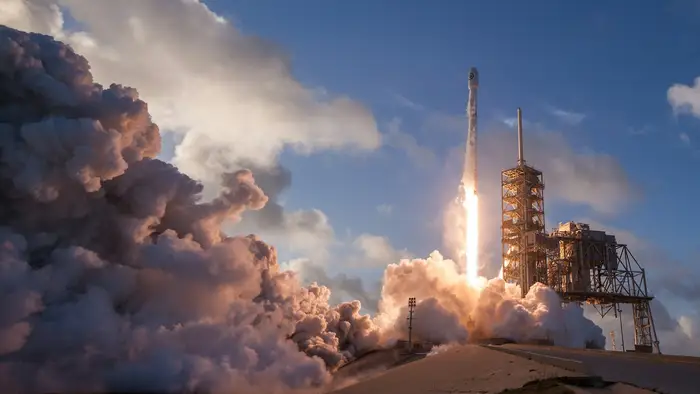
A rocket climbs away from its launch pad. Sustaining 15,000 satellites in very low orbit will require a constant rhythm of replacement launches. Image: Unsplash.
From emergency texting to everyday broadband
The current service, at around 4 megabits per second through roughly 650 satellites, proved that a phone could talk to space at all. The new system aims to prove something harder: that it can do so fast enough, and for enough people at once, to matter every day rather than only in an emergency. The gap between those two proofs is the whole story of the next decade in satellite communications, and it will be closed satellite by satellite, beam by beam, rather than in a single launch.
Solar panels glinting in sunlight above Earth. Each new mobile satellite must generate its own power while serving phones far below. Image: Unsplash.
Dead zones, and what replaces them
For a driver on a remote road, a hiker beyond the last tower, or a community rebuilding after a storm, the most important number in this story is not 150 megabits per second. It is zero — the signal strength today. A satellite network does not need to beat a city tower to change those lives. It only needs to be there, reliably, when the tower is not. That is the promise the FCC has licensed, and the standard by which the first years of Starlink Mobile should be judged.

A star-filled sky over dark mountains. In places like this, where towers are few and far between, a satellite link can be the only link. Image: Unsplash.
The race is now a market
SpaceX is not the only company chasing direct-to-device service, and the carriers’ joint satellite venture is a sign that the incumbents intend to contest this ground rather than concede it. The FCC’s approval does not pick a winner. It enlarges the field, sets deadlines, and forces every player to build rather than merely announce. By 2032, when half of this constellation is supposed to be in orbit, we will know whether the phone network in the sky was a turning point or a very expensive licence. The satellites, as ever, will have the final word — and this time, they will be close enough to hear a phone call.
Earth from orbit, blue and cloud-streaked. The next mobile network may be built not on the ground, but above it. Image: Unsplash.