Fourth Time's the Charm: SpaceX Launches 27 Starlinks as Veteran Booster B1063 Flies for the 36th Time
A Falcon 9 rocket finally left the California coast on Friday afternoon, October 23, 2026, carrying 27 Starlink internet satellites into low Earth orbit after three earlier attempts were called off for weather and technical reasons. Liftoff from Space Launch Complex 4E at Vandenberg Space Force Base came at 3:48 p.m. local time, or 6:48 p.m. Eastern time, and about eight and a half minutes later the mission’s veteran first-stage booster touched down on a droneship in the Pacific Ocean, completing its 36th flight.
The mission, designated Starlink Group 15-15, was in many ways a routine entry in SpaceX’s long-running effort to build out its satellite internet constellation. Yet the details of the flight tell a larger story about where SpaceX’s workhorse rocket stands in late 2026: a fleet of boosters flying dozens of times each, a constellation that now counts more than 11,000 active spacecraft, and a launch pace that is beginning to ease as the company turns more of its attention to the much larger Starship rocket that is meant to succeed Falcon 9.
A launch four days in the making
Starlink 15-15 was originally supposed to fly earlier in the week. The first attempt, on Tuesday, October 20, was called off because of a technical issue, and poor weather compounded the problem. On Wednesday, bad weather stopped the countdown before fueling even began. On Thursday, the countdown got much further, but the launch director called a hold in the final seconds because of weather. When the rocket finally lifted off on Friday, it was the fourth attempt in four days.
That kind of persistence is not unusual for Vandenberg, where coastal fog and shifting winds frequently complicate launch windows, and it is not unusual for SpaceX either. The company’s high flight rate depends on a willingness to scrub, reset, and try again the next day rather than push through marginal conditions. In this case, the patience paid off: Friday’s weather cooperated, and the countdown ran cleanly to zero.
The Falcon 9 flew on a southeasterly trajectory from Vandenberg, a departure path that carries the rocket over the Pacific and is standard for Starlink missions launched from the California coast. About two and a half minutes after liftoff, the first stage’s nine Merlin engines shut down in main engine cutoff, and the stage separated from the upper stage. Just before the three-minute mark, the rocket’s two-piece payload fairing, the protective shell enclosing the 27 satellites, was jettisoned. Meanwhile, the booster flipped around and began its journey back to Earth.
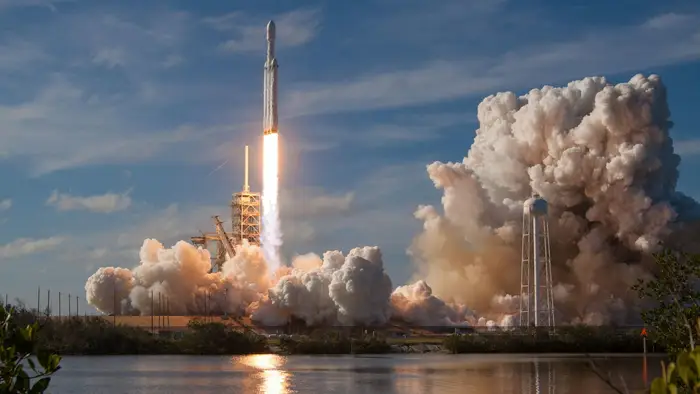
A Falcon 9 climbs away from the California coast. Starlink 15-15 lifted off from Vandenberg after three scrubbed attempts earlier in the week. Image: Unsplash.
The booster that keeps coming back
The star of the mission, in the sense that it has starred in so many missions before, was the first-stage booster designated B1063. Friday’s flight was its 36th launch and landing, making it only the second Falcon 9 booster to reach three dozen flights. After separating from the upper stage, B1063 reoriented itself for descent, fired its engines to slow down, and, as the mission clock passed eight minutes, began its landing burn. About 20 seconds later it touched down on the droneship Of Course I Still Love You, stationed in the Pacific Ocean.
B1063’s career is a tour through the last several years of American spaceflight. The booster first flew in November 2020 carrying Sentinel-6 Michael Freilich, a joint NASA and European ocean-monitoring satellite. A year later, in November 2021, it launched NASA’s Double Asteroid Redirection Test, or DART, the mission that deliberately crashed a spacecraft into the asteroid Dimorphos and proved that a threatening space rock’s path can be nudged by a kinetic impact. Since then, B1063 has flown Transporter-7, a rideshare mission; OneWeb 19 and Iridium-9 communications satellites; a series of national security missions including NROL-113, NROL-167, and NROL-149; the SDA Tranche 0B mission for the Space Development Agency; the NAOS Earth-observation satellite; and 26 previous Starlink missions. The turnaround for this flight was 52 days, a reminder that even a booster with 35 prior flights under its belt can be inspected, refurbished, and returned to the pad in under two months.
That reusability is the foundation of SpaceX’s business model, and it is why a single booster can rack up a flight history that reads like a catalog of the space industry. When Falcon 9 first began landing its boosters in 2015, recovering a first stage was a novelty. A decade later, it is the default, and the company’s fleet leaders have each flown more times than most rockets in history have flown in total. B1063’s 36th flight puts it in rare company, and it is unlikely to be its last: SpaceX has shown no sign of retiring its most experienced boosters while they continue to pass inspection.

A Falcon 9 waits on the pad. Vandenberg’s coastal weather forced three scrubs before Starlink 15-15 finally flew. Image: Unsplash.
Twenty-seven satellites for a constellation of more than 11,000
Once B1063 was safely on the droneship, the mission’s second act belonged to the upper stage. After completing its first engine burn, the upper stage coasted for about 45 minutes before firing again for a final orbital insertion burn. Deployment of the 27 satellites into low Earth orbit was scheduled to begin about 62 minutes after liftoff. The satellites are V2 Mini spacecraft, the second-generation Starlink design that has been the backbone of the constellation’s recent growth.
With this launch, the Starlink constellation passed yet another milestone in scale. SpaceX’s network now counts more than 11,000 active spacecraft, a figure that would have seemed fanciful when the first 60 Starlink satellites launched in 2019. The constellation provides broadband internet to homes, businesses, ships, aircraft, and remote communities, and it has become the largest satellite network ever assembled.
The commercial momentum behind that network was on display just days before the launch. During SpaceX’s third-quarter earnings call on Tuesday, October 20, hours before the original Starlink 15-15 attempt, company president and chief operating officer Gwynne Shotwell said SpaceX had added 1.6 million Starlink customers in the three-month period and that the service was active across 174 markets around the world. Those numbers help explain why Starlink launches remain a steady drumbeat even as the constellation matures: every new batch of satellites adds capacity, replaces older spacecraft, and supports growth in new regions.
The southeasterly trajectory flown from Vandenberg is part of that story too. Starlink’s orbital shells are arranged in rings inclined at various angles to the equator, and launches from California’s coast are well suited to filling the higher-inclination shells that serve customers at northern and southern latitudes. Florida launches handle other shells. The division of labor between the two coasts is one of the quiet logistical achievements behind the constellation’s rapid build-out.

Starlink satellites join a constellation of more than 11,000 active spacecraft in low Earth orbit. Image: Unsplash.
A slowing cadence, and the shadow of Starship
One of the more notable observations around Starlink 15-15 is that Starlink launches are not quite as frequent as they used to be. SpaceX is deliberately shifting its focus from Falcon 9 to Starship, the far larger and fully reusable rocket still under development at the company’s Starbase site in Texas. Starship is designed to carry much larger Version 3 Starlink satellites, which will eventually take over the job of expanding the constellation once the vehicle is operational.
That transition is the defining strategic question for SpaceX in the second half of the decade. Falcon 9 is a proven, profitable machine, but it is approaching the physical limits of what it can lift, and each Starlink launch carries a few dozen satellites at a time. Starship, if it works as intended, could deploy hundreds of satellites in a single flight and do so with a fully reusable vehicle. The company has been open about the fact that Starlink’s revenue is funding Starship’s development, and Starship’s success would in turn supercharge Starlink’s growth. For now, though, Falcon 9 remains the workhorse, and missions like Starlink 15-15 are what keep the constellation growing while the next generation is prepared.
The shift also shows up in how SpaceX talks about its own pace. A few years ago, the company was setting records for the number of launches in a year and for the shortest turnaround between flights. In 2026, the emphasis has moved toward reliability, reuse milestones like B1063’s 36th flight, and the careful, deliberate work of bringing Starship to operational status. The Falcon 9 fleet is not slowing down because it is tired; it is slowing down because its successor is finally close enough to plan around.
For the engineers and technicians who turned B1063 around in 52 days, and for the launch team that worked through four countdowns in four days at Vandenberg, the mission was a reminder of how routine the extraordinary has become. A booster flying for the 36th time, a constellation of more than 11,000 satellites, a scrubbed launch retried the next morning as a matter of course: these are the normal operations of a space industry that, not long ago, treated any one of them as a headline.
A week of weather at Vandenberg
The three scrubs that preceded Friday’s success each had their own character, and together they illustrate how much of launching rockets still comes down to reading the sky. The Tuesday attempt was stopped by a technical issue, with poor weather in the mix as well. Wednesday’s attempt never got as far as fueling, because weather halted the countdown before propellant loading began. Thursday’s attempt was the most frustrating kind of scrub: the countdown ran deep into its final phase before the launch director called a hold in the final seconds, again because of weather.
For a launch site on the California coast, this is familiar territory. Vandenberg sits on a headland where marine layers, coastal fog, and shifting upper-level winds can change conditions hour by hour. The rules that govern whether a Falcon 9 may fly cover not just the weather at the pad but also the winds the rocket will fly through, the conditions at the landing site offshore, and the state of the range. A hold in the final seconds is expensive in effort and disappointing for everyone watching, but it is also the system working as designed: the launch director’s job is to protect the vehicle, the payload, and the people on the range, and a rocket that can fly tomorrow is worth more than one pushed through marginal weather today.
The scrub-and-retry rhythm also depends on the ground crews. Each attempt involves loading super-chilled liquid oxygen and rocket-grade kerosene, running through checkouts, and then, when a scrub is called, safely offloading propellant and securing the vehicle. Doing that four times in four days is a demanding tempo, and it is one of the less visible reasons SpaceX’s high flight rate is hard to replicate. The hardware gets the attention, but the people and procedures that turn a rocket around in a day are just as much a part of the achievement.
B1063’s greatest hits
It is worth lingering on B1063’s flight history, because few individual machines in the history of spaceflight have done so much. The booster’s first flight, in November 2020, carried Sentinel-6 Michael Freilich, a satellite that measures sea-level rise with radar altimetry precise enough to track changes of a few millimeters across the global oceans. That mission was a partnership between NASA and the European Space Agency, and it gave climate scientists one of their most important long-term data sets.
A year later, B1063 launched DART, NASA’s first planetary defense test. The DART spacecraft flew to the asteroid Dimorphos, a small moonlet orbiting the larger asteroid Didymos, and struck it at about 14,000 miles per hour. The impact shortened Dimorphos’s orbit around Didymos by 32 minutes, far more than the mission’s minimum success threshold, and proved that humanity can deflect a dangerous asteroid if one is ever found on a collision course with Earth. That a single booster could launch both a climate satellite and a planetary defense mission, and then go on to fly 34 more times, says something about how thoroughly reusability has changed the economics of getting to orbit.
Between those headline missions and its Starlink work, B1063 also carried national security payloads whose details remain classified, a rideshare mission that deployed dozens of small satellites for many customers at once, and commercial communications satellites. Its 52-day turnaround for this flight is itself unremarkable by SpaceX standards, which is the point: a process that was once experimental has become industrial. The booster is inspected, its engines are checked, worn components are replaced, and it is stacked for another flight, all on a schedule measured in weeks rather than years.
What 11,000 satellites actually means
The size of the Starlink constellation is often quoted as a single number, but the number conceals a network of real complexity. More than 11,000 active spacecraft means thousands of satellites in multiple orbital shells, each communicating with ground stations and with one another via laser links, handing off connections as they race around the planet every 90 minutes or so. It means a network that can serve a research station in Antarctica, a ship in the middle of the Pacific, a village far from any fiber-optic cable, and an aircraft at cruising altitude, all at the same time.
The commercial results reported by Shotwell on October 20 put scale to that picture. Adding 1.6 million customers in a single quarter is a growth rate that few internet providers anywhere can match, and operating in 174 markets means the service now reaches most of the world’s countries and territories. That growth is also why Starlink launches continue even as the constellation matures: satellites in low Earth orbit have finite lifespans, typically around five years, so the network must be continuously replenished even before it grows. Every launch like Starlink 15-15 is partly replacement and partly expansion.
There is also a strategic dimension. Starlink’s revenue has become the financial engine of SpaceX’s larger ambitions, funding the development of Starship and, by extension, the company’s plans for the Moon and Mars. The constellation is not just a business in its own right; it is the mechanism by which SpaceX pays for its next generation of rockets. That is why the slowing Falcon 9 cadence is not a sign of decline but of a handoff: the money Falcon 9 earns launching Starlinks is being spent to build the rocket that will launch Starlinks far more cheaply.
The long road to Starship taking over
Starship’s role in this story deserves a closer look, because it explains the timing of the transition. The vehicle is designed to be fully reusable, with both its Super Heavy booster and its upper stage returning to the launch site to be caught or landed. It can lift far more mass than Falcon 9, and its payload bay is wide enough to carry the larger Version 3 Starlink satellites, which are too big for Falcon 9’s fairing. Those satellites are expected to carry more capacity per spacecraft, which means fewer launches are needed to add the same amount of bandwidth.
But Starship is still in development. Its test program has made enormous progress, yet operational Starlink deployment from Starship is a milestone that has not yet been reached. Until it is, Falcon 9 remains the only vehicle that can keep the constellation growing and replenished. That is the quiet tension behind Starlink 15-15: a proven rocket doing a job it does superbly, while its replacement is prepared in the background. The transition will not happen in a single moment; it will happen gradually, as Starship begins to take on more Starlink flights and Falcon 9’s Starlink cadence eases further.
For now, the division of labor is clear. Falcon 9 launches a few dozen satellites at a time, several times a month, from both coasts. Starship’s job is to be ready. And boosters like B1063 are the bridge between the two eras, flying often enough and cheaply enough to keep the business growing while the future is built.
What comes next
The 27 satellites from Starlink 15-15 will spend the coming weeks raising their orbits and checking out their systems before entering service. For B1063, the next step is a return to port aboard the droneship, followed by inspection and, if all goes well, preparation for a 37th flight. SpaceX’s manifest for the rest of the year includes more Starlink launches from both coasts, continued national security and commercial missions, and further Starship test flights.
There is also a broader significance to missions like this one that is easy to miss amid the routine. Every Starlink launch is, in effect, a rehearsal for the economics of reusable spaceflight: the same booster, the same pad, the same droneship, the same procedures, repeated until they are boring. That boredom is the achievement. When launching a rocket becomes as repeatable as flying an airplane, the cost of reaching orbit falls, and everything else in space, from science missions to lunar landers, gets cheaper too.
B1063 began its career launching an ocean-monitoring satellite and a planetary defense experiment. On Friday, it launched internet satellites for the 27th time in its own long history, if one counts only its Starlink flights, and it did so after a week in which weather and a technical glitch tried three times to keep it on the ground. The fourth time, as the launch team at Vandenberg learned again, proved to be the charm.

The night sky over a launch site. Starlink’s growth is increasingly tied to Starship, which is designed to carry larger next-generation satellites. Image: Unsplash.
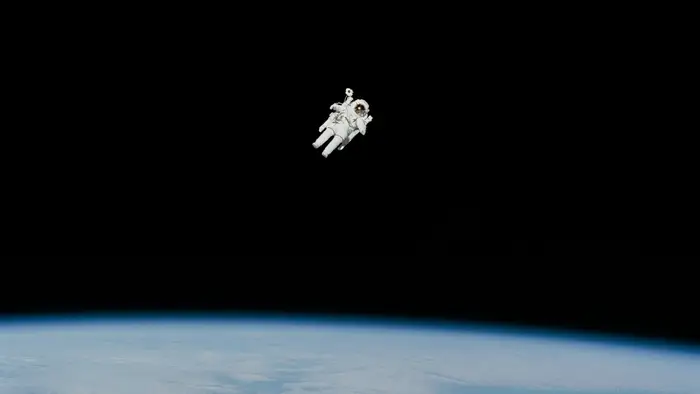
Deep space, where the next generation of exploration will depend on cheaper, reusable access to orbit. Image: Unsplash.