One Hundred Falcons: SpaceX Hits Triple-Digit Launches in 2026 as Booster B1067 Flies a Record 37th Time
At 5:33 on a Tuesday morning, while most of Florida was still asleep, a pillar of fire climbed out of Cape Canaveral and wrote a new line in the record books. The Falcon 9 that rose from Space Launch Complex 40 on August 25, 2026, was carrying 29 Starlink internet satellites — a routine enough payload by SpaceX’s standards. But the flight itself was anything but routine: it was the company’s 100th Falcon launch of the year, and the first-stage booster making the trip was flying for a record-breaking 37th time.
In an industry where reaching orbit at all was once the headline, SpaceX has quietly rewritten what “normal” means. Triple-digit annual launches by late August. A single rocket core flying nearly forty times. A constellation topping 11,000 satellites. Each of those facts would have sounded like science fiction a decade ago. On Tuesday, they were just another morning at the Cape.
A century of Falcons — and it’s only August
The numbers behind the milestone are difficult to fully absorb. SpaceX flew 96 Falcon missions in all of 2023, a figure that once seemed untouchable. In 2025, the company flew 165 Falcon 9 missions — more than all of the world’s other orbital rockets combined, and every one of them fully successful. Now, with more than four months still left in 2026, the century mark has already fallen.
By the time of the 100th flight, SpaceX was averaging roughly one Falcon 9 orbital launch every 2.4 days. Most of this year’s missions have supported Starlink — the August 25 flight was the 77th Starlink-dedicated mission of 2026 — but the manifest has also carried crew to the International Space Station, cargo resupply runs, national security payloads, and commercial satellites for customers around the world.
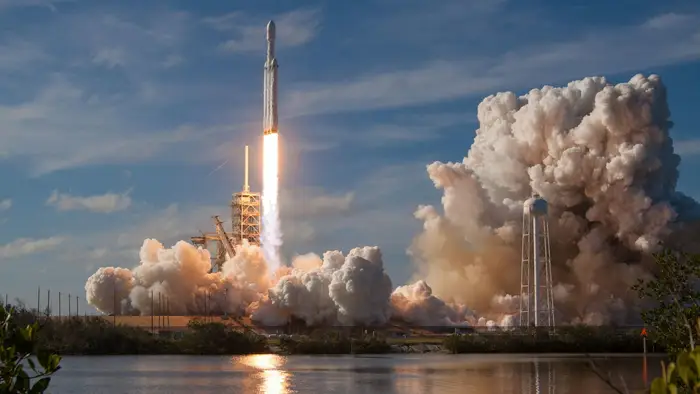
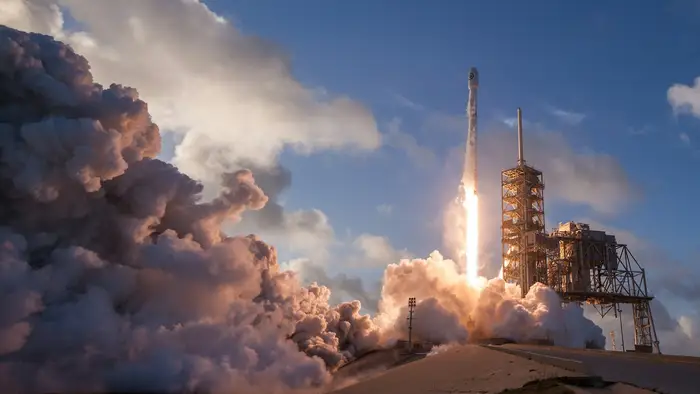
The cadence is the product of an industrial machine that treats rockets the way airlines treat aircraft. Boosters land, get inspected and refurbished, and fly again — sometimes within weeks. Launch pads at Cape Canaveral, Vandenberg, and Kennedy Space Center operate like airport gates. And the Starlink constellation, with its insatiable appetite for new satellites, provides a steady drumbeat of demand that keeps the line moving.
It is worth pausing on what triple digits means in historical context. For most of the Space Age, the entire world combined managed a few dozen orbital launches per year. The Soviet Union at its Cold War peak never approached 100 launches in a year. SpaceX did it with a single rocket family, by late August, as a matter of routine operations — and the company’s own internal target for the full year stretches considerably higher still.
The booster that wouldn’t quit
If the 100th flight was the headline, booster B1067 was the story. The veteran first stage entered service in 2021, and its résumé reads like a highlight reel of the last five years of American spaceflight: NASA’s Crew-3 and Crew-4 astronaut missions, the CRS-22 and CRS-25 cargo resupply flights to the International Space Station, and commercial deployments including Turksat, Eutelsat, O3b mPOWER, and Europe’s Galileo navigation satellites.
Tuesday’s mission was its 37th. After stage separation, B1067 executed its entry and landing burns and touched down on the autonomous droneship A Shortfall of Gravitas stationed in the Atlantic Ocean, about eight and a half minutes after liftoff. The upper stage, meanwhile, continued to orbit and deployed all 29 Starlink satellites roughly 61.5 minutes into the flight.
Thirty-seven flights puts B1067 within striking distance of one of the most hallowed records in spaceflight: NASA’s Space Shuttle fleet, whose most-flown orbiter reached 39 missions. That a single expendable-era-busting booster is now closing in on the Shuttle’s all-time reuse mark — achieved across an entire fleet over three decades — says everything about how far the economics of spaceflight have moved.
B1067 is not alone in the high-mileage club. SpaceX now operates six Falcon 9 boosters with at least 30 flights each: B1077 and B1078 at 30, B1069 at 32, B1063 at 34, B1071 at 35, and B1067 leading at 37. No other orbital launch provider on the planet comes close. In the past six weeks, two different Chinese rockets managed successful landings during orbital missions — genuine progress — but neither has yet made it back to the pad for a second flight.
How reuse became routine
The Falcon 9’s secret sauce is no secret at all: extensive first-stage reuse makes it cheaper and more efficient to fly than anything else in its class. The Block 5 version of the rocket was originally designed for at least ten flights per booster during early development. Continuous engineering improvements — to the engines, the thermal protection, the landing legs, the grid fins, the avionics — have pushed individual cores far past that target.
Each reuse eliminates the cost of manufacturing a new first stage, historically estimated at roughly 60 to 70 percent of a Falcon 9’s per-launch price. Some of that saving flows into mission pricing, which is why SpaceX can launch Starlink batches at a pace no competitor can match, and why government customers — including the Pentagon — now routinely fly national security payloads on boosters with dozens of prior missions under their belts.
The operational rhythm matters as much as the hardware. SpaceX’s launch teams have turned range operations, pad turnaround, and booster refurbishment into something resembling an airline schedule. Weather delays and technical scrubs still happen, but the system absorbs them: miss a window on Tuesday, and there’s another Falcon ready to go within days, sometimes hours.
The jellyfish over Florida
Tuesday’s launch gave early risers an unexpected show. Atmospheric conditions in the upper atmosphere created a visible noctilucent vapor plume — the twisting, glowing cloud sometimes called a “space jellyfish” — as the Falcon 9’s exhaust interacted with the thin air at the edge of space. Observers reported the phenomenon from Florida’s Gulf Coast all the way up the Eastern Seaboard to the Washington, D.C. region, with photos flooding social media within minutes.

The effect is a familiar one to launch watchers: sunlight catching frozen exhaust crystals tens of kilometers up, long before sunrise reaches the ground. But it never quite loses its power to startle. For a few minutes on Tuesday morning, thousands of people looked up at a luminous spiral in the dark sky and wondered what on Earth — or above it — they were seeing.
Dawn launches are particularly prone to the phenomenon, which is one reason SpaceX’s early-morning Starlink missions have become a reliable source of viral sky photos. The rocket climbs through darkness while the sun, still below the horizon for observers on the ground, illuminates the exhaust plume from above. The result is a glowing corkscrew that can stretch for hundreds of kilometers — visible, on this occasion, across half the Eastern Seaboard.
What 11,000 Starlinks means
The 29 satellites deployed on Tuesday joined a constellation that now counts more than 11,000 spacecraft in orbit, with over 9,700 of them operational, according to tracking data compiled by astronomer Jonathan McDowell of the Harvard-Smithsonian Center for Astrophysics. Starlink is by far the largest satellite constellation ever assembled, providing broadband internet service worldwide.
The sheer scale of the network is what makes the launch cadence possible — and necessary. Satellites in low Earth orbit have finite lifespans, typically around five years, so maintaining and growing a constellation of this size requires a relentless replacement rate. SpaceX’s answer is to launch constantly, using its own rockets, at marginal costs no competitor can touch.
That vertical integration — building the satellites, building the rockets, operating the launch sites — is the deeper story behind the 100-flight milestone. SpaceX is simultaneously its own best customer and its own launch provider, which means the factory logic of mass production applies to both ends of the business.
The anatomy of a 37-flight booster
To appreciate what B1067 has accomplished, it helps to walk through its career. The booster entered service in 2021, in the middle of the pandemic-era space boom, and its early assignments were among the most demanding in SpaceX’s manifest: crewed missions.
Its résumé includes NASA’s Crew-3 and Crew-4 astronaut flights — the missions that carried professional astronauts to the International Space Station aboard Crew Dragon capsules in late 2021 and early 2022. Flying humans is the ultimate vote of confidence in a rocket stage, and B1067 earned that confidence repeatedly. It also flew the CRS-22 and CRS-25 cargo resupply missions, hauling supplies and science experiments to the orbiting laboratory.
Between those NASA assignments, the booster worked the commercial beat: Turksat 5B, expanding Turkey’s communications coverage; Eutelsat missions serving European broadcast markets; O3b mPOWER satellites for SES’s medium-Earth-orbit broadband constellation; and Galileo navigation satellites for Europe’s independent positioning system — a particularly notable assignment, since flying European institutional payloads on an American reusable rocket would once have been politically unthinkable.
Dozens of Starlink missions filled out the rest of the log. Each flight added wear: thermal cycling on the engines, salt spray from ocean landings, the structural fatigue of supersonic reentry. SpaceX’s engineers responded with rolling upgrades — improved thermal protection, more durable coatings, refined inspection routines — and the booster kept flying. Thirty-seven times and counting.
Counting to one hundred
The road to the century mark was paved month by month. January and February set the tempo with the usual Starlink batches interspersed with customer missions. By spring, the cadence had settled into its now-familiar rhythm: a Falcon lifting off every two to three days, weather and range availability permitting, from one of three active pads.
Summer brought the milestones in quick succession. The fleet’s high-mileage boosters rotated through refurbishment bays with airline-like regularity. Turnaround records — the time between a booster’s landing and its next flight — kept shrinking as ground crews refined their procedures. What was once a months-long process of inspection and recertification became a matter of weeks, then days for the healthiest cores.
The 100th flight arriving in late August, rather than deep into autumn, tells its own story about acceleration. In 2023, the 96-flight total felt like a ceiling being pushed. In 2025, 165 flights reset every assumption. In 2026, triple digits arrived with a third of the year still to go. The curve is not flattening; if anything, it is steepening, even as SpaceX begins shifting some Florida operations toward Starship.
That shift is worth noting. With Starship development consuming more of the company’s attention — and Cape Canaveral’s future increasingly oriented around the giant vehicle — the Falcon 9’s center of gravity has been drifting west. Vandenberg Space Force Base in California has become the workhorse site for Starlink and an expanding share of other missions. The 100th flight, though, was a Florida affair: a dawn launch from the Cape, the way so many milestones have been.
The economics of flying again
Behind every reuse record is a balance sheet. Building a new Falcon 9 first stage costs tens of millions of dollars; recovering and reflying one costs a fraction of that. Multiply the savings across hundreds of flights per year, and reusability becomes the engine of SpaceX’s entire business model.
The effect compounds. Cheaper launches mean more Starlink satellites deployed per dollar, which means a bigger constellation generating more revenue, which funds more launches. Competitors face the brutal arithmetic of expendable rockets: every flight starts from zero, with a brand-new vehicle consumed each time. Even partially reusable designs still in development must first prove they can match what SpaceX does routinely — then do it cheaper, which is a much harder problem.
Government customers have noticed. National security payloads — once the exclusive domain of expensive expendable rockets — now routinely fly on boosters with double-digit flight histories. The Pentagon’s launch procurement has adapted to the new reality, and SpaceX’s competitors have been forced to promise reusability of their own, on timelines measured in years.
None of this was inevitable. When SpaceX first began landing boosters in 2015, industry veterans predicted rapid reuse would prove impractical — that salt water, reentry heating, and engine wear would make refurbishment uneconomical. A decade later, a single booster has flown 37 times, six have passed 30, and the company is designing its next rocket to fly multiple times per day. The skeptics were not just wrong; they were wrong by an order of magnitude.
The road ahead
There is no sign of the pace slowing. SpaceX continues to prepare its next-generation Starship vehicle — designed to be completely and rapidly reusable, with each vehicle capable of flying multiple times per day — while the Falcon fleet handles the present. The company is also shifting operations: with Starship activity ramping up at Cape Canaveral, Florida’s Falcon 9 manifest is thinning even as Vandenberg picks up the slack on the West Coast.
For the rest of the industry, the 100th flight is both a benchmark and a warning. Reusability was supposed to be the great equalizer; instead, SpaceX has turned it into a widening moat. Competitors are making strides — China’s landing tests, Europe’s recovery efforts, new American vehicles inching toward debut — but the gap between a first successful landing and a 37-times-flown booster is measured in years of operational learning, not months.

On Tuesday morning, as B1067 settled onto the droneship deck and the 29 satellites drifted free of the upper stage an hour later, the milestone passed with the quiet competence that now defines SpaceX operations. No grand ceremony. No pause for reflection. Just another entry in the logbook — number one hundred, with plenty more to come.
There is a temptation, amid the statistics, to treat all of this as inevitable — as though rockets were always going to become reusable, launches were always going to happen weekly, and the only question was who would get there first. The history says otherwise. For half a century, the industry’s brightest minds insisted that recovering orbital boosters was a fool’s errand, that the physics didn’t close, that the economics would never work. SpaceX’s answer was not a white paper but a booster touching down on a ship in the Atlantic for the thirty-seventh time.
A century of Falcons, achieved by late August. The most remarkable thing about it might be how thoroughly unremarkable SpaceX has made it feel — and how much further the curve still has to run.