South Korea's Nuri Rocket Flies Its Biggest Mission Yet: 15 Satellites for a New Earth-Watching Constellation
A 47.2-meter tower of South Korean engineering rose off its pad in the early afternoon, climbed into a pale October sky, and 20 minutes later did something no Korean rocket had ever done: it released 15 satellites into orbit in a single flight. The fifth launch of the Nuri rocket — South Korea’s first fully homegrown orbital launcher — on October 7, 2026, was the vehicle’s most demanding mission to date, and it succeeded almost completely, deploying the core of the country’s first domestically launched microsatellite constellation along the way.
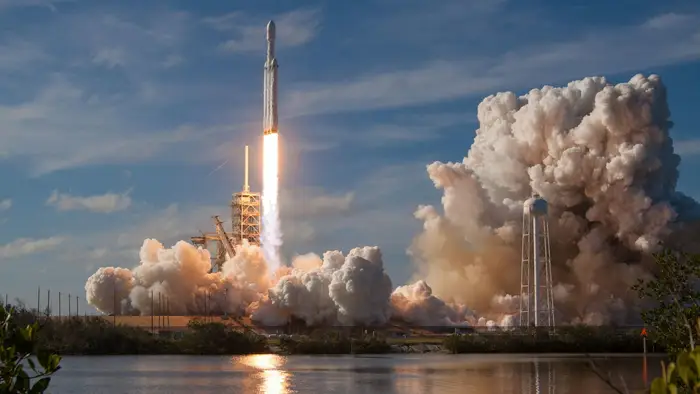
The liftoff came at 12:25 p.m. local time (11:25 p.m. EDT on October 6) from the second launch pad at the Naro Space Center in Goheung, about 400 kilometers southwest of Seoul. The three-stage, 200-ton KSLV-II — Korea Space Launch Vehicle II — was carrying its heaviest load yet: 15 satellites with a combined mass of roughly 1,071 kilograms, bound for a sun-synchronous orbit some 570 kilometers above Earth. Fourteen of the 15 payloads reached their intended destination. Only one, a small CubeSat named PERSAT-02 developed by the South Korean company Quaternion, failed to separate from the rocket, according to the state-run Korea Aerospace Research Institute (KARI).
The main event: five satellites, one constellation
The heart of the mission was five small satellites known as NEONSATs — the New-space Earth Observation Satellite Constellation for National Safety, Nos. 2 through 6. Each weighs less than 100 kilograms and carries an electro-optical camera sharp enough to distinguish objects as small as one meter across in black-and-white images and four meters in color images. Together they form the seed of a planned ten-satellite network that South Korea intends to use for monitoring the Korean Peninsula and surrounding areas for national security and disaster response — the kind of imagery that becomes invaluable during wildfires, floods, and other emergencies.
Getting all five into orbit was a choreography problem. The deployment sequence was the most complex ever attempted by a Korean rocket: the five NEONSAT satellites were to be released one after another at intervals of about 35 to 40 seconds, each in a slightly different direction, with the rocket’s upper stage rotating roughly 45 degrees between each separation to keep the fresh satellites from colliding with one another. Then the ten CubeSats were to follow, released in pairs. The plan worked. Nuri entered its target orbit and executed the full release sequence exactly as designed.
Confirmation came quickly. KARI announced that all five NEONSAT satellites had established communication within hours of liftoff, checking in through ground stations scattered around the globe: NeonSat 6 made first contact with Antarctica’s Sejong Station at about 1:08 p.m. local time, NeonSat 4 followed at 2:42 p.m., NeonSat 3 reached the Svalbard station in the Arctic at 3:27 p.m., and NeonSats 2 and 5 phoned home to Sejong Station at 4:18 p.m. and 5:52 p.m., respectively. The satellites transmitted their first images within 24 hours of deployment.
A constellation years in the making
The five new satellites do not stand alone. They join a small but growing family. The first NEONSAT satellite flew in April 2024 aboard a Rocket Lab Electron rocket from New Zealand; the second followed the same route in January 2026. This launch was the first time South Korea put NEONSAT hardware into orbit on its own rocket — the “first domestically launched microsatellite constellation” in the country’s history, as officials described it.
The Korea Advanced Institute of Science and Technology (KAIST), through its Satellite Technology Research Center, oversaw the development of the microsatellites. Satrec Initiative — a Korean space company spun out of KAIST in 1999 — built them, and the five satellites that flew on this mission were the first units off the company’s satellite production line. That detail matters: South Korea is not merely assembling a constellation; it is standing up a manufacturing pipeline intended to produce more.
Five more NEONSAT satellites are planned for Nuri’s sixth mission in 2027, which would complete the ten-satellite constellation. Once the full network is operational, officials say the system should be able to image the Korean Peninsula more than three times per day and revisit the same location within 24 hours during emergencies. For a country that lives under one of the most heavily monitored borders on Earth — and that has been forced to rely on commercial imagery or foreign partners for many of its needs — that is a genuine step toward sovereign space capability.
From national project to industrial product
Nuri’s story is, in a sense, the story of South Korea’s space program compressing decades of development into a few frantic years. The rocket failed on its debut in October 2021, when its dummy payload failed to reach orbit. It succeeded on its second flight in June 2022, becoming the first orbital rocket developed entirely with South Korean technology to reach orbit. The third flight followed in May 2023. The fourth, on November 27, 2025, was the first overnight launch in Korean history and carried 13 satellites — and it was also the first mission with Hanwha Aerospace as prime contractor.
The rocket itself: kerosene, liquid oxygen, and Korean engines
Nuri’s hardware tells the story of a program that insisted on doing things the hard way — domestically, from the ground up. The rocket is a three-stage vehicle, and every engine on it was developed in South Korea. The first stage burns four KRE-075 sea-level engines producing a combined 266.4 tons of thrust. The second stage carries a single vacuum-optimized version of the same engine family, the KRE-075 Vacuum, with a wider nozzle for better efficiency in space. The smaller third stage is powered by one KRE-007 engine. All of them run on the same unglamorous but dependable propellant combination: Jet A-1 aviation kerosene and liquid oxygen.
Technology development began in October 2010 with a single design goal: an expendable medium-lift launcher that was entirely South Korean — design, manufacturing, and testing. The program cost roughly US$1.5 billion. When the second flight succeeded in June 2022, South Korea became the seventh country in the world with the ability to place a satellite of at least one ton into orbit, and the seventh to develop a liquid-propellant rocket engine in the 75-ton class. After the two test flights, engineers found the vehicle was outperforming expectations, and the rated payload capacity was raised from 1,500 kilograms to 1,900 kilograms. The fifth flight’s roughly 1,071-kilogram manifest sits comfortably inside that envelope — but launching 15 separate payloads in sequence was a test of operations and choreography, not brute lifting power.
Four flights in the rear-view mirror
Nuri’s flight record reads like a compressed coming-of-age story. The debut flight in October 2021 ended in disappointment: the rocket reached its targeted apogee of 700 kilometers, but the third stage shut down about 46 seconds earlier than planned, and the dummy payload fell short of orbital velocity. Eight months later, on June 21, 2022, the second flight carried a 1,500-kilogram payload — a 1,300-kilogram dummy satellite, the 180-kilogram performance verification satellite PVSAT, and four CubeSats — to a 700-kilometer sun-synchronous orbit. This time everything worked, and South Korea joined the small club of nations with independent access to orbit.
The third flight, in May 2023, confirmed the rocket was no one-off success. The fourth, on November 27, 2025, was the mission that announced Nuri’s graduation from test program to operational launcher: Korea’s first overnight orbital launch, 13 satellites deployed, and Hanwha Aerospace stepping in as prime contractor. That last fact deserves emphasis. South Korea is deliberately handing Nuri off from government development to industry. KARI and the Korea AeroSpace Administration (KASA) built the rocket; Hanwha Aerospace is now being trained to own it, build it, and fly it commercially. The model resembles the way the European Space Agency industrialized Ariane, or the way JAXA transferred the H3 program to Mitsubishi Heavy Industries. The fifth flight of Nuri — the first orbital mission of 2026 — was planned under this new division of labor, with KASA’s Launch Management Committee, headed by Administrator Oh Tae-seok, selecting the October 7 date back on August 27, with a backup window running October 8 through 14.
The rollout itself was a public event. On the morning of October 6, the rocket emerged from its assembly building at 6 a.m. and crawled 1.8 kilometers to the second launch pad aboard an unmanned transporter, arriving about 90 minutes later. Engineers raised it upright with a lifting rig known as an erector, anchored it to the pad, and connected the umbilical lines carrying power, fuel, and oxidizer. By the evening of the 6th, the rocket was erected, and leak checks for the propellant systems were complete. On the morning of the 7th, KASA and KARI held a final launch management committee meeting to set the exact liftoff time, weighing technical readiness, weather, and even the risk of collision with orbiting debris. The window opened at 12:23 p.m.; the rocket left at 12:25.
The flight profile was straightforward on paper: first-stage separation two minutes and three seconds after liftoff at 67 kilometers altitude; jettison of the payload fairing at three minutes and 53 seconds at 224 kilometers; second-stage separation at four minutes and 28 seconds at 277 kilometers; third-stage engine cutoff at 12 minutes and 41 seconds at roughly 575 kilometers. Then the long, delicate business of letting go of 15 satellites without any of them touching each other.
Why sun-synchronous — and why ten satellites
The mission’s target orbit was no accident. A sun-synchronous orbit at roughly 570 kilometers means the satellites pass over any given point on the ground at roughly the same local solar time on every pass. For an Earth observation system, that is the difference between useful and useless data: consistent lighting makes it possible to compare images taken days or weeks apart and spot what changed — a flooded river, a burned forest, a new structure. Without it, shadows shift, glare comes and goes, and change detection becomes a guessing game.
The number ten is about cadence. Five satellites can only see so much; a full ten-satellite network, spread around the orbit, means the Korean Peninsula gets imaged more than three times per day, and any single location can be revisited within 24 hours during an emergency. That emergency-revisit requirement is the heart of the NEONSAT concept. South Korea has lived through catastrophic wildfires and floods — disasters where the first satellite image of the damage zone can determine where rescue teams go — and officials have been explicit that the constellation exists to put eyes on such scenes fast. NeonSat 5, for example, is tasked specifically with precision observation of key national security areas and rapid imaging of disaster-stricken regions.
This is also why the five satellites that flew this week were spread apart in deployment, peeled off 35 to 40 seconds apart as the upper stage rotated between each release. The separation was not merely about avoiding collisions on the day; it spaced the satellites around their orbit so they can settle into the choreography of a constellation — each passing over the peninsula at its own time, each filling a gap in coverage.
Why it matters beyond South Korea
A 15-satellite launch would be unremarkable for SpaceX, which routinely dispatches dozens at a time. For South Korea, it is the largest single payload manifest the country has ever flown on its own rocket — and the fact that it flew at all says something about the changing geometry of global spaceflight. A decade ago, the club of countries with independent orbital launch capability fit comfortably in a short list. Today, South Korea is one of a growing number of mid-sized powers — India, Japan, and now increasingly South Korea — building not just launchers but the full stack: rockets, satellites, manufacturing, and the ground infrastructure to use them.
The mission also carries a diplomatic dimension. The Philippine Embassy in Seoul sent officials to Goheung to witness the launch, at KASA’s invitation. The Philippine Space Agency (PhilSA) has been working with South Korea’s space industry — including cooperation between PhilSA and the South Korean company Perigee Aerospace — and ten Filipino engineers are currently undergoing advanced training in South Korea ahead of the Philippines’ planned liquid-fueled sounding rocket launch in Cagayan in 2027. South Korea is positioning itself not just as a space power but as a space partner: a country that can sell launches, build satellites, and train engineers across the region.
That ambition is visible in the economics. South Korea established KASA, its dedicated space agency, to consolidate the country’s space efforts under one roof — a recognition that space had become too important to remain a side project of the science ministry. The agency’s long-term plans include participation in the Artemis program, lunar exploration missions, and a far more aggressive launch cadence. Nuri is meant to become a workhorse: KASA has discussed flying it more frequently, with Hanwha Aerospace eventually taking over production entirely.
One satellite that didn’t make it
The mission was not perfect. PERSAT-02, one of the ten CubeSats aboard — developed by the South Korean startup Quaternion — failed to separate from the rocket, KARI announced in an X post about two hours after launch. Nine of the ten CubeSats deployed successfully. CubeSats, which are small satellites built to standardized dimensions and often developed by universities and startups, carry a higher tolerance for such failures; they are cheap, experimental, and numerous by design. A single separation failure among fifteen payloads on a record-complexity mission is, by the standards of the industry, a good result. But it is also a reminder that even mature rockets — and Nuri, on its fifth flight, is just reaching maturity — can surprise their operators at the margins.
What comes next
The immediate priority is commissioning. The five NEONSAT satellites are healthy and communicating, but they must now be calibrated, tested, and brought into operational service — a process that takes weeks to months for an Earth observation constellation. KARI engineers will be characterizing the cameras, validating the imagery, and integrating the data streams with the systems that will use them: national security analysts and disaster response coordinators among them.
Then comes the sixth flight. Nuri’s sixth mission, planned for 2027, is expected to carry the remaining five NEONSAT satellites and complete the ten-satellite constellation. That launch will also be a further test of the Hanwha Aerospace industrialization: each Nuri flight is meant to move the rocket further from a government science project and closer to a commercial product.

Looking further ahead, South Korea’s space agency has ambitions that reach well past low Earth orbit. The country has flown lunar orbiters — the Korea Pathfinder Lunar Orbiter, Danuri, launched in 2022 — and KASA’s roadmaps envision more ambitious deep-space missions. The experience of designing, building, and flying a rocket that can release 15 satellites in a coordinated sequence is exactly the kind of operational maturity those missions will require.
For now, though, the significance of October 7 is simpler. A rocket that failed on its debut five years ago just flew the most complex mission in its country’s history, released fourteen satellites where it aimed them, and put the core of a national Earth observation network into orbit. South Korea went to space on Wednesday morning. It brought its own satellites, its own cameras, and — this time — its own rocket.