JWST Dragon Galaxy 104 Magnified Stars: Webb Doubles the Record in a Distant Arc
Six and a half billion light-years from Earth, a galaxy stretched into a thin arc of light has been quietly blinking. For two years, the James Webb Space Telescope watched that arc, frame after frame, waiting for individual stars inside it to flare and fade as they drifted across invisible lines of extreme magnification. When astronomers finally tallied the flickers, they counted 104 of them — more than double the previous record for a single galaxy, and the largest haul of magnified stars ever assembled in one place.
The result, published in the journal Astronomy & Astrophysics on September 30, 2026, turns a distant galaxy nicknamed the Dragon into something new: not just a curiosity of gravitational lensing, but a working laboratory. Its 104 stellar events let astronomers take a census of the brightest stars in a galaxy seen as it was roughly six billion years ago, and they may even carry a whisper about the nature of dark matter — the invisible substance that shapes the universe but has never been directly seen.
The study was led by José María Palencia of the Institute of Physics of Cantabria, working with colleagues including Fengwu Sun, José María Diego and Yoshinobu Fudamoto. The team compared Webb images of the Dragon collected between 2022 and 2024, hunting for points of light that changed brightness from one visit to the next. What they found, they write in the paper, is “a catalog of 104 unique CCEs in the Dragon arc, which currently represents the largest sample of highly magnified star candidates identified in a single galaxy.”
CCE stands for caustic crossing event, the technical name for what happens when a distant star crosses one of the most extreme magnifying lines in the universe. It is a mouthful of jargon for a simple and spectacular idea: the gravity of an enormous cluster of galaxies can act as a telescope, and when the alignment is just right, a single star billions of light-years away can briefly shine hundreds or thousands of times brighter than it normally would. For days or weeks, a star that no telescope could ever see becomes visible. Then it fades, and the moment is gone.

Stars shining through glowing gas and dust. Image: Unsplash.
A Record Written in Flickering Light
To understand why 104 is such a striking number, it helps to know how rare these events are. Before this study, only a few dozen highly magnified stars had ever been reported at such distances, and the Dragon itself held the record with 44 detections, found in 2025 by a team led by Yoshinobu Fudamoto. That haul was, at the time, the largest number of individual stars ever detected in the distant universe, according to the Harvard-Smithsonian Center for Astrophysics. The new study more than doubles it.
The jump did not come from a new telescope or a lucky night. It came from patience and method. The researchers used imaging data from three different Webb observing cycles, spanning 2022 to 2024, taken with the Near Infrared Camera (NIRCam) in four filters — F150W, F182M, F200W and F210M. By stacking and subtracting images taken at different times, they could isolate exactly what had changed: a star that had brightened, a star that had faded, a new point of light where none had been before.
That sounds straightforward, but the work is painstaking. The images were taken at slightly different angles, so the team had to correct for tiny misalignments that could otherwise leave false residues when one image was subtracted from another. They removed bright unrelated objects, the galaxy’s own bright core and other contaminants that could be mistaken for flares. They measured the normal noise level using another image of the same galaxy far from the critical curve — the line where magnification is strongest and therefore has no microlensing — so they could tell a real event from random flicker. Only after merging repeated detections across filters and observations did the final number emerge: 104 unique stellar events.
Each one of those events is a star at the very top of the brightness scale. Only the most luminous stars can be detected this way, which means the stars astronomers catch are almost always supergiants — stars dozens of times more massive than the Sun, burning furiously and briefly. A single one can outshine tens of thousands of Suns. In the Dragon, Webb caught them in the act of crossing a caustic, the moment when their light is focused to its peak.
How a Cluster Becomes a Telescope
The Dragon owes its strange shape to a cosmic coincidence. Its light travels toward us for 6.5 billion years, but along the way it passes a massive galaxy cluster called Abell 370, which sits around 4 billion light-years away. The cluster is so massive that its gravity bends the light passing near it, stretching and brightening whatever lies behind it — as if the cluster were a vast, uneven lens. A portion of the Dragon is stretched into a long, thin arc, famously called the Dragon arc. The phenomenon is called gravitational lensing, and it is the only reason we can see individual stars in a galaxy so far away at all.
The lensing is not uniform. A galaxy cluster is not a smooth blob; its gravity bends light by different amounts in different places. Along certain lines, called caustics, the light from the background galaxy can be focused so strongly that its brightness increases dramatically. The cluster’s own stars — and possibly its dark matter — create small distortions that break a single caustic line into a web of “microcaustics.” As the background galaxy moves slowly relative to the lensing cluster, individual stars inside it drift across these microcaustics, and each crossing produces a caustic crossing event.
At the crossing, two images of the star merge and the star reaches maximum brightness, up to hundreds or thousands of times its normal level. The magnification from the main gravitational lens — the “macrolens” of Abell 370 — can align with the magnification from individual stars acting as “microlenses” over a few days to a week, vastly increasing the brightness of the star, according to researchers at Arizona State University. Once the star finishes crossing, those two images vanish, and the star fades back within days to weeks. Because the events are temporary, the only way to find them is to compare images of the same distorted region taken at different times and look for what changed.
That is why the Dragon is such a prized target. It was the first giant arc ever identified, spotted in 1987, and it is among the lowest-redshift and highest surface-brightness caustic-crossing galaxies known. It is intersected by powerful cluster caustics multiple times, making it the ideal place to catch stars in the act. Even so, a single star in the Dragon is far too faint for Webb to see on its own. The study notes that the lensing enhancement can raise the observed flux of a distant star above the detection limit with just a one-hour observation using Webb. Without the cluster, the Dragon’s stars would remain invisible; with it, they become a fireworks display spread across three years of observations.
The team’s analysis relied on the recent lens model of Abell 370 published by Diego and colleagues in 2025, which maps the cluster’s critical curves — the lines of maximum magnification — across the Dragon arc. Plotting the 104 events against that model showed them clustered along the predicted curves, exactly where theory says caustic crossings should happen. That agreement is part of what makes the catalog convincing: the events are not scattered randomly across the image, but fall where the lens model says they must.

The core of a galaxy crowded with stars. Image: Unsplash.
Blue and Red Supergiants: Reading a Galaxy’s Life Story
The 104 events are more than a record. They are a census, and a census can tell astronomers what kind of galaxy the Dragon is. The stars Webb catches in these events come in two main types: blue supergiants and red supergiants. Blue supergiants are hot and shine mostly at short wavelengths; red supergiants are cool, enormous, and emit mostly in the near-infrared. The ratio between the two types reveals the nature of the stellar population inside the galaxy. Younger and more metal-poor populations produce more luminous blue supergiants, while higher-metallicity and older populations evolve toward the red category.
This is where the choice of telescope matters. The Hubble Space Telescope, which observes mostly at shorter wavelengths, is more likely to detect blue supergiants. Webb, with its longer wavelength coverage, is more likely to observe red supergiants — cooler and larger than their blue counterparts. The new study used Webb’s infrared eyes, and its color analysis found roughly equal numbers of blue and red supergiants, a ratio of about one to one.
“This suggests that both BSGs and RSGs contribute to the observed CCEs, in agreement with expectations for a relatively evolved, still star-forming system,” the team writes. In plain language: the Dragon is not a newborn galaxy blazing with only young blue stars, nor a dying one fading into the red. It is a mature galaxy, still forming stars, with a balanced population of both kinds of supergiant. That is a remarkably detailed portrait to draw of a galaxy 6.5 billion light-years away, and it is possible only because the lensing lets astronomers sample individual stars rather than the galaxy’s blended light.
The result also demonstrates something broader about the method. A single lensed galaxy, watched patiently over several years, can yield a statistical sample of its brightest stars — enough to test ideas about how stars live and die in the distant universe. Until now, the numbers were too small for that kind of statistics. With 104 events, the Dragon becomes the first galaxy where the approach works at scale.
The Dragon Arc at a Glance
| Fact | Value |
|---|---|
| Galaxy | The Dragon (Dragon arc) |
| Distance | ~6.5 billion light-years |
| Redshift | z ≈ 0.725 |
| Lensing cluster | Abell 370 (~4 billion light-years away) |
| Magnified stellar events found | 104 (new record) |
| Previous record in the Dragon | 44 (Fudamoto et al., 2025) |
| Webb observations used | 2022–2024, three cycles, NIRCam |
| Filters | F150W, F182M, F200W, F210M |
| Peak magnification at caustic crossing | Hundreds to thousands of times |
| Typical event duration | Days to weeks; largest stars visible for months |
| Blue-to-red supergiant ratio | ~1 (relatively evolved, still star-forming) |
| Paper | Palencia et al., Astronomy & Astrophysics, Sept. 30, 2026 |
| Lead author | José María Palencia, Institute of Physics of Cantabria |
The table makes the scale of the achievement plain: the new catalog is not a marginal improvement but a leap, and it rests on three years of Webb data rather than a single snapshot.
A Hint of Fuzzy Dark Matter
Beyond the stars themselves, the pattern of the 104 events may carry a clue about dark matter — the invisible material that outweighs ordinary matter several times over and holds galaxies and clusters together, yet has never been directly detected. Dark matter inside the lensing cluster can also create microcaustics, so the distribution of events across the arc could, in principle, reveal something about its nature.
The team tested this by counting how many events appear on each side of the critical curve, the line of maximum magnification. Far from the curve, both sides looked the same. But close to it, the count dropped on one side while staying the same on the other. That asymmetric pattern fit a model called “fuzzy” dark matter — a proposed form made of very light, wavelike particles that would produce a blobby, wavy distribution of dark matter in galaxies, rather than the smoother clumps predicted by the standard picture of cold dark matter.
It is important to be precise about what this means. The study does not claim a detection of a dark matter particle, and it does not settle what dark matter is. The authors themselves are careful: “This could provide a hint of a fuzzy nature of DM, although it may also arise from an incorrect location of the CC in the lens model,” they write. If the lens model’s critical curve is drawn in slightly the wrong place, the same asymmetry could appear for entirely mundane reasons. The fuzzy dark matter reading is a tentative interpretation inside a peer-reviewed paper, not a discovery announcement.
But the fact that the question can even be asked is significant. A catalog of 104 events is large enough to test statistical predictions about dark matter’s distribution — something that was impossible when the sample numbered in the dozens. As the researchers note, applying this methodology to other strongly lensed galaxies, along with repeated, frequent observations and better lens models, can turn out to be a tool for studying both ordinary stars and dark matter in and around massive galaxy clusters. The Dragon is the proof of concept. Other arcs are waiting.
That promise is what has made lensed stars one of the most watched frontiers in astronomy. Webb’s ability to find individual stars at cosmological distances was barely imagined a decade ago; now it is producing catalogs of a hundred at a time. Each new lensed galaxy adds another sample, and each sample sharpens the picture of how stars and dark matter are distributed in the young universe. The same techniques that found 104 stars in the Dragon are already being aimed elsewhere, and the record is unlikely to stand for long.
Individual stars, impossibly far away, made visible by gravity. Image: Unsplash.
From First Arc to 104 Stars: A Short Timeline
1987 — The Dragon is found. The Dragon arc becomes the first giant arc ever identified, a stretched image of a distant galaxy bent by the gravity of the cluster Abell 370. Astronomers realize that galaxy clusters can act as natural telescopes.
2022–2024 — Webb watches. The James Webb Space Telescope images the Dragon across three observing cycles, using its NIRCam camera in four infrared filters. Each visit captures the arc anew, building the time-domain dataset the study will mine.
2025 — The record stands at 44. Researchers led by Yoshinobu Fudamoto identify 44 individual stars in the Dragon from Webb images — at the time, the largest number of individual stars detected in the distant universe.
September 30, 2026 — The new catalog is published. Palencia and colleagues publish “The first statistical study of over 100 magnified stellar events at a redshift z ≈ 0.725 with JWST” in Astronomy & Astrophysics, reporting 104 unique caustic crossing events — more than double the old record.
November 8, 2026 — The news breaks. Science press reports the result, and the Dragon’s 104 flickering stars reach a wider audience.
The timeline shows a field moving fast. In a single year, the record for magnified stars in one galaxy went from 44 to 104, and the method went from a demonstration to a statistical science. The next step is repetition: more arcs, more epochs, better lens models, and larger catalogs.
Why a Hundred Flickers Matter
It is easy to miss the significance of a result like this amid the louder stories of rockets and rovers. No spacecraft flew anywhere. No new world was found. What happened is quieter: astronomers learned to read a galaxy star by star at a distance where entire galaxies are usually no more than smudges of light.
That matters because the brightest stars are the ones that shape galaxies. Supergiants forge heavy elements in their cores and scatter them when they explode, seeding the next generation of stars and planets. They drive winds and radiation that sculpt the gas around them. A census of supergiants in a galaxy 6.5 billion light-years away — seen when the universe was roughly half its present age — is a direct look at how galaxies built themselves up, star by star, in the middle chapters of cosmic history.
The Dragon also matters because it shows what Webb can do when patience meets precision. The telescope did not need a new instrument or a heroic single observation. It needed three years of return visits, careful subtraction of images, and a lens model good enough to predict where the flickers should fall. That is a repeatable recipe, and it is already being applied to other lensed arcs. If the Dragon yielded 104 events, other arcs may yield more — and each new catalog will test the same questions: how many blue supergiants, how many red, and does the pattern of events whisper anything about dark matter?
Webb’s work on distant galaxies has already produced striking results across the field, from the JWST Firefly Sparkle Black Hole Seeds: 10 Young Star Clusters May Grow Supermassive Giants to the Webb FLIP 51 Eridani b November 2026: The Hidden Planet in Two-Year-Old Data, a reminder that patient re-examination of existing Webb data keeps paying off. The Dragon study belongs in that same tradition: old images, new eyes, and a result no one could have obtained from a single snapshot. Webb has also turned its infrared gaze on closer mysteries, as in Holmberg II X-1 JWST Black Hole Lights Up a Nebula in a Metal-Poor Galaxy, showing how the same telescope moves between the nearby universe and the edge of the observable one.
For now, the record belongs to the Dragon: 104 stars, each one caught at the instant a cosmic lens flared it into view, each one a data point in the first true census of supergiants in a galaxy halfway across the observable universe. The arc will keep blinking. Webb will keep watching. And the next catalog may be bigger still.
The Dragon’s stars are among the most luminous ever seen at such distances. Image: Unsplash.
What Comes Next
The immediate future of this work is straightforward: watch more arcs, more often. The Dragon’s 104 events came from images spread across three years; more frequent visits would catch shorter events and fill in the gaps. Better lens models for Abell 370 and other clusters would sharpen the predictions of where caustic crossings should occur — and would test whether the fuzzy dark matter hint survives closer scrutiny or dissolves into a modeling artifact.
There is also a wider prize. Every strongly lensed galaxy is a potential Dragon, and Webb has already imaged many of them. The same time-domain technique — compare, subtract, verify, catalog — can be run on each one. Some will yield a handful of events; a few may yield a hundred. Together, they will build a picture of the brightest stars across cosmic time, and of the dark matter that lenses them, that no single galaxy could provide alone.
That is the quiet revolution behind the headline number. A hundred flickers in a distant arc is not just a record. It is the first time astronomers have had enough magnified stars in one galaxy to do statistics — to count, to compare, to test a model and find it wanting or confirmed. The universe has been lensing distant stars for billions of years. We have only just learned how to count them.
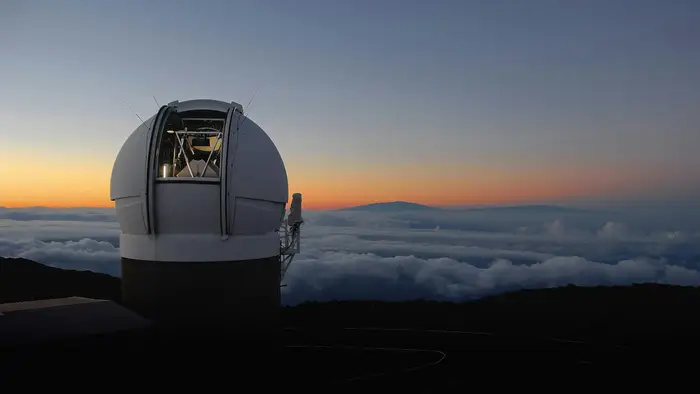
Observatories on Earth and telescopes in space will keep watching the Dragon arc. Image: Unsplash.
Sources
- Phys.org: JWST tracks more than 100 magnified stellar events in the Dragon galaxy
- Discover Magazine: Magnified Light From Distant Dragon Galaxy Reveals Supergiant Stars and Clues to Dark Matter
- arXiv: First Statistical Study of Over 100 Magnified Stellar Events at Redshift z ≈ 0.725 with JWST
- Astronomy & Astrophysics: The first statistical study of over 100 magnified stellar events at a redshift z ≈ 0.725 with JWST