'Something Out of Science Fiction': Astronomers Find the First Green Star Ever Seen
Ask anyone to describe the colors of stars, and you will hear a familiar roster: the warm orange of a campfire star, the white of the Sun, the icy blue of the hottest suns. Now astronomers have found something that has never appeared in that list. A team at the University of Warwick has identified the first star ever credibly documented as green — a ghostly chartreuse-glowing white dwarf about 280 light-years from Earth that got its otherworldly color by eating the remains of its own planets.

The star, catalogued as WD J1330+6435, sits in the constellation Draco the Dragon, faint enough that no backyard telescope would reveal its secret. But when the researchers modeled its spectrum through a calculation of how human vision actually perceives light, the result was unmistakable: lime, green-apple, chartreuse — a shade of green that no other known star, living or dead, is known to produce.
“To our knowledge, no star with a green color has been discovered before,” the astronomers report. The finding, led by Warwick Prize Fellow Dr. Mark Hollands of the Astronomy and Astrophysics Group at the University of Warwick, was published in the journal RAS Techniques and Instruments and announced on October 14, 2026.
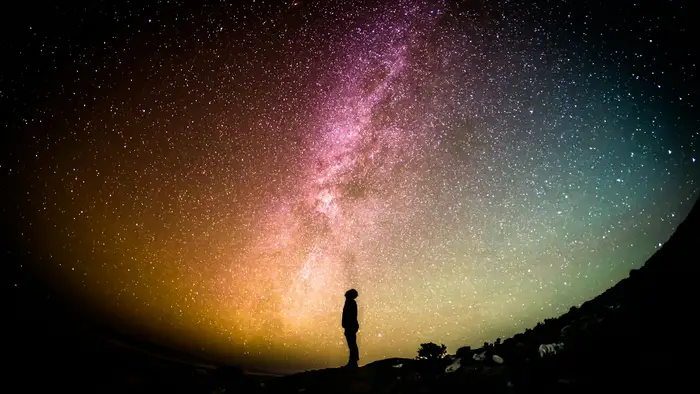
“The traces of sodium in the atmosphere of this white dwarf absorb the orange part of the spectrum, leaving behind a ghostly green glow,” Hollands said. “Imagine standing on a planet and looking up at a green star. It feels like something out of science fiction.”
A star that broke the temperature rule
For most of astronomy’s history, a star’s color has been a simple thermometer. Like a blacksmith’s iron, stars glow red, then orange, then white-hot as they heat up: cool stars look orange, Sun-like stars look white, and the hottest glow pale blue. The rule is so reliable that stellar classifications — the famous OBAFGKM sequence astronomers memorize with the mnemonic “Oh Be A Fine Girl, Kiss Me” — are organized around it.
White dwarfs were thought to follow the same rule. These are the dense stellar corpses left behind when low- to medium-mass stars, like our Sun, exhaust their nuclear fuel and shed their outer layers during a red-giant phase. What remains is a core roughly the size of Earth but containing roughly the mass of a star, so dense that a teaspoon of its material would weigh several tons. The earliest examples found were hot and glowed white or pale blue, and the class earned its name from them.
But white dwarfs turned out to be more complicated. Their color is not set by temperature alone. Over billions of years, chemistry rewrites their appearance: convection stirs elements up from the interior, and the remains of shredded planets rain down from above, polluting the thin atmosphere with metals. New calculations by Hollands and his colleagues show that these processes can shift white dwarfs into colors far outside the familiar palette — green, pink, cyan, yellow and purple.
“Most stars, including most white dwarfs, behave like ‘perfect radiators,’ so their color is set almost entirely by temperature,” Hollands said. “But nobody had really looked into what else might be possible for white dwarfs. It turns out these incredibly dense stars can produce colors nobody expected, and some of them genuinely surprised me.”
How a star turns green
WD J1330+6435 is cool by stellar standards — roughly 4,000 degrees Celsius, about 7,200 degrees Fahrenheit — and a normal white dwarf at that temperature would appear yellowish. This one glows green because it has been eating.
The astronomers first became interested in this white dwarf because fragments of planetary material had fallen onto its surface, enriching its outer layers in calcium, lithium and, in particular, sodium. Those metals likely arrived with rocky debris — shredded asteroids or the ground-up remains of planets that once orbited the star before it died.
In the crushingly dense atmosphere of a white dwarf, sodium behaves unusually. Under such conditions, elements like carbon, calcium and sodium interact with the dense helium plasma, absorbing light across a broader spectrum of colors than they would in a thinner atmosphere. The sodium in WD J1330+6435 soaks up light over a broad range of yellow, orange and red wavelengths — roughly centered near 500 nanometers — leaving the light that escapes to appear ghostly green to the human eye.
It is a vivid demonstration of a phenomenon astronomers call metal pollution: white dwarfs that have consumed the rocky remains of their planetary systems. Such “polluted” white dwarfs are valuable laboratories, because the elements dissolved into the stellar atmosphere reveal the chemical composition of the destroyed planets — sometimes the only way scientists can ever analyze the bulk makeup of an exoplanetary body. In this case, the pollution did more than reveal chemistry. It painted the star.
The researchers identified two other white dwarfs with a slightly greenish glow, though neither as pronounced as WD J1330+6435. One of them appears pale greenish-blue; its coloring is driven by calcium ions and a steep drop in light at red wavelengths.
The pinkest star ever
Green was not the only surprise in the study. The same analysis turned up what may be the pinkest star ever found: WD J1011+2845, a white dwarf just 48 light-years from Earth — practically next door in cosmic terms. It has a deep convection zone that dredges carbon up from the interior to the atmosphere, distorting its starlight and giving it an otherworldly deep salmon-pink color.
Another white dwarf, WDJ0902+2010, also owes its pinkish hue to carbon brought to the surface by convection. High-carbon white dwarfs can appear pink or violet, the study shows; white dwarfs enriched with debris from engulfed asteroids or comets tend to shine yellowish; and cooler white dwarfs with mixed hydrogen and helium atmospheres often appear cyan or pale blue, because of the way hydrogen molecules and helium atoms collide in their atmospheres.
These are not subtle effects visible only in spectrographs. The Warwick team ran the stellar wavelengths through a model of human color vision — the same kind of calculation that maps display colors — to determine what a person would actually see standing nearby. The simulated color-accurate images are striking: alongside the familiar blue of Sirius-like stars and the orange of cooler ones, they show pink, red, pale-green and blue tones that look, as Hollands put it, like something out of science fiction.
Why green stars were thought impossible
There is a reason green was the missing color. The physics of starlight works against it. Stars radiate across the whole spectrum, and the human eye blends those wavelengths together. A star whose emission peaks in the green part of the spectrum — like the Sun, which actually peaks near green-yellow wavelengths — still radiates plenty of red and blue light, which our eyes mix back into white. That is why there are no green stars on the main sequence: blackbody physics plus human vision conspire to keep them white, yellow, orange or blue.
White dwarfs slip past that constraint because their color is no longer set by blackbody physics alone. In these ultra-dense objects, the atmosphere is so compact that absorbed wavelengths are carved out of the spectrum in broad bands rather than narrow lines. When sodium absorbs the yellow, orange and red portions, what remains genuinely looks green to human vision — not a blend of other colors, but chartreuse itself.
This is also why the discovery required such careful modeling. The star is far too faint for anyone to see its color with the naked eye, and even professional photographs do not directly show what a human observer would perceive. Only by combining the measured spectrum with a model of the eye’s color response could the team assign WD J1330+6435 its place in the record books as the first green star.
Most white dwarfs are still just white
Before anyone starts scanning the sky for a universe of psychedelic suns, the researchers offer a reality check. They crunched the numbers on 151 white dwarfs within 65 light-years of Earth — the local neighborhood — and found that only five had extraordinary coloring. Two were yellow and three were pink. The rest would appear to us a cool white, like an LED bulb. Useful for lighting a cosmic kitchen, as one science writer noted, but nothing to write home about.
That rarity is itself a finding. It means the green star is genuinely exceptional, not a common quirk that astronomers had simply overlooked. And it tells scientists something about how unusual the pollution history of WD J1330+6435 must be: most white dwarfs either never consume enough planetary material, or never concentrate the right elements, to shift their visible color so dramatically.
The discovery also sharpens a growing scientific appreciation of white dwarfs as dynamic objects. Long treated as the inert endpoints of stellar evolution — fading embers cooling slowly toward a hypothetical state astronomers call black dwarfs — white dwarfs are now understood to be active chemical laboratories. Their atmospheres record the destruction of planetary systems, their interiors crystallize as they cool, and some are even suspected of triggering faint outbursts. The new color palette adds one more reason to pay attention to the stellar dead.
A mission of dead planets
There is a melancholy backstory to the green star’s glow. To become a white dwarf, WD J1330+6435’s progenitor star had to die — swelling into a red giant, engulfing or destabilizing the inner planets of its system, then casting off its outer layers. Whatever planets survived that catastrophe did not survive forever: asteroids and planetary fragments were pulled inward by gravitational disturbances and torn apart by the white dwarf’s tidal forces, forming a disk of rocky debris that eventually rained onto the star.
The calcium, lithium and sodium now dissolved in the star’s atmosphere are the chemical fingerprints of those destroyed worlds. In a sense, WD J1330+6435 glows green because it is digesting its planets — a “zombie star” feeding on the remains of its planetary system, as some coverage has dubbed it.
That interpretation is consistent with what planetary scientists expect for our own solar system’s far future. In about five billion years, the Sun will become a red giant and then a white dwarf, and models predict that surviving asteroids, and possibly the outer planets, will eventually be ground down and accreted. If a distant astronomer ever observes our white dwarf Sun, they might see it glowing with colors borrowed from the shattered Earth — though whether our star ends up green, pink or stubbornly white is a question for a future billions of years hence.
Why broad absorption paints a star green
The key to the green color lies not just in which elements are present, but in how the extreme environment of a white dwarf changes the way they absorb light. In an ordinary stellar atmosphere, an element like sodium absorbs light in narrow, sharp lines — the familiar dark Fraunhofer lines that sodium imprints on the Sun’s spectrum. In the atmosphere of a white dwarf, the gas is compressed to extraordinary densities, and atoms and ions are packed so tightly that they collide constantly with neighboring particles.
Those collisions do two things. First, they smear the absorption features across much wider wavelength ranges, in a process called pressure broadening. Second, in a dense helium plasma, the metals interact with their surroundings in ways that extend the absorption across broad swaths of color rather than isolated slivers. The result is that the sodium in WD J1330+6435 does not just notch out a thin line of orange light — it dims a wide band spanning yellow, orange and red. What leaks through the gaps is weighted toward the middle of the visible spectrum, around 500 nanometers, the wavelength of lime-green light.
This same physics explains the rest of the newly mapped palette. Carbon lifted by convection shifts some white dwarfs toward pink and violet; hydrogen and helium molecules colliding in cooler atmospheres scatter light toward cyan; and rocky debris from engulfed asteroids pushes others toward yellow. Each color is a chemical fingerprint, readable across hundreds of light-years, of what the dead star has absorbed or dredged up.
A dragon’s den in the northern sky
WD J1330+6435 lies in the constellation Draco, the Dragon, a sprawling circumpolar constellation that winds between the Big and Little Dippers in the northern sky. At about 280 light-years away — some reports give the figure as 326 light-years, reflecting the uncertainties in the distance measurement — it is far too faint to see without professional instruments. No stargazer will ever point a backyard telescope at Draco and spot a green sparkle; the star’s color exists in its spectrum and in the color-vision model, not in any eyepiece.
That faintness is part of why the discovery took so long. White dwarfs are small and dim, and detailed spectral analysis of individual objects requires dedicated telescope time. The Warwick team did not stumble on a green star by looking at one — they built the theoretical framework that predicts such colors, then checked which real white dwarfs match. It was a prediction-first discovery: the models said green was possible, and the sky obliged.
What comes next
The study opens a new observational frontier. If one green star exists, others may be hiding in spectroscopic surveys, their unusual colors unnoticed because no one had predicted what to look for. Large-scale surveys like Gaia, which has catalogued hundreds of thousands of white dwarfs, provide a hunting ground: the Warwick team’s models now tell astronomers exactly which spectral signatures should produce green, pink or purple hues, and they can search existing data for matches.
The work also matters beyond aesthetics. White dwarf colors are used to estimate temperatures and ages, which in turn calibrate models of how stars cool over cosmic time. If chemistry can shift a white dwarf’s apparent color independently of temperature, astronomers need to account for that effect to avoid misreading the ages of the oldest stars in the galaxy — some of which are used to date the formation of the Milky Way itself.
And there is the exoplanet angle. Polluted white dwarfs are already prized because they offer direct chemical analysis of destroyed exoplanets, complementing the indirect measurements possible for planets around living stars. The new research suggests that the most heavily polluted white dwarfs — the ones whose atmospheres carry the richest record of destroyed worlds — may announce themselves by their colors. A green tint could become a beacon, flagging the systems most worth studying in detail.
A new line in the textbooks
Science is full of “firsts” that turn out to be footnotes, but this one feels different. The color of a star is among the most basic things astronomy claims to know — it is taught in elementary school, printed on classroom posters, embedded in the HR diagram that every student learns. To add a genuinely new entry, centuries after the first stellar spectra were recorded, is a reminder that even the most settled parts of science keep their secrets.
WD J1330+6435 will never be visible as a green point of light to anyone standing on Earth. It is too far, too faint, a number in a catalogue with a color that exists only in a model. But models are how astronomy reaches past the limits of eyes and telescopes. The researchers’ calculation says that if you could stand close — if you could look up from some imagined planet around this dead star — you would see a green sun rising.
As Hollands put it: imagine standing on a planet and looking up at a green star. For the first time in history, that image is not science fiction. It is a measurement.